Wound care billing is one of the few service lines where the code and the payment both come down to a number the clinician wrote in the note: how deep the tissue was removed, and how many square centimeters were treated. Get either measurement wrong and the claim pays the wrong code or pays nothing.
Why wound care billing turns on a measurement
A level of service codes on time or complexity. A debridement codes on two numbers: the depth the tissue came from, and the total surface area debrided. The CGS Administrators billing article for its debridement policy states it directly. These services are defined by the body surface area of the debrided tissue, not by individual ulcers or wounds (CGS Administrators, Debridement Services).
The article gives an example. Two ulcers on a foot debrided to subcutaneous tissue, six square centimeters in total, are one unit of 11042. Not two codes, not two units. The code has to describe the level of debridement performed rather than the depth of the ulcer, so a deep ulcer treated with a superficial debridement is reported with a superficial code.
That rule starts most wound care coding disputes. Two clinicians treat the same wound, bill different codes, and both are defensible, because the notes record different measurements. The measurement is the code, and the diagnosis only has to carry it. Nothing here looks like E/M coding levels, where time or medical decision making picks the code.
A template that asks for the wound stage is not asking for what the code needs. If the note records the ulcer’s depth rather than the debridement’s, the coder guesses.
The three debridement families
Medicare’s wound care policy splits debridement three ways, by method and depth.
Selective debridement, 97597 and 97598, removes devitalized tissue from the wound surface. CGS requires devitalized tissue to be present: secretions of any consistency do not meet the definition, and a simple cleansing is not a debridement service. These are usually the recurrent debridement codes, and after an initial deep debridement the later ones are more superficial.
Non-selective debridement, 97602, has no separate Medicare payment. CGS lists it at status indicator B in the fee schedule database, which means it is not separately payable. A practice that bills it has built a denial.
Surgical debridement, 11042 through 11047, is where the measurement does the most work. The family escalates by depth of tissue removed and by total surface area treated, and two CGS coding rules then decide the claim. For a single wound, report the deepest level removed. For multiple wounds, sum the surface area of the wounds at the same depth, and never combine sums from different depths.
One CGS restriction catches coders out: the deepest codes may only be billed in an inpatient hospital, an outpatient hospital or an ambulatory surgical centre, so an office practice cannot capture them.
| Route | Codes | What sets the code | Where Medicare pays it |
|---|---|---|---|
| Selective | 97597, 97598 | Devitalized tissue, then surface area debrided | Physician office and most outpatient settings |
| Non-selective | 97602 | Nothing. CGS lists it at status indicator B | Nowhere on its own |
| Surgical | 11042 to 11047 | Depth removed and area treated, summed at each depth | Deep codes only in inpatient, outpatient hospital or an ASC |
How skin substitutes are paid
A skin substitute is a supply with its own HCPCS product code. For years Medicare paid these products as biologicals under an average sales price method. The Office of Inspector General put the rate at 106 percent of average sales price, and described the gap between what Medicare paid and what a practice paid as a driver of volume (OIG, OEI-BL-24-00420).
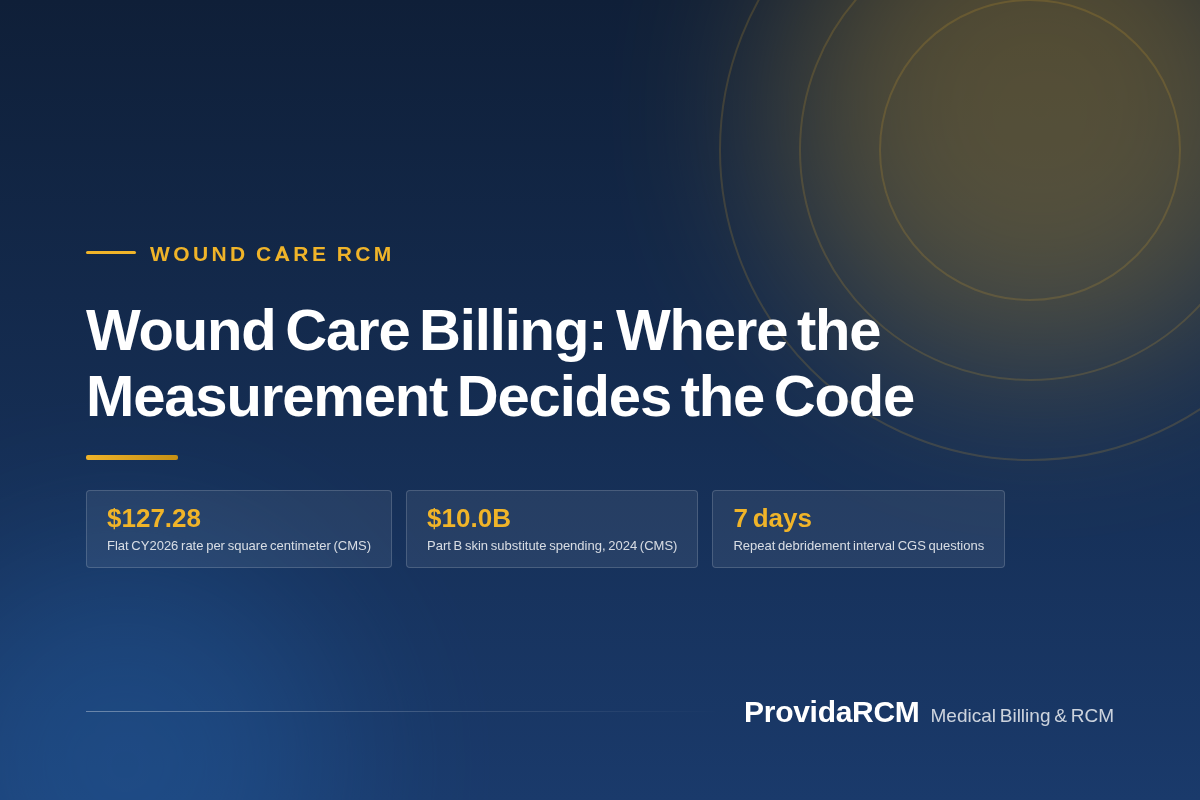
From 1 January 2026 that changed. The CY 2026 Physician Fee Schedule final rule finalized paying for these products as incident-to supplies when used during a covered application procedure in the non-facility setting or under the hospital outpatient payment system. CMS set a single rate of about $127.28, based on the highest average across three FDA regulatory categories: 361 human cells and tissues products, premarket approval devices and 510(k) devices (CMS CY 2026 PFS final rule fact sheet). Products licensed under section 351 of the Public Health Service Act remain on the average sales price method.
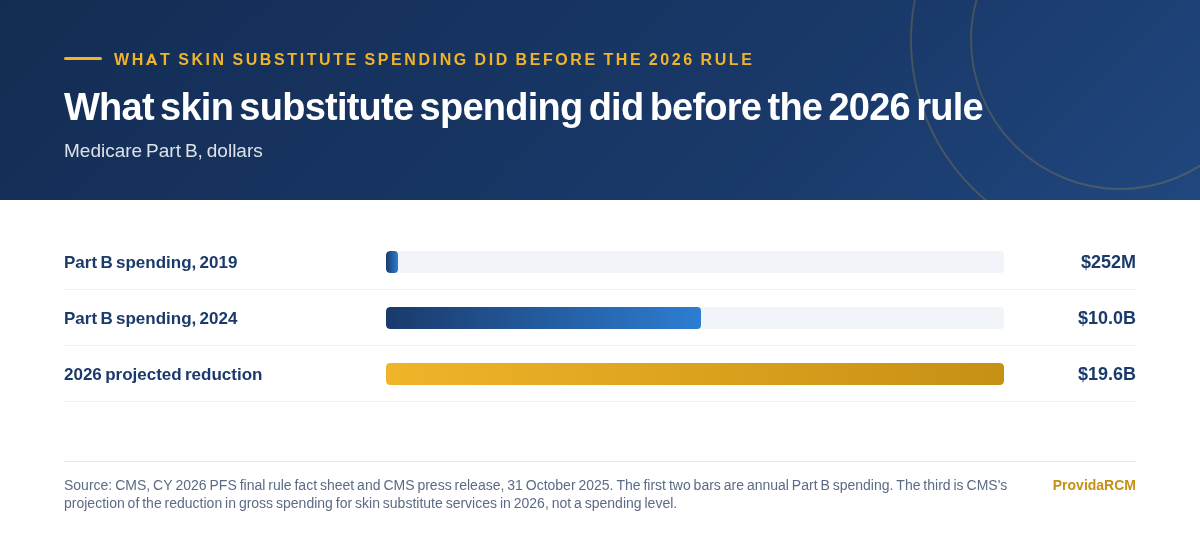
The trajectory explains why. CMS puts Part B spending on these products at $252 million in 2019 and over $10 billion in 2024, with prices reaching more than $2,000 per square centimetre, and projects a $19.6 billion reduction in gross spending for skin substitute services in 2026 (CMS press release, 31 October 2025).
Medicare Part B spending on skin substitutes
Source: CMS CY 2026 PFS final rule fact sheet, 31 October 2025. The CMS press release of the same date gives $256 million for 2019 where the fact sheet gives $252 million.
What Medicare pays per square centimetre
Sources: CMS press release, 31 October 2025, for pre-2026 prices; CMS CY 2026 PFS final rule fact sheet for the finalized rate.
Authorization moved at the same time. The WISeR model began on 1 January 2026 for skin and tissue substitutes in selected MAC jurisdictions and states with an active coverage determination. A provider either submits a prior authorization request or goes through pre-payment review. The model enforces the coverage criteria already in force and does not change what Medicare pays (WISeR model provider factsheet).
The product code set, the rate and the category rules are period-specific. The $127.28 rate and the three FDA categories are the CY2026 position, effective 1 January 2026. Do not carry a product list or a rate forward from one period, or take either from a distributor page.
Two payments, one claim
The substitute and the application are paid on different logic. From 1 January 2026 the product pays a flat rate per square centimetre as an incident-to supply. The application pays as a physician fee schedule procedure through the skin replacement codes, 15271 to 15278, at the usual rate for the place of service.
CGS sets the rules that hold the two together. The application code has to be reported on the same claim as the product code, and when the product line is denied the related application line is denied with it (CGS Administrators, Wound Application of CTPs). One missing measurement therefore costs two lines: the supply that carried the real cost and the procedure that would have paid alone.
The same article lists what cannot ride along. Non-graft dressings and injected substitutes are bundled into other management procedures and are not separately payable. The non-selective debridement code should never be reported with a substitute and its application codes, and those codes are not to be used for anything other than skin replacement.
Unlisted product codes carry paperwork. Where a practice reports a substitute with A4100 or another unlisted code, the product name, the package size purchased, the amount applied and the amount wasted must appear in the claim narrative or in box 19, or the claim is returned rather than denied. Where a product is not paid at a standardized rate, CGS asks for actual invoice cost in the documentation field.
| Component | What it is | How it pays from 1 January 2026 | What the claim must carry |
|---|---|---|---|
| The substitute | A tissue-based product with its own HCPCS code | Incident-to supply at about $127.28 per square centimetre | Product name, package size, amount applied, wasted amount if unlisted |
| The application | The skin replacement procedure, 15271 to 15278 | Physician fee schedule procedure payment | Reported on the same claim as the product |
| Section 351 biologicals | Products licensed under the Public Health Service Act | Still paid under the average sales price method | The detail required of any Part B biological |
| Dressings and injected substitutes | Products that are not grafts | Bundled into the management procedure | Not reported with the application codes |
The product is where the money is, and from 2026 it pays per square centimetre of product used, so the measurement sets the units as well as the code. The application is rarely denied on its own. Without the wound size in the record, the payer has no basis to allow either line.
What the record has to carry
The CGS debridement article lists the documentation a reviewer expects before allowing a wound care line, and every item answers a question about the measurement.
- A procedure note giving the anatomical location treated, the instruments used, any anesthesia, the type of tissue removed, the depth and area of the wound, and the post-procedure care.
- Wound location, size, depth and stage, written out or shown in a drawing or photograph.
- The tissue involvement and the destruction: undermining or tunneling, necrosis, infection or reduced circulation, the patient’s response to infection, and the comorbid conditions behind this intensity of treatment.
- The initial plan, including expected frequency and duration of treatment and the potential to heal.
- Continuation of the plan with evidence it is working, meaning diminishing area and depth and settling surrounding tissue.
The tissue-based product policy adds a timing rule. While a wound is treated without improvement, its response is expected to be documented at least once every 30 days for each episode, with measurements of the initial ulcer and of the wound at completion (LCD L36690). That is a documentation rule rather than a payment interval, and treating it as a billing limit still loses the line for the note nobody wrote.
Two items get checked first, because neither needs clinical judgement: the wound size and the depth of tissue removed. A photograph with a ruler in the frame settles both. When a denial arrives, the appeal is built from the coverage determination that applies rather than from a general argument, the method in medical necessity denials.
The edits that produce the denials
Four patterns account for most denials in this service line, and three of them are decided before the claim is built.
A same-day pair that will not pay. The CGS coding guideline bars reporting 11042 through 11047 with 97597 through 97602 for the same wound. The NCCI policy manual closes the other half: debridement of a skin wound before a graft or substitute is included in the substitute procedure and may not be reported separately, and debridement of a tissue transfer site is included in the transfer (NCCI Policy Manual, Chapter III). No modifier turns either pair into two payments, as we cover in NCCI edits and modifiers.
A product that needed an authorization. A substitute billed in a WISeR model area without a prior authorization request or a completed pre-payment review returns as an authorization denial, and the application line goes with it. The fix is administrative, so it belongs in the scheduling workflow alongside prior authorization for other high-cost products.
A global period that swallows the visit. Under the NCCI policy manual a procedure with a global period of 000 or 010 days is a minor surgical procedure, and an evaluation and management service on the same date is included in its payment unless it was significant and separately identifiable and is reported with modifier 25. The decision to perform the procedure is included too, and a new patient does not by itself justify a visit.
A procedure with a 090 day global period is a major one, and only the visit that decided to operate is separately reportable, with modifier 57. The standard for a separately identifiable visit is in modifier 25 documentation.
A repeat debridement inside the interval. CGS states that debridement of diabetic foot ulcers more frequently than once every seven days, for longer than three months, may not be reasonable and necessary, and that services beyond the fifth deep surgical debridement per patient, per year, per wound may require a medical review of records. Both are coverage thresholds rather than daily unit limits, so the note has to explain the wound.
| CARC | X12 wording | What it means here | Next step |
|---|---|---|---|
| 16 | Claim lacks information or has a billing error | The measurement is missing from the note, or the product detail from the narrative | Rebuild the line. The remark code names the field |
| 50 | Not deemed a medical necessity by the payer | The record did not show a wound meeting the applicable criteria | Appeal against those criteria, one at a time |
| 97 | Benefit included in payment for another service already adjudicated | Debridement billed with the substitute procedure that includes it | Drop the line. No modifier separates the pair |
| 197 | Precertification, authorization or pre-treatment absent | A product that needed prior authorization was billed without it | Check the model area and the request |
| 252 | An attachment or other documentation is required | The payer wants the note or the invoice detail before it looks at the line | Send what the remark code names |
CARC 15, the old code for a missing or invalid authorization number, was deactivated by X12 on 1 May 2018, and the live row carries that stop date. Wound care denial reports still list it as current. If your dashboard reports 15 volume, the code mapping is years behind the remittance. The live code is 197, which X12 last modified the day 15 stopped (X12 Claim Adjustment Reason Codes).
Questions practices ask us about this
Can we bill a debridement and a skin substitute application on the same day?
Not when the debridement treated the same wound. The NCCI policy manual states that debridement of a skin wound before a graft or substitute is included in the substitute procedure and cannot be reported separately, and the CGS coding guideline bars the surgical and selective debridement codes together for the same wound.
How do we code debridement when the patient has more than one wound?
Sum the surface area of the wounds debrided to the same depth, and do not combine wounds at different depths. CGS defines debridement by the body surface area of the debrided tissue rather than by individual ulcers: two foot ulcers debrided to subcutaneous tissue totalling six square centimetres are one unit of the subcutaneous code.
What changed in skin substitute payment for 2026?
From 1 January 2026 CMS pays for skin substitutes as incident-to supplies when used with a covered application procedure in the non-facility setting or under the hospital outpatient payment system. CMS set a single rate of about $127.28 based on the highest average across three FDA regulatory categories. Section 351 biologicals remain on the average sales price method.
Does a skin substitute need prior authorization?
In some areas. The WISeR model began on 1 January 2026 for skin and tissue substitutes in selected MAC jurisdictions and states with an active coverage determination, and a provider either submits a prior authorization request or goes through pre-payment review. A product billed without the request returns as an authorization denial, and the application line with it.
Can we bill an office visit with a wound debridement on the same day?
Only when the visit was significant and separately identifiable from the procedure. The NCCI policy manual treats a procedure with a 000 or 010 day global period as a minor surgical procedure, and a same-day evaluation and management service is included in its payment unless reported with modifier 25. The decision to perform it is always included.
What has to be in the note for a wound care claim to survive review?
The wound’s location, size, depth and stage, by description, drawing or photograph. The tissue involvement, the severity of destruction, and any undermining, tunneling, necrosis or infection. The instruments and anesthesia used, the tissue removed, and the depth and area of the wound. The plan with its expected frequency, and the response documented at least once every 30 days while the wound is not improving.
Wound care claims are their own audit
We code and bill wound care for practices across the country, including the product lines, the authorization requests and the repeat-visit documentation. Send us three months of wound care claims and we will show you which lines survive review.
See wound care billing services- CMS, CY 2026 Physician Fee Schedule final rule fact sheet (CMS-1832-F). cms.gov/newsroom/fact-sheets/calendar-year-cy-2026-medicare-physician-fee-schedule-final-rule-cms-1832-f
- CMS press release, 31 October 2025, skin substitute spending and payment. cms.gov/newsroom/press-releases/cms-modernizes-payment-accuracy-significantly-cuts-spending-waste
- CMS, Medicare NCCI Policy Manual, Chapter III, Integumentary System, revision 1 January 2026. cms.gov/files/document/03-chapter3-ncci-medicare-policy-manual-2026-final.pdf
- CGS Administrators, Billing and Coding: Debridement Services (A56617). cms.gov/medicare-coverage-database/view/article.aspx?articleId=56617
- CGS Administrators, Billing and Coding: Wound Application of CTPs, Lower Extremities (A56696). cms.gov/medicare-coverage-database/view/article.aspx?articleId=56696
- CGS Administrators, Debridement Services LCD (L34032). cms.gov/medicare-coverage-database/view/lcd.aspx?LCDId=34032
- CGS Administrators, Wound Application of CTPs, Lower Extremities LCD (L36690). cms.gov/medicare-coverage-database/view/lcd.aspx?LCDId=36690
- X12, Claim Adjustment Reason Codes, current list. x12.org/codes/claim-adjustment-reason-codes
- HHS Office of Inspector General, OEI-BL-24-00420, September 2025. oig.hhs.gov/reports/all/2025/medicare-part-b-payment-trends-for-skin-substitutes-raise-major-concerns-about-fraud-waste-and-abuse
- CMS Innovation Center, WISeR model provider factsheet. cms.gov/priorities/innovation/files/wiser-provider-fact-sheet.pdf