Radiology billing splits most imaging codes into two payments. The professional component is the physician interpretation and the written report. The technical component is the equipment, the technologist, the supplies and the facility overhead. Modifier 26 bills the interpretation alone, modifier TC bills the technical work alone, and a claim with neither modifier says one entity furnished both halves.
Radiology billing splits one code into two payments
A single line on an 837 does not say who did the work. Most imaging procedures are described by one code and priced as two services, and the Medicare Claims Processing Manual treats them that way: Chapter 13 puts the professional and technical components in separate payment conditions under section 20. The split decides who may bill, and how much each party collects.
The professional component is physician work. Section 20.1 states that an interpretation of a diagnostic procedure includes a written report, and the fee schedule prices it with physician work RVUs plus practice expense and malpractice expense. The technical component carries no physician work. Its RVUs are practice expense and malpractice expense only, which is how CMS prices the equipment, technologist and supplies.
Total RVUs for one study, split two ways
Source: CMS 2026 Physician Fee Schedule relative value file (RVU26A, released December 29, 2025). Total RVUs as listed for each code line.
| Component | What it covers | RVUs it carries | Who bills it |
|---|---|---|---|
| Professional component, modifier 26 | The physician interpretation and written report | Physician work, practice expense, malpractice expense | The interpreting physician or group |
| Technical component, modifier TC | Equipment, technologist time, supplies, facility overhead | Practice expense and malpractice expense only | The entity bearing the equipment and staff cost |
| Global service, no modifier | Both halves furnished by one entity | The sum of the professional and technical RVUs | The single entity that did both |

The two claims are not describing the same event. The technical component is billed on the date the study was performed, and the professional component on the date the interpretation was completed, which for an overnight batch is the next business day. MACs spell that out in their own component billing guidance.
Modifier 26, modifier TC and the global claim
Two modifiers carry the whole split, and a third option carries none. Modifier 26 identifies the professional component alone. Modifier TC identifies the technical component alone. A claim with neither modifier is the global service, meaning one entity furnished the study and produced the reading.
| Line as submitted | What the payer reads | What gets paid | The common error |
|---|---|---|---|
| Code only | One entity furnished the study and the reading | The global fee schedule amount | Appending nothing when the hospital owns the technical component |
| Code with 26 | The physician furnished the interpretation alone | The professional component amount | Billing a report that was never written |
| Code with TC | The billing entity furnished equipment and staff alone | The technical component amount | Billing TC for a hospital inpatient, where it is bundled |
| Code with 26 and TC | A contradiction on its face | Nothing. The line fails the edits | Using two component modifiers on one service |
What happens when neither modifier is appended to a service one entity only half performed is the expensive question. A practice that bills global for a study the hospital performed gets the global amount, then has the claim compared against the hospital’s inpatient history and the technical portion recouped. The manual is blunt: A/B MACs (B) may not pay the technical component of radiology services furnished to hospital patients. The recovery audit topic for radiology technical components exists because contractors recover those payments systematically.
When a hospital inpatient claim lands in the common working file, the system compares the admission and discharge dates against the line item service date on any technical component billed by a supplier. A hit generates an unsolicited response, and the MAC recoups the payment.
Place of service is the second place the split goes wrong. Section 150 of Chapter 13 directs that the place of service on the physician’s claim for an interpretation is the setting where the beneficiary received the technical service. A radiologist reading an outpatient study from a separate office reports the hospital’s outpatient place of service. A mismatch on a split study produces a denial that reads like a coding error.
Which codes split at all: reading the CMS indicator file
The clinical question is not the first question. Every code on the Physician Fee Schedule carries a professional and technical component indicator in the relative value file CMS publishes each year, and that indicator decides whether modifiers 26 and TC are allowed at all. Attachment A of the file’s readme spells out every value. Indicator 1 covers diagnostic tests, including radiology services, that permit both modifiers.
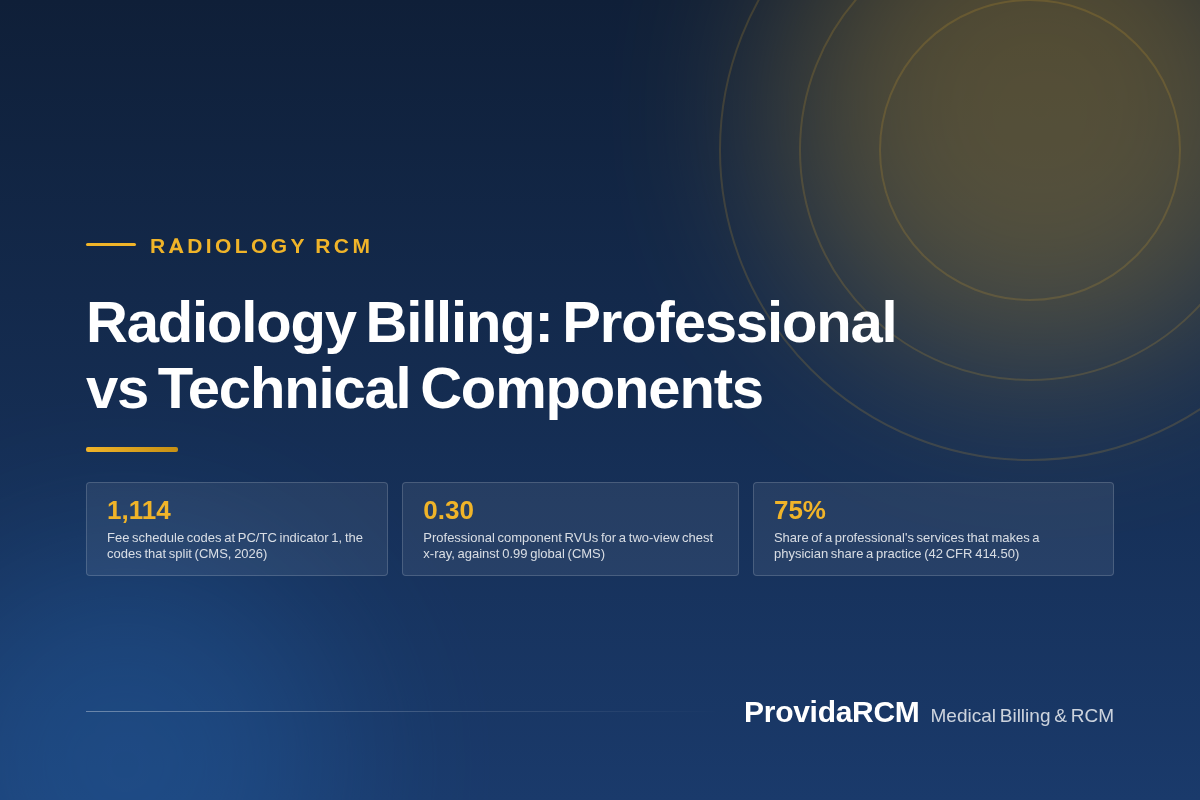
The 2026 file lists 1,114 codes at indicator 1 with no modifier, and 3,340 rows at indicator 1 once the separate component lines are counted. Most of the schedule cannot split. Indicator 0 covers 7,324 physician service codes, where the concept does not apply and neither modifier may be used.
Codes on the 2026 fee schedule by PC/TC indicator
Source: CMS 2026 Physician Fee Schedule relative value file (RVU26A). Counts of code lines listed without a modifier.
| Indicator | What it covers | Modifier 26 | Modifier TC |
|---|---|---|---|
| 0 | Physician services such as visits, consultations and surgery | Not allowed | Not allowed |
| 1 | Diagnostic tests, including radiology, with both components | Allowed | Allowed |
| 2 | Stand-alone codes for the physician work portion | Not allowed. The code is already the professional part | Not allowed |
| 3 | Stand-alone codes for the technical portion | Not allowed | Not allowed. The code is already the technical part |
| 4 | Stand-alone global test codes | Not allowed | Not allowed |
The pattern to hold onto is narrow: the two component modifiers exist for indicator 1 and effectively nothing else. Where a stand-alone code for the interpretation already exists, such as 93010, appending modifier 26 to the global test code instead of reporting the stand-alone code is a different mistake with the same result. Indicators 2, 3 and 4 exist because those stand-alone codes exist.
Laboratory codes are their own case. Indicators 6 and 8 cover a narrow set of physician interpretations, and the test performance itself is paid under the clinical laboratory fee schedule.
Billing the technical component from an IDTF
An independent diagnostic testing facility is a facility independent of both a physician’s office and a hospital. MACs pay for diagnostic procedures under the physician fee schedule when an IDTF performs them, and an IDTF may be a fixed location or a mobile entity. To bill the technical component in that setting, a practice enrolls as an IDTF for each location, meets the performance standards in 42 CFR 410.33(g), and passes an unannounced site visit.
The standards are operational rather than clinical, which is why a practice that owns a scanner cannot simply start billing TC. CMS restates all 17 in MLN909060.
- Enroll each practice location separately on the CMS-855B. Warehouses and repair facilities are the only locations that skip their own enrollment.
- Keep diagnostic testing equipment at the physical site, hold an inventory with serial numbers, and report equipment changes within 90 days.
- Carry liability coverage of at least $300,000 per location through a company not owned by a relative, and keep it in force.
- Name a supervising physician responsible for testing quality, equipment calibration and the qualifications of non-physician staff.
- Staff tests with personnel who hold the credentials the test requires, and produce those licenses on request.
| Requirement | What the rule requires | Where it is written |
|---|---|---|
| One enrollment per location | Each location enrolls separately and meets every performance standard | 42 CFR 410.33 and MLN909060 |
| Independence | The facility is independent of a physician’s office and of a hospital | 42 CFR 410.33(a) |
| Supervising physician | Oversight of test quality, equipment calibration and staff qualifications | 42 CFR 410.33(g) and MLN909060 |
| Mobile services | The IDTF bills for every mobile diagnostic service it furnishes unless provided under arrangement | 42 CFR 410.33(g)(17) |
The hospital outpatient route is the alternative. For imaging furnished to a hospital outpatient, the manual states that the service is paid to the hospital under the outpatient prospective payment system, so the hospital holds the technical component and the physician bills the interpretation with modifier 26. The same radiologist can bill a professional component for a hospital study and a global service for a practice-owned scan in one afternoon.
The inpatient case is stricter. For a hospital inpatient the technical component sits inside the prospective payment to the hospital, and hospital bundling rules exclude payment to suppliers for it. A practice that reads for inpatients should expect the technical component to belong to the facility.
The anti-markup rule when you buy the reading
A practice that orders a study from an outside supplier and bills Medicare for it meets the anti-markup limitation at 42 CFR 414.50. The rule applies when the physician who performed or supervised the test does not share a practice with the billing entity. It has covered the technical component since 1994 and the professional component since January 1, 2009.
Payment cannot exceed the lowest of three amounts, and the comparison is done component by component. For the technical component the performing supplier is the physician who supervised the test, and for the professional component the performing supplier is the physician who produced the reading.
| Limit | What the number is | Where it comes from |
|---|---|---|
| Performing supplier’s net charge | What the outside supplier charged the billing practice, net of discounts | The supplier’s invoice to the practice |
| Billing practice’s actual charge | What the practice billed for the service | The claim |
| Fee schedule amount | What the fee schedule would have allowed if the performing supplier had billed Medicare directly | The physician fee schedule |
Two routes take a practice out of the rule, and both are facts about the arrangement rather than intentions recorded afterwards. A performing physician shares a practice when at least 75 percent of that physician’s professional services run through the billing entity, judged on a reasonable belief about the prior 12 months or the coming 12. The alternative is the site of service test: the performing physician is an owner, employee or independent contractor and the component is performed in that entity’s office.
The claim has to carry the proof. The billing entity reports the performing supplier’s name, address and NPI with the net charge, and for anti-markup tests global billing is not accepted, so each component goes on its own line. The purchased service indicator in item 20 of the CMS-1500, or the PS1 segment on the 837, is the field that answers the question. Without the performing physician identified, no payment is allowed.
Documentation the interpretation has to carry
The professional component is one of the easier payments to lose on review, because a claim and a chart can disagree about whether a report exists. Chapter 13 draws the line at section 100.1: an interpretation and report addresses the findings, the relevant clinical issues and comparative data when available. A two-word impression typed into the record is a review of the findings, paid through the evaluation and management visit.
The distinction is not about length. It is about whether the record shows a physician took the study on and produced an interpretation another physician could act on without seeing the images.
- State the findings for the study that was performed, rather than copying the technologist’s worksheet impression.
- Answer the clinical question the ordering physician asked, and compare with prior studies when priors exist.
- Identify the interpreting physician and the date and time the interpretation was completed.
- Keep the report in the record the MAC will review, practice chart or hospital record.
- For a technical component, keep the equipment records, staff credentials and the performing supplier’s identity and net charge.
- Match the place of service on the professional claim to where the patient received the technical service.
Most professional component reviews come down to whether a complete report exists and whether the physician named on the claim produced it. A practice that can answer both defends the line. A practice that billed a report against the technologist’s documentation cannot appeal its way out of the problem.
The split runs through the rest of the claim. Modifier choices interact with bundling edits, which is where NCCI edits and modifiers decide whether two imaging lines survive the first pass, and the modifier cheat sheet shows where 26 and TC sit beside the other modifiers a practice appends.
We work the component split, the modifier logic and the anti-markup documentation on the same claim file as part of radiology billing, and the same team runs full-cycle medical billing for practices that read their own studies.
Questions practices ask us about this
What is the difference between the professional and technical component?
The professional component is the physician’s interpretation of the study and the written report with it. The technical component is everything that produced the study: equipment, technologist, supplies and facility overhead. The professional side carries physician work RVUs, while the technical side carries practice expense and malpractice expense only. The two are billed separately with modifier 26 and modifier TC, or together as a global service.
When do I use modifier 26 instead of modifier TC?
Use modifier 26 when your physician furnished only the interpretation, which is the usual case for a radiologist reading a study performed on someone else’s equipment. Use modifier TC when your entity furnished the equipment, technologist and supplies but someone else wrote the interpretation. Both modifiers need a code with a PC/TC indicator of 1. Where CMS assigns indicator 0, 2, 3 or 4, neither modifier may be used.
What happens if I bill global when the hospital owns the technical component?
Medicare pays the global amount first, then compares the claim against the hospital’s inpatient history and recoups the technical portion. The manual states that A/B MACs (B) may not pay for the technical component of radiology services furnished to hospital patients, and hospital bundling rules exclude supplier payment for technical work during an inpatient stay. The fix is to bill the interpretation with modifier 26.
Can any imaging practice bill the technical component?
Not without meeting the IDTF standards. A facility independent of a physician’s office and of a hospital can enroll as an independent diagnostic testing facility, but it must enroll each location separately, meet the performance standards at 42 CFR 410.33(g), and pass an unannounced site visit. Those standards cover the physical site, equipment inventory, liability coverage of at least $300,000 per location and supervising physician oversight.
Does the anti-markup rule apply to the professional component too?
It has since January 1, 2009. The limitation originally applied only to the technical component of a purchased diagnostic test, and it now covers both. A practice that buys a reading from an outside radiologist who does not share a practice with it is limited to the lowest of three amounts: the performing supplier’s net charge, the practice’s own charge, or what the fee schedule would have allowed the performing supplier directly.
What does CMS treat as a review rather than an interpretation?
A notation that reports the finding without a complete written report, such as a short impression entered into the record. Chapter 13 explains that a professional component billing based on a review of findings does not meet the conditions for separate payment, because the review is already inside the evaluation and management payment. An interpretation and report addresses the findings, the relevant clinical issues and comparative data.
Want this fixed in your practice?
We run full-cycle billing, coding, credentialing and denial work for practices across the country. Send us a few months of claims and we will show you where the money is going.
Book a free billing review- CMS, Physician Fee Schedule Relative Value Files, RVU26A (released December 2025). cms.gov/medicare/payment/fee-schedules/physician/pfs-relative-value-files/rvu26a
- CMS, Medicare Claims Processing Manual, Chapter 13, Radiology Services and Other Diagnostic Procedures. cms.gov/regulations-and-guidance/guidance/manuals/downloads/clm104c13.pdf
- CMS, MLN909060 Independent Diagnostic Testing Facility (February 2026). cms.gov/files/document/mln909060-independent-diagnostic-testing-facility.pdf
- eCFR, 42 CFR 414.50, billing for diagnostic tests performed by a physician who does not share a practice. ecfr.gov/current/title-42/section-414.50
- eCFR, 42 CFR 410.33, independent diagnostic testing facility. ecfr.gov/current/title-42/section-410.33
- CMS, IDTF performance standards under 42 CFR 410.33(g). cms.gov/Medicare/Provider-Enrollment-and-Certification/MedicareProviderSupEnroll/downloads/independentdiagnostictestingfacility.pdf
- CGS Medicare, Billing the Professional and Technical Components (J15, February 2025). cgsmedicare.com/partb/pubs/news/2025/02/cope172553.html