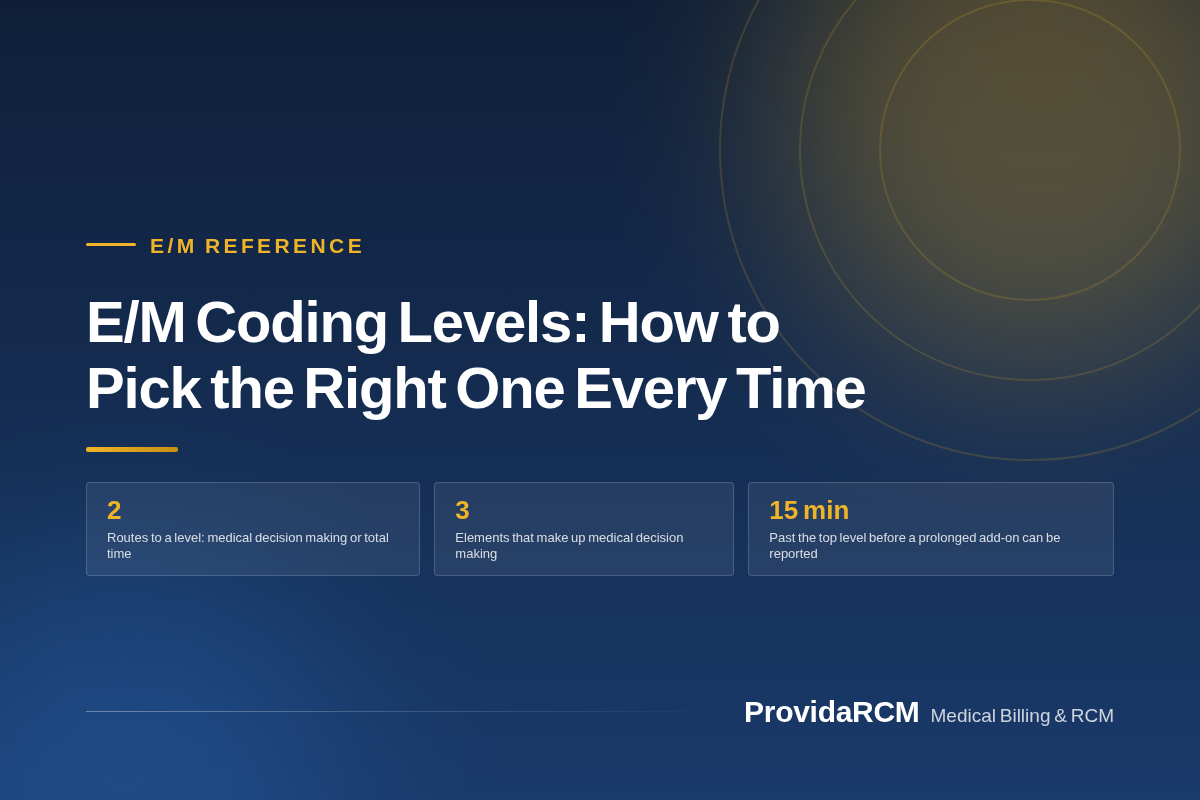
EM coding levels come down to one of two routes: the level of medical decision making, or the total time on the date of the encounter. The reporting practitioner picks the route, the code family is set by the setting, and the note has to carry whichever one was used.
The two E/M families a practice bills most
Almost every practice lives in two E/M code families: the office or other outpatient visit for a new patient, and the same visit for an established patient. Both come from one range of the codebook, and the family is set by the patient’s history with the practice.
CMS defines a new patient as a person who has not received any professional services from the physician, the nurse practitioner, or another physician of the same specialty in the same group practice in the previous 3 years. An established patient is the same person with a visit inside that window. The clock runs against the group and the specialty, not the individual clinician (CMS MLN006764).
| Family | Who the patient is | Where the codes sit | What it changes |
|---|---|---|---|
| New patient | No professional service from the clinician, the nurse practitioner or another clinician of the same specialty in the same group practice in the previous 3 years | The new patient codes in the office or other outpatient set | The new patient codes carry the higher work value on the Medicare fee schedule, so the same visit pays differently in each family |
| Established patient | A professional service from that same specialty and group practice inside the previous 3 years | The established patient codes in the same set | Selection works the same way; only the patient type changed |
| Levels 2 through 5 | Either family | Medical decision making, or total time on the date of the encounter | The new patient family lost its lowest level on January 1, 2021 |
The distinction is about money, not method. A returning patient billed as new is a code the record cannot support, and the overpayment comes back in a review. A patient seen last year by a partner in the same group is established for every clinician in it. The medical billing glossary covers the vocabulary these rules are built on.
A patient seen by any clinician of the same specialty in the same group practice inside three years is established for the whole group. Splitting a group into separate tax identities on paper does not change the record a review will ask for.
EM coding levels: the two routes to a level
Since January 1, 2021 for office and outpatient visits, and January 1, 2023 for most other E/M families, a level is set in one of two ways: the level of medical decision making, or the total time the reporting practitioner spent on the date of the encounter. CMS states that for most E/M visit families you select the level on decision making or on the time spent (CMS E/M compliance guidance).
The choice belongs to the practitioner and can be made fresh at each encounter. It is not a blend: a visit is coded on one route, and that route has to be carried in full. When time is the route, the full time for the level has to be met, and the midpoint convention that applies to other timed services does not apply.
| Route | What it measures | What the note has to show | Where it cannot be used |
|---|---|---|---|
| Medical decision making | The problems addressed, the data reviewed and analysed, and the risk that management carries | Each element that reaches the level reported | Nowhere; every family with levels uses this route |
| Total time | All reportable time the reporting practitioner spends on the date of the encounter, including time without the patient present | A start and stop time, or the stated total for the date | Emergency department visits and cognitive impairment assessment, which are not timed |
| The choice | The practitioner’s decision for this encounter, not a practice wide setting | The one route actually used | Critical care, which runs the other way and is selected on time only |
Total time CMS attaches to the established patient office levels
Source: CMS MLN006764 and the CMS office/outpatient E/M fact sheet, which publish the total time required for reporting each level.
The steps between levels are not uniform. A visit documented at 28 minutes sits inside one level; the same note written as 30 minutes sits in the next one up, and that version holds only if the time is real. Reviewers look for the time in the record, as a start and stop time or a stated total (CMS MLN006764).
The three elements of medical decision making
Medical decision making is built from three elements, and the same three apply to every family that uses it: the number and complexity of problems addressed, the amount and complexity of data reviewed and analysed, and the risk of complications, morbidity or mortality from management.
CMS does not publish the level table itself. Its booklet points practitioners to the AMA CPT E/M guidelines for the element detail, so this page describes the framework rather than quoting it. The habit for a coding team is the same either way: the level has to be defensible element by element from the note.
| Element | What it measures | What moves it up | What the record has to show |
|---|---|---|---|
| Number and complexity of problems addressed | What the practitioner took responsibility for at this encounter, not the standing problem list | From one minor problem, to a stable chronic illness, to an undiagnosed new problem, to a chronic illness with severe exacerbation | An assessment for every problem evaluated or treated, and the plan attached to it |
| Amount and complexity of data reviewed and analysed | The tests, records and outside input that reached the decision, rather than the tests ordered | From a single item, to a moderate set drawn from several kinds of data work, to work in several kinds at once | Each unique test, order or document, plus any interpretation the practitioner performed and any outside discussion |
| Risk of complications, morbidity or mortality | The risk the management carries, which is a separate question from the risk of the condition itself | From minimal risk, through prescription drug management, to drug therapy that needs intensive monitoring or a decision about major surgery | The management decision, and any comorbidity that raises the risk of what was chosen |
The three elements do not add up and they are not averaged. The E/M guidelines read each element against four levels, from straightforward through low and moderate to high, and the level reported is the one at least two of the three elements reach. That explains most odd looking charts: a moderate problem list beside extensive data still lands at moderate if risk is only low.
A long problem list is not a level. A comorbidity earns its place only when it was addressed and raised either the data work or the risk of what was decided.
The data element, where over-counting starts
Data is the element that gets misread most often, and the reason is structural. It is the only one of the three with a countable list, so a coder working quickly counts everything in the note. CMS ties the amount and complexity of data to the testing ordered or reviewed, and counts a decision to obtain old records or outside history as one of the things that raises it.
| Kind of data work | How it is counted | The over-count to watch | The under-count to watch |
|---|---|---|---|
| Tests, orders, documents and outside records | Each unique item counts once toward the set reviewed or ordered for this encounter | Counting a test twice because it was ordered and then reviewed, or counting each value in a panel as its own test | Leaving out an outside record or an order that was part of the encounter |
| Independent interpretation of a test | Counts as its own kind of data work when the practitioner reads the image, tracing or specimen and the reading is not separately billed | Treating a reporting radiologist’s impression as an independent interpretation, or claiming a reading already billed | Not counting it when the practitioner did review the study and signed the conclusion |
| Discussion with an outside clinician | Counts as its own kind of data work when management or a result is discussed with a practitioner outside the reporting practice | Counting a conversation with a partner in the same practice, or a discussion that was separately billed | Not documenting the discussion at all, which loses the element even though it happened |
An order nobody followed up on adds nothing to the visit, and neither does a result filed before the encounter and never opened. Both pull the level down rather than up.
Because data usually sits below the level of the problems and the risk, it is often the third element rather than part of the deciding pair. Where a level turns on data, the note has to show that the practitioner read the material, not that the practice received it. Our medical coding services work reads notes on that distinction.
What happened to history and examination
History and examination no longer select the level of an E/M visit. For the two office and outpatient families that changed on January 1, 2021, when CMS adopted the revised framework for those visits (CMS fact sheet). For hospital, nursing facility, home and emergency department visits it changed on January 1, 2023.
The 1995 and 1997 documentation guidelines that counted systems reviewed and examined are out for level selection. What replaced them is clinical judgement: the treating practitioner decides how much history and examination the visit needs. A note with no clinical narrative still fails, because medical necessity is a separate test.
| Part of the visit | Selects the level | Still required | Why it still matters |
|---|---|---|---|
| History and examination | No | Yes, to the extent the visit needs it | Medical necessity, continuity, and the next clinician reading the note |
| Medical decision making | Yes, as one of the two routes | Yes, in every note that carries a level | It is the route most audits reconstruct, element by element |
| Total time | Yes, as the other route | Only when time is the route used | CMS looks for a start and stop time or a stated total for the date |
Two habits follow. A copied forward history and examination is dead weight in a review, because it neither selects the level nor proves the visit was necessary. The assessment and plan carry more weight than before, since they are what a reviewer reads to see why the level was met.
A note that lists twelve systems reviewed adds nothing to the level and reads as boilerplate. Keep the history and examination proportionate to the problem, and put the detail into the assessment and plan.
Prolonged service add-ons and what has to be documented
A prolonged service add-on pays for time beyond the highest level of a family, and it exists only where time selected the level. CMS requires the practitioner to go at least 15 minutes past the total time for that highest level, and the add-on is listed separately from the primary visit on the same date.
Medicare bills these add-ons with its own HCPCS codes rather than the CPT prolonged codes. CMS finalized G2212 for office and outpatient visits in the CY 2021 rule, and created G0316, G0317 and G0318 for hospital inpatient or observation, nursing facility and home or residence visits in the CY 2023 rule. Practices are told not to report prolonged office time to Medicare using CPT codes 99354, 99355, 99358, 99359, 99415, 99416 or 99417.
| Family | Medicare add-on | The time threshold CMS publishes | What has to be documented |
|---|---|---|---|
| Office or other outpatient | G2212 | Total time past the top office level by 15 minutes or more | Total time for the date, and that time selected the level |
| Hospital inpatient or observation | G0316 | 90 minutes for an initial visit, 65 for a subsequent one | The date or dates the time was spent on, and the qualifying activities behind it |
| Nursing facility | G0317 | 95 minutes for an initial visit, 85 for a subsequent one | Time inside the window CMS publishes for the family, plus the qualifying activities |
| Home or residence | G0318 | 140 minutes for a new patient visit, 110 for an established one | Time inside the window CMS publishes for the family, plus the qualifying activities |
Total time CMS publishes before prolonged care can be reported
Source: CMS MLN006764, table of prolonged other E/M visits, which lists a time threshold and a count period for each family.
Two documentation habits decide these claims. The time has to be the reporting practitioner’s own, counted on the date of the encounter and not the day before or after, and it leaves out separately billable procedures and travel. CMS lists the qualifying activities, from preparing to see the patient through counselling, ordering and documenting the encounter.
Two families are closed to the add-ons. Nursing facility discharge day management cannot be paired with prolonged time, and emergency department visits carry no prolonged add-on at all. Prolonged cognitive impairment assessment time is reported with G2212, the office code, rather than with a code of its own.
The setting difference people miss
The framework is shared; the rules around it are not. Office and outpatient visits are split by new against established patient, and home or residence visits are as well. The hospital, nursing facility, emergency department and cognitive impairment families count initial against subsequent visits instead. Hospital inpatient and observation were merged into one code set, and home and domiciliary visits into another.
| Family | How the patient type is set | Route to the level | What the practice has to watch |
|---|---|---|---|
| Office or other outpatient | New or established, from the 3 year lookback across the same specialty and group practice | Medical decision making or total time | Two families for the same clinical work, decided only by the 3 year lookback |
| Hospital inpatient or observation | Initial or subsequent visit | Medical decision making or total time | Inpatient and observation share one code set, so the setting is carried by the place of service code |
| Nursing facility | Initial or subsequent visit | Medical decision making or total time | The annual nursing facility assessment no longer has a code of its own |
| Home or residence | New or established patient | Medical decision making or total time | Domiciliary and home visits are one family now, so place of service does the separating |
| Emergency department | Not split by patient type | Medical decision making only | Time cannot select the level and no prolonged add-on applies |
| Cognitive impairment assessment | Not split by patient type | Medical decision making only | It is not a timed service, and prolonged time is reported with the office code G2212 |
Payment differs again on top of the coding rules. A hospital outpatient department and a physician office can report the same code at different allowed amounts, because payment in a facility setting reflects only the resources the practitioner incurs, as CMS describes in the CY 2023 final rule. The place of service code tells the payer which rate applies.
The mistake to avoid is treating the office rules as universal. A coder who applies the new against established split to a hospital visit, or who reaches for total time on an emergency department encounter, produces a claim the setting does not allow. Read the place of service first, then the family, then the route.
For the visits that sit beside these rules, see the modifier 25 documentation question for a problem visit billed next to a preventive service, and NCCI edits and modifiers for pairs that should not be reported together. When the pattern is the problem rather than one claim, a revenue cycle health check reads a quarter of levels against the notes behind them.
Questions practices ask us about this
Can a provider choose between medical decision making and total time on the same visit?
Yes. CMS states that for most E/M visit families you select the level on the level of medical decision making or on the amount of time you spend with the patient. The choice belongs to the reporting practitioner and can be made fresh at each encounter. Whichever route is used has to be carried in full.
Does the history and examination still have to be documented for an E/M visit?
Yes, but not for the level. CMS states that for all E/M visits you should include a medically appropriate history and physical exam when performed, and that history and exam no longer affect visit level selection. The guidelines that counted systems reviewed and examined no longer select the level. A note still has to support medical necessity.
Why do coders over-count the data element of medical decision making?
Data is the only one of the three elements with a countable list, so it invites counting everything in the note. Each unique test, order or document counts once, and a test does not count twice because it was both ordered and reviewed. Independent interpretation and outside discussion are their own kinds of data work.
What decides whether a patient is new or established for an E/M code?
The previous 3 years with the same specialty and the same group practice. CMS defines a new patient as someone who has not received any professional services from the physician, the nurse practitioner or another physician of the same specialty in the same group practice in the previous 3 years. A patient seen by a partner in that group is established for the practice.
When can a practice report G2212 for a prolonged office visit?
Only when time selected the level, and only once the total time on the date of the encounter passes the maximum time of the highest office level by at least 15 minutes. CMS tells practices not to report prolonged office time with the CPT prolonged codes, including 99417. The note has to show total time for the date.
Why can an emergency department visit not be coded on total time?
Because emergency department visits are not timed services. CMS states that for certain services, including emergency department visits, the choice between decision making and time does not exist and only one route applies. For the emergency department that route is medical decision making. Cognitive impairment assessment works the same way, and critical care runs the other way.
Do hospital and nursing facility visits use the office rules for picking a level?
They share the framework but not every rule. Since January 1, 2023 hospital inpatient and observation, nursing facility, home or residence, emergency department and cognitive impairment visits select the level on decision making or total time, and history and exam no longer select it. Inpatient and observation were merged into one code set, home and domiciliary into another, and emergency department visits are not timed.
Want this fixed in your practice?
We run full-cycle billing, coding, credentialing and denial work for practices across the country. Send us a few months of claims and we will show you where the money is going.
Book a free billing review- CMS, Physician Fee Schedule payment for office/outpatient E/M visits, fact sheet. cms.gov/files/document/physician-fee-schedule-pfs-payment-officeoutpatient-evaluation-and-management-em-visits-fact-sheet.pdf
- CMS, Evaluation and Management (E/M) services compliance guidance. cms.gov/training-education/medicare-learning-networkr-mln/compliance/medicare-provider-compliance-tips/evaluation-management-services
- CMS, MLN006764, Evaluation and Management Services booklet (MDM elements, new and established patient, prolonged thresholds). cms.gov/files/document/mln006764-evaluation-management-services.pdf
- CMS, CY 2023 Medicare Physician Fee Schedule final rule fact sheet. cms.gov/newsroom/fact-sheets/calendar-year-cy-2023-medicare-physician-fee-schedule-final-rule
- CMS, Place of service codes. cms.gov/medicare/coding-billing/place-of-service-codes
- CMS, Medicare Claims Processing Manual, Pub. 100-04, chapter 12. cms.gov/regulations-and-guidance/guidance/manuals/downloads/clm104c12.pdf