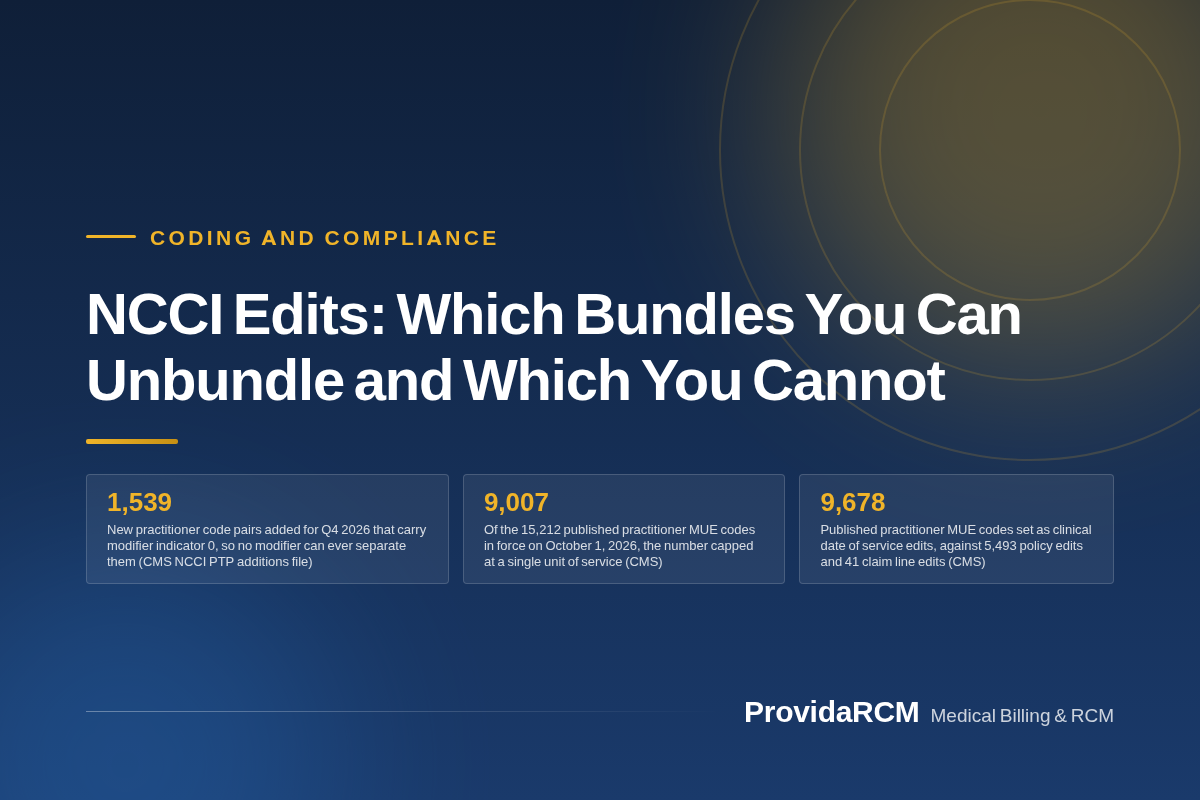
NCCI edits are two rule sets, not one. Procedure to procedure edits pair a payable code with a component code and carry a modifier indicator that says whether any modifier can bypass the pair. Medically unlikely edits set a units ceiling and carry a separate indicator that decides whether that ceiling is absolute or clinical.
How NCCI edits split into two families
The National Correct Coding Initiative exists to stop payment for code combinations that should not both be reported. CMS built it as two rule sets that fail in different ways. A procedure to procedure edit pairs a column one code with a column two code, and the column two code is the one denied. A medically unlikely edit sets a maximum units of service for one code, one patient, one date.
One family asks whether two codes belong together. The other asks how many times one code could plausibly have been performed. That is why a single unbundling playbook does not cover both.
| Procedure to procedure (PTP) | Medically unlikely edit (MUE) | |
|---|---|---|
| What is compared | Two codes against each other | Units billed for one code against a ceiling |
| What gets denied | The column two code | Every line for that code and date on a date of service edit |
| The indicator on the row | Correct Coding Modifier Indicator: 0, 1 or 9 | MUE Adjudication Indicator: 1, 2 or 3 |
| What can change it | An NCCI PTP-associated modifier, when the indicator allows it | For clinical edits, documented medically necessary units, at MAC discretion |
Both files are republished every quarter and the rows carry effective and deletion dates. A pair in the current file may not have covered an older date of service, and a pair that was in force then may be gone now. Look the edit up against the date of service.
New NCCI code pairs added for Q4 2026
Source: CMS, Medicare NCCI 2026 Q4 practitioner quarterly additions file, effective October 1, 2026.
The churn is substantial. In the file effective October 1, 2026, CMS added 4,249 new practitioner pairs, of which 1,539 carry indicator 0 and 2,710 carry indicator 1. A workflow that treats every bundling denial the same way is generating appeals against the 1,539 that cannot succeed.
The modifier indicator decides whether a bundle can be unbundled
CMS calls the field the Correct Coding Modifier Indicator. It belongs to the row, not to either code on its own, and it has three possible values. Only one of them opens a door, and none of them is a statement that a claim will be paid.
| Indicator | What CMS says it means | What to do with the denial |
|---|---|---|
| 0 | NCCI PTP-associated modifiers cannot be used to bypass the edit | Remove the column two code, or bill it on a date when column one is not also billed |
| 1 | NCCI PTP-associated modifiers may be used to bypass the edit under appropriate circumstances | Check whether the record describes a separate service, then choose the modifier that describes it |
| 9 | Not specified, on rows where the deletion date equals the effective date | Nothing to bypass. Confirm the pair covered the date of service on the claim |
Indicator 0 is the one billers get wrong. It does not mean your modifier was rejected. It means the pair is never separately payable, so no wording in an appeal changes the outcome. Appending 59 to an indicator 0 pair is an incorrect use of the modifier, and a reviewer reads it that way.
The NCCI Policy Manual, Chapter I states that a modifier shall not be appended to a code solely to bypass an NCCI PTP edit when the clinical circumstances do not support it. Payment after an append does not make the append correct. The rule is about the circumstances, not the outcome.
Indicator 9 is the quiet one. CMS uses it on rows where the effective date and the deletion date are the same day, which keeps a blank out of the indicator column. Those pairs are not in force, so an answer read off one of them applies to nothing.
The PTP-associated modifier list is narrower than most billers assume
A defined set of modifiers can bypass a procedure to procedure edit, and only when the row’s indicator is 1. The manual groups them as anatomic modifiers, global surgery modifiers and a short list of others. Anything outside that set does nothing to the edit, however well it describes the service.
| Group | Modifiers | What the modifier establishes |
|---|---|---|
| Anatomic | E1 to E4, FA, F1 to F9, TA, T1 to T9, LT, RT, LC, LD, RC, LM, RI | The service was performed at a different site, or on a different side of the body |
| Global surgery | 24, 25, 57, 58, 78, 79 | A service outside or after a global period, or a staged or related procedure |
| Other | 27, 59, 91, XE, XS, XP, XU | A second outpatient encounter on the same date, a distinct procedural service, a repeat laboratory test, or a separate encounter, structure, practitioner or non-overlapping service |
| Named and excluded | 22, 76, 77 | CMS names these three to state that they are not PTP-associated and do not bypass a PTP edit |
Modifier 22 reports increased procedural services, and 76 and 77 report a repeat procedure. Each has legitimate uses unrelated to bundling, and CMS names all three to say they do not bypass a PTP edit. Additional payment for modifier 22 is left to the MAC, which is a separate question from whether the pair is payable.
Notice where 25 sits. Modifier 25 is on the list because a significant, separately identifiable E/M service on the day of a procedure is a real exception. It is not a general-purpose unbundling tool and it does not apply to two procedures. Append it to every visit billed with a procedure and the pattern becomes a finding.
Modifier 59, the X{EPSU} family, and why the specific modifier matters
For NCCI purposes, modifier 59 exists to say that two procedures were performed at different anatomic sites or during different patient encounters, which the NCCI Policy Manual, Chapter I calls its primary purpose for this program. It is a general-purpose modifier, and MLN1783722 directs providers to use a more specific modifier whenever one describes what happened, reserving 59 for the cases nothing else covers.
| Modifier | Meaning | When it fits |
|---|---|---|
| 59 | Distinct procedural service | Two procedures at different sites or in different encounters when no more specific modifier describes the situation |
| XE | Separate encounter | The second service occurred during a separate encounter on the same date of service |
| XS | Separate structure | The second service involved a separate organ or anatomic structure |
| XP | Separate practitioner | A different practitioner performed the second service |
| XU | Unusual non-overlapping service | The service does not overlap the usual components of the main service |
CMS introduced XE, XS, XP and XU effective January 1, 2015 to split modifier 59 into more precise pieces. Transmittal 1422 says the agency wanted more precise coding alongside education and selective editing, and that it would not stop recognizing 59. Providers were told to use the specific modifier whenever one fits.
The documentation requirement is identical either way. Whatever you append, the record has to establish the separate site, the separate encounter, the separate practitioner, or the non-overlapping service. The modifier describes the documentation. It cannot replace it.
Two mechanics catch people out. CMS allows 59, XE, XS, XP or XU on column one or column two, so the bypass modifier does not have to sit on the denied code. And 59 should not be appended to an E/M service; an E/M on the same day as a procedure is reported with 25.
Medically unlikely edits cap units, and the indicator says who can lift the cap
An MUE is the maximum units of service CMS expects to see for one code, one patient, on one date of service. It is not a coverage rule. It is a plausibility check on the count. The quarterly table carries the value and an MUE Adjudication Indicator that tells you how the edit was built.
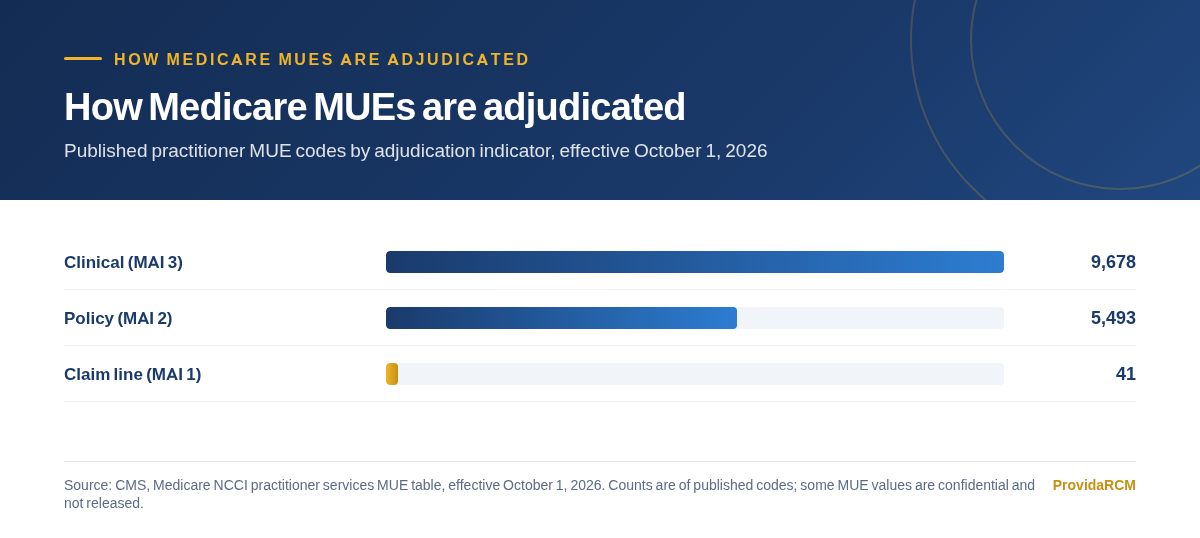
An indicator of 1 marks a claim line edit, so modifiers can report the same code on separate lines and each line is judged against the ceiling on its own. Indicators of 2 and 3 make the edit a date of service edit: every line for that code and date is summed, and if the total exceeds the value, all of them are denied.
| Indicator | Basis | Can the ceiling be exceeded? | First move on the denial |
|---|---|---|---|
| 1 | Claim line edit | Yes, when the units were correctly reported and medically necessary | Report the code on separate lines with the modifier that describes the separation |
| 2 | Date of service edit based on policy | No. CMS states that override during processing, reopening or redetermination would be contrary to its policy | Check the units field first. If the count was wrong, use a clerical error reopening |
| 3 | Date of service edit based on clinical benchmarks | Yes, with documentation that the units were provided, correctly coded and medically necessary | Send the clinical record supporting the units to the MAC |
The practical split is between a counting error and a coverage argument. Most policy-based denials are a units field that went wrong: a 2 became a 12, or a bilateral procedure was submitted as two units when Medicare requires one. Fix the count and use the reopening path, which MM8853 places with the MAC, not the NCCI contractor.
Published Medicare MUE values for five frequently billed codes
Source: CMS, Medicare NCCI practitioner services MUE table, effective October 1, 2026. The table lists each code with its value, its adjudication indicator and a rationale.
Clinical edits are the other case. Where the indicator is 3, CMS expects the MAC to pay correctly counted, medically necessary units above the value when the record supports it. That is an argument about what was done and how it was counted, not about which modifier to append.
How to tell a real unbundling opportunity from a pair that never splits
Work bundling denials in a fixed order. Every step before the appeal is cheap, and skipping the first one is what turns a coding question into a stack of unsuccessful letters.
- 01
Pull the edit row, not the modifier
Look up both codes against the date of service on the claim and read the indicator on that row. Until the indicator is in front of you, any plan is a guess.
- 02
If the indicator is 0, stop there
Remove the column two code, or bill it on a date when column one is not also billed. No modifier and no appeal letter makes the pair separately payable.
- 03
If the indicator is 1, find the sentence first
Look for the line in the note that establishes a separate site, encounter, practitioner or non-overlapping service, then choose the modifier that describes it. If no such line exists, the denial is correct.
- 04
On a units denial, check the count first
Total the units for that code and date and compare them with the MUE value. A wrong count is a clerical error reopening, not an appeal.
| What the remittance shows | What it usually means | First move |
|---|---|---|
| A second procedure denied as included in another | A PTP edit, with or without a route to bypass it | Look up the pair and read the modifier indicator |
| Every line for one code and date denied | A date of service MUE, or a units total above the value | Sum the units and confirm the count before anything else |
| The same pair denied every month | A template or charge capture problem | Change the source, not the claim |
A practice that appends 25 to every E/M billed with a procedure, or 59 to every code pair, is not unlucky. The pattern is in the data. Modifier use can be compared across providers and codes, and a modifier that appears far more often than the notes support is the easiest thing in a claim file to find.
We work this inside full-cycle medical billing and medical coding, and the team that works the bundle is the team that changes the template behind it. Our CARC and RARC reference maps remittance wording to the office that owns the fix, and denial management is where the query work sits.
Questions practices ask us about this
Can a modifier ever bypass an NCCI edit that carries indicator 0?
No. CMS defines indicator 0 as meaning that NCCI PTP-associated modifiers cannot be used to bypass the edit, so no documentation and no modifier makes the pair separately payable. The correct response is to remove the column two code, or to bill it on a date of service when the column one code is not also reported.
When should modifier 59 be used instead of XE, XS, XP or XU?
Only when none of the four more specific modifiers describes the situation. CMS instructs providers to use the specific modifier whenever one fits and to use 59 only if no more descriptive modifier is appropriate. For NCCI purposes, 59 signals different anatomic sites or different patient encounters when no anatomic modifier or X modifier covers it.
Why did CMS add the X{EPSU} modifiers?
CMS created XE, XS, XP and XU effective January 1, 2015 to break modifier 59 into more precise pieces, on the reasoning that clearer reporting paired with education and selective editing would reduce incorrect payments. CMS did not stop recognizing 59. It made the specific modifiers the preferred choice, and it can require a particular X modifier for pairs at high risk of incorrect billing.
Can we be paid for units of service above an MUE value?
It depends on the adjudication indicator. For a claim line edit, or for a clinical date of service edit, MACs may pay correctly counted and medically necessary units above the value when the documentation supports it, and the appeal goes to the MAC. For a policy-based date of service edit, CMS states that overriding the limit during processing, reopening or redetermination would be contrary to its policy.
How often do NCCI edits change, and does that affect old claims?
CMS republishes the PTP and MUE files every quarter, effective January 1, April 1, July 1 and October 1. Each row carries an effective date and, once withdrawn, a deletion date. A claim is judged against the file in force for its date of service, so checking an older claim against the current file can give you the wrong answer.
Find out how much of this is sitting in your A/R
We audit bundling and units denials against the edit file for the date of service, then fix the templates that produced them. Send us three months of claims and we will show you which denials were never recoverable and which ones were money you already earned.
Book a free billing review- CMS, Medicare NCCI Policy Manual for Medicare Services, Chapter I, General Correct Coding Policies (revision January 1, 2026). cms.gov/files/document/01-chapter1-ncci-medicare-policy-manual-2026-final.pdf
- CMS, MLN1783722, Proper Use of Modifiers 59, XE, XP, XS and XU. cms.gov/files/document/mln1783722-proper-use-modifiers-59-xe-xp-xs-xu.pdf
- CMS, Medicare NCCI Procedure to Procedure (PTP) edits, quarterly practitioner edit files. cms.gov/medicare/coding-billing/national-correct-coding-initiative-ncci-edits/medicare-ncci-procedure-procedure-ptp-edits
- CMS, Medicare NCCI Medically Unlikely Edits (MUEs), quarterly MUE tables. cms.gov/medicare/coding-billing/national-correct-coding-initiative-ncci-edits/medicare-ncci-medically-unlikely-edits-mues
- CMS, MLN Matters MM8853, Revised Modification to the Medically Unlikely Edit (MUE) Program. cms.gov/files/document/revised-modification-medically-unlikely-edit-mue-program-mm8853.pdf
- CMS, MLN Matters SE1422, Medically Unlikely Edits and Bilateral Surgical Procedures. cms.gov/files/document/se1422-medically-unlikely-edits-mue-and-bilateral-surgical-procedures.pdf
- CMS, Transmittal 1422, Change Request 8863, Specific Modifiers for Distinct Procedural Services, effective January 1, 2015. cms.gov/regulations-and-guidance/guidance/transmittals/downloads/r1422otn.pdf