The credentialing timeline is not one number. It is a chain of stages, each with its own owner: a CAQH profile that must be re-attested every 120 days, a payer’s application queue, primary source verification, a committee decision, contracting, and finally an effective date. A practice controls its documentation and its response speed. It does not control payer queues.
Your credentialing timeline is a chain, not a number
Search for how long credentialing takes and the same range comes back across billing sites: 90 to 120 days. Almost none of those pages name who owns the number. It blends payers, states, and stages that run on separate clocks, so two practices with similar files can be months apart.
A provider file moves through six stages, and only some of them respond to anything the practice does. The table below separates the stages by who actually controls the time.
| Stage | Who owns the clock | What the owner publishes | What the practice controls |
|---|---|---|---|
| CAQH profile and attestation | The provider, on a CAQH cycle | Re-attestation every 120 days, every 180 in Illinois | Profile accuracy and attestation timing |
| Payer application submission | The payer’s intake team | Often nothing | Packet completeness and reply speed |
| Primary source verification | The payer or its verification vendor | Depends on outside sources | Nothing once the file is submitted |
| Committee review and decision | The payer credentialing committee | Committee cadence, rarely published | Nothing |
| Contracting and fee schedule loading | Payer contracting and claims operations | Loading windows, sometimes published | How fast you return the signed contract |
| Effective date | The payer | Assigned only after every step above | Confirming it in writing before you bill |
A practice controls two things: the accuracy of the file and how fast it answers a request for more information. It does not control the payer’s review queue. Every file that runs long traces back to one of those two.
Stage one: the CAQH profile and its 120-day clock
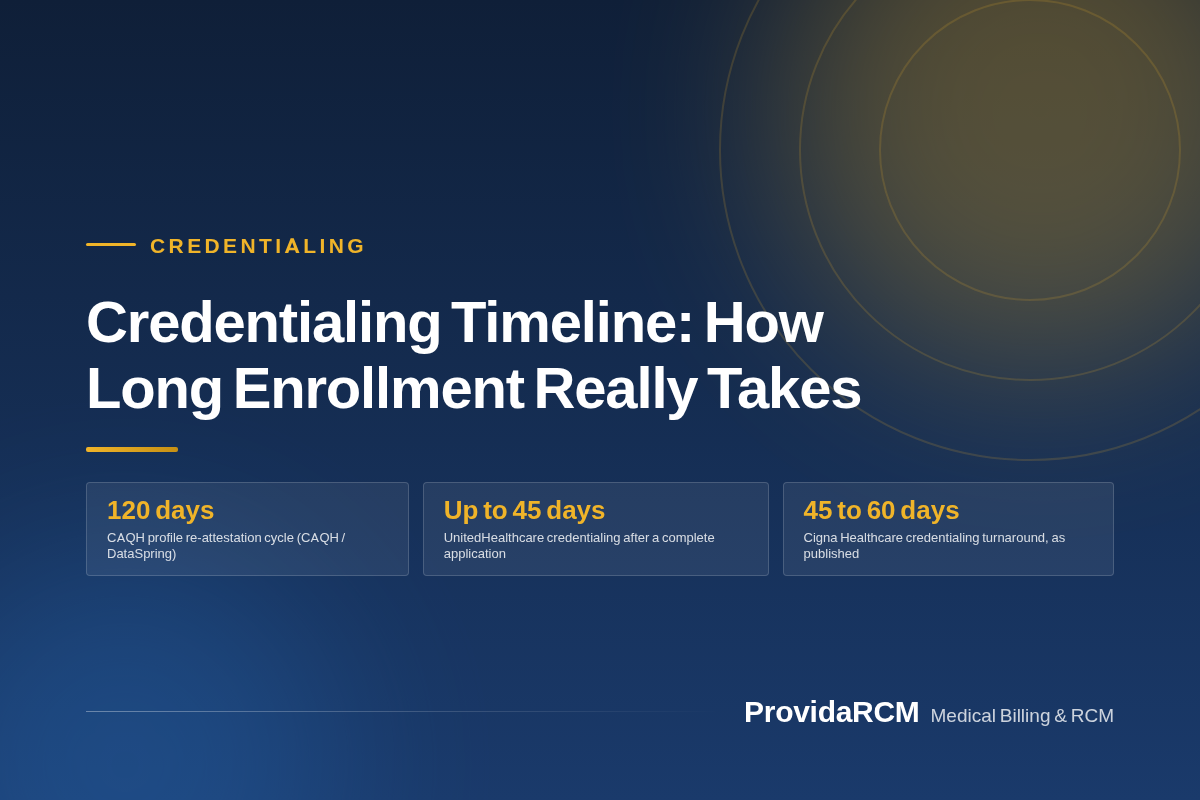
Most commercial payers pull credentialing data from the CAQH Provider Data Portal rather than collecting it themselves, so the profile is the first thing on the clock. CAQH requires a provider to re-attest that the profile is accurate every 120 days, and every 180 days for providers who practice in Illinois. A profile past its attestation date flips to expired status.
The clock is personal. It resets on the day you attest, not on a shared calendar date, so two clinicians who started the same week can be a month apart. The control here is a calendar reminder set for day 100, not day 119, because a lapsed profile stalls every payer that pulls from it.
- Re-attest every 120 days, or every 180 in Illinois. The deadline runs from your last attestation, not a fixed date.
- Authorize each payer to pull the profile. A complete profile a payer cannot open is the same as no profile.
- Keep licenses, malpractice face sheets, and DEA registration current. An expiration mid-review triggers a new document request.
- Answer CAQH document queries within a few days. Document approval itself can take up to three business days.
Stage two and three: submission and primary source verification
Once the profile is current and authorized, the payer pulls it and starts verification. Each payer publishes its own figure, and they disagree because they are not measuring the same thing. UnitedHealthcare states the entire credentialing process generally takes up to 45 calendar days or more once it has a completed application. Cigna Healthcare states a 45 to 60 day turnaround from receipt of the packet.
Aetna is the cautionary case. Its published 45 day figure, and 60 days for facilities, covers the network-need decision only. Aetna does not publish an end-to-end credentialing timeline, so any total you see for Aetna comes from a third party, not from Aetna.
Payer-published credentialing turnaround, as each payer states it
Source: each payer’s own published page. UnitedHealthcare states up to 45 calendar days after a complete application; Cigna states 45 to 60 days; Aetna’s 45 days covers the network-need decision, not credentialing.
| Payer | What the figure covers | Figure | Where it stops |
|---|---|---|---|
| UnitedHealthcare | End-to-end credentialing after a complete application | Up to 45 calendar days | Contracting runs as a separate step |
| Cigna Healthcare | Credentialing from receipt of the application packet | 45 to 60 days | Directory and claims load follow within 10 business days |
| Aetna | Network-need eligibility decision only | Up to 45 days, 60 for facilities | Aetna publishes no end-to-end credentialing figure |
| CAQH | How often the profile must be re-attested | Every 120 days, 180 in Illinois | It governs the data source, not the payer decision |
Primary source verification is where the practice loses control entirely. The payer or its vendor queries state licensing boards, the National Practitioner Data Bank, and sanction lists. State boards can take more than a week to answer, and that lag lands on your timeline rather than the payer’s.
Stage four: the committee decision and the verification window
After verification, the file goes to a credentialing committee that meets on a schedule. A file marked complete the day after a meeting waits for the next one, which is why this stage is the hardest to forecast. Most payers do not publish committee cadence, and no practice can shorten it.
NCQA sets the standards that accredited plans follow. NCQA requires recredentialing every three years, and in 2025 it shortened the window in which verification results stay usable so committees work from more current data. A file that sits too long can need fresh checks before a committee can act on it.
The 90 to 120 day figure appears on hundreds of billing pages with no named source. It blurs stages that have different owners and different clocks. Treat it as a round marketing number, not a commitment from any payer.
Medicare runs its own cycle on a different clock. Under 42 CFR 424.515, a provider must resubmit and recertify enrollment information every five years, and a new revalidation cycle starts once a complete application is validated. The same rule gives 60 calendar days to respond to CMS’s notice.
Stage five and six: contracting, loading, and the effective date
A committee approval is not the finish line. The payer sends a participation agreement next, and only a signed contract plus a loaded provider record lets a claim pay at in-network rates. Cigna loads provider information into its directories and claims systems within about 10 business days of approval. Arizona’s credentialing statute, reproduced in UnitedHealthcare’s regulatory addendum, allows an insurer 30 calendar days after credentialing to load the provider into its billing system.
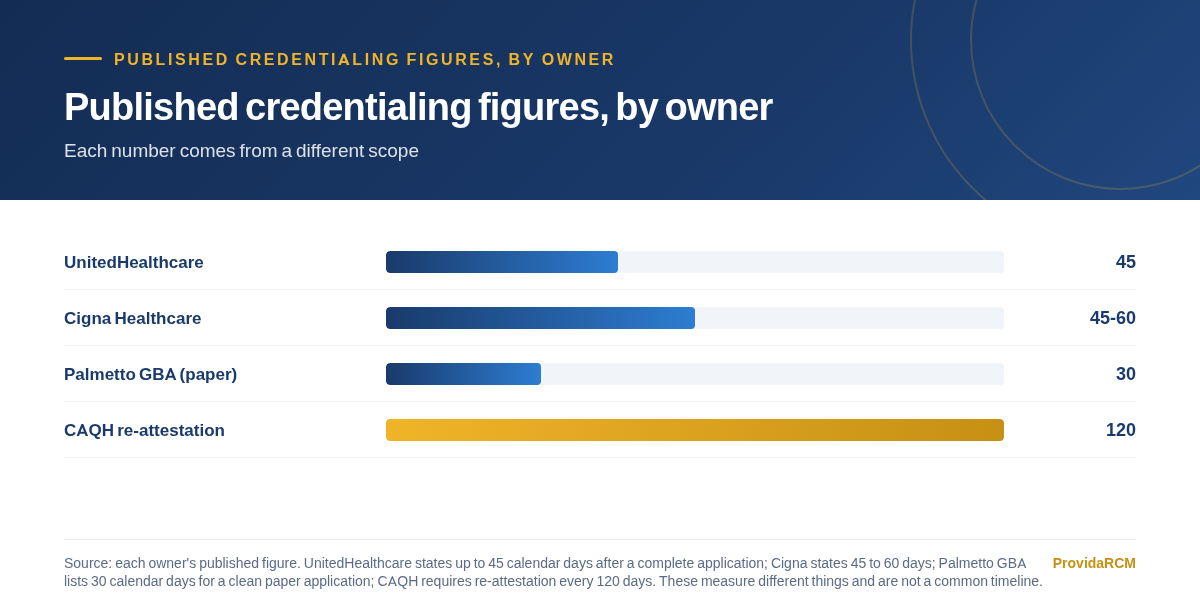
CMS publishes its own per-step estimates for institutional applicants in its enrollment roadmap. They are estimates for each step, not a total, and they apply to institutional applicants rather than to an individual physician filing a CMS-855I.
CMS per-step processing estimates for institutional enrollment
Source: CMS, Enrollment and Certification Roadmap for Institutional Providers. These steps apply to institutional applicants, not to an individual physician filing a CMS-855I.
| Step | Published timeframe | Who publishes it | Applies to |
|---|---|---|---|
| Clean paper application, no development | 30 calendar days | Palmetto GBA enrollment page | Paper CMS-855 applications needing no site visit or fingerprint |
| Application processing standard | 30 calendar days of receipt | WPS GHA timeframes page | CMS-set enrollment processing standards |
| Institutional intake, paper versus web | About 65 days versus 30 days | CMS enrollment roadmap | Institutional applicants using CMS-855A, 855B, or 855S |
| Answer a MAC request for information | 30 days | CMS MLN9658742 | Any pending enrollment or revalidation |
| Answer a revalidation notice | 60 calendar days | 42 CFR 424.515(a)(2) | Medicare providers and suppliers |
| Enrollment application fee | $750 for calendar year 2026 | Federal Register notice 2025-21877 | Institutional providers; CMS-855I physicians are exempt |
What a practice controls, and what it does not
Two questions decide whether a file moves or stalls: is the documentation complete and accurate, and does the practice answer payer requests quickly? CMS tells applicants to respond to a MAC request for information within 30 days. A payer that never hears back cannot advance the file, and the clock keeps running while it waits.
- Build the CAQH profile once and keep it attested, so no payer pulls a stale record.
- Authorize each payer before you submit, so the file never waits on access.
- Send a complete packet the first time, with current licenses, malpractice, and tax documents.
- Answer every development request in a few days, not at the 30-day deadline.
- Confirm the effective date in writing, because a signed contract and a loaded record are both required before you bill.
The stages a payer owns, primary source verification and committee review, run on the payer’s queue and on outside sources such as state boards. No amount of follow-up shortens those steps. What follow-up does is keep your file from being the one stuck behind an unanswered question.
For the Medicare side, revalidation runs on its own five-year cycle with its own deadlines, and the reporting rules in 42 CFR 424.516 require physicians to report a change of ownership or practice location within 30 days. We run the whole sequence through our medical credentialing services, alongside medical billing and prior authorization.
Questions practices ask us about this
How long does credentialing actually take from start to finish?
There is no single owner of an end-to-end number. What payers publish is narrower: UnitedHealthcare states up to 45 calendar days after a complete application, Cigna states 45 to 60 days, and Aetna publishes only its 45 day network-need decision. Add the profile setup, primary source verification, contracting, and claims loading, and a clean file usually runs longer than any one published figure.
Why do payers publish different credentialing timelines?
Because they are not measuring the same thing. UnitedHealthcare’s figure starts from a completed application. Cigna’s starts from receipt of the packet. Aetna’s 45 days covers only the network-need decision. Arizona’s statute measures credentialing itself and then adds a 30 day loading window. When a source does not state its starting point, its number is not comparable to the others.
How often do I have to re-attest my CAQH profile?
CAQH requires re-attestation every 120 days, and every 180 days for providers who practice in Illinois. The clock runs from your last attestation date, not a shared calendar date, so the deadline is personal to each provider. A profile that passes its window flips to expired status, and every payer that pulls from it stalls until you log back in.
What is the credentialing committee, and why does it add time?
The committee is the payer body that reviews a verified file and decides whether a practitioner joins the network. It meets on a schedule, so a file completed the day after a meeting waits for the next one. Most payers do not publish committee cadence, and the practice cannot influence it, which makes this one of the least predictable stages in the process.
How long does Medicare take to process an enrollment application?
CMS does not publish one total. Its roadmap gives per-step estimates for institutional applicants: about 65 days for paper intake and 30 for web, 45 days for a state agency review, and roughly 30 days for CMS review. MACs publish their own figures, and Palmetto GBA lists 30 calendar days for a clean paper application needing no site visit or development.
When can we start billing after credentialing?
After the committee approves, the payer still has to send and countersign a contract and load your provider record into its claims system. Cigna states that directory and claims loading happens within about 10 business days of approval. Do not see members or submit claims until the effective date is confirmed in writing, because claims for services before that date are typically denied.
Do we have to go through credentialing again later?
Yes. NCQA requires accredited plans to recredential every three years, and Medicare runs a separate five-year revalidation cycle under 42 CFR 424.515. Keep the CAQH profile attested and the enrollment record current, and both cycles move without a gap. Miss either one, and the practice can lose in-network status or have its Medicare billing privileges deactivated.
Want this fixed in your practice?
We run full-cycle billing, coding, credentialing and denial work for practices across the country. Send us a few months of claims and we will show you where the money is going.
Book a free billing review- CMS, Medicare Provider Enrollment (MLN9658742). cms.gov/Outreach-and-Education/Medicare-Learning-Network-MLN/MLNProducts/EnrollmentResources/provider-resources/provider-enrolment/Med-Prov-Enroll-MLN9658742.html
- CMS, Enrollment and Certification Roadmap for Institutional Providers. cms.gov/files/document/provider-enrollment-certification-roadmap.pdf
- eCFR, 42 CFR 424.515, revalidation cycle and 60-day response. ecfr.gov/current/title-42/chapter-IV/subchapter-B/part-424/subpart-P/section-424.515
- eCFR, 42 CFR 424.516, reporting requirements for physicians and practitioners. ecfr.gov/current/title-42/chapter-IV/subchapter-B/part-424/subpart-P/section-424.516
- UnitedHealthcare, Join our network for medical providers (credentialing time). uhcprovider.com/en/resource-library/Join-Our-Network/Medical-Provider.html
- Cigna Healthcare, Provider Credentialing (45 to 60 day turnaround). cigna.com/health-care-providers/credentialing
- Aetna, Join the Aetna network (45-day network-need decision). aetna.com/health-care-professionals/join-the-aetna-network.html
- NCQA, Credentialing standards (recredentialing every three years). ncqa.org/blog/ncqas-credentialing-standards-ensure-safety-and-integrity-of-practitioner-networks
- CAQH / DataSpring, CAQH ProView provider resources (120-day re-attestation). caqh.org/solutions/caqh-proview
- Palmetto GBA, Provider Enrollment Application Processing Time. palmettogba.com/jmb/did/blcsyr3231
- WPS GHA, Provider Enrollment Timeframes. wpsgha.com/guides-resources/view/provider-enrollment-timeframes
- UnitedHealthcare, Credentialing Plan State and Federal Regulatory Addendum (Arizona ARS 20-3453). uhcprovider.com/content/dam/provider/docs/public/resources/join-network/Credentialing-Plan-State-and-Federal-Regulatory-Addendum.pdf
- Federal Register, Provider Enrollment Application Fee for Calendar Year 2026 (2025-21877). federalregister.gov/d/2025-21877
- CMS, Revalidations (due dates, notices, and deactivation). cms.gov/medicare/enrollment-renewal/providers-suppliers/revalidations