A medical necessity denial is the payer applying a criterion to your record, and the criterion is usually one you were never shown. The appeal has to name that criterion, answer each element of it with a line from the chart, and file at the level that owns the decision.
What a medical necessity denial is actually telling you
A denial that arrives as CARC 50 says the payer does not consider the service medically necessary. The wording comes from the current X12 code list, not from a payer crosswalk. That is a coverage opinion, and it differs from every other code on the remittance. CO-16 means the claim was incomplete. CARC 197 means an authorization was missing. CARC 50 means a reviewer read your record against a rule and decided the record did not meet it.
The trap is that CARC 50 gets attached to two problems that need opposite responses. One is a real coverage disagreement: the payer’s policy covers the service only under conditions your record does not show. The other is a clerical defect wearing a clinical label, such as a missing authorization or a note that never reached the reviewer.
| Element | Coverage determination | Payment policy |
|---|---|---|
| What it decides | Whether a service is covered, and under what conditions | Whether a correctly coded claim for a covered service pays |
| Where it lives | Medicare statute, an NCD or LCD, or the plan’s clinical criteria | Fee schedule, NCCI edits, bundling rules, claim edits |
| How it reaches you | CARC 50, non-covered because not medically necessary | CARC 97 for bundling, CARC 45 for a write-off |
| What reverses it | A clinical reviewer, and at level three an ALJ | A corrected claim or a documented modifier |
Read the two lines together and the instrument picks itself. If the payer says the service is not covered under its criteria, the work is a criterion-by-criterion appeal. If the payer covered the service and edited the claim down, a medical necessity letter is the wrong tool.
Pull two documents the day the denial posts: the payer’s policy for the service billed, and the remark codes on the remittance. An appeal that restates the diagnosis without addressing the criterion gives the reviewer nothing to overturn, and it burns a filing window.
Getting the payer’s criterion in writing
The practical problem is that the payer applied a criterion you cannot see. Start by asking for it in writing. For a group health plan, 29 CFR 2560.503-1(g)(1)(v)(A) requires the denial notice to give the specific guideline that was relied on, or a statement that a copy will be provided free of charge on request.
The next clause covers the clinical side. The same paragraph requires an explanation of the scientific or clinical judgment behind a medical necessity denial, applying the plan’s terms to that patient’s circumstances, or a statement that the explanation will be provided free of charge. Ask for both on the day the remittance arrives.
Medicare Advantage runs on a different rule. 42 CFR 422.101(b)(6) lets a plan create internal coverage criteria only where a Medicare statute, regulation, NCD or LCD has not fully established the criteria, and it requires those criteria to be publicly accessible.
| Ask for | The rule behind it | Why it matters to the appeal |
|---|---|---|
| The specific guideline or criterion relied on | 29 CFR 2560.503-1(g)(1)(v)(A) for group health plans | Gives you the elements to answer one at a time |
| The clinical judgment behind the denial | 29 CFR 2560.503-1(g)(1)(v)(B) | Often names the finding the reviewer said is absent |
| The payer’s policy document and its version date | The payer’s published medical policy | Criteria change on a cycle. An old version can win the appeal |
| The name and credentials of the reviewing clinician | 29 CFR 2560.503-1(h)(3)(iii) through (v) | A medical necessity denial needs a clinician reviewer with the right training |
| A copy of the record the payer reviewed | The plan’s claims procedure under 29 CFR 2560.503-1 | Shows whether the reviewer ever saw the note you sent |
Criteria like MCG or InterQual are licensed to the payer and are not yours to reproduce, in an appeal or on a website. Cite the payer’s policy number and version, and the criterion identifier it publishes.
How Medicare decides what is reasonable and necessary
Original Medicare pays for an item or service only if it is reasonable and necessary for the diagnosis or treatment of illness or injury. That sentence is section 1862(a)(1)(A) of the Social Security Act, and every Medicare coverage rule is built on it.
The rules that apply it come in two shapes. A national coverage determination is a decision by the Secretary about whether an item or service is covered nationally. Under 42 CFR 405.1060, an NCD binds the Medicare contractors, the QIC, the ALJ and the Medicare Appeals Council.
A local coverage determination is issued by a Medicare Administrative Contractor for its own jurisdiction. It does not bind an ALJ, but 42 CFR 405.1062 tells the ALJ and the Council to give an applicable LCD substantial deference. An LCD is close to dispositive at the first two levels and arguable at a hearing.
Both kinds of determination go through a public process that the MACs run under Chapter 13 of the Medicare Program Integrity Manual: proposed policy, an open meeting, a written comment period, then a final determination published in the Medicare Coverage Database. The rule the contractor applied was published before the claim existed, and it can be read before the appeal is written.
The Medicare appeal ladder, level by level
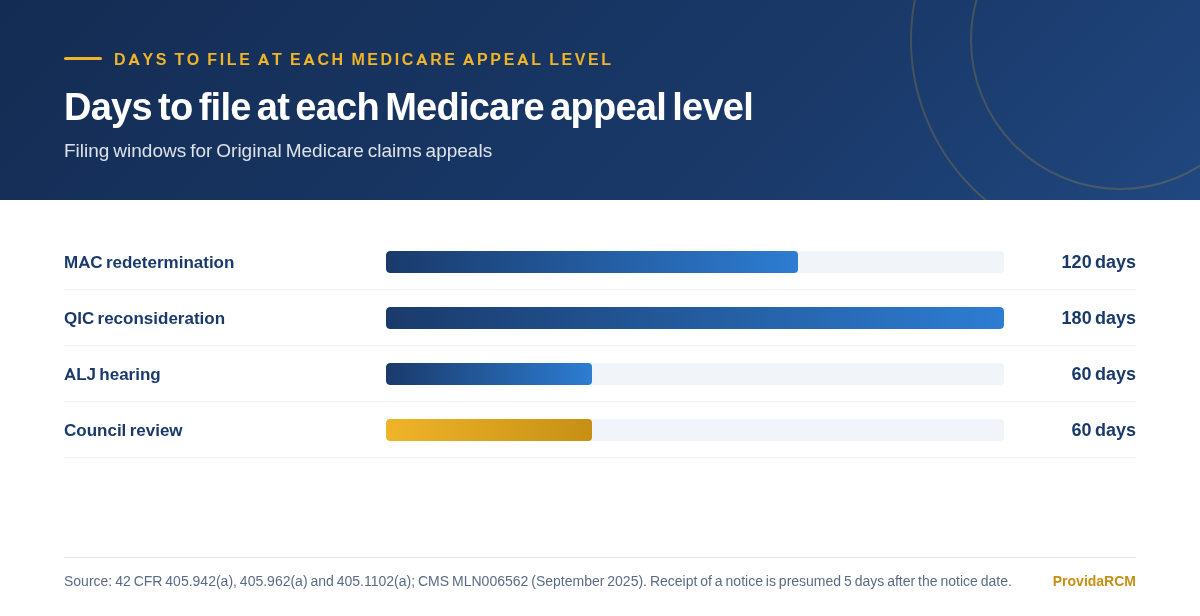
Medicare appeal rights for a denied claim run through five levels, and each level has its own filing window, decision maker and form. Get the level wrong and the request is dismissed, which does not extend the deadline.
| Level | Who decides | How long you have to file | Form | Decision clock |
|---|---|---|---|---|
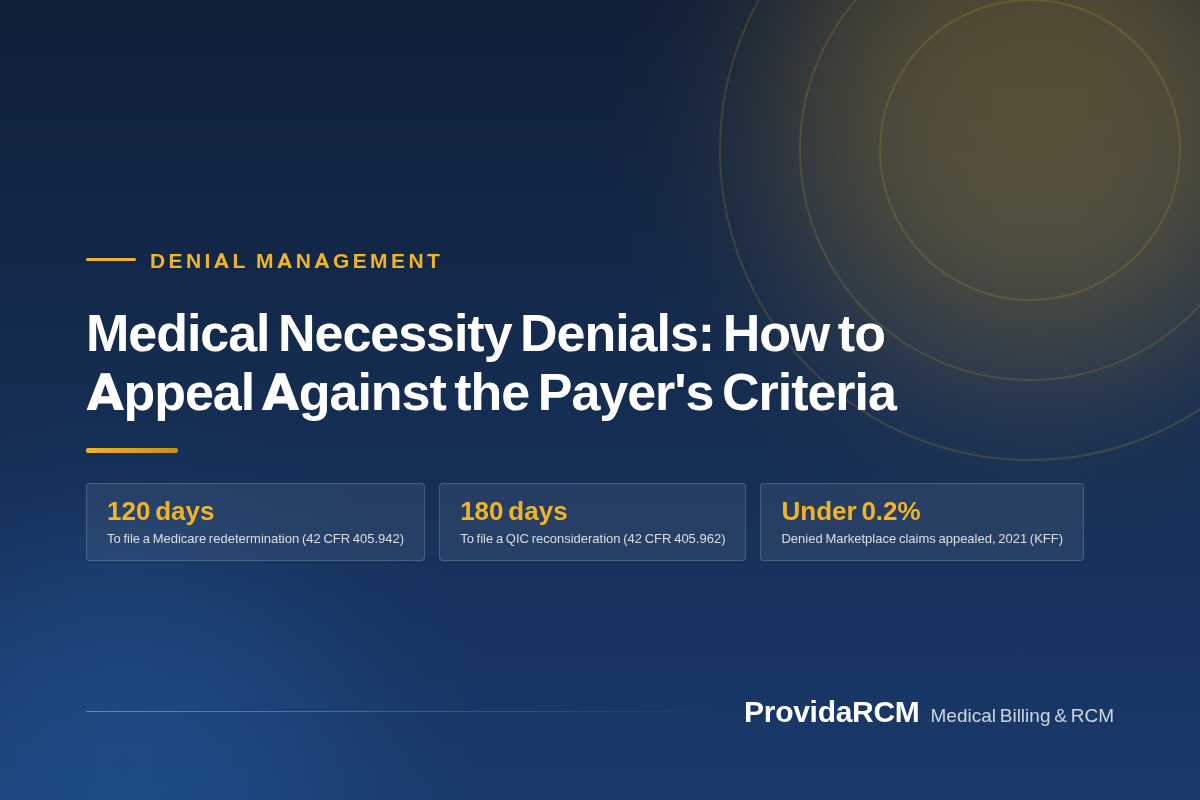
| 1. Redetermination | Medicare Administrative Contractor | 120 days from the initial determination notice | CMS-20027 | 60 days |
| 2. Reconsideration | Qualified Independent Contractor | 180 days from the redetermination notice | CMS-20033 | 60 days |
| 3. Hearing | ALJ or attorney adjudicator | 60 days from the QIC decision | OMHA-100 | 90 days if appealing a decision |
| 4. Council review | HHS Departmental Appeals Board | 60 days from the ALJ decision | DAB-101 | Not fixed in the regulation |
| 5. Judicial review | U.S. District Court | 60 days from the Council decision | Filed with the court | Set by the court |
How long the reviewer has to decide
Sources: 42 CFR 405.950(a) for the contractor clock; CMS MLN006562 (September 2025) for the QIC and OMHA clocks.
Levels three and five also carry an amount-in-controversy threshold that CMS adjusts every year. The first two levels do not. For most denied claims under a few hundred dollars the economically rational fight ends at level two, which is why the letter at that level has to be built properly the first time.
Levels three and five also carry an amount-in-controversy threshold that CMS adjusts every year. The redetermination and reconsideration levels do not. For most denied claims under a few hundred dollars, the economically rational fight ends at level two, which is exactly why the letter at that level has to be built properly the first time.
- File the redetermination with the MAC that processed the claim, on CMS-20027 or any written equivalent
- Attach the clinical note and any missing documentation the payer says it did not have
- File the reconsideration with the QIC named on the redetermination notice, on CMS-20033
- Track the decision clock for each level, and escalate if the clock runs without a decision
- Keep every request, notice and receipt date in one file for the claim
Commercial payers and the licensed criteria they buy
Commercial plans rarely write their own clinical criteria. They license them from a vendor and adopt them in a medical policy. Premera’s policy 10.01.531 is titled InterQual criteria for services reviewed for medical necessity: the plan owns the policy, the vendor owns the criteria text, and the reviewer applies the version in force on the date of service.
That structure decides how the appeal is built. Never argue the criterion is wrong. Ask which version applied, then answer the elements of that version with citations from the record. Criteria are revised on a cycle, so a denial can be won on version control alone.
Why Marketplace plans denied in-network claims, 2021
Source: KFF analysis of CMS transparency data, 2021 plan year. A claim can be denied for more than one reason.
The KFF analysis of CMS transparency data counted 44.7 million in-network denials in the 2021 plan year, of which 1.7% were reported as medical necessity. Members appealed 90,599 of those denials, under two-tenths of one percent, and issuers upheld 59% of the denials that were appealed.
| What the criterion asks | What fails | What wins |
|---|---|---|
| Severity, or failure of conservative care | A diagnosis and a plan for it | Dates, treatments tried, and the measured outcome |
| A prior study or objective finding | A reference to a report not attached | The finding itself, quoted, with the date |
| Functional limitation | A note that the patient has pain | The measured deficit and the activity it blocks |
| Why a higher level of care is needed | The same note the office visit generated | Why the lower level will not work |
| Timing against a policy version | Whatever the payer asks for later | The criterion in force on the date of service, quoted |
Medicare Advantage plans sit between the two worlds. They follow NCDs and LCDs where those exist, and they may publish internal criteria where Medicare has not fully established coverage. Because the plan must make those criteria public, an appeal can ask for the published version and cite it back.
The appeal letter answers the criterion, not the diagnosis
An appeal letter has one job: give the reviewer a reason to reverse. Most letters restate the diagnosis, describe the patient, and ask for reconsideration. That letter gives a reviewer bound to a written criterion nothing to act on, and it usually produces a second denial on the same policy language.
Two review protections are worth using. For a medical necessity denial, the plan must consult a clinician with appropriate training and experience in the field involved, and that reviewer cannot be the person who made the original decision or a subordinate of that person. Those requirements sit in 29 CFR 2560.503-1(h)(3)(iii) through (v).
- 01
Open with the criterion
Name the denial, the claim number, the date of service and the policy the payer cited, by number and version.
- 02
Answer each element in order
Take the criterion’s elements in the payer’s sequence and put one sentence and one record citation against each.
- 03
Quote the record, do not summarize
Give the date, the author, the measurement and the finding, then point to the page.
- 04
Send the missing record with the letter
If the denial notice lists evidence the payer says is missing, attach it to the appeal.
- 05
Ask for the peer-to-peer early
A clinician to clinician call is cheapest before the denial hardens. Log who was on it and what was agreed.
When the denial is a technical defect dressed up as medical necessity
Not every CARC 50 is a coverage decision. Watch for the tells: the remittance also carries a remark code about authorization or documentation, a paid claim is later recouped, or the denied amount equals a unit shortfall rather than the whole charge. Each of those points at an operational defect.
A missing prior authorization for a service the plan does cover is CARC 197, and the remedy is the authorization history plus a retroactive request, not a criterion-by-criterion letter. A progress note that never reached the reviewer is a records problem. The CO-16 remark codes tell you which of the two you are holding, and the CARC and RARC reference tells you what each code obliges the payer to explain.
- Read the remark codes on the remittance before reaching for an appeal template
- Ask the payer for the authorization history on the date of service
- Compare billed units against denied units before calling it a coverage finding
- Check whether the note the payer says is missing was sent, and when
- Confirm the denial report’s code mapping is current before trusting its categories
If a denial report still shows CO-15, the mapping is years out of date. X12 deactivated that code on 1 May 2018. Categories built on a retired code misroute the claims a corrected claim would have fixed.
Work the defects first and the criteria second. A corrected claim or a retroactive authorization clears a technical issue in days. A criterion appeal consumes a filing window and a clinician’s time, and the denial workflow that holds up under volume runs both tracks without confusing them. Where denial volume needs a system rather than a process, our denial management services team works the same split alongside the billing staff who submitted the claim.
Questions practices ask us about this
What does CARC 50 mean?
It is the X12 code a payer returns when it decides a service is not medically necessary. The denial is a coverage opinion, not a clerical error, and it means a reviewer read the record against a published criterion and found an element missing. The appeal must name that criterion and answer each element from the record.
How long do we have to appeal a Medicare medical necessity denial?
File the redetermination with the Medicare Administrative Contractor within 120 days of the initial determination notice, under 42 CFR 405.942. If it is denied, file the reconsideration with the Qualified Independent Contractor within 180 days of the redetermination notice, under 42 CFR 405.962. A level three hearing request is then due within 60 days of the QIC decision.
Can we get the criteria the payer applied?
For a group health plan, 29 CFR 2560.503-1(g)(1)(v) requires the notice to give the guideline relied on, or a statement that a copy will be provided free of charge on request. The same paragraph requires the scientific or clinical judgment behind a medical necessity decision.
What is a peer-to-peer review, and when should we ask for one?
It is a call between the treating clinician and the plan’s reviewing clinician, and it is the cheapest chance to reverse a denial because no filing window or formal record is consumed. Ask as soon as the denial posts. Log who was on the call, the criterion discussed, and what was agreed.
What is the difference between an NCD and an LCD?
A national coverage determination is made by the Secretary and states whether an item or service is covered nationally. Under 42 CFR 405.1060 it binds the contractors, the QIC, the ALJ and the Council. A local coverage determination is issued by a Medicare Administrative Contractor and does not bind an ALJ, though 42 CFR 405.1062 requires substantial deference to it.
What if the denial is a missing authorization rather than medical necessity?
Then you are holding a technical defect. A covered service denied for lack of prior authorization is CARC 197, and the remedy is the authorization history plus a retroactive request. Check the remark codes, compare billed units with denied units, and correct the claim where the defect is real.
Do we have to appeal at every level?
No. Levels three and five carry an amount-in-controversy threshold that CMS adjusts annually, while the first two levels have none. On a claim worth a few hundred dollars the rational path ends at reconsideration. Put the appeals budget on claims where recovery is larger than the cost of the appeal.
Denials piling up faster than you can appeal them?
We run appeals and denial work for practices nationwide, with the coding and billing staff who filed the claim.
Book a free billing review- CMS, Medicare Parts A & B Appeals Process (MLN006562, September 2025). cms.gov/files/document/mln006562-medicare-parts-b-appeals-process.pdf
- 42 CFR 405.942, filing a redetermination (Cornell LII, e-CFR text). law.cornell.edu/cfr/text/42/405.942
- 42 CFR 405.1060 and 405.1062, NCDs and LCDs in appeals (Cornell LII, e-CFR text). law.cornell.edu/cfr/text/42/405.1062
- 42 CFR 422.101, Medicare Advantage coverage criteria (Cornell LII, e-CFR text). law.cornell.edu/cfr/text/42/422.101
- 29 CFR 2560.503-1, ERISA claims procedure (2024 CFR). govinfo.gov/content/pkg/CFR-2024-title29-vol9/pdf/CFR-2024-title29-vol9-sec2560-503-1.pdf
- Social Security Act 1862(a)(1)(A), reasonable and necessary. ssa.gov/OP_Home/ssact/title18/1862.htm
- X12, Claim Adjustment Reason Codes. x12.org/codes/claim-adjustment-reason-codes
- KFF, Claims Denials and Appeals in ACA Marketplace Plans. kff.org/private-insurance/claims-denials-and-appeals-in-aca-marketplace-plans
- Premera policy 10.01.531, InterQual medical necessity criteria. premera.com/medicalpolicies/10.01.531.pdf