A single case agreement is a contract between an out-of-network practice and a payer that sets a rate, a term and a scope for one patient. It is not network participation, and it is not a No Surprises Act right. Asked for early and documented well, it is how one out-of-network case gets paid.
What a single case agreement is, and what it is not
A single case agreement is a one-patient contract. The payer agrees to treat your out-of-network practice as though it were participating, for one named member, for a defined set of services and dates, at a rate the two sides set in writing. Nothing in the document adds you to the network. Nothing in it obliges the payer to send another member, and the next patient from that plan is an out-of-network patient again.
Payers name the instrument differently. The UnitedHealthcare Community Plan Colorado behavioral health manual says the plan may enter letters of agreement with behavioral health providers to foster continuity of care, and notes that these letters of agreement are also known as single case agreements. A payer’s own definition is the one that matters, because the request path and the review department live in that payer’s documents.
| Term | Single case agreement | Network participation | What it means at claim time |
|---|---|---|---|
| Who is covered | One named member for one episode | Every member on the plan | A new patient needs a new agreement |
| Who sets the rate | You and the payer, case by case | The contract, for a multi-year term | The agreement rate is your allowed amount |
| How long it lasts | The written term or the authorized visits | Until the contract ends | Care past the term bills as out-of-network |
| The next patient | Out of network again | In network | No referral stream comes with it |
| Who holds the paper | A countersigned document you can find later | A participation agreement on file | A verbal yes is not payable |
The No Surprises Act and a single case agreement are separate mechanisms. The Act limits what an out-of-network provider may bill a continuing care patient and sets the cost sharing that applies. It creates no right to a negotiated rate with your practice. The agreement is a contract you obtain, and CMS publishes the provider duties.
The four situations a single case agreement is built for
Most requests fall into four situations. Each gives the payer a different reason to say yes, and each needs different evidence. Naming the situation in the first sentence of the request shortens the review.
| Situation | What the payer is asked to accept | Evidence the payer looks for | Who usually opens it |
|---|---|---|---|
| Continuity of care mid-treatment | That breaking an active course of treatment would harm the patient | Treatment history, current plan and the clinical consequence of a break | The practice or the patient |
| A service no in-network provider furnishes | That the network has no qualified provider for this service | Directory searches with dates, calls, distances and wait times | The practice |
| A patient who chose the practice before the plan changed | That the relationship predates the new plan | Enrolment dates, prior authorizations and claims under the old plan | The patient, with the practice’s records |
| A referral the network cannot serve | That the in-network referral cannot deliver the care | The referring provider’s note and the specific clinical requirement | The referring in-network provider |
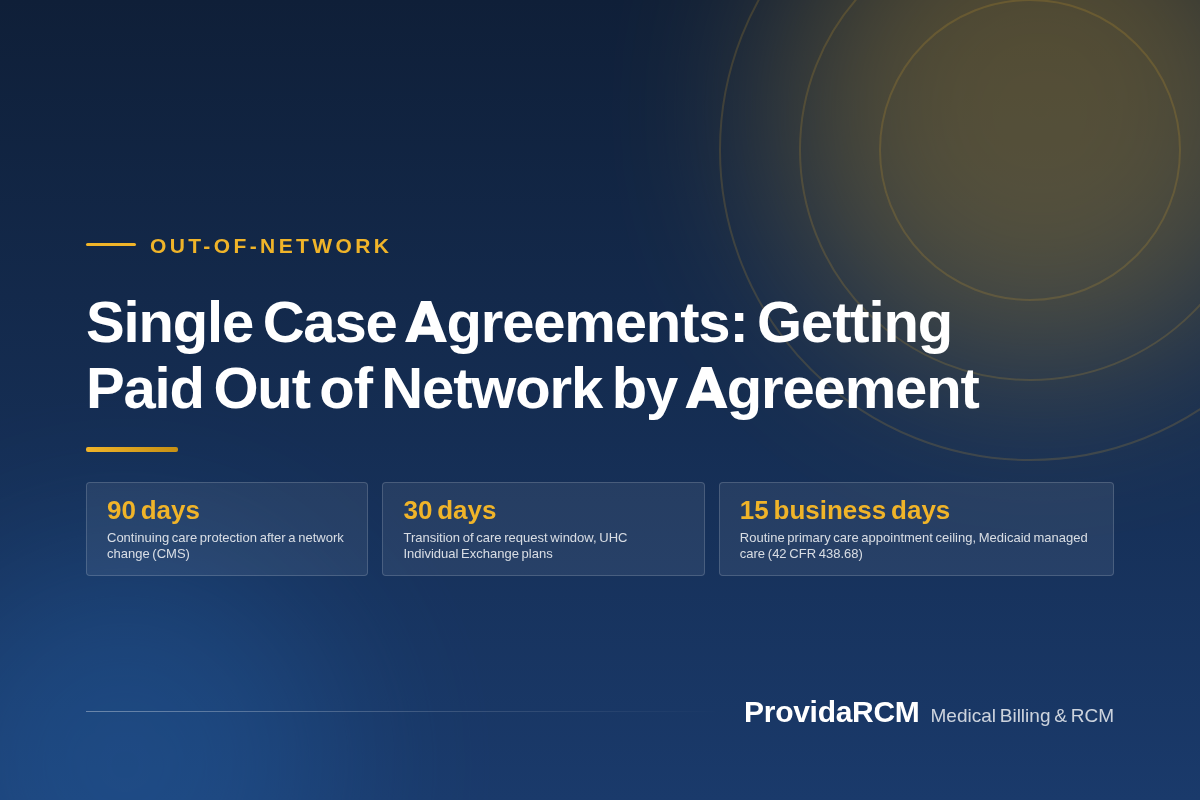
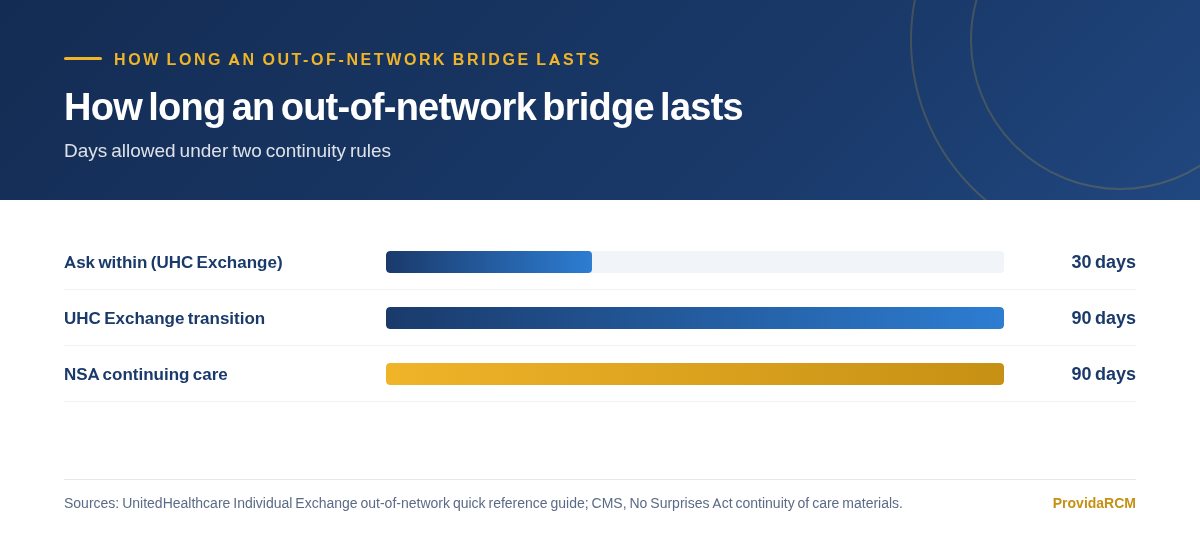
Continuity is the situation with a written rule behind it. CMS states that a provider ending a contract with a plan must accept payment from the plan and the patient’s cost sharing as payment in full for a continuing care patient, at the previously agreed amount, for up to 90 days after the patient is notified of the network change. The 2024 Medicare Advantage final rule adds a separate duty for coordinated care plans: a minimum 90-day transition period when a new enrollee is mid-treatment, during which the plan may not require prior authorization for that course of treatment.
What makes a request succeed
The request is a documentation exercise with clinical content, not a negotiation letter. Four things decide the outcome: why this provider, why now, what the patient’s situation is, and what the network actually offers. A payer does not accept a preference as a reason, so a request that says the patient wants to stay with you has no footing. A request that names the service, the clinical requirement and the providers you already tried has one.
Follow the payer’s own sequence. The UnitedHealthcare commercial network gap exception form is explicit about order: submit the prior authorization request first, keep the service reference number it generates, then complete the gap exception form and attach the clinical documentation to that same case. The form asks for the in-network referring provider, the specific clinical reason for the exception, the CPT codes with visits or units, and whether a gap exception was granted before.
That last point matters, because a payer’s written access standard is the yardstick your network search has to beat. Medicaid managed care is where that standard is written down in regulation. Under 42 CFR 438.68(e), routine appointments must be available within no more than 10 business days for outpatient mental health and substance use disorder, and 15 business days for primary care and OB/GYN.
Routine appointment wait time ceilings, Medicaid managed care
Source: 42 CFR 438.68(e), eCFR.
These ceilings bind Medicaid managed care, not a commercial payer. They are useful because they turn a vague claim about access into a measurable one. If the patient cannot be seen inside that standard, or the directory sends you to providers who are not accepting patients, the gap is a set of numbers rather than an argument.
- Name the situation in the first sentence: continuity, a missing service, a plan change, or a referral the network cannot serve
- Log every directory search with the date, the practice, who answered, the wait time and the driving distance
- Attach the clinical record connecting the diagnosis to the request, not a summary written for the payer
- State the codes, units and dates the request covers, and the rate you are asking for
- Get a reference number when the request opens, and log every later call against it
The rate and the basis you are agreeing to
The rate is the term that decides whether the case is worth taking, and the basis matters as much as the number. Payers and practices use several bases: a percentage of the Medicare Physician Fee Schedule, a per diem, a flat case rate, a per-code allowed amount, or a percentage of billed charges. None of those is the standard. What your agreement pays is whatever your agreement says, so the basis has to be written out against the code set it applies to.
A rate expressed as a percentage of a fee schedule needs three details or it is ambiguous: which schedule and which year, which geographic locality, and whether the rate updates when the schedule changes. A percentage of billed charges depends on your charge master holding still, which you rarely control. A per diem needs a definition of what it includes.
A payer may also publish a floor of its own. Gold Kidney Health Plan, a Medicare Advantage plan, states in its single case agreement materials that an agreement is not required if the out-of-network provider agrees to accept reimbursement at 100 percent of Medicare rates, and that only a prior authorization is needed in that situation. That is one plan’s published rule for its own product. It is not a rate to expect from another payer.
| Term | What to pin down | What it costs when you leave it vague |
|---|---|---|
| Rate and basis | The exact allowed amount per code, and the schedule or formula behind it | The payer reprocesses to its own out-of-network rate |
| Scope | Whether the agreement covers the whole episode or one date of service | Follow-up visits bill with no agreement behind them |
| Follow-up and related services | Whether follow-ups, labs, imaging and anesthesia sit inside the term | The main service pays and the support work does not |
| Who authorizes | The department, the case number and the name on the approval | A second reviewer declines care the first one approved |
| Claim route and identifiers | Payer ID, claim address and the reference number the system matches | The claim routes as out-of-network or comes back CO-109 |
| Member cost sharing | Whether the member pays the in-network copay and coinsurance | The patient is billed the out-of-network share and disputes it later |
Confirm it in writing, load it, and reconcile the payment
Confirm the agreement in writing before the service. A call that ends with a person saying the case is approved is not a rate, and it is not a document you can put in front of a claims system. Ask for the countersigned agreement or the authorization letter, and check that it carries the member’s name, your NPI, the codes, the units, the dates and the reference number the payer will match.
Then load it into the practice’s system before the first claim goes out. An agreement never entered as a payer-specific contract is one the billing software cannot see, so the claim leaves at your standard out-of-network charge. The payer ID and claim address on the agreement are often different from the ones you use for that payer’s network business.
X12 defines CARC 109 as claim or service not covered by this payer or contractor, with the instruction to send the claim to the correct entity. On an agreement claim it usually means the claim reached the wrong payer, plan or carve-out administrator, so the fix is a refile rather than an appeal. Check your code mapping too: X12 deactivated CO-15 on 1 May 2018.
Federal IDR administrative fee per party
Source: CMS, No Surprises Act notices, Federal IDR administrative fee update.
That chart is about the fallback, not about the agreement. When a payer and a practice cannot settle on an amount, the federal independent dispute resolution process is one route for certain out-of-network claims, and CMS lists the administrative fee per party for each period. An agreement reached before the service is the other route, and it is the only one that sets a rate in advance. Keep the two apart, because the Act’s dispute process is statutory while the agreement is a contract you negotiate.
Reconciliation is the step practices skip. Post the payment, then compare the allowed amount on the 835 against the rate in the agreement, line by line. A payer that pays a different figure has usually processed the claim outside the agreement rather than repriced it. Send the countersigned document with the claim number and ask for reprocessing. Keep every agreement in one register with the patient, the payer, the codes, the units and the end date.
When a single case agreement stops being the answer
One agreement is a tool. Six a year from the same payer is a signal. If you are asking one plan repeatedly, the volume says the network has a gap that touches your specialty, your region, or both. That is the case for a participation contract.
Credentialing is the other route, and the documentation you built for the requests is most of the application. The network search logs and wait times that made the case for one patient also make the case for adding your practice to the panel. We run that work through medical credentialing and payer enrolment, alongside out-of-network billing.
Two related pieces are worth reading next. Out-of-network claim documentation covers the dispute file you build when no agreement was signed. Out-of-network billing after the 2026 IDR overhaul covers the federal process, and qualifying payment amount explains the rate floor it starts from.
Questions practices ask us about this
Is a single case agreement the same as joining the network?
No. Network participation is a multi-year contract that applies to every member on the plan and puts the practice in the payer’s directory. A single case agreement covers one named member for a defined set of services and dates. It does not credential the practice, does not add it to the directory, and does not make the next patient from that plan an in-network patient.
Does the No Surprises Act give a practice the right to a single case agreement?
No. The No Surprises Act creates statutory protections: limits on balance billing, in-network cost sharing for continuing care patients, and a federal dispute process that carries an administrative fee per party. A single case agreement is a contract a practice negotiates with the payer, and the payer decides whether to grant one. The two mechanisms are separate, and a payment dispute under the Act does not produce an agreement.
What rate should a practice ask for in a single case agreement?
There is no standard rate, so the ask has to be built from your own case. Ask for a specific allowed amount per code and name the basis: a percentage of the Medicare Physician Fee Schedule, a per diem, or a flat case rate. Write the code set it applies to, the units and the dates. A rate expressed as a percentage of billed charges depends on your charge master holding still, which is a term you rarely control.
Does a single case agreement cover follow-up visits and related services?
Only if the document says so. An agreement that authorizes one procedure on one date leaves the follow-up visit, the imaging, the labs and the anesthesia outside it, and those claims arrive with no agreement behind them. Ask for the whole episode where the care genuinely runs past one date, and get the related codes written into the scope rather than assuming the payer will group them in.
How do I make sure the claim pays under the agreement?
Load the agreement into the practice’s system before the first claim goes out, with the payer ID and claim address the payer gave you, and put the reference number on the claim. Then compare the allowed amount on the 835 against the rate in the agreement, line by line. A payer that pays outside the agreement has usually processed the claim as out-of-network rather than repriced it.
What does CARC 109 mean on a single case agreement claim?
X12 defines CARC 109 as claim or service not covered by this payer or contractor, and it directs you to send the claim to the correct entity. On an agreement claim it usually means the claim routed to the wrong payer, plan or carve-out administrator, not that the service was denied. Refile to the responsible entity, because an appeal to the payer that returned it does not change the routing.
Can one single case agreement be used for more than one patient or service?
No. The agreement is written for one named member and for the services it lists. Gold Kidney Health Plan states in its own single case agreement materials that a new agreement must be executed for additional members or services beyond the original scope. Treat each new patient and each new service as a fresh request, even when the clinical situation looks identical to the last one.
Want this fixed in your practice?
We run full-cycle billing, coding, credentialing and denial work for practices across the country. Send us a few months of claims and we will show you where the money is going.
Book a free billing review- CMS, Key Responsibilities for Health Care Providers and Facilities Under the No Surprises Act. cms.gov/files/document/nsa-key-responsibilities-providers.pdf
- CMS, The No Surprises Act Continuity of Care, Provider Directory, and Public Disclosure Requirements. cms.gov/files/document/a274577-1b-training-2nsa-disclosure-continuity-care-directoriesfinal-508.pdf
- CMS, No Surprises Act notices, Federal IDR administrative fee update. cms.gov/initiatives/no-surprise-billing/overview/notices
- UnitedHealthcare, Commercial Network Gap Exception Request Form. uhcprovider.com/content/dam/provider/docs/public/prior-auth/UHC-Commercial-GAP-Application-form.pdf
- UnitedHealthcare, Individual Exchange plans quick reference guide for out-of-network providers. uhcprovider.com/content/dam/provider/docs/public/health-plans/exchanges/UHC-Exchange-Plans-QRG-Out-Network.pdf
- UnitedHealthcare Community Plan, 2026 Colorado Behavioral Health Care Provider Manual. uhcprovider.com/content/dam/provider/docs/public/admin-guides/comm-plan/CO-RHMP-BH-Manual.pdf
- Gold Kidney Health Plan, Single Case Agreement FAQ and Request Form. goldkidney.com/wp-content/uploads/2026/02/SCA-FAQ-and-Form.pdf
- eCFR, 42 CFR 438.68, Network adequacy standards. ecfr.gov/current/title-42/chapter-IV/subchapter-C/part-438/subpart-B/section-438.68
- X12, Claim Adjustment Reason Codes. x12.org/codes/claim-adjustment-reason-codes