Most denied claims come back to five fixable things: missing or wrong information on the claim, a prior authorization that was never obtained, a service the payer does not consider medically necessary, a procedure billed that the payer bundled into another, and a filing deadline that has already passed. Each one has a different owner and a different fix.
Denial rates fell in 2026. Most practices did not feel it.
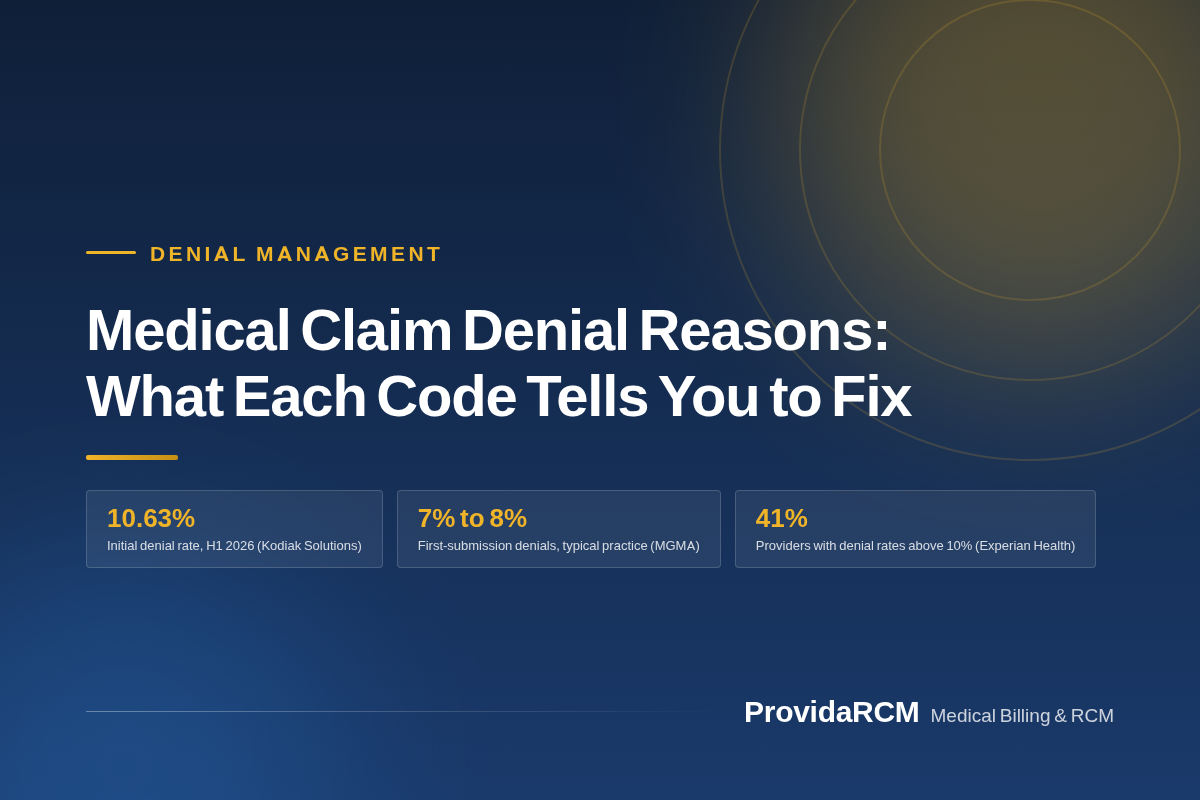
The headline number improved. Kodiak Solutions, which tracks more than 2,100 hospitals and 300,000 physicians, put the average initial denial rate at 10.63% in the first half of 2026, down from 12.00% a year earlier. Denials on traditional Medicare fell to 4.21%. On its own, that reads like payers got easier to deal with.
The second number is the one that matters. Payer takebacks, money recouped after a claim was already paid, climbed to 1.57% from 1.38% (Fierce Healthcare reported the shift). Payers are paying first and recovering later. A falling denial rate sitting next to rising takebacks is not a cleaner revenue cycle. It is a surprise that arrives a quarter after the money was counted.
For a physician practice the benchmark is narrower. MGMA’s benchmarking has put first-submission denials at 7% to 8% for four straight years, and its 2025 Financials and Operations report suggests targeted process fixes can push below 5%. On a practice collecting $4 million a year, three points of avoided denials is real money.
Initial denial rate, all payers
Source: Experian Health State of Claims for 2020 to 2024; Kodiak Solutions for H1 2026.
| Benchmark | What it tells you | 2026 reading | Source |
|---|---|---|---|
| Initial denial rate | Share of claims denied on first submission, all payers | 10.63% | Kodiak Solutions |
| Practice first-pass denial rate | The range most physician groups actually run at | 7% to 8% | MGMA |
| Process-fix target | Where process fixes can take a practice | Under 5% | MGMA 2025 Financials and Operations |
| Payer takebacks | Money recouped after a payment, as Kodiak reports it | 1.57% | Kodiak Solutions |
| Cost to contest one denial | Administrative cost of one appeal, not the claim value | $57.23 | Premier Inc. |
Denial economics do not scale with practice size. A solo practice paying $57.23 to contest a $180 claim is deciding whether to eat a loss on every single one of them. That decision is where a lot of recoverable revenue quietly disappears.
The five CARC families behind most denials
Every denial arrives with a claim adjustment reason code on the 835 remittance advice. The code is the payer telling you who owns the fix. Two claims denied for completely different reasons will look identical on a spreadsheet and completely different once you read the code.
Five families account for the bulk of denied volume. The wordings below are taken from the current X12 code list, not from a payer crosswalk, because crosswalks go stale.
| Code | What the payer is saying | What it usually means in practice | Who owns the fix |
|---|---|---|---|
| CO-16 | Claim or service lacks information, or has a submission or billing error | A required field is missing, wrong, or inconsistent. At least one remark code accompanies it | Front end and billing |
| CO-197 | Precertification, authorization, notification or pre-treatment absent | The authorization was never obtained, expired, or does not match the billed service | Front end and clinical |
| CO-50 | Non-covered because the payer does not consider it medically necessary | Documentation did not establish necessity against the payer’s own policy | Coding and clinical documentation |
| CO-97 | Benefit is included in the payment for another service already adjudicated | The payer bundled a procedure into another. Often an NCCI edit, sometimes a missing modifier | Coding |
| CO-29 | The time limit for filing has expired | The claim went out after the payer’s filing window closed | Billing operations |
| CO-11 | The diagnosis is inconsistent with the procedure | The diagnosis on the claim does not support the CPT billed | Coding |
| CO-22 | This care may be covered by another payer per coordination of benefits | Insurance was not verified, or COB order is wrong in the clearinghouse | Front end |
| CO-45 | Charge exceeds fee schedule, maximum allowable, or contracted rate | A contractual write-off, not a denial to appeal | Nobody. Do not chase it |
CO-15, the old code for an authorization number that is missing or invalid, was deactivated on 1 May 2018. It still shows up in denial analyses and vendor blog posts as a leading 2026 reason. If your denial dashboard reports CO-15 volume, your code mapping is roughly eight years behind the remittance you are receiving. The live code for that situation is CO-197, which X12 modified on the same date. CO-252 is a different case: it reports that an attachment or other documentation is required to adjudicate the claim.
The practical move is to stop organizing denial work by code and start organizing it by owner. CO-16 and CO-22 are front-desk problems. CO-11 and CO-97 are coder problems. CO-50 is a documentation problem, which makes it partly a clinician workflow problem. CO-29 is an operations failure with no remedy. Sort your denial report into those buckets and the monthly meeting stops being a review of a list.
Front-end failures are the cheapest denials to eliminate
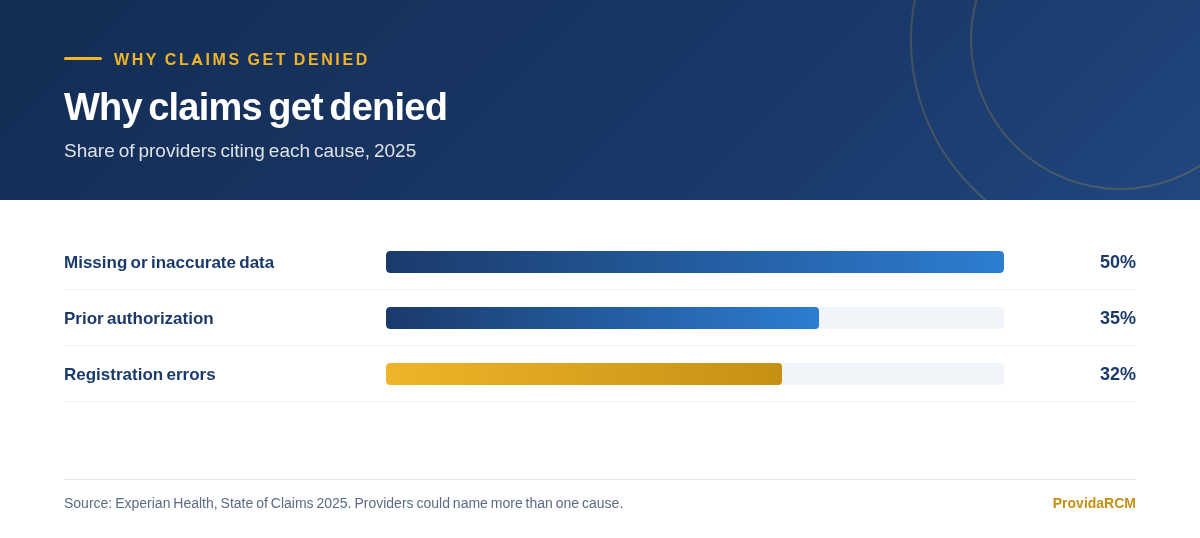
When Experian Health asked providers what was driving their denials in 2025, half named missing or inaccurate data, 35% named prior authorization, and 32% named registration errors. Those are the denials that never needed to exist, and they are the ones a practice can still control.
Eligibility verification is the highest-yield control available. A real-time check run 48 to 72 hours before the visit catches terminated coverage (CO-27), coordination-of-benefits problems (CO-22), and wrong-payer submissions (CO-109) before a claim exists. MGMA’s July 2026 poll found the groups that lowered days in A/R most often cited exactly this kind of deliberate front-end work.
- Verify eligibility and benefits 48 to 72 hours before the visit, not at check-in
- Confirm the prior authorization number against the CPT codes and dates on the schedule
- Check coordination of benefits and Medicare Secondary Payer order before the claim goes out
- Capture the patient’s current demographic and insurance card images at every visit
- Run a payer-specific claim scrub before submission, not after the first denial
A practice that verifies eligibility on 100% of appointments and scrubs claims against payer rules typically stops seeing CO-16 volume as a recurring line item. It becomes an exception report. That is the whole goal: rotate the noise out of the daily work.
Coding, bundling and medical necessity denials
CO-11 is the diagnosis-to-procedure mismatch. It shows up when a coder picks a diagnosis that describes the symptom rather than the condition the procedure was performed for, or when the documentation does not link the two. Payers read a claim, not a chart. If the link is not on the claim, the claim is the problem.
CO-97 is bundling. The payer decided one procedure is included in another and paid it once. Some of those edits can be unbundled with an approved modifier when the documentation genuinely supports separate and distinct services. Others cannot be undone by any modifier, and resubmitting them unchanged is a waste of a filing window and an appeal slot.
CO-50 is the expensive one, because it is a coverage opinion rather than a clerical error. The claim meets the billing rules and fails the payer’s clinical policy. The fix runs through documentation: what the provider recorded, whether it establishes severity and failed conservative treatment, and whether a specific payer policy was addressed. A medical necessity appeal that does not quote the payer’s own criteria rarely wins.
- 01
Pull the payer’s medical policy first
Find the policy that covers the service, and read the criteria the payer applies. The appeal has to answer those criteria in order.
- 02
Match the record to each criterion
Give the reviewer the note, the prior studies, and the failed treatments that satisfy the criteria you are citing. Quote the line, do not summarize the whole encounter.
- 03
Send the correct level the first time
Most Medicare medical necessity disputes start as a redetermination, not an appeal at a higher level. Sending the wrong form usually just consumes time.
The appeal math most practices never sit down and run
Contesting a denial has a price and the price is rising faster than the claim values are. Premier Inc. put the average administrative cost to contest one denial at $43.84 in 2022 and $57.23 in 2023, an increase of about 31% in a single year. Change Healthcare data cited by MGMA puts the rework cost of a denied claim at $25.20, which is the cheaper end of the range because it measures resubmission rather than a formal appeal.
Average administrative cost to work one denied claim
Sources: Premier Inc. for 2022 and 2023 contest costs; Change Healthcare for rework cost, cited by MGMA.
That arithmetic changes how you triage. A $60 claim with a weak appeal position costs more to fight than it will ever return. A $2,400 claim denied for a missing authorization is worth a phone call, a retro authorization request, and an appeal. The practices that recover the most are not the ones that appeal everything. They are the ones that split the denial report into two piles and stop spending money on the wrong one.
HFMA’s Claim Integrity Task Force standardized the metrics for this reason. Its set goes past the raw denial rate to include denial write-offs as a share of net patient service revenue, the time from denial to appeal, and the percentage of initial denials overturned. Those numbers together tell you whether denial work is producing money or just activity.
| Metric | What it reveals | Warning sign |
|---|---|---|
| Initial denial rate | Front-end and coding accuracy at submission | Rising for two straight months |
| Denial write-offs as a share of net patient service revenue | How much money denials are actually costing you | Creeping up while the denial rate falls |
| Time from denial to appeal | Whether appeal deadlines are being managed | Answers measured in weeks, not days |
| Percentage of initial denials overturned | Whether appeals are built on the payer’s criteria | Below the payer’s own published overturn pattern |
| Payer takebacks as a share of net revenue | Post-payment recovery and audit exposure | Any sustained increase |
A 30-day denial workflow that holds up under volume
Denial work fails in one of two ways. Either nothing happens for three weeks and then everything happens in a panic, or claims get resubmitted unchanged and come back denied the same way. A workflow built around the calendar and the code prevents both.
- 01
Days 1 to 2: post the remittance and sort
Post every electronic remittance advice within 24 hours. Sort denials by CARC code and dollar value, not by date. Dollar value decides what gets touched first.
- 02
Days 2 to 5: clear the mechanical denials
CO-16, CO-22 and registration-driven CO-109 claims are corrected and resubmitted in the same week. There is no reason to sit on a fixable clerical denial.
- 03
Days 3 to 10: start the appeal clock
Pull the payer’s filing deadline on the day the denial is posted and put it on a calendar with a 14-day internal buffer. CO-29 exists because practices discover deadlines after they pass.
- 04
Days 10 to 30: build and send appeals
Medical necessity appeals quote the payer’s criteria. Authorization appeals include the retro-auth request and the clinical note. Bundling appeals include the modifier rationale.
- 05
End of month: review root cause
Report denial volume by code, by payer and by provider. The provider-level view is uncomfortable and it is the one that changes behavior.
If your team tracks a single denial metric, track the time from denial to first action by your staff. Denials that get touched within two business days are recoverable. The same denials touched in week three are mostly write-offs, because the filing window and the appeal window have both narrowed.
What to ask any billing partner about denials
Any billing company can send you a monthly report with a denial rate on it. Very few will show you the underlying work. Five questions separate the two kinds.
- Ask for denial volume by CARC code and by payer for the last six months. A partner working denials by root cause can produce this in an afternoon.
- Ask how the denial report sorts by owner: front end, coding, clinical documentation, or operations. If everything is one number, nothing is being fixed.
- Ask what percentage of denials get appealed and what percentage of those appeals are overturned. The second number is the one that shows whether the appeals are built properly.
- Ask how appeal deadlines are tracked and who owns the calendar. Timely filing losses are an operations failure, and they should not appear on your report at all.
- Ask what changes get pushed back into the front end. A denial that is corrected and resubmitted is revenue. A denial that is corrected and prevented is margin.
We do this work through our denial management service, which sits on top of full-cycle medical billing, medical coding and AR management. The teams working the denials are the same people who scrub the claims, so corrections go back to the front end instead of into a folder. If you would rather size the problem first, an eligibility verification review of the last 90 days usually shows the pattern within a week.
Questions practices ask us about this
What is the most common reason medical claims get denied?
Missing or inaccurate information on the claim, which payers report as CARC 16. Experian Health’s 2025 survey found half of providers named missing or inaccurate data as a cause of denials, ahead of prior authorization at 35% and registration errors at 32%. The fix is a payer-specific claim scrub and eligibility check before submission rather than after the first denial arrives.
Is a claim denial the same thing as a claim rejection?
No, and mixing them up misdirects the work. A rejection means the claim never reached adjudication, usually because a clearinghouse or payer edit caught a format or data problem. A denial means the payer adjudicated the claim and made a negative payment determination, which is what produces a claim adjustment reason code on the 835 remittance advice.
How long do we have to appeal a denied claim?
It depends on the payer and the plan, so the deadline has to be looked up per payer rather than assumed. Commercial appeal windows commonly run 90 to 180 days from the remittance date, while Medicare redeterminations generally must be filed within 120 days of the initial determination. Missing the window converts a recoverable claim into a write-off with no appeal route.
Should we appeal every denied claim?
No. Premier Inc. puts the administrative cost of contesting a denial at $57.23 per claim, so appealing a small-dollar claim with a weak position can cost more than the claim pays. Triage by dollar value and by whether the denial is overturnable at all, then appeal the claims where the expected recovery exceeds the cost of the work.
What does CARC 197 mean and how do we clear it?
CARC 197 is the payer saying the precertification, authorization, notification, or pre-treatment requirement was absent. It replaced the retired CO-15 code, which X12 deactivated on 1 May 2018. Clear it by checking whether a retroactive authorization is allowed for that service and payer, then appeal with the clinical documentation that establishes urgency or medical need.
How much does a single denied claim cost the practice?
Between roughly $25 and $57, depending on whether the claim is reworked and resubmitted or formally appealed. Change Healthcare data cited by MGMA puts rework at $25.20 per claim, while Premier Inc. reported the average cost to contest a denial rose from $43.84 in 2022 to $57.23 in 2023. Neither figure includes the claim value you may never collect.
Want this fixed in your practice?
We run full-cycle billing, coding, credentialing and denial work for practices across the country. Send us a few months of claims and we will show you where the money is going.
Book a free billing review- X12, Claim Adjustment Reason Codes (current list, reviewed August 2026). x12.org/codes/claim-adjustment-reason-codes
- MGMA Stat, Days in A/R holds steady but payer pressure persists, July 2026. mgma.com/mgma-stat/days-in-a/r-holds-steady-for-most-practices-but-payer-pressure-persists-in-2026
- HFMA Claim Integrity Task Force, Standardizing denial metrics for the revenue cycle. hfma.org/guidance/standardizing-denial-metrics-revenue-cycle-benchmarking-process-improvement
- Experian Health, State of Claims report (denial rate trend 2020 to 2024). experian.com/healthcare/resources-insights/thought-leadership/white-papers-insights/state-claims-report
- Premier Inc., cost to contest a denied claim, 2022 and 2023. premierinc.com/newsroom
- CMS Medicare Claims Processing Manual, Chapter 29, appeal timeframes. cms.gov/regulations-and-guidance/guidance/manuals/internet-only-manuals-ioms