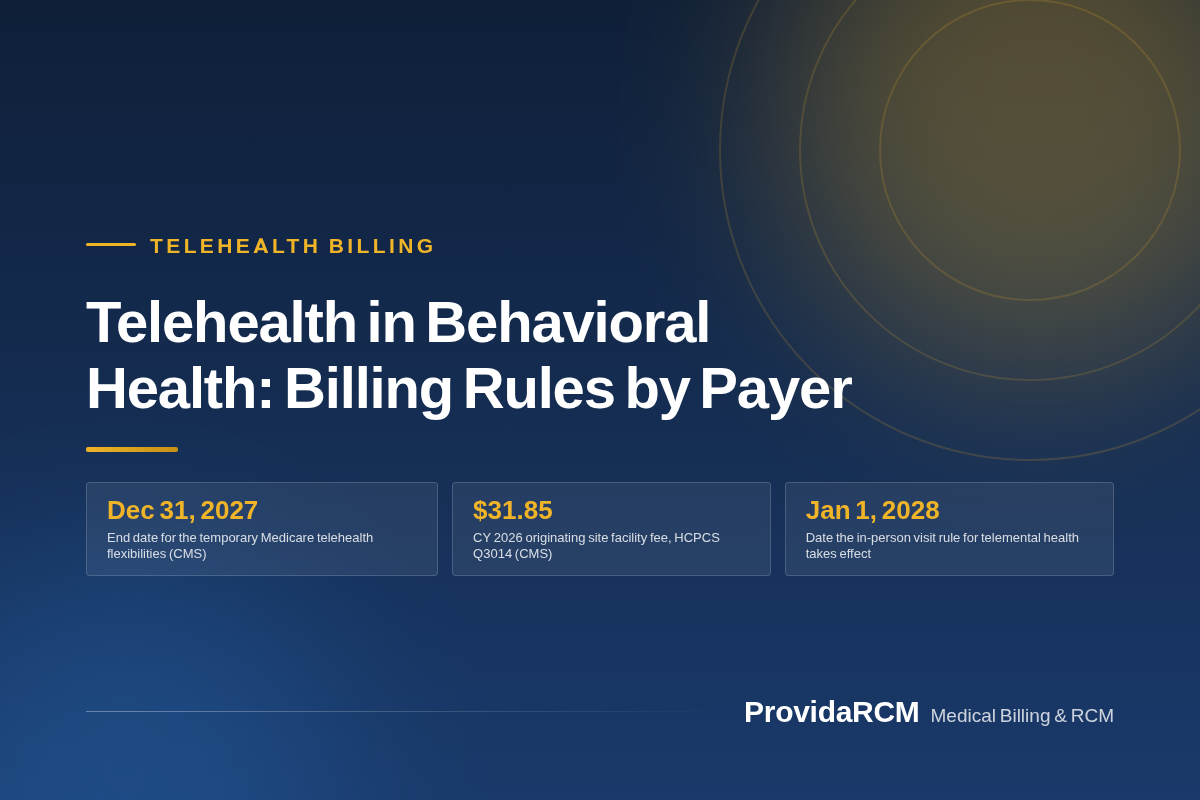
Behavioral health telehealth billing rests on rules that are now permanent in Medicare: no geographic limit, the patient’s home counts as an originating site, and audio-only is allowed. Everything else runs through December 31, 2027. What a claim pays still depends on the place of service code, the modifier and the payer in front of you.
Behavioral health telehealth billing: what is permanent and what still expires
Start with the part that is settled. For behavioral and mental health services, Medicare’s geographic restriction and originating site limit do not apply, and the patient’s home counts as an originating site. Audio-only is allowed. CMS states all three as permanent policy on its Medicare payment policies page, and the audio-only rule sits in 42 CFR 410.78(a)(3).
The rest of the telehealth package is temporary. Congress extended it through December 31, 2027 in the Consolidated Appropriations Act, 2026, signed on February 3, 2026. Before that, the flexibilities lapsed on October 1, 2025 during the funding impasse, were restored retroactively by a short-term act, and then carried forward. CMS’s Telehealth FAQ, updated February 26, 2026, carries the dates provision by provision.
The CY 2026 Physician Fee Schedule final rule, CMS-1832-F, was published in the Federal Register on November 5, 2025 and took effect January 1, 2026. It did not extend the temporary flexibilities, because that takes an act of Congress. It rewrote how services are added to the telehealth list, kept the originating site fee at $31.85, and expanded payment for digital mental health treatment devices.
The in-person visit rule for telemental health was delayed, not repealed. CMS states that an in-person, non-telehealth visit within six months of the first mental health telehealth service applies to services furnished after December 31, 2027. A practice that has run a tele-only panel since 2020 has one budget year to build an in-person path, or a documented exception, for every patient.
| Provision | Status | Source | What it changes on the claim |
|---|---|---|---|
| No geographic limit, behavioral health | Permanent | Section 1834(m) of the Social Security Act | The patient’s address is not a coverage test |
| Patient’s home as an originating site | Permanent | 42 CFR 410.78 | POS 10 is valid for a behavioral health visit |
| Audio-only behavioral health | Permanent | 42 CFR 410.78(a)(3) | Modifier 93 pays when the conditions hold |
| In-person visit, telemental health | Delayed to after December 31, 2027 | CMS Telehealth FAQ, February 26, 2026 | Start building the in-person path now |
| Home and any location, non-behavioral | Ends December 31, 2027 | Consolidated Appropriations Act, 2026 | A medical visit from a home reverts to the old site rules |
| FQHC and RHC distant site, non-behavioral | Ends December 31, 2027 | CMS Telehealth FAQ | Behavioral health distant site work from these sites stays permanent |
Why the patient’s location stopped being a coverage question
Before the permanent change, a therapy session delivered to a patient at home sat outside the originating site definition unless the visit concerned substance use treatment, where a narrower authority applied from July 1, 2019. The geographic test for mental health services fell away for services furnished on or after January 1, 2025. That is what makes POS 10 a routine code on a behavioral health claim instead of an exception.
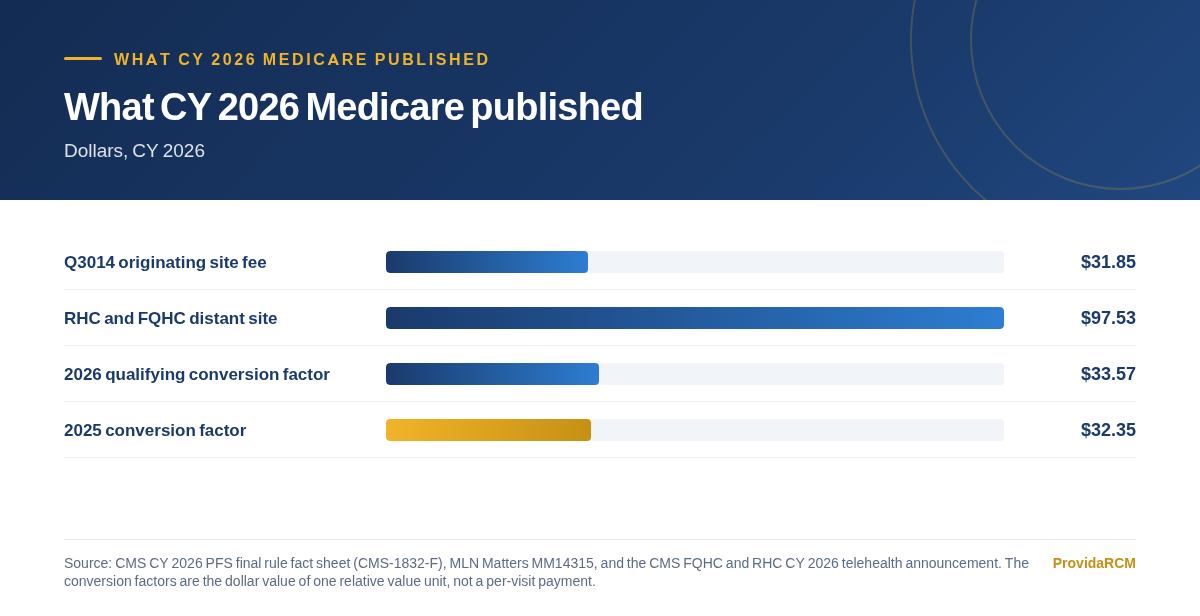
The work changes shape rather than shrinking. Coverage is no longer the argument; the question is which field goes where. The originating site facility fee is a separate payment to the site where the patient is, not to the practitioner, and CMS set HCPCS Q3014 at $31.85 for CY 2026. When the patient is at home there is no site to bill it, so a home visit and a clinic visit produce different claims from the same session.
The originating site facility fee
Source: CMS MLN Matters MM14315. The statutory amount was $20 for 2001 through 2002; the CY 2026 amount is 80 percent of the lesser of the charge or $31.85.
Two details cause most of the trouble. The place of service code follows the patient, not the clinician, so a therapist working from a spare bedroom and a patient sitting in a school office still produce POS 02. And the claim has to match the note. If the record says the patient was at home while the claim says POS 02, the underpayment is silent and no denial arrives to warn anyone.
The place of service code, the modifier, and what each one does
Medicare accepts exactly two telehealth place of service codes. The Medicare Claims Processing Manual, chapter 26 states that POS 02 applies when the patient is not in their home and POS 10 when the patient is, that the code must be paired with the appropriate telehealth modifier, and that the modifier does not change the payment rate. Only the place of service code does.
Modifier 95 identifies real-time audio and video. Modifier 93 identifies audio-only, and it does more than describe the technology. Under 42 CFR 410.78(a)(3), audio-only is an acceptable interactive telecommunications system for a patient at home only if the practitioner is capable of using audio and video and the patient is not capable of, or does not consent to, video. The regulation requires modifier 93 on the claim, and Medicare modifier FQ as well for rural health clinics and federally qualified health centers.
| Field | Value | When it applies | What it does |
|---|---|---|---|
| Place of service | POS 10 | Patient is in their home | Pays the non-facility rate |
| Place of service | POS 02 | Patient is anywhere other than home | Pays the facility rate |
| Modifier | 95 | Real-time audio and video | Identifies the modality; no rate change |
| Modifier | 93 | Audio-only, conditions met | Attests the conditions in 42 CFR 410.78(a)(3) |
| Modifier | FQ | RHC or FQHC, audio-only | Required on top of modifier 93 |
| Modifier | GT | Legacy audio and video | Accepted by some commercial payers; Medicare uses 95 |
The conversion factor behind every rate
Source: CMS CY 2026 Physician Fee Schedule final rule fact sheet (CMS-1832-F). The qualifying and nonqualifying factors apply to different groups of clinicians under the Quality Payment Program.
CO-15 is not a live code. The current X12 list gives the authorization code a stop date of May 1, 2018, and the replacement in use is CO-197, precertification, authorization, notification or pre-treatment absent, modified on the same date. A denial report still showing CO-15 volume is working from a mapping older than the remittance. Place of service problems arrive as CO-5 with remark code M77, missing, incomplete, invalid or inappropriate place of service.
Which behavioral health codes a phone visit can carry
Audio-only is permanent for behavioral health in Medicare, but permanent does not mean unlimited. The service still has to be on the telehealth list, and the claim still has to meet the four conditions in the regulation. Two things follow. A code that is not on the list is not payable as telehealth under any modifier. And a listed code billed audio-only without a documented reason for skipping video attests to something that did not happen.
Medicare’s list runs past 250 services and is rebuilt each year through the fee schedule rule. The CY 2026 rule added services including multiple-family group psychotherapy and dropped the old split between provisional and permanent entries, so a listed service is reviewed rather than guaranteed. Check the list against the date of service, not the date you last printed it.
| Code | Service | Audio-only eligible | Watch for |
|---|---|---|---|
| 90791, 90792 | Psychiatric diagnostic interview | Listed by Aetna with modifier 93 or FQ | Frequency limits in many policies |
| 90832, 90834, 90837 | Individual psychotherapy, 30, 45 and 60 minutes | Listed by Aetna with modifier 93 or FQ | Time thresholds decide the code |
| 90846, 90847 | Family psychotherapy | Listed by Aetna with modifier 93 or FQ | The patient is absent from 90846 |
| 90853 | Group psychotherapy | Check the payer’s own list | Group billing rules differ by payer |
| 99441 to 99443 | Telephone evaluation and management | Separate from the therapy codes | Verify against the payer’s list before the session |
The same session on three payers, three different answers
Medicare is a floor, not the rule. The New York State Medicaid telehealth provider manual, updated January 2026, tells providers to code place of service 02, 10, or 11 to document where the member was during the visit. That is one option more than Medicare allows, so a claim built for Medicare is not automatically valid for a state system that expects 11 when the member sat in a clinic.
Audio-only separates the payers further. New York covers audio-only visits when the member lacks the equipment, prefers audio-only, or cannot use video, and the department says it expects audio-only to be far more common for behavioral health than for medical visits. Medicare allows audio-only for behavioral health permanently, subject to the consent conditions. Aetna’s commercial telemedicine payment policy states that it does not pay for synchronous audio-only services as a rule, then lists the codes it will pay with modifier 93 or FQ, which include the psychotherapy codes.
| Payer | Place of service | Audio-only position | In-person visit rule |
|---|---|---|---|
| Medicare Part B | 02 or 10 only | Permanent for behavioral health; conditions apply | Applies to services furnished after December 31, 2027 |
| New York State Medicaid | 02, 10 or 11 | Covered when the member prefers or cannot use video | Not stated as a payment condition in the manual |
| Aetna commercial | Policy identifies telehealth by modifier | Not paid as a rule; a listed set of codes is excepted | Not an Aetna payment condition |
| UnitedHealthcare commercial | 02 or 10 | Per its eligible audio-only code list | Not a UHC payment condition |
Put two patients on the same schedule and the mechanics become visible. At nine in the morning a Medicare patient takes a 45-minute session by phone from home after declining video: POS 10, modifier 93, the reason in the note, and the claim pays. At ten a commercial patient on a plan that pays only listed codes by phone takes the same 45 minutes. Same code, same modality, no payable route. Nothing about the service changed. The payer did.
What to change in the workflow before the next renewal
Most telehealth denials in behavioral health are created before the claim exists, in an EHR appointment type that writes a default place of service. Fixing that default is the highest-yield change available, and it costs nothing.
- Make place of service a field the clinician confirms at the start of the session, not a default the scheduler sets
- Ask every patient whether they can use video, and record the answer for the sessions where they decline
- Keep each payer’s audio-only code list on the billing desk and confirm the code before the session is booked
- Match the note to the code and the location; a home session documented as a clinic visit is an underpayment you never see
- Track the in-person visit clock for Medicare patients so the requirement after December 31, 2027 does not arrive as a surprise
Two audits keep the process honest. Pull twenty audio-only claims a month and check that the record states why video was not used. Then pull twenty POS 10 claims and confirm the note places the patient at home. Neither audit needs software. Both catch errors a denial report never shows, because a wrong place of service usually pays quietly at the wrong rate.
The pieces around telehealth are where the rest of the money sits. A practice that has sorted out behavioral health payer carve-outs still needs a clean insurance verification process and, when a plan starts a unit review, the authorization trail that ABA billing lives on. We run that work for behavioral health groups through mental health billing, medical coding and prior authorization. That is where a telehealth claim usually fails first.
Questions practices ask us about this
Is telehealth for behavioral health permanent in Medicare?
The core of it is. Under section 1834(m) of the Social Security Act and 42 CFR 410.78, there is no geographic restriction for behavioral and mental health telehealth, the patient’s home is an acceptable originating site, and audio-only is permitted when the practitioner can use video and the patient cannot or declines. CMS states all three as permanent. The temporary items, such as the same flexibility for medical visits, run through December 31, 2027.
Which place of service code do I use for a therapy session by telehealth?
POS 10 when the patient is in their home, POS 02 when the patient is anywhere else. Medicare accepts only those two for telehealth, and the code decides the rate: POS 10 pays the non-facility amount, POS 02 the facility amount. New York State Medicaid also accepts POS 11 in some cases, so a claim built for one payer is not automatically valid for another.
Do I need modifier 93 or modifier 95?
Modifier 95 for a real-time audio and video visit, modifier 93 for audio-only. Modifier 93 is an attestation under 42 CFR 410.78(a)(3): the patient was at home, the practitioner was capable of video, and the patient could not use it or did not consent. Rural health clinics and federally qualified health centers add modifier FQ. Neither modifier changes the payment rate, because the place of service code sets that.
Why will a commercial payer deny an audio-only visit that Medicare pays?
Because the two run on different rules. Medicare allows audio-only behavioral health permanently, subject to conditions. Aetna’s commercial telemedicine policy does not pay synchronous audio-only services as a general rule and lists the codes it will pay with modifier 93 or FQ, the psychotherapy codes among them. A state Medicaid program sets its own conditions again. Check the payer’s own document before the session, not after the denial.
Does the patient’s home count as an originating site in Medicare?
Yes, permanently, for diagnosis, evaluation and treatment of a mental health disorder. The consequence lands on the claim rather than on coverage. A patient’s home cannot bill the originating site facility fee, so the visit produces POS 10 and no separate site charge. CMS set HCPCS Q3014, the originating site fee, at $31.85 for CY 2026.
What changes on January 1, 2028?
Two things, unless Congress acts again. The temporary flexibilities for non-behavioral telehealth, including home as a location and the wider practitioner list, end on December 31, 2027. The in-person visit requirement for telemental health then takes effect for services furnished after that date: an in-person, non-telehealth visit within six months of the first telehealth service, with documented exceptions.
Want this fixed in your practice?
We run full-cycle billing, coding, credentialing and denial work for practices across the country. Send us a few months of claims and we will show you where the money is going.
Book a free billing review- CMS, CY 2026 Physician Fee Schedule final rule fact sheet (CMS-1832-F), October 31, 2025. cms.gov/newsroom/fact-sheets/calendar-year-cy-2026-medicare-physician-fee-schedule-final-rule-cms-1832-f
- Federal Register, CY 2026 Payment Policies Under the Physician Fee Schedule, CMS-1832-F, November 5, 2025. federalregister.gov/d/2025-19787
- CMS, Telehealth FAQ, updated February 26, 2026. cms.gov/files/document/telehealth-faq-updated-02-26-2026.pdf
- Telehealth.HHS.gov, Medicare payment policies. telehealth.hhs.gov/providers/billing-and-reimbursement/medicare-payment-policies
- CMS, MLN Matters MM14315, CY 2026 PFS final rule summary. cms.gov/files/document/mm14315-medicare-physician-fee-schedule-final-rule-summary-cy-2026.pdf
- eCFR, 42 CFR 410.78, Telehealth services. ecfr.gov/current/title-42/chapter-IV/subchapter-B/part-410/subpart-B/section-410.78
- CMS, Medicare Claims Processing Manual, chapter 26, telehealth billing and place of service. cms.gov/regulations-and-guidance/guidance/manuals/downloads/clm104c26.pdf
- New York State Department of Health, NYS Medicaid Telehealth Policy Manual, updated January 2026. health.ny.gov/health_care/medicaid/redesign/telehealth/docs/provider_manual.pdf
- Aetna, Telemedicine and Direct Patient Contact Payment Policy. aetna.com/content/dam/aetna/pdfs/aetnacom/pdf/telemedicine.pdf
- UnitedHealthcare, Telehealth/Virtual Health Policy, Professional, 2026R0046A. uhcprovider.com/content/dam/provider/docs/public/policies/comm-reimbursement/COMM-Telehealth-and-Telemedicine-Policy.pdf
- X12, Claim Adjustment Reason Codes, current list. x12.org/codes/claim-adjustment-reason-codes
- CMS, FQHC and RHC news announcements, CY 2026 telehealth billing change. cms.gov/fqhc-rhc-news-announcements