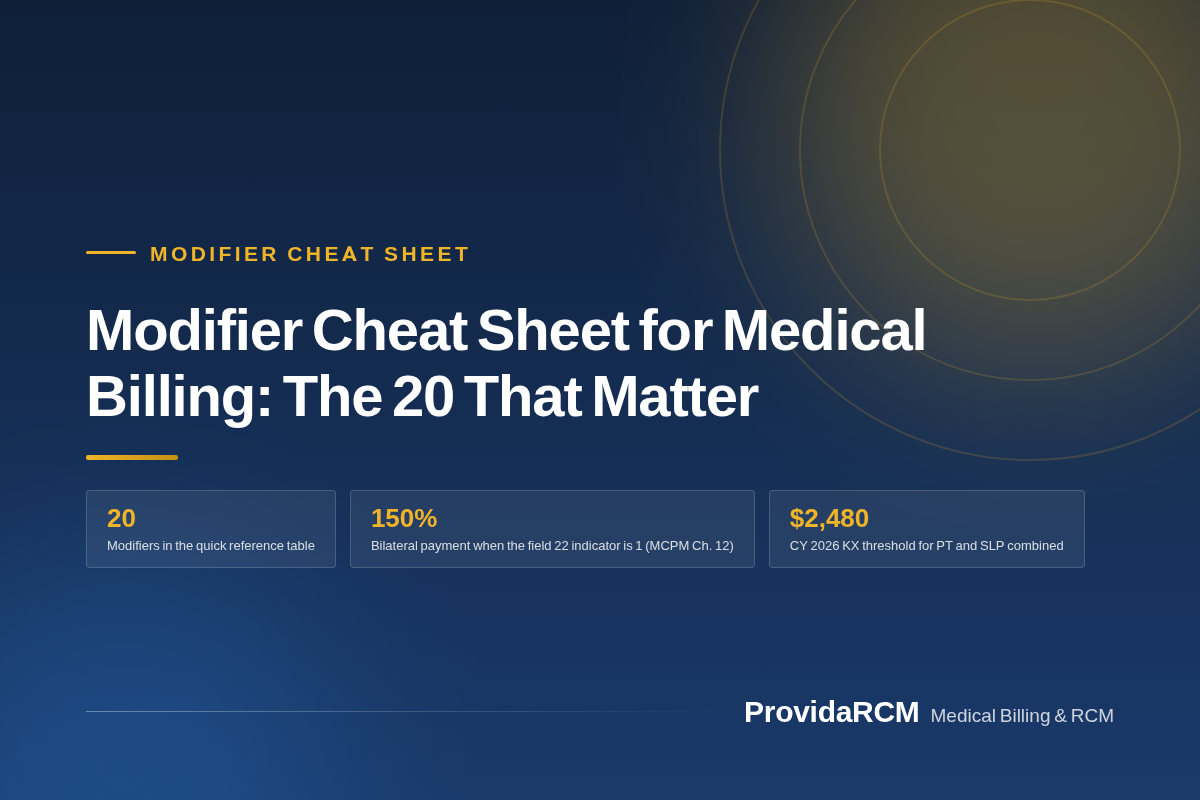
The medical billing modifiers that change payment are a short list, and most denials trace back to a handful of them. This cheat sheet covers 20 working modifiers, what each one tells the payer, what Medicare pays when it applies, and the CMS document the rule comes from.
How medical billing modifiers change what a payer does
A modifier is a two-character suffix on a procedure code that reports a circumstance the code cannot carry on its own: which side of the body, who did the work, or why something happened twice. The code does not change. The modifier tells the payer a different story about the same service, and that story is what decides whether the line pays, denies or disappears into a bundle.
CMS runs two edits that surface most modifier problems. Procedure-to-procedure edits name code pairs that should not be reported together on the same date, and a modifier can bypass the edit only when the column one indicator on that row allows it. Units-of-service edits are separate and cap how many units of a code are plausible on one date. The NCCI policy manual is the governing document, and the indicator column is the switch.
| Indicator | What it says | What a modifier can do |
|---|---|---|
| 0 | The pair is a hard edit and no circumstance overrides it. | Nothing. Do not report the pair and do not append a bypass modifier. |
| 1 | The two codes may be reported together when the record supports a distinct service. | A PTP-associated modifier can bypass the edit if the documentation holds up. |
| 9 | The row is not a coding rule but a payer policy about the same service. | Modifiers do not open the edit. Read the policy the row cites. |
A bypass modifier asserts that the circumstances differed. If the note cannot show what differed, the modifier becomes the denial reason, and repeated misuse of the same one in the same code pair is how a practice ends up on a contractor’s review list.
Modifier choice is a coding decision, so it belongs with medical coding rather than with charge entry. The vocabulary underneath it is defined in the medical billing glossary.
Payment and edit overrides: 25, 59 and the X{EPSU} family
Four modifiers carry most of the bypass work in an office practice. Modifier 25 flags a significant, separately identifiable E/M service furnished on the same day as a procedure or another service. Modifier 59 states that a procedure was distinct from the other services reported on that date. The X{EPSU} family splits that single statement into four narrower ones.
Because 59 is vague, CMS directs coders to the specific suffix when one fits. MLN1783722 names the four: XE for a separate encounter, XS for a separate structure, XP for a separate practitioner and XU for an unusual, non-overlapping service. Modifier 59 remains valid, and it still should not be appended to an E/M service, nor used with 77427.
The trap is that not every modifier bypasses an edit. Modifiers 22, 76 and 77 are not PTP-associated, so none of them will move a bundled pair through. The PTP-associated set includes 24, 25, 27, 57, 58, 59, 78, 79 and 91, the four X{EPSU} codes, and the anatomic and global surgery modifiers.
| Modifier | What it reports | PTP-associated in the 2026 manual |
|---|---|---|
| 24 | An E/M service unrelated to the surgery, inside the postoperative period. | Yes |
| 25 | A significant, separately identifiable E/M service on the same day as another service. | Yes |
| 57 | The visit where the decision for surgery was made. | Yes |
| 58 | A procedure during the postoperative period that was staged or planned. | Yes |
| 59 | A distinct procedural service, distinct from the others on that date. | Yes, but use the specific X{EPSU} code when one fits |
| 78 | A return to the operating room for a related procedure. | Yes |
| 79 | An unrelated procedure during the postoperative period. | Yes |
| 91 | A repeat clinical diagnostic laboratory test on the same day. | Yes |
| XE, XS, XP, XU | A separate encounter, structure or practitioner, or an unusual service. | Yes |
| 22 | Increased procedural services. | No |
| 76 | A repeat procedure by the same physician. | No |
| 77 | A repeat procedure by a different physician. | No |
Modifier 25 is the most audited modifier on the list. The HHS Office of Inspector General reviewed claims from June 2022 through May 2023 and found Medicare paid $313 million for 3.3 million intravitreal injections, with $124 million for 1.4 million same-day E/M services billed with modifier 25. Forty-two percent of the injections had a same-day E/M carrying that modifier. The OIG audit report is the source, and work like this usually arrives as a denial before it arrives as a letter.
Modifiers 22 and 52 are the two where the modifier only opens a conversation. Section 20.4.6 of the claims processing manual leaves payment for both to the Medicare Administrative Contractor’s judgment on the submitted records. There is no CMS-published 125 percent or 120 percent figure for modifier 22, and vendor crosswalks that quote one are quoting a payer policy or a convention rather than a national rule.
When a bundling denial lands, the CARC names the edit and the RARC often names the modifier the payer wanted. Claim denial codes is the reference for reading those two together before you resubmit.
Who did the work: 26, TC, 80, 81, 82, AS and GC
A service can be divided, and a service can be assisted, and the two produce different payment. Modifiers 26 and TC split a procedure into its professional and technical halves. Modifier 26 bills the physician’s interpretation and report, and TC bills the equipment, supplies and trained staff time that produced the study. Medicare prices the halves separately against the Physician Fee Schedule, and the mechanics sit in the Medicare Claims Processing Manual Chapter 13, sections 20.1 and 20.2.
Surgical assist modifiers describe a second pair of hands. Modifier 80 reports a physician assistant at surgery, 81 a minimum assistant surgeon, 82 an assistant when a qualified resident was not available, and AS an assistant who is a physician assistant, nurse practitioner or clinical nurse specialist. The payment difference between an assistant who is a physician and one who is not is material, and it is published.
What Medicare pays of the fee schedule
Source: CMS, Medicare Claims Processing Manual, Pub. 100-04 Ch. 12, sections 20.4.2 and 20.4.3.
Two more entries belong in this group. Modifier GC reports a service performed in part by a resident under the direction of a teaching physician, which decides who may bill the case at all. Modifiers LT and RT report laterality when the code is unilateral by definition, and they are the cleanest way to keep a payer from pairing two lines as a duplicate.
Duplicates and repeats: 50, 62, 66, 76 through 79 and 91
Bilateral, co-surgery and team surgery each carry a published percentage. Under Chapter 12 of the claims processing manual, bilateral modifier 50 pays 150 percent of the fee schedule when the procedure’s field 22 indicator is 1. Co-surgeons using 62 are paid 62.5 percent each, and team surgery with 66 is paid by report. Modifiers 23, 32, 47, 76 and 90 carry no fee schedule adjustment of any kind.
| Modifier | What it reports | Medicare payment |
|---|---|---|
| 50 | A bilateral procedure performed on both sides. | 150 percent of the fee schedule when the field 22 indicator is 1. |
| 62 | Two surgeons acting as primary surgeons on the same procedure. | 62.5 percent to each surgeon. |
| 66 | Team surgery involving more than two surgeons. | By report, on the documentation submitted. |
| 80, 81, 82 | A physician acting as assistant surgeon, minimum assistant, or assistant when no qualified resident was available. | 16 percent of the fee schedule for the physician assistant at surgery. |
| AS | A physician assistant, nurse practitioner or clinical nurse specialist assisting at surgery. | 13.6 percent of the fee schedule. |
| 23, 32, 47, 76, 90 | A circumstance that changes how a service is reported rather than creating a separate service. | No fee schedule adjustment under Chapter 12. |
When several procedures are performed on the same patient on the same day, the payment ranking decides the total. The highest-valued procedure pays in full, the second pays at the second tier and later procedures fall to the lowest tier. Two indicators govern how deep that reduction goes, and the difference between them is the reason a same-day schedule can pay out very differently for two practices with identical codes.
| Procedure in the ranking | Indicator 1 payment | Indicator 2 payment |
|---|---|---|
| Highest-valued procedure | 100 percent of the fee schedule | 100 percent of the fee schedule |
| Second procedure | 50 percent | 50 percent |
| Third and later procedures | 25 percent | The ranking has no third tier |
Repeat and return-to-the-room modifiers run on the global surgery calendar. Modifier 76 repeats a procedure on the same day by the same physician, and 77 repeats it by a different physician. Modifier 78 reports an unplanned return to the operating room for a related procedure during the postoperative period, and 79 reports an unrelated one. Modifier 91 covers a repeated clinical diagnostic laboratory test.
Modifiers 54 and 55 divide a surgical global period between the surgeon who only operates and the one who only provides the postoperative care. CMS global surgery guidance sets out the global surgery modifiers, and 57 never applies to a procedure that carries a 000 day or 010 day global period.
Informational modifiers: the ABN set, laterality and modifier 33
A second family of modifiers reports a liability decision instead of a service. The ABN set tells Medicare whether a notice of noncoverage was given before a service the contractor is expected to deny, and the CMS ABN guidance is where the wording and the form come from. The modifier is what moves the balance from the practice to the patient, so the notice and the modifier have to agree.
| Modifier | What it states | Who carries the balance |
|---|---|---|
| GA | A notice is on file and the item is expected to be denied as not reasonable and necessary. | The patient, when the notice is valid. |
| GX | A notice is on file for an item that is not a Medicare benefit. | The patient, and the claim is still filed. |
| GY | No notice was required because the item is statutorily excluded. | The patient, and the claim is still filed. |
| GZ | A notice was required and was not obtained. | The practice, because liability does not shift without the notice. |
| GK, GL | Additional notice modifiers used when the ABN covers a denial on medical necessity grounds. | The patient, when the notice and the documentation agree. |
Modifier 33 has no current instruction in a CMS manual or MLN product. It does not appear in the current NCCI policy manual, in Chapter 12 of the claims processing manual, or in a current MLN article, and the most recent CMS reference located is a 2016 preventive-services quick reference tied to anesthesia code 00810. Treat 33 as an AMA and commercial-payer convention, and check the payer’s own policy document before you depend on it.
The practical rule for this whole family is that the modifier reports what happened with the notice, not what the practice hoped would happen. A GZ on a claim where a valid ABN was actually signed, or a GA where no notice exists, converts a billable balance into an audit finding in either direction.
Therapy and anesthesia: where modifiers carry the money
Therapy claims turn on a dollar threshold, and the modifier is what certifies it. For CY 2026 the KX modifier threshold shown on the CMS Therapy Services page is $2,480 for physical therapy and speech-language pathology combined, and separately $2,480 for occupational therapy. Above that amount, KX tells the contractor that the documentation supports medical necessity. The CY 2026 physician fee schedule final rule summary states the same figure.
CY 2026 therapy thresholds
Source: CMS, Therapy Services, CY 2026 KX modifier and targeted medical review thresholds.
The targeted medical review threshold is a different number and a different event. It sits at $3,000, and claims above it become candidates for review whether or not KX was appended. Confusing the two thresholds produces one of two errors: a modifier the claim did not need, or an unmanaged exposure that nobody is watching. Visit caps and the necessity standard are covered in physical therapy billing limits.
Anesthesia bills with its own set. Modifiers AA, AD, G8, G9, QK, QS, QY and GC all appear in Chapter 12 of the claims processing manual, and each one states who was in the room and how much of the case the anesthesiologist personally provided. The set exists because medical direction of two to four concurrent cases is priced differently from one-on-one care, and the modifier is the only place that distinction reaches the claim.
| Modifier | What it reports | Why it changes payment |
|---|---|---|
| AA | Anesthesia performed personally by the anesthesiologist. | Pays as personally performed. |
| AD | Medical supervision of more than four concurrent anesthesia cases. | Pays below the personal performance level. |
| QK | Medical direction of two, three or four concurrent cases. | Pays at the medically directed level. |
| QY | Medical direction of a single case delivered by a non-physician anesthetist. | Pays at the medically directed level. |
| QS | Monitored anesthesia care. | Reports the type of service rather than a reduction. |
| G8, G9 | Monitored anesthesia care for specific clinical indications. | Reports the indication the contractor expects to see. |
| GC | A service performed in part by a resident under the direction of a teaching physician. | Decides who may bill the case. |
The 20 modifiers that matter, in one table
This is the working list, ordered by how often the question comes up in a practice that files claims every week. The last column names the CMS document the behavior comes from, so a biller can check the rule rather than a vendor crosswalk.
| Modifier | What it does to the claim | Where the rule lives |
|---|---|---|
| 25 | Separates a same-day E/M service from a procedure so both can be considered. | MCPM Ch. 12; MLN907166 |
| 59 | States that a procedure was distinct from the others on the same date. | MCPM Ch. 12; MLN1783722 |
| XE | Narrows the distinct-service statement to a separate encounter. | MLN1783722 |
| XU | Narrows the distinct-service statement to an unusual, non-overlapping service. | MLN1783722 |
| 24 | Opens a postoperative E/M service for a problem unrelated to the surgery. | MLN907166 |
| 57 | Marks the visit where the decision for surgery was made. | MLN907166 |
| 22 | Signals increased work; payment is left to the contractor’s review of the record. | MCPM Ch. 12, section 20.4.6 |
| 52 | Signals a reduced service; payment is left to the contractor’s review of the record. | MCPM Ch. 12, section 20.4.6 |
| 26 | Bills the professional component of a divided service. | MCPM Ch. 13, sections 20.1 and 20.2 |
| TC | Bills the technical component of a divided service. | MCPM Ch. 13, section 20.2 |
| 80 | Bills a physician assistant at surgery at 16 percent of the fee schedule. | MCPM Ch. 12, section 20.4.2 |
| AS | Bills a PA, NP or CNS assistant at surgery at 13.6 percent. | MCPM Ch. 12, section 20.4.3 |
| GC | Reports a service performed in part by a resident under a teaching physician. | MCPM Ch. 12 |
| 50 | Pays a bilateral procedure at 150 percent when the indicator allows it. | MCPM Ch. 12, field 22 indicator |
| 62 | Pays each of two surgeons 62.5 percent. | MCPM Ch. 12 |
| 76 | Repeats a same-day procedure by the same physician, with no fee schedule change. | MCPM Ch. 12 |
| 78 | Reports a return to the operating room for a related procedure; not PTP-associated. | 2026 NCCI policy manual |
| 79 | Reports an unrelated procedure during the postoperative period; PTP-associated. | 2026 NCCI policy manual |
| 91 | Reports a repeat clinical diagnostic laboratory test; PTP-associated. | 2026 NCCI policy manual |
| KX | Certifies that documentation supports medical necessity above the therapy threshold. | CMS Therapy Services, CY 2026 |
Two habits keep the list working. Check the column one indicator before appending any bypass modifier, and never use a modifier to describe something the record does not say. A practice that does both will see fewer bundling denials and fewer questions from a contractor.
Questions practices ask us about this
Can I use modifier 59 instead of XE, XP, XS or XU?
Modifier 59 is still valid, and CMS directs coders to the more specific suffix when one describes the circumstance. Use XE for a separate encounter, XS for a separate structure, XP for a separate practitioner and XU for an unusual, non-overlapping service. Reserve 59 for the case where none of the four fits. Do not append 59 to an E/M service, and do not use it with 77427.
Does modifier 25 increase what Medicare pays for the visit?
No. Modifier 25 does not raise the fee schedule amount for the E/M service. What it does is prevent the visit from being bundled into the procedure performed on the same day, so the E/M pays at its own allowed amount instead of paying nothing. The audit exposure sits in the documentation: the note has to support a significant, separately identifiable service beyond the procedure itself.
What percentage does Medicare pay for an assistant at surgery?
A physician acting as assistant at surgery is paid 16 percent of the fee schedule. A physician assistant, nurse practitioner or clinical nurse specialist assisting at surgery is paid 13.6 percent. Both figures come from Chapter 12 of the Medicare Claims Processing Manual. A minimum assistant surgeon and an assistant billed when no qualified resident was available are also priced at the assistant rate rather than the primary surgeon rate.
How much does bilateral modifier 50 pay?
When the procedure’s field 22 indicator is 1, bilateral modifier 50 pays 150 percent of the fee schedule for the pair. That is one and a half times the single-procedure allowed amount, not two full payments. If the indicator does not permit bilateral payment, the second side is not paid at all through 50. Confirm the indicator on the code before you assume the multiplier applies.
What is the KX modifier threshold for therapy in CY 2026?
The CY 2026 KX modifier threshold is $2,480 for physical therapy and speech-language pathology combined, and separately $2,480 for occupational therapy. Above that amount the KX modifier tells the contractor that the documentation supports medical necessity. The targeted medical review threshold is a separate figure, $3,000, and claims above it are review candidates whether or not KX was appended.
Which modifiers can override an NCCI procedure-to-procedure edit?
The PTP-associated set includes 24, 25, 27, 57, 58, 59, 78, 79 and 91, the four X{EPSU} codes, and the anatomic and global surgery modifiers. Modifiers 22, 76 and 77 are not PTP-associated, so they cannot move a bundled pair through an edit. Bypassing an edit also requires the column one indicator on that row to be 1 and documentation that supports the distinct service.
Does Medicare accept modifier 33?
Modifier 33 has no current instruction in a CMS manual or MLN product. It does not appear in the NCCI policy manual, in Chapter 12 of the Medicare Claims Processing Manual, or in a current MLN article. The most recent CMS reference located is a 2016 preventive-services quick reference tied to anesthesia code 00810. Treat 33 as an AMA and commercial-payer convention and check the payer’s own policy before relying on it.
Want this fixed in your practice?
We run full-cycle billing, coding, credentialing and denial work for practices across the country. Send us a few months of claims and we will show you where the money is going.
Book a free billing review- CMS, National Correct Coding Initiative (NCCI) program and 2026 policy manual. cms.gov/national-correct-coding-initiative-ncci
- CMS MLN1783722, Proper Use of Modifiers 59, XE, XS, XP and XU (April 2026). cms.gov/files/document/mln1783722-proper-use-modifiers-59-xe-xp-xs-xu.pdf
- CMS, Medicare Claims Processing Manual, Pub. 100-04 Ch. 12, sections 20.4 and 40 (payment for modifiers 22, 50, 52, 62, 66, 80, 81, 82, AS and the anesthesia set). cms.gov/regulations-and-guidance/guidance/manuals/downloads/clm104c12.pdf
- CMS, Medicare Claims Processing Manual, Pub. 100-04 Ch. 13, sections 20.1 and 20.2 (professional and technical components). cms.gov/regulations-and-guidance/guidance/manuals/downloads/clm104c13.pdf
- CMS MLN907166, Global Surgery (December 2025). cms.gov/files/document/mln907166-global-surgery-booklet.pdf
- CMS, Advance Beneficiary Notice of Noncoverage (ABN), form CMS-R-131 (modifiers GA, GX, GY, GZ, GK and GL). cms.gov/medicare/forms-notices/beneficiary-notices-initiative/ffs-abn
- CMS, Therapy Services (CY 2026 KX modifier and targeted medical review thresholds). cms.gov/medicare/coding-billing/therapy-services
- HHS Office of Inspector General, A-09-23-03014, Medicare Payments for Intravitreal Injections and Same-Day Evaluation and Management Services (May 2025). oig.hhs.gov/documents/audit/10286/A-09-23-03014.pdf