A CO-16 denial is the payer saying your claim was missing something, and the reason code never says what. The X12 wording for CARC 16 obliges the payer to attach at least one remark code, so the remark code is the real denial reason. Read it before you appeal or rebill.
A CO-16 denial arrives with no reason written on it
Claim adjustment reason code 16 reads, in full: “Claim/service lacks information or has submission/billing error(s). Usage: Do not use this code for claims attachment(s)/other documentation. At least one Remark Code must be provided (may be comprised of either the NCPDP Reject Reason Code, or Remittance Advice Remark Code that is not an ALERT.)” That entry is live in the X12 claim adjustment reason code list, last modified 1 March 2018.
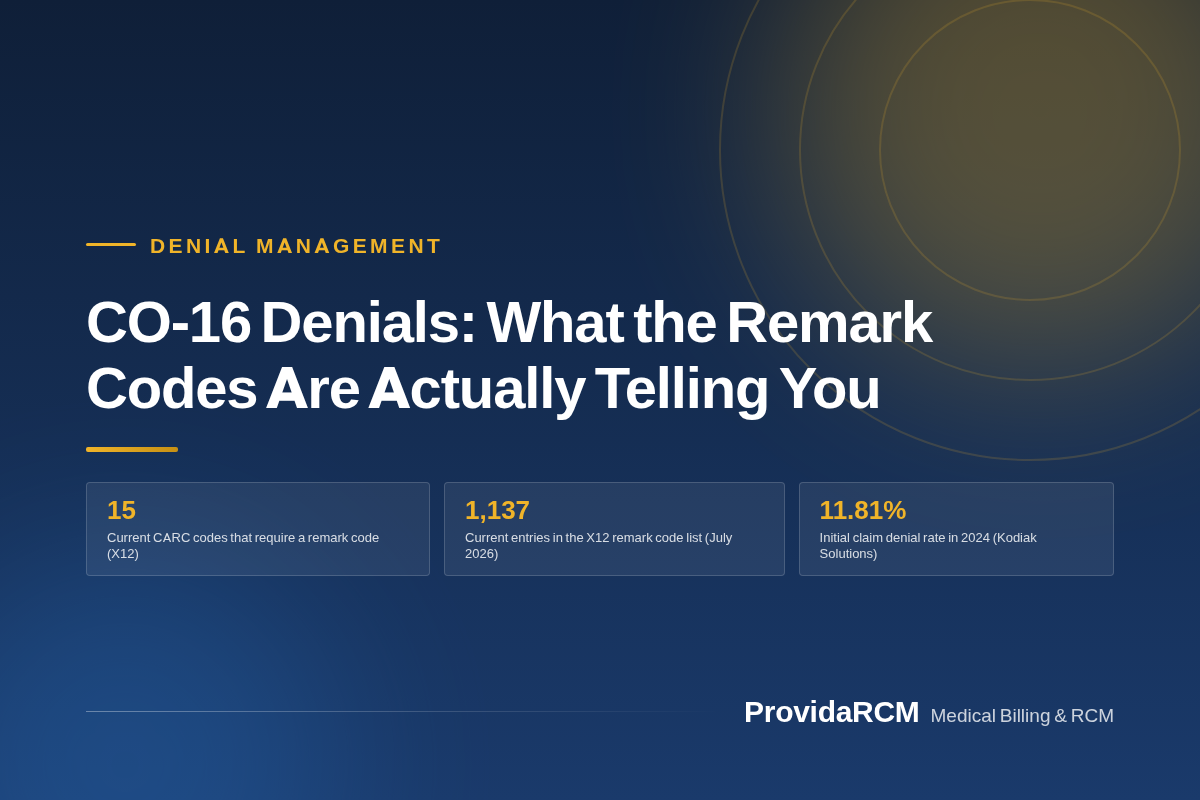
Read the third sentence again. The code that carries the denial also obliges the payer to send a second code that explains it. A remittance showing CO-16 and nothing else is not a terse denial. It is an incomplete one, and the field you cannot see is the field that got the claim returned. Fifteen of the 297 current CARC entries carry that same requirement.
Two failures follow from that sentence. A payer can pair CARC 16 with an ALERT-only remark code, which the same wording forbids. Or a payer can pair it with a code such as MA130 that names no defect at all. The practice then holds a denial notice that identifies nothing, while the claim sits and somebody guesses.
| Code set | Who maintains it | What it does on this line |
|---|---|---|
| Group code CO | X12 claim adjustment group codes | Puts the unpaid balance on the practice, so the patient is not billed |
| Reason code 16 | National CARC maintenance committee | States that the claim cannot adjudicate as sent, and requires a remark code |
| Remark code | CMS, as the X12 recognized maintainer | Names the missing field, or says whether an appeal is open |
CMS defines the group codes by financial responsibility, and CO stands for contractual obligation, which lands on the provider. The same page states that Medicare beneficiaries may be billed only when group code PR is used. Moving a CO-16 balance to the patient is a compliance problem wearing a collections costume.
The M-series remark codes name the missing element
The M series is the oldest block in the list and the plainest. Nearly every M code follows one template: missing, incomplete or invalid, then the data element the payer could not use. Read one line and you know which field to open, which is the exact thing CARC 16 withholds.
| RARC | X12 wording | The field to open |
|---|---|---|
| M76 | Missing/incomplete/invalid diagnosis or condition | The diagnosis on the claim, or the condition the note describes |
| M51 | Missing/incomplete/invalid procedure code(s) | The CPT or HCPCS code on the line |
| M67 | Missing/incomplete/invalid other procedure code(s) | A secondary procedure field |
| M77 | Missing/incomplete/invalid/inappropriate place of service | Where the patient was actually seen |
| M79 | Missing/incomplete/invalid charge | The billed charge on the line |
| M20 | Missing/incomplete/invalid HCPCS | The drug, supply or equipment code |
| M64 | Missing/incomplete/invalid other diagnosis | A secondary diagnosis field |
M76 deserves a close read because its wording names two things. A missing or invalid diagnosis code is the obvious case. The words “or condition” point past the code set and at what the record says about the condition being treated. When M76 keeps coming back on the same account after a code change, the note is the next place to look.
Medicare publishes worked examples rather than descriptions, and they show the pairing in code. Chapter 1 of the Claims Processing Manual tells contractors to treat a claim carrying more than one place-of-service code as unprocessable, and to return it with group code CO, CARC 16 and RARC M77. That is the M series doing its job inside a primary source.
The M series also carries codes that are not about a missing field at all. M81 states that you are required to code to the highest level of specificity, and M127 reports a missing patient medical record. Either can sit under a CO-16 as readily as M76 does, and both point at the coder and the chart rather than at the front desk.
The MA-series codes close the appeal door
MA130 reads: “Your claim contains incomplete and/or invalid information, and no appeal rights are afforded because the claim is unprocessable. Please submit a new claim with the complete/correct information.” That is a payer stating, inside its own code list, that the appeal route does not exist on this claim.
The Manual agrees. Chapter 1 defines an unprocessable claim as any claim with incomplete or missing required information, or a claim whose information is complete but invalid. It then instructs contractors not to deny such claims and not to afford appeal rights on them. Nothing was adjudicated, so nothing can be appealed.
MA130 is a status, not a diagnosis of the defect. Medicare’s older instruction required a minimum of two codes on a returned claim and named MA130 as the one that had to be present. The code that names your problem is whichever remark code travels beside it, so read the pair before you act on the pair.
MA113 does the same job for a taxpayer identification number, and adds that there are no appeal rights for unprocessable claims. MA92 and MA83 handle other-insurance plan information and the primary or secondary payer question. None of these codes asks you to argue. Each one is telling you that the claim, as submitted, was never accepted.
That leaves the practical rule for the MA block. When MA130 or MA113 appears, the question is not whether to appeal. It is whether the claim was ever a claim. MA130’s own instruction is to submit a new claim, which is a different act from filing a correction on a record the payer never accepted. Whether your original filing date protects the resubmission depends on the payer’s own filing rule, so check that rule rather than assuming it.
The N-series carries the field-level detail
The N series is where the list got specific. N290 points at the rendering provider’s primary identifier, N382 at the patient identifier, N265 at the ordering provider’s identifier, N264 at the ordering provider’s name, and N286 at the referring provider’s. N822 flags a missing procedure modifier and N823 an invalid one. N706 and its neighbours cover missing orders, notes and reports.
X12 sorts every remark code into one of two types. Supplemental codes explain an adjustment that a reason code already described. Informational codes carry processing information instead, are always prefixed with the word Alert:, and are never tied to a specific adjustment. CMS’s own training article adds that informational codes must not be the default pairing when a remark code is required with CARC 16.
| RARC | X12 wording | What it licenses on a CO-16 |
|---|---|---|
| N211 | Alert: You may not appeal this decision. | No appeal. Fix the named element and resubmit. |
| N704 | Alert: You may not appeal this decision but can resubmit this claim/service with corrected information if warranted. | A resubmission, not an appeal. |
| N210 | Alert: You may appeal this decision. | An appeal is open to you. |
| N1 | Alert: You may appeal this decision in writing within the required time limits following receipt of this notice. | An appeal, and a deadline worth finding early. |
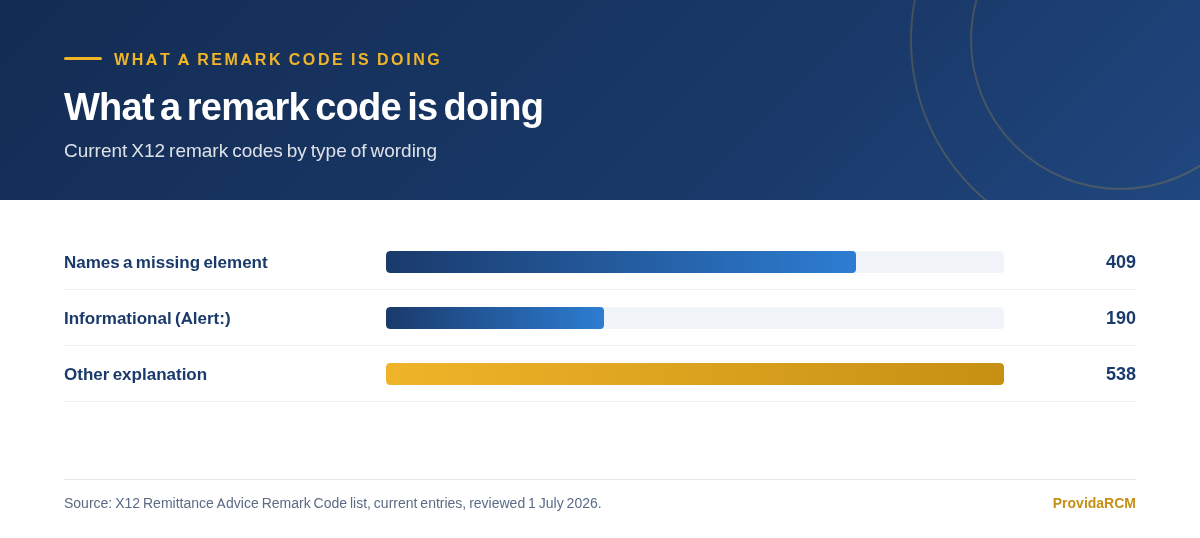
Current X12 remark codes by series
Source: X12 Remittance Advice Remark Code list, current entries, reviewed 1 July 2026.
Put the three series together and the workflow writes itself. An MA code tells you whether the claim was processable at all. An M or N code tells you which element failed. The CARC tells you nothing beyond the fact that one of them did. Reading the remark code first is the step that turns a CO-16 line into an action.
Sort every CO-16 by who owns the fix
Denial reports usually group CO-16 volume by payer and by date. Neither grouping tells a manager who should pick the claim up. Sort the same lines by the element the remark code named and the work splits into four piles, each with a different owner and a different fix time.
| Bucket | Codes you will see | Where the fix lands |
|---|---|---|
| Front end | N382, N290, N286, N265, M77 | Registration, eligibility and provider identifiers |
| Coding | M76, M51, M67, M64, M81, N822 | The codes selected on the claim |
| Documentation | M127, M29, M30, M31, N706, N707, N709 | The record the coder and the payer both read |
| Charge capture | M79, M54, M119 | Line charges, units and drug codes |
The volume is why this matters now. Kodiak Solutions, drawing on more than 2,100 hospitals and 300,000 physicians, put the initial denial rate at 11.81% for 2024 and reported a 5.4% rise in requests for more information, the category a CO-16 line belongs to. The same release notes that payors ultimately pay about 90% of claims. Most of this work is recoverable, which is the argument for reading the remark code properly.
The buckets explain the most common CO-16 mistake. A practice reads the CARC, fixes whatever it assumes is wrong, and resubmits. If the named element was untouched, the second claim comes back the same way, and the appeal window has moved closer while the work looked productive.
Remark codes the list retires but still prints
Source: X12 Remittance Advice Remark Code list, deactivated entries, reviewed 1 July 2026.
The list needs a look every quarter, because retired codes stay visible. Of 1,216 entries, 79 are deactivated: 22 in the M series, 24 in the MA series and 33 in the N series. CAQH CORE’s CARC and RARC rule is blunt about them and states that a deactivated code must not be used. A dashboard that still counts one is describing remittances you no longer receive.
Two retired CARC codes are worth naming, because both required a remark code. CARC 17 stopped on 1 July 2009 and CARC 125 on 1 November 2013. CMS listed both in the same sentence as CARC 16, which is why so many vendor crosswalks still show them as current.
A short pass over the CO-16 lines each week
The work is small enough to run weekly if it is run at all. Five steps cover the lines worth money, and none of them needs a new system. This is the order of operations we use on client remittances.
- 01
Pull the remark code, not the reason code
Export the 835 lines and put the RARC beside the CARC. A CO-16 with no remark code at all is a payer problem, and it is worth a call to the provider representative.
- 02
Split the list into the four buckets
Front end, coding, documentation, charge capture. Send each pile to its owner in the same week, because a CO-16 line that waits a month has lost the value of being cheap to fix.
- 03
Fix the named element before resubmitting
Change the field the remark code named. Resubmitting a claim with the same defect is the most expensive way to spend a filing window.
- 04
Read the appeal line on every MA code
MA130 and MA113 carry their own answer, and the answer is not an appeal. Where an appeal does exist, put the payer’s deadline on a calendar the same day.
- 05
Check the codes quarterly against the live list
Compare your denial report with the current X12 list. If the report counts a retired code, it is describing remittances you are no longer receiving.
We work these lines through our denial management service, which sits on top of medical coding and full-cycle medical billing. For the wider code picture, our CARC and RARC reference walks through the families this article only touches, and the denial management workflow covers the calendar side.
Questions practices ask us about this
What does a CO-16 denial actually mean?
CO-16 means the payer could not adjudicate the claim as submitted, because a required element was missing or the information provided was invalid. The reason code is deliberately broad. X12 requires the payer to attach at least one remark code alongside it, and that remark code names the element that failed.
Why is a CO-16 code not enough to fix the claim?
Because CARC 16 names no field. It says the claim lacks information or carries a submission error, then stops. The next code on the line, the RARC, does the naming. Practices that appeal or rebill from the CARC alone are working from a description that was never meant to be actionable on its own.
Can I appeal a claim denied with CARC 16?
Sometimes, and the remark code answers it. If the line carries MA130 or MA113, the payer states that no appeal rights are afforded because the claim was unprocessable. If it carries N211 or N704, an appeal is closed. If it carries N210 or N1, an appeal is open and there is a deadline to meet.
What does remark code MA130 mean for my practice?
MA130 states that your claim contained incomplete or invalid information and that no appeal rights are afforded because the claim is unprocessable, and it asks you to submit a new claim with the correct information. It is a status rather than a diagnosis, so the code beside it is the one that names your defect.
Does M76 mean my diagnosis code is wrong?
Not always. M76 reads missing, incomplete or invalid diagnosis or condition. That covers a code that is absent, a code that was not valid on the date of service, and a claim where the condition treated is not described adequately. If a code correction does not clear it, read the note against the payer’s coverage policy.
Are the N-series remark codes appealable?
Most of them say nothing about appeals. The N series is mostly field-level wording such as N290 for a rendering provider identifier or N822 for a missing modifier, and each one names an element to correct. A handful are informational Alert codes, like N210 and N211, and those do speak to appeal rights directly.
How often do the CARC and RARC lists change?
The lists are published three times a year, around 1 March, 1 July and 1 November. That cadence is why a code you memorized two years ago can be retired today, and why deactivated entries sit inside the same list as live ones, marked with a stop date.
Want the CO-16 lines worked instead of counted?
We read every remittance by remark code, fix the named element, and report denial volume by owner rather than by date. Send us a few months of 835s and we will show you which lines were recoverable.
Book a free billing review- X12, Remittance Advice Remark Codes (current list, reviewed 1 July 2026). x12.org/codes/remittance-advice-remark-codes
- X12, Claim Adjustment Reason Codes (current list, reviewed 1 November 2025). x12.org/codes/claim-adjustment-reason-codes
- CMS, MLN Matters MM6229, Remittance Advice Remark Code and Claim Adjustment Reason Code Update. cms.gov/outreach-and-education/medicare-learning-network-mln/mlnmattersarticles/downloads/mm6229.pdf
- CMS, Medicare Claims Processing Manual, Pub. 100-04, Chapter 1, section 80.3. cms.gov/regulations-and-guidance/guidance/manuals/downloads/clm104c01.pdf
- CMS, Health Care Payment and Remittance Advice (group codes, CARC and RARC). cms.gov/medicare/coding-billing/electronic-billing/health-care-payment-remittance-advice
- CAQH CORE, Phase III CORE 360 Uniform Use of CARCs and RARCs (835) Rule. caqh.org/core/operating-rules
- Kodiak Solutions, 2024 revenue cycle data on initial denials and requests for information, press release, 21 May 2025. businesswire.com/news/home/20250521892947/en/Rate-of-initial-denials-of-medical-insurance-claims-continued-to-rise-in-2024-Kodiak-Solutions-proprietary-data-show