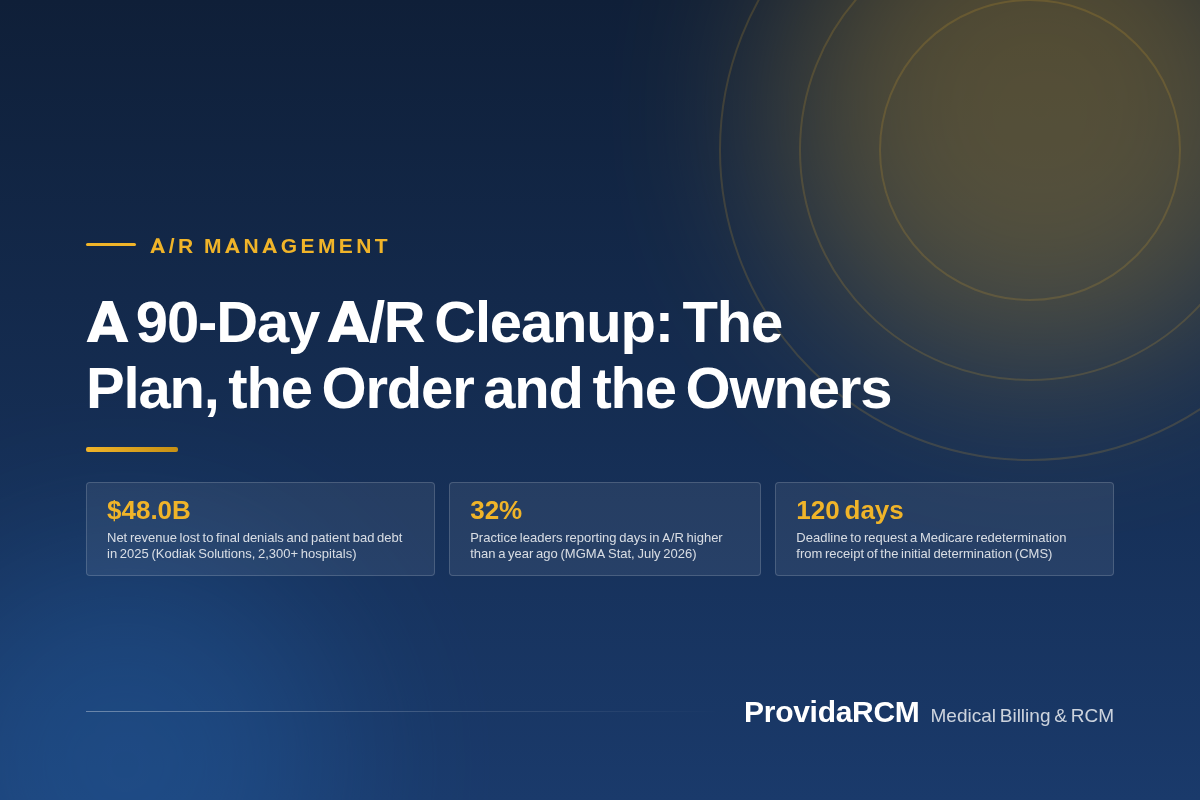
A 90-day AR cleanup is not a pep talk about working harder. It is a scoped list, a sort order, a cadence and a named owner for every account. This plan covers how to pick the accounts, sequence the work by deadline, and close the loop so the same arrears do not rebuild.
Scope the AR cleanup before the first day of work
The project covers one part of the ledger: the accounts a normal collection cycle has already failed to close. HFMA’s MAP Keys define the standard measure as aged A/R as a percentage of total billed A/R, split into 0-30, 31-60, 61-90, 91-120 and over-120-day buckets (HFMA MAP Keys).
Those buckets split the work into two jobs. The first 60 days are the ordinary collection cycle: claims still moving, remittances arriving, follow-up that belongs to daily operations. From 91 days out, an account has survived several rounds of normal work and needs a project.
The worked example runs through the rest of this article: a six-physician primary care group with $812,000 in billed A/R and $17,600 in average daily charges, about 46 days in A/R. Every dollar below belongs to that practice’s own scenario.
| Decision | In scope | Out of scope |
|---|---|---|
| Ageing buckets | 91-120 and over-120 days | 0-30, 31-60 and 61-90 days, unless a claim is stuck there |
| Payers | Every payer with aged balances, worked in payer order | Capitated and risk-based lives with no claim to bill |
| Dollar floor | Accounts of $250 or more get an individual owner | Accounts under $100 go to a monthly write-off review |
| Claim types | Denials, no-response claims, underpayments, credit balances | Contractual adjustments already taken per the fee schedule |
| Time limits | Claims with a live filing or appeal route | Claims already past every remedy |
The floor matters more than it looks. A dedicated owner on a $40 balance costs more than the account will ever pay, so the scenario gives individual ownership above $250, batches $100 to $249 into a weekly sweep, and sends accounts under $100 to a write-off review. Set the floor where one staff touch stops being worth it.
Net revenue lost to final denials and patient bad debt
Source: Kodiak Solutions Revenue Cycle Analytics, March 2026; more than 2,300 hospitals on the platform.
The 0-60 day buckets are excluded from the project, not because they are healthy but because they belong to a different system. If those buckets are weak too, the fix is a front-end workflow change.
Segment the aged A/R so the work can be assigned
An aged trial balance is a poor to-do list because it sorts by age, and age is not a reason. Four cuts turn the same list into assigned work: the payer, the bucket, the reason the claim is stuck, and the owner who can move it. Sort on all four and every account lands on one desk.
The reason is the cut that matters most, and it comes off the 835 remittance. Each claim adjustment reason code names what the payer objected to, which names the fix and its owner.
| CARC | Payer wording (X12) | Who owns the fix | Recoverable? |
|---|---|---|---|
| 29 | The time limit for filing has expired | Billing operations | Only through a reopening where a CMS exception applies |
| 50 | Non-covered because the payer does not deem it medically necessary | Coding and clinical documentation | Yes, if the record meets the payer’s criteria |
| 197 | Precertification, authorization, notification or pre-treatment absent | Front end and clinical | Yes, via retroactive authorization where the payer allows it |
| 16 | Claim or service lacks information, or has a submission or billing error | Front end and billing | Yes, once the remark code is read and the field fixed |
| 252 | An attachment or other documentation is required to adjudicate the claim | Billing operations | Yes, if the attachment can still be supplied |
Read the codes against the current X12 list rather than a payer crosswalk, because a crosswalk can outlive the code it maps. CARC 15 read that the authorization number was missing, invalid, or did not apply to the billed services or provider. X12 stopped that code on 1 May 2018.
The second useful cut is the owner, because an account assigned to a person gets worked and an account assigned to a team does not. Front-end failures, authorization gaps, coding disputes and operations losses need four desks, and one combined number hides which desk is behind.
CARC 15 was deactivated on 1 May 2018 and still appears in vendor denial breakdowns as a live authorization denial. The code that replaced it, CARC 197, was modified the same date. A dashboard counting 15 is counting a retired code.
The order of work is not simply oldest first
Age is a proxy for difficulty, not for value. An unworked denial inside its appeal window can still become cash, while a two-year-old self-pay balance of the same size is mostly a write-off. Ordering by age first spends hours on the accounts least likely to pay.
Two clocks decide the order. The first is the filing clock. Medicare requires a claim to reach the correct contractor within one calendar year of the date of service, under 42 CFR 424.44. A claim denied for late filing is not an initial determination, so there is no appeal to file and only a reopening request remains.
The second is the appeal clock, and it is shorter. A Medicare redetermination must be requested within 120 days of receiving the initial determination, and Medicare presumes receipt five calendar days after the notice date, which leaves roughly 115 usable days. The Medicare Claims Processing Manual, Chapter 29 sets out each level and its filing limit.
A claim approaching a filing deadline is an emergency and should jump the queue regardless of size. A stale self-pay balance can wait a week. A claim with 20 days left in its appeal window cannot wait a day.
| Tier | What it contains | Why it comes here | Owner |
|---|---|---|---|
| 1 | Claims inside a live appeal window, especially clinical and authorization denials | The window closes on a fixed date and the money is reachable | A/R specialist |
| 2 | Claims within 30 days of a filing or appeal deadline | Miss it and the account becomes a write-off with no route back | Billing manager |
| 3 | High-dollar claims with a clear correction, such as missing information or an attachment | Fast fixes on large balances return the most per hour | Front end and billing |
| 4 | Small and medium claims carrying a recoverable code | Work them in batch once the deadline work is clear | A/R specialist |
| 5 | Self-pay and residual balances | Lowest return per hour, and the patient relationship caps the pressure | Patient accounts |
In the scenario, 148 accounts worth $61,000 sit inside a live appeal window and 22 accounts worth $9,000 are within 30 days of a deadline. Those 170 are the first two weeks. The other 470, worth $82,000, wait.
The daily and weekly cadence, with a named owner
A cleanup fails quietly. The worklist gets built, week one goes well, and by week three only the deadline claims are being worked while the rest of the list ages. The cadence exists to keep the whole list moving.
- 01
Daily: 30-minute aged A/R huddle
The A/R specialist opens the worklist, names the accounts touched yesterday, and flags anything now inside 30 days of a deadline. The billing manager attends and clears blockers the same day.
- 02
Weekly: payer-by-payer review
Each payer gets one status line: dollars over 90 days, appeals filed, appeals decided, and write-offs proposed. The billing manager owns the meeting and its numbers.
- 03
Weekly: write-off and reopening decisions
The practice administrator signs the write-off list and the reopening requests. Nothing is written off without a stated reason and a date.
- 04
Monthly: root-cause report to the physician owners
One page, by payer and CARC code, showing what keeps entering the aged buckets and why. The physician owner uses it to fix the front end.
The cadence is small on purpose: sustainable through a busy quarter, and it stops the same accounts from being re-sorted without ever being touched.
If a task on the worklist cannot be written with a person’s name beside it, it is not a task yet. Teams do not work lists. People do.
Writing off what cannot be recovered, on purpose
An aged A/R project has three outputs, not one: money collected, money appealed, and money deliberately written off with a reason. A plan that counts only recoveries carries dead accounts for years and inflates the number it exists to fix.
A deliberate write-off is a decision made on a date with a stated cause, in contrast to the habit of clearing anything that looks old. The write-off discipline worth copying is a reason code, a named approver, and a monthly total reviewed beside net patient service revenue.
- CARC 29 accounts with no reopening exception, because no appeal route is left
- Balances under the dollar floor that have already had a first and second statement
- Small accounts where one more staff touch costs more than the account can return
- Claims denied twice on the same code with no new documentation to send
In the scenario, the 120 accounts under $100, worth $8,000, go to the monthly review. Writing them off moves $8,000 out of the over-90 bucket in one decision, and it is the honest number: those balances were never going to be collected.
Write-offs are also a signal. A list that keeps showing the same payer and code is a front-end problem wearing a write-off label, and the monthly report should say so.
The numbers that show the project is working
The project does not need new metrics. Days in A/R and the net collection rate are defined elsewhere on this site. HFMA’s MAP Keys define aged A/R as a percentage of total billed A/R, with buckets that must sum to 100%, and net days in A/R as current receivables net of credits divided by average daily charge. HFMA publishes definitions rather than pass or fail targets, so the practice sets its own bar.
For shape, HFMA’s 2024 MAP Award data for physician-practice winners reports the 75th percentile at 6.8% of A/R over 90 days, the median at 14.2%, and the 25th percentile at 15.5%. That covers seven award-winning practices, so it is a shape and not a national benchmark.
Aged A/R over 90 days, physician-practice MAP Award winners
Source: HFMA MAP Award winner statistical data, 2024; seven physician-practice winners.
| Number | What it proves | Where it comes from | Cadence |
|---|---|---|---|
| Over-90 share of billed A/R | Whether the aged tail is truly shrinking | The aged trial balance, bucketed the HFMA way | Weekly |
| Dollars moved to a decision | Whether the list is worked rather than re-sorted | Paid, appealed and written-off totals | Weekly |
| Appeals filed inside the window | Whether deadline discipline is holding | The appeal calendar against remittance dates | Weekly |
| Write-offs as a share of net patient service revenue | Whether money leaves the ledger without a decision | The write-off log | Monthly |
Notice what is absent: a recovery rate for aged A/R. No industry body publishes one, so the practice measures its own from the first 30 days and uses it to set the floor and the triage.
In the scenario, the target is to bring the over-90 share from 18.7% to 10% or less and give all 640 accounts a dated outcome. Both can be checked on day 91.
The handoff: the fix behind each bucket
A cleanup that ends on day 90 with a shorter list and no workflow change rebuilds the same arrears inside a year. Every bucket of stuck claims points at a fix upstream, and the project is unfinished until each has an owner outside the A/R team.
| Bucket of stuck claims | The fix upstream | Owner outside A/R |
|---|---|---|
| CARC 16, missing or inaccurate information | A payer-specific claim scrub before submission, plus eligibility checked 48 to 72 hours ahead | Front desk and billing |
| CARC 197, authorization absent or expired | Authorization tracked against the scheduled CPT codes and dates, with a retroactive request run early | Prior authorization desk |
| CARC 50, medical necessity | Documentation that addresses the payer’s own criteria while the encounter is fresh | Coding and clinicians |
| CARC 252, attachment required | Attachment packets assembled at submission rather than after a request arrives | Billing operations |
| Credit balances and unapplied cash | Unapplied payments reconciled weekly so cash is matched to the account | Payment posting |
Two of those fixes pay for themselves. A claim scrub that catches missing information before submission removes CARC 16 volume from the aged buckets, and authorization tracking that starts at scheduling removes CARC 197. Both cost less than working the same denial twice.
Where the aged list shows a pattern the practice cannot staff, this is the work we run through A/R management and denial management on top of full-cycle medical billing. A revenue cycle health check shows which buckets will rebuild.
Questions practices ask us about this
How do we decide which ageing buckets to work first?
Start with the claims that are still reachable, not the oldest ones. Any account inside a live appeal or filing window comes first, because its value falls to zero on a fixed date. Then work the high-dollar claims with a mechanical fix, then the recoverable mid-range, and leave self-pay residuals for last.
What dollar floor should an A/R cleanup use?
There is no published floor, because the right number depends on what one staff touch costs your practice. Set it where working an account costs more than it can return, then route everything below it to a single review rather than an owner. A common arrangement is individual ownership above $250, a batch list from $100 to $249, and a write-off review below $100.
How long do we have to appeal a denied claim?
It depends on the payer and the plan, so look the deadline up rather than assuming it. For Medicare, a redetermination must be requested within 120 days of receiving the initial determination, and Medicare presumes receipt five days after the notice date, leaving roughly 115 usable days.
Should we write off the accounts we cannot collect?
Yes, and on a schedule. A deliberate write-off is a decision recorded on a date with a stated reason and a named approver. Carrying dead accounts keeps them in the over-90 bucket and in days in A/R, which hides whether the project is working. Review the total monthly beside net patient service revenue.
What is CARC 15 and why does it still appear on denial reports?
CARC 15 read that the authorization number was missing, invalid, or did not apply to the billed services or provider, and X12 deactivated it on 1 May 2018. It still appears in vendor denial breakdowns. The live code for that situation is CARC 197, which X12 modified on the same date, so a report still counting 15 is years out of date.
How do we stop the same arrears from building again?
Close the loop on the front end. Missing-information denials trace to a claim scrub and eligibility checks, authorization denials trace to tracking at scheduling, and medical necessity denials trace to documentation written against the payer’s criteria. Give each one a named owner outside the A/R team, and track new claims entering the over-90 bucket.
Want this fixed in your practice?
We run full-cycle billing, coding, credentialing and denial work for practices across the country. Send us a few months of claims and we will show you where the money is going.
Book a free billing review- HFMA MAP Keys, definitions of aged A/R as a percentage of billed A/R and net days in A/R. hfma.org/data-and-insights/map-initiative/map-keys
- HFMA MAP Award winner statistical data, 2024 (physician-practice percentiles). hfma.org/wp-content/uploads/2024/07/MAP_230608_Winner-Resources_Stats-2024.pdf
- MGMA Stat, Days in A/R holds steady for most practices, but payer pressure persists in 2026, July 28, 2026. mgma.com/mgma-stat/days-in-a/r-holds-steady-for-most-practices-but-payer-pressure-persists-in-2026
- MGMA, 2025 Financials and Operations data report. mgma.com/2025-financials-and-operations
- Kodiak Solutions, Revenue Cycle Analytics benchmarking release, March 31, 2026. businesswire.com/news/home/20260331038554/en
- CMS, Medicare Claims Processing Manual, Chapter 29, Appeals of Claims Decisions. cms.gov/regulations-and-guidance/guidance/manuals/downloads/clm104c29.pdf
- eCFR, 42 CFR 424.44, Time limits for filing claims. ecfr.gov/current/title-42/chapter-IV/subchapter-B/part-424/subpart-C/section-424.44
- X12, Claim Adjustment Reason Codes (current list). x12.org/codes/claim-adjustment-reason-codes