Patient balance collection works when the practice asks for the money in the right order: estimate the patient’s share before the visit, verify the benefit, collect at the point of service where the plan allows, reconcile the statement against the explanation of benefits, offer a plain payment plan, and escalate only after that. The policy has to be written down before any of it runs.
Patient balance collection starts before the visit, not at the counter
A balance the patient first hears about six weeks after care is a balance the patient argues with. The practice sends a statement, the patient calls the front desk, the desk explains a deductible, and the conversation restarts at a point where nobody has any leverage. The work that prevents that happens before the visit, when the practice can still tell the patient what the visit will cost and what the plan will not cover.
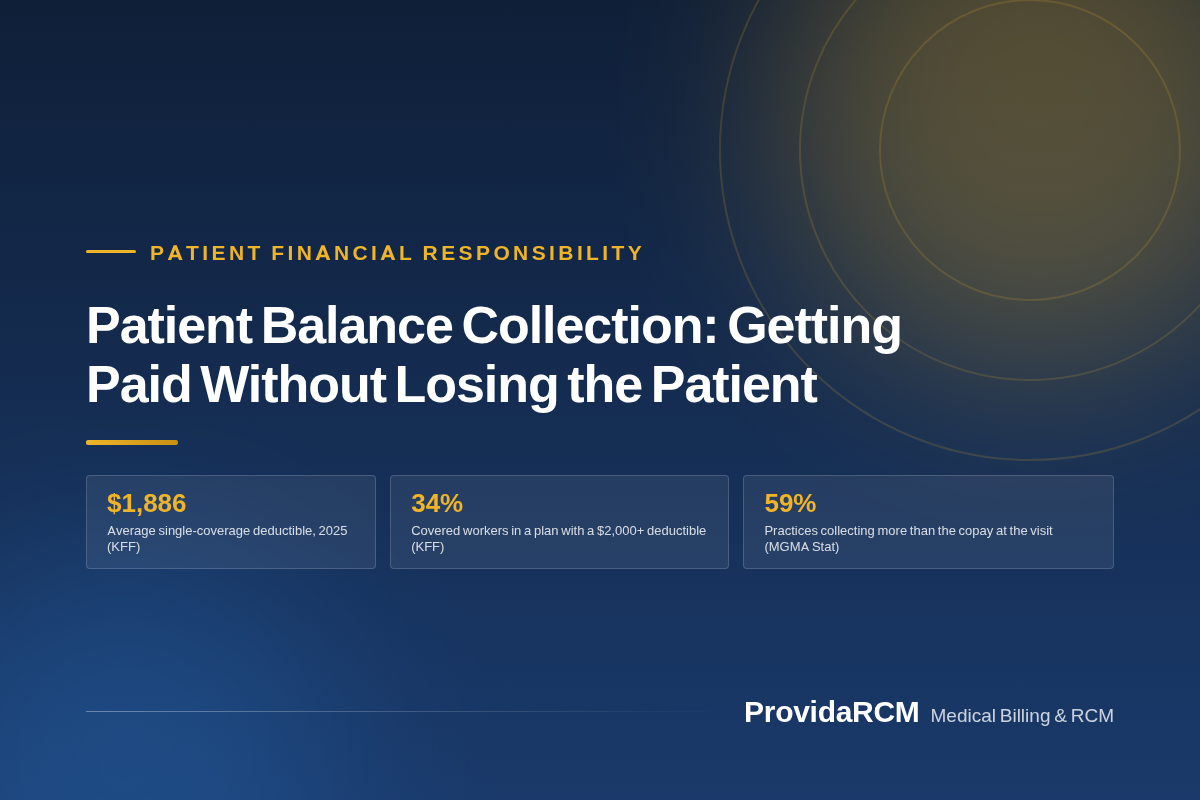
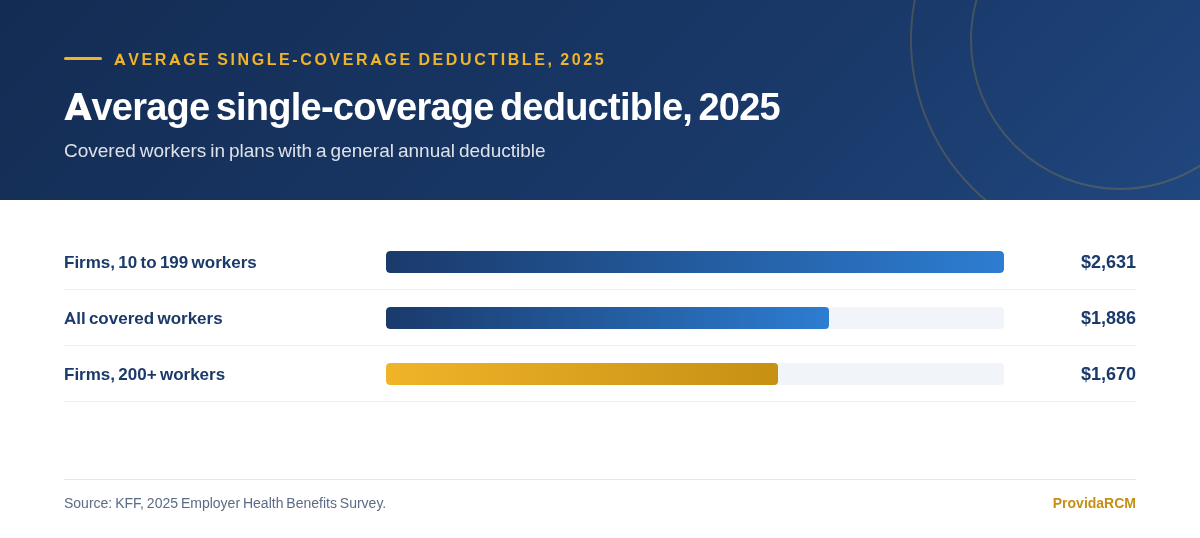
Patient responsibility has grown because the deductible has grown. KFF’s 2025 Employer Health Benefits Survey puts the average single-coverage deductible at $1,886, up 43% over ten years, and 34% of covered workers now sit in a plan with a $2,000 deductible or higher. At firms with 10 to 199 workers the average single deductible is $2,631. A practice that treated a $40 copay as the whole patient conversation is now quoting five or ten times that.
Move the number earlier. An estimate delivered before the visit turns a debt conversation into a planning conversation, and it removes the most common reason patients give for not paying: nobody told them what it would cost.
Estimate the patient’s share before the visit, not after
An estimate built on a real eligibility and benefits check is worth more than a guess built on last year’s plan. Run the check 48 to 72 hours before the appointment, confirm the deductible remaining, the coinsurance percentage, the copay and the out-of-pocket maximum, and quote from those figures. The insurance verification checklist walks through the fields that change the answer.
For an uninsured or self-pay patient the estimate is not optional. Under the No Surprises Act, providers generally must give an uninsured or self-pay patient a good faith estimate of expected charges, and the patient can dispute a bill that lands at least $400 above it (CMS explains the patient-side rules). Our post on good faith estimates covers who needs one and when.
Not every practice collects at the point of service, and not every plan allows it. Where the participation agreement requires the practice to wait for adjudication, the estimate still does its job: it sets the expectation, so the statement that arrives later matches a number the patient already heard. The estimate is the control. Collection is only one of the ways it pays off.
What practices collect at the time of service
Source: MGMA Stat poll, 1,338 responses, April 2017. Shares are as MGMA reported them.
Collect at the point of service where the plan allows it
Where the plan permits it, collection at the point of service is the most reliable patient payment a practice takes. The money is collected while the visit is still a service rather than a bill, and the staff has the patient’s full attention. Where the plan does not permit it, do not invent a workaround. Read the participation agreement, then decide.
The 835 remittance advice tells you what belongs to the patient. The group code PR means patient responsibility, and the codes underneath it decide what may be billed. The wordings below are taken from the live X12 code list, not from a payer crosswalk, because crosswalks are the part that goes stale.
| Group code and CARC | X12 wording | What the patient owes | Before you bill it |
|---|---|---|---|
| PR-1 | Deductible Amount | The unmet deductible for the plan year | Confirm the remaining deductible on the day of service |
| PR-2 | Coinsurance Amount | A percentage of the allowed amount | Calculate from the allowed amount, never from your charge |
| PR-3 | Co-payment Amount | A flat dollar amount set by the plan | Collect at the desk where the plan allows it |
| CARC 45 (CO or PR) | Charge exceeds fee schedule/maximum allowable or contracted/legislated fee arrangement | The amount above the allowed amount, only when the adjustment falls on the patient | Do not move a CO-45 contractual write-off to the patient |
| PR-275 | Prior payer’s patient responsibility (deductible, coinsurance, co-payment) not covered | The first payer’s patient share that the secondary plan will not cover | Check the coordination of benefits order first |
CARC 15, the old code for an authorization number that is missing, invalid or does not apply, was deactivated on 1 May 2018. The live X12 list marks it with a stop date and it still appears in vendor crosswalks as current. When a patient account is being built from a mapping that calls CARC 15 active, the age of that mapping is the finding.
The statement has to reconcile against the explanation of benefits
Most patient complaints start with two pieces of paper that do not agree. The patient has the explanation of benefits from the plan, the practice has a statement, and the numbers differ because one shows the billed charge and the other shows the allowed amount. A statement that leads with the allowed amount, names the deductible and coinsurance already applied, and shows what the plan paid removes that argument before it starts.
Send fewer statements, not more. A first statement, one reminder and one final notice before escalation is a sequence a patient can follow. Six statements in ten weeks teach the patient that the practice is not serious about any of them. The count and the interval belong in the written policy, and every account of the same size should get the same sequence.
- Lead with the allowed amount and the plan’s payment, then the patient’s share
- Name the deductible and coinsurance amounts already applied to the account
- Show the date the claim was adjudicated alongside the visit date
- Give one phone number and one online option for a payment question
- Print a plain-language reason for any amount the plan did not cover
Balance-level reconciliation is patient statement services work, which is the argument for keeping the statement cycle with the team that posts the remittance. When the people who send the statement never see the 835, the patient is the one who finds the mismatch, and the practice pays for it in call volume. A practice measuring its net collection rate will see statement mismatches show up there before they show up anywhere else.
Write the collection policy down before anything goes out
Consistency is the whole product. A patient offered a payment plan on Tuesday and a collection notice on Friday will not pay either amount, because the practice has taught the patient that the rules move. Each decision below has to be written, dated and owned by a named person before the first statement leaves the building.
| Decision | What the policy must state | Who owns it | The default that causes trouble |
|---|---|---|---|
| Statement count and interval | How many statements go out and how many days apart | Billing manager | Statements sent when staff has time, so no two accounts get the same sequence |
| Discount authority | Who may reduce a balance, by how much, on what grounds | Practice owner | The front desk discounts to end an argument and the write-off is never reviewed |
| Payment plan terms | The minimum monthly amount, the maximum length, and when a plan is first offered | Billing manager | Plans offered only after a collection notice, when the patient is already angry |
| Write-off reasons | Which adjustments are allowed and which balances may be written off | Billing manager and owner | Balances parked in an aged bucket with no reason attached |
| Small-balance threshold | The minimum balance that justifies a statement, a call or an agency referral | Practice owner | A small balance referred out at a cost above the balance |
| Escalation trigger | The exact point a balance leaves the practice | Practice owner | One account escalated at 60 days and another at 300 |
The 501(r) clock a hospital facility works against
Source: IRS, Section 501(r)(4) financial assistance policy and Section 501(r)(6) billing and collections rules.
The 501(r) rules bind hospital organizations, not independent physician practices, so a group with no hospital facility has no financial assistance policy requirement. A practice that shares a billing office with a hospital, or bills on behalf of one, has to know which side of that line it stands on. The AR management team sorts accounts by the policy that governs them before anyone calls a patient, because the escalation route depends on it.
The legal frame behind patient balance collection
The obligations come from four places: the participation agreement with each payer, the Fair Debt Collection Practices Act, the Fair Credit Reporting Act, and state consumer law where a state has written one. The participation agreement is the one practices forget, and it is the one that decides whether a practice may collect before adjudication.
The FDCPA applies to a debt collector, and most practices are not one. Section 1692a(6)(A) excludes an officer or employee of a creditor who collects the creditor’s own debt in the creditor’s name (15 U.S.C. 1692a). A practice billing its own patient for its own service, under its own name, sits inside that exclusion. Two things move a practice out of it: using a name that suggests a third party is collecting, and handing the account to an outside agency, which is a debt collector covered by Regulation F, 12 CFR part 1006.
The credit reporting rule that would have removed medical debt from consumer reports is not in effect. The CFPB finalized the Prohibition on Creditors and Consumer Reporting Agencies Concerning Medical Information rule on 7 January 2025, published it at 90 Fed. Reg. 3276 on 14 January 2025, with an effective date of 17 March 2025. On 11 July 2025 the U.S. District Court for the Eastern District of Texas vacated it in Cornerstone Credit Union League v. CFPB, No. 4:25-cv-00016, holding that it exceeded the Bureau’s authority and conflicted with section 1681b(g) of the Fair Credit Reporting Act (the Bureau’s rule page now labels the materials reference only).
The operative rule is therefore the one that was always there. FCRA section 1681b(g) permits a consumer reporting agency to report medical debt information as long as the information does not identify the provider or the nature of the services. A practice that furnishes accounts, or refers them to an agency that furnishes, should confirm what is actually being reported and should not assume a federal ban is doing the work.
A large share of the medical billing content published since 2025 still describes the Regulation V medical debt rule as a live prohibition with compliance dates ahead of it. It was vacated on 11 July 2025 and the Bureau’s own page says the materials are for reference only. A written policy built on the old summary is built on a rule no court will enforce.
| Rule | Who it binds | What it requires of a practice | Where it lives |
|---|---|---|---|
| FDCPA | Debt collectors as defined in the statute | Nothing, for a practice collecting its own debt in its own name | 15 U.S.C. 1692 et seq. |
| Regulation F | FDCPA debt collectors, including outside agencies and debt buyers | Vetting any agency before an account is referred to it | 12 CFR part 1006 |
| FCRA medical information | Consumer reporting agencies and furnishers | Coded, accurate information only | 15 U.S.C. 1681b(g) |
| Medical debt reporting rule | Vacated 11 July 2025 | No compliance duty remains | 90 Fed. Reg. 3276; Cornerstone Credit Union League v. CFPB |
| Section 501(r) | Hospital organizations and their facilities | A written financial assistance and billing policy | 26 CFR 1.501(r)-4 |
Questions practices ask us about this
Does the FDCPA apply when a medical practice bills its own patients?
Generally no. The definition of debt collector at 15 U.S.C. 1692a(6) excludes an officer or employee of a creditor who, in the creditor’s name, collects the creditor’s own debts. A practice collecting its own balance under its own name falls inside that exclusion. If the practice uses a name suggesting a third party is collecting, or refers the account to an outside agency, the analysis changes and Regulation F applies to the agency.
Is medical debt still reported to credit bureaus?
There is no federal ban in effect. The CFPB’s Regulation V medical debt rule was vacated on 11 July 2025 by the U.S. District Court for the Eastern District of Texas in Cornerstone Credit Union League v. CFPB, so it imposes no duty on anyone. FCRA section 1681b(g) still permits coded medical debt information on consumer reports. Whether a specific account is furnished depends on the practice’s policy and its bureau or agency agreement, not on the vacated rule.
How many statements should we send before escalating a patient balance?
There is no federal number, and a practice should not copy one from a vendor page. The count and the interval are policy decisions. A workable default is a first statement, one reminder and one final notice, each a defined number of days apart, with the escalation point written down before the first statement goes out. Whatever the practice chooses, the same balance should get the same sequence.
Can we collect the patient’s deductible at the time of service?
Only where the plan and the participation agreement allow it. Some agreements require the practice to wait for adjudication before billing the patient anything, and the amount can change between the estimate and the remittance. Confirm the payer’s own rule first, then collect the copay, deductible or coinsurance it permits. Where collection is not permitted, the upfront estimate still sets the patient’s expectation.
Why does our statement disagree with the patient’s explanation of benefits?
Because one document usually shows the billed charge and the other shows the allowed amount. The explanation of benefits from the plan reports the allowed amount, the plan payment and the patient’s share under the group code PR. A statement that leads with the billed charge looks wrong even when every figure on it is right. Rebuild the statement to lead with the allowed amount and the plan’s adjudication date.
Which CARC codes create a patient balance?
The patient responsibility group code, PR, carries the balance. Under it, CARC 1 is the deductible amount, 2 is coinsurance, 3 is the co-payment, and 275 is a prior payer’s patient responsibility that a secondary plan will not cover. CARC 45 reports a charge above the allowed amount and is used with group code CO or PR depending on who bears the adjustment, so it should never be moved to the patient automatically.
Want the patient balance work off your front desk?
We run statements, patient collections and full-cycle billing for practices across the country. Send us a few months of accounts and we will show you where the balances are leaking.
Book a free billing review- CFPB, Prohibition on Creditors and Consumer Reporting Agencies Concerning Medical Information (Regulation V), vacated July 11, 2025. consumerfinance.gov/rules-policy/final-rules/prohibition-on-creditors-and-consumer-reporting-agencies-concerning-medical-information-regulation-v
- U.S. District Court, E.D. Tex., Cornerstone Credit Union League v. CFPB, No. 4:25-cv-00016, memorandum opinion and order vacating the Medical Debt Rule, July 11, 2025. law.justia.com/cases/federal/district-courts/texas/txedce/4:2025cv00016/235173/52
- 15 U.S.C. 1692a, FDCPA definitions, including the creditor exclusion at 1692a(6)(A). law.cornell.edu/uscode/text/15/1692a
- 12 CFR Part 1006, Debt Collection Practices (Regulation F). ecfr.gov/current/title-12/chapter-X/part-1006
- X12, Claim Adjustment Reason Codes and Claim Adjustment Group Codes (current list). x12.org/codes/claim-adjustment-reason-codes
- KFF, 2025 Employer Health Benefits Survey, deductibles and premiums. kff.org/health-costs/2025-employer-health-benefits-survey
- CMS, Medical bill rights and the No Surprises Act patient protections. cms.gov/initiatives/your-patient-rights/medical-bill-rights
- IRS, Financial assistance policy and emergency medical care policy, Section 501(r)(4). irs.gov/charities-non-profits/financial-assistance-policy-and-emergency-medical-care-policy-section-501r4
- MGMA Stat, Collecting the patient’s responsibility for care. mgma.com/mgma-stats/collecting-the-patient-s-responsibility-for-care