The net collection rate tells you what your practice actually collected against what it was genuinely owed, not against the sticker price it billed. It is the hardest number in the revenue cycle to dress up, because the denominator only counts the dollars a payer contract said you could keep.
The net collection rate is what you collected against what you were owed
The net collection rate is payments received divided by charges net of contractual adjustments, measured over the same period. Payments means the money that posted, insurance and patient together, less refunds and credits. Charges net of contractual adjustments means what the payer contracts allowed your practice to collect. Because it runs on cash movement rather than claim events, it is the number a busy front office cannot accidentally inflate.
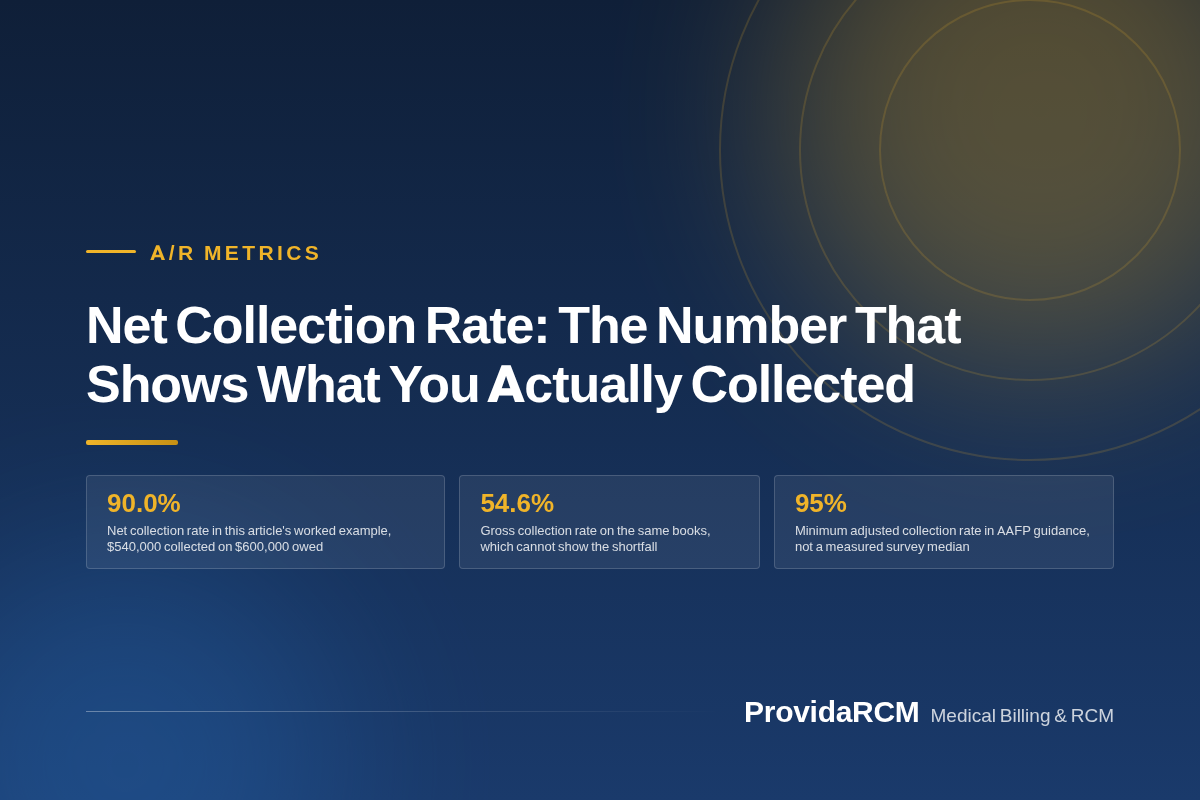
The American Academy of Family Physicians publishes the arithmetic under the name adjusted collection rate: payments net of credits, divided by charges net of approved contractual agreements, over a 12-month window. It states the result should be 95 percent at minimum, that the average runs 95 to 99 percent, and that the highest performers reach 99 percent (AAFP practice finances).
There is a reason this number belongs at the top of the report. A practice’s charges are a fee schedule, its contractual adjustments are a set of contracts, and its payments are the only line that reflects work done. The net collection rate is the one ratio in the revenue cycle built mostly from that third line.
| Line | Where it goes | Why it matters |
|---|---|---|
| Insurance payments posted | Numerator | Cash that actually landed, not the amount billed |
| Patient payments posted | Numerator | Leaving patient cash out quietly understates the rate |
| Refunds and credits issued | Subtracted from the numerator | A reversal is not a collection, so it comes back out |
| Billed charges | Starting point for the denominator | The full fee schedule, before any contract discount |
| Contractual adjustments | Subtracted from the denominator | The discount a payer contract already built in |
The net collection rate answers one question: of the dollars your contracts said you could keep, how many landed in the bank. Everything else in the metric exists to keep that answer honest.
Contractual adjustments have to be posted for the number to mean anything
A contractual adjustment is the gap between what you billed and what the contract says you are allowed to collect. Until that write-off is posted, your charges and your receivables are both overstated. The adjustment posts on the remittance advice under claim adjustment reason code 45, charge exceeds fee schedule, maximum allowable, or a contracted or legislated fee arrangement (X12 code list).
When the adjustment is missing, the denominator stays at gross charges and the net collection rate collapses toward the gross rate. Nothing about your collections changed. The books are simply still carrying money that no payer was ever going to send.
One month, with and without the contractual adjustment posted
Source: worked example in this article.
That is why the posting lag is not bookkeeping housekeeping. A practice two weeks behind on adjustments shows a net collection rate that swings by tens of points and then recovers, and the story told at the monthly meeting becomes a story about payer behavior. HFMA’s MAP Keys define the standard revenue cycle metrics with the equation, inclusions, exclusions and data source for each, and they print no target value.
If a report still tags adjustments with CO-15, that code was deactivated on 1 May 2018, when CO-197 became the code for an absent authorization. The current charge-exceeds-allowable adjustment is code 45. A dashboard built on a retired code is describing a remittance format payers stopped sending years ago.
The gross collection ratio flatters a practice with a write-off habit
The gross collection ratio divides payments by total billed charges. That denominator keeps the contractual discounts in place, so the ratio moves with how the practice sets its fees and with payer mix as much as with collection work. A practice billing at three times the Medicare allowed amount can collect flawlessly and still report a gross ratio near 35 percent.
The flattery runs the other way. Every dollar the practice writes off, expected or not, disappears into the same gap between charges and payments. A contractual discount and an unworked denial look identical to the gross ratio. A practice that writes off hard claims as a habit shows a gross ratio that reads like ordinary fee-schedule discounting, and nothing on the report flags the money that was there to collect.
Walk one month of books. Gross charges of $1,000,000, contractual adjustments of $400,000, and $546,000 in payments less $6,000 in refunds and credits. The net collection rate is $540,000 divided by $600,000, which is 90.0 percent. The gross collection ratio is $546,000 divided by $1,000,000, which is 54.6 percent. This is our own example, built to show the arithmetic rather than to set a benchmark.
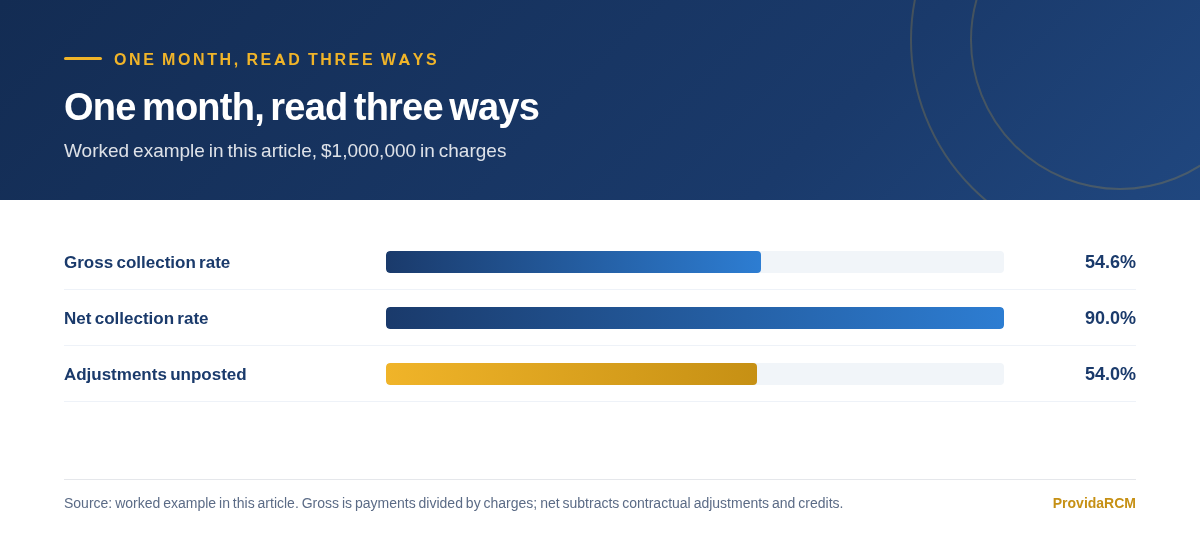
Gross and net collection rate on the same month
Source: worked example in this article.
Both numbers come from one month of books. The gross ratio is useful for one job, spotting a fee-schedule change or a payer-mix shift. It is the wrong number for grading collection performance, because the write-offs you should worry about and the write-offs you agreed to are added together in the same denominator.
Three ways practices get the net collection rate wrong
Most wrong net collection rates come from three decisions, and each one is defensible until it is written down. The fix is not a new system. It is one page of definitions that does not change in the month the number looks bad.
- 01
Unposted contractual adjustments
If adjustments lag or never post, the denominator carries the discount the payer already removed and the rate falls toward the gross figure. Post every remittance within a day or two of receipt, and post the contractual line with it.
- 02
Patient balances counted inconsistently
Some practices leave patient responsibility out of the numerator and the denominator, which lifts the rate. Others count patient payments but not the patient balances owed. Keep both the patient cash and the patient responsibility inside the metric.
- 03
A period mismatch between charges and payments
Charges posted in March were earned by claims submitted weeks later, and payments land after adjudication. Measuring March charges against March cash divides one cohort of claims by a different one, so a change in volume alone moves the rate.
| Treatment | Numerator | Denominator | Rate |
|---|---|---|---|
| Patient cash and balances inside | $540,000 | $600,000 | 90.0% |
| Patient cash excluded | $470,000 | $600,000 | 78.3% |
| Bad debt also removed | $540,000 | $540,000 | 100.0% |
The third line is the one that fools a board. Remove the $60,000 that never arrived from the denominator and the same month reports a flawless 100 percent, while the practice is still short $60,000. That is why the denominator is a management decision, not a software default.
A growing practice reads low on a single month
Source: worked example in this article.
Reconciling the net collection rate against days in A/R and payer contracts
Two numbers that should move together make each other checkable. The net collection rate says whether the money arrives, and days in A/R says how long it takes. When the net rate falls and days in A/R rises at the same time, the loss is real and it is sitting in open receivables. When the net rate falls and days in A/R holds steady, suspect a posting problem rather than payer behavior.
MGMA’s July 2026 poll found days in A/R holding steady for most practices while payer pressure increased, which is exactly the pattern that hides a slow leak behind a stable headline (MGMA Stat).
| What you see | What it usually means | Where to look first |
|---|---|---|
| Net rate falls, days in A/R rises | A real loss sitting in open receivables | Aging report by payer and bucket |
| Net rate falls, days in A/R flat | A posting or classification problem | Unposted adjustments and patient cash |
| Net rate flat, days in A/R rises | Slower payers, same eventual yield | Follow-up queue and appeal calendar |
| Net rate above 100 percent | Non-contractual write-offs pulled from the denominator | Adjustment reason codes on the 835 |
| Net rate falls for one payer only | A contract term or policy change | The payer contract’s allowed amounts |
The contract itself is the second check. Sample paid claims and compare each posted contractual adjustment to the allowed amount the contract specifies. If the adjustment is larger than the contract allows, the practice wrote off money it was owed and the net rate understates the problem. If it is smaller, the practice may be carrying an underpayment as if it were a discount.
That single test catches the most expensive habit in medical billing, which is letting an underpayment pass as a contractual write-off. A code 45 adjustment is supposed to equal the contract gap, nothing more (X12 example 04). When it quietly absorbs denials and filing losses, the net rate looks acceptable and the money is gone.
How to read the net collection rate month to month
A single month is a noisy number. Payments posted in a month were earned by claims submitted earlier, so the numerator and the denominator describe different claim cohorts whenever volume moves. The AAFP advises a 12-month window, and the arithmetic is why: a longer window lets the claims that produced the cash finish adjudicating before they are measured.
- Anchor the numerator and denominator to the same rolling 12-month window, updated monthly
- Report the rate by payer group, so one payer cannot hide inside a healthy blend
- Put unposted adjustments and patient cash posting on the same daily checklist
- Compare the rate to your own trend before comparing it to any published figure
- Never change the definition in a month the number looks bad
The habit that makes the number usable is dull. Write the definition on page one of the monthly report, above the figure, and leave it in place through good months and bad ones. A rate whose arithmetic is explained only when the practice is under question cannot be trended, because you cannot tell a change in collections from a change in counting.
Then read direction, not level. Three months of a falling net collection rate is a trend worth acting on, and one soft month after a coding transition is not. If the slide persists while days in A/R climbs, the work sits in the aging report (A/R aging buckets) and the fastest lever is usually the front end (clean claim rate).
Where the loss is denial-driven, the net collection rate only falls after an appeal window has closed, which is why follow-up belongs to denial management and A/R management rather than to a monthly report. A full-cycle billing team reconciles the rate against the contract and the aging at the same time.
Questions practices ask us about this
What is a good net collection rate for a medical practice?
The American Academy of Family Physicians publishes the guidance most often quoted: an adjusted collection rate of 95 percent at minimum, an average of 95 to 99 percent, and 99 percent for the highest performers. It is published as guidance, not as a measured survey median. No national body publishes a target value with a sample behind it. Read the direction of your own number before you read any target.
How is the net collection rate different from the gross collection ratio?
They differ in the denominator. The gross collection ratio divides payments by total billed charges, so contractual discounts stay in and the number moves with your fee schedule and payer mix. The net collection rate divides payments by charges net of contractual adjustments, so only the dollars you were allowed to keep remain. Gross is useful for spotting fee-schedule shifts. Net is the collection scorecard.
Why does an unposted contractual adjustment change the net collection rate?
Because the denominator is charges net of contractual adjustments. When the adjustment is not posted, charges stay at their billed value and the denominator is too large, so the rate falls toward the gross ratio. Nothing about your collections changed, but the number now describes a fee schedule rather than your work. Post the adjustment with the remittance.
Should patient balances be part of the net collection rate?
Yes, and consistently. The AAFP formula counts payments net of credits against charges net of approved contractual agreements, which includes patient responsibility because it is money the practice was allowed to collect. Practices that leave patient cash out of the numerator report a lower rate, and practices that also strip patient balances from the denominator report a higher one. Pick one treatment and hold it.
What time period should the net collection rate cover?
Twelve months, on a rolling basis. A single month divides cash posted in that month by charges posted in that month, and those two figures come from different claim cohorts. The AAFP advises a 12-month window, and the effect of a shorter one is largest for a practice whose volume is changing, because a growing practice reads low and a shrinking one reads high.
How do I know when the net collection rate is hiding a real problem?
Check it against days in A/R and against the payer contracts. If the rate falls while days in A/R rises, the loss is sitting in open receivables. If the rate falls while days in A/R is steady, suspect posting. Then sample paid claims and compare each posted code 45 adjustment to the allowed amount in the contract, because an underpayment booked as a contractual write-off inflates the ratio.
Want your net collection rate measured correctly?
We run full-cycle billing, coding, credentialing and denial work for practices across the country, and we reconcile the net collection rate against your payer contracts and your aging.
Book a free billing review- HFMA MAP Keys, industry-standard revenue cycle KPIs, definitions with inclusions and exclusions. hfma.org/data-and-insights/map-initiative/map-keys
- American Academy of Family Physicians, Practice finances and revenue cycle management (adjusted collection rate). aafp.org/practice-operations/practice-finances
- X12, Claim Adjustment Reason Codes, current and deactivated code list. x12.org/codes/claim-adjustment-reason-codes
- X12, Example 04, Claim Adjustment Reason Code 45, charge exceeds fee schedule or contracted amount. x12.org/examples/005010×221/example-04-claim-adjustment-reason-code-45
- MGMA Stat, Days in A/R holds steady but payer pressure persists, July 2026. mgma.com/mgma-stat/days-in-a/r-holds-steady-for-most-practices-but-payer-pressure-persists-in-2026
- MGMA, 2025 Financials and Operations Data Report. mgma.com/2025-financials-and-operations