
A credit balance is money your practice is holding that belongs to someone else: a payer that paid twice, a patient who paid before the claim was adjudicated, or a payment posted to the wrong account. It is a liability with a clock on it, and Medicare’s clock is 60 days.
A credit balance is money that belongs to someone else
A credit balance is any account where the money posted exceeds what the practice is owed. In most systems it shows up as a negative patient balance, a credit sitting on the ledger, or unapplied cash nobody has matched to a claim. The service was billed, but someone paid more than the allowed amount, paid a claim another payer had already settled, or paid an account that was never theirs. The ownership is not the practice’s.
Two parties can own a credit balance: a payer and a patient. A payer credit is money a health plan sent that it did not owe, usually because a claim was paid twice or paid in the wrong order. A patient credit is money the patient paid that the plan later covered, or paid twice at the desk. A third group belongs to neither: posting errors that landed a payment on the wrong account.
The destination differs by owner. Payer money goes back through a claim adjustment or a refund with the explanation of benefits attached. Patient money goes back to the patient with a letter saying what it is for. Neither becomes revenue. Writing the amount off to close the account does not remove the liability. It removes the liability from the report.
If the practice was not entitled to the money when it arrived, the practice is holding someone else’s cash. For every credit, answer two questions: which payment source produced it, and what does that payer or patient expect to happen next.
Six ways a credit balance gets created
Credits do not appear at random. In a practice they come from six situations that repeat, and each leaves a recognizable mark in the ledger. Naming the cause before touching the account keeps you from resolving a Medicare overpayment as a patient refund, or sending a payer money that belonged to the patient.
| Cause | What the ledger shows | Who it belongs to | The correct move |
|---|---|---|---|
| A payment posted twice | Two identical payments on one claim | The payer, if both came from it | Reverse the duplicate, then refund it |
| The payer paid after the patient | The patient paid at the desk, then the plan paid its share | The patient | Refund the patient what the plan covered |
| A posting error on the wrong account | A credit with no matching charge, and a short payment elsewhere | The payer or the patient who was shorted | Move the payment to the account it belongs to |
| A coordination of benefits change | A paid claim now carries CARC 22, care may be covered by another payer | The payer that paid in the wrong order | Fix the COB order, then refund that payer |
| A secondary payer pays a written-off balance | A contracted write-off and a payment for the same amount | The secondary payer | Re-adjudicate the claim or return the payment |
| Two payers both paid as primary | Two primary payments for one date of service | The payer that did not owe the claim | Return one payment with the other plan’s EOB |
Two of those six are Medicare problems and four usually are not, and that difference decides which clock you are on. A duplicate Medicare payment, a Medicare payment made when another plan was primary, and a payment for a service never furnished are Medicare overpayments. A patient who paid twice is a refund to that patient. Mixing the categories is how a practice refunds the wrong party and then owes the money twice.
What Medicare requires before the credit gets old
Medicare’s rule is statutory and it is short. Section 1128J(d) of the Social Security Act, carried in the United States Code at 42 U.S.C. 1320a-7k(d), requires a person who received an overpayment to report it and return it. The regulation implementing it, 42 CFR 401.305, sets the deadline.
Under 42 CFR 401.305(b)(1), an overpayment must be reported and returned by the later of 60 days after it was identified, or the date the corresponding cost report is due. A physician practice files no cost report, so the 60 days is the operative number. The lookback in 401.305(f) reaches overpayments identified within six years of receipt.
Identification is where practices get caught. Since the December 2024 amendment (89 FR 98553), a person has identified an overpayment when they knowingly receive or retain it, with knowingly taking its meaning from the False Claims Act at 31 U.S.C. 3729(b)(1)(A). Actual knowledge, deliberate ignorance, and reckless disregard each start the clock.
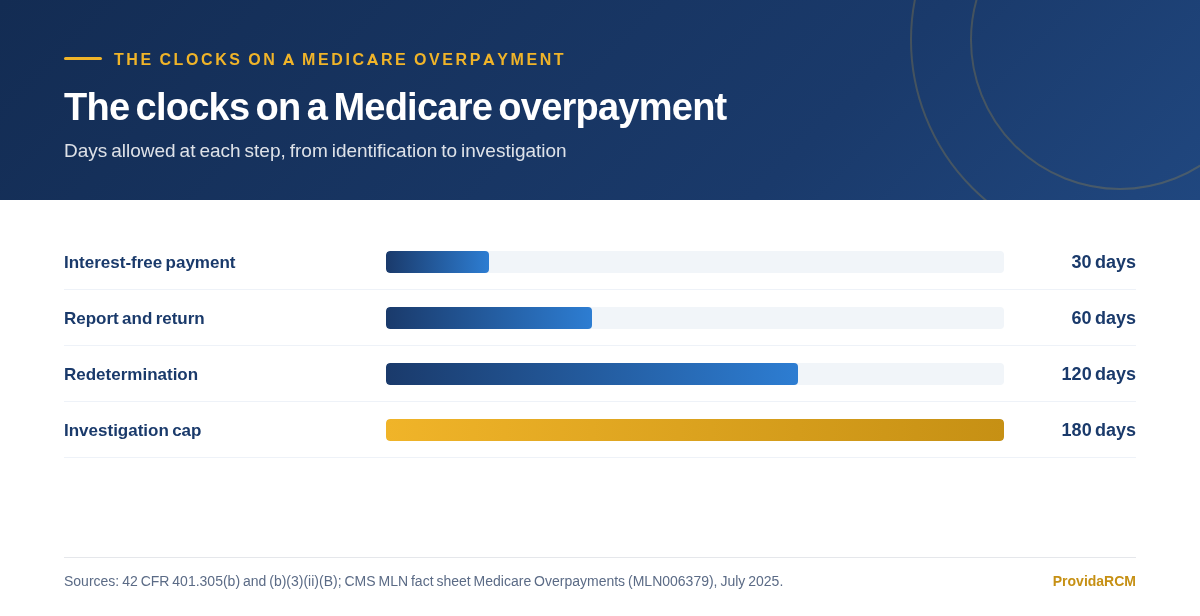
The CMS Medicare Overpayments fact sheet confirms the 60 days and the lookback. 42 CFR 401.305(d)(1) accepts a claims adjustment, a credit balance report, a self-reported refund, or another process your contractor sets up. The clock pauses while a disclosure sits with the OIG Self-Disclosure Protocol, or while you run a timely, good-faith investigation of related overpayments.
Medicare’s 60 days is not a commercial payer’s deadline. Retention past the deadline makes the overpayment an obligation under the False Claims Act, so the exposure is statutory. A commercial plan recovering money is enforcing the recovery clause in the participation agreement, which sets its own notice period. Read that clause instead of assuming Medicare’s number applies.
An unworked credit balance is an exposure, not an asset
A credit balance sits in the ledger as cash, and that is the problem. The money is a liability even after it has been spent, so a healthy bank balance can hide a refund the practice already owes. When the payer finds it first, the recovery arrives as a takeback or a demand letter, and interest accrues on what is unpaid.
The Office of Inspector General has audited this for years. In one multistate review of credit balances, seven of eight sampled hospitals did not reconcile invoice records against the balances on those accounts and report the overpayments they contained. The balances were not automatically overpayments either, which is what makes the work unavoidable.
Share of reviewed credit balances that were overpayments
Source: HHS OIG reports A-01-91-00515 (1,370 Medicare credit balances reviewed, 457 overpayments) and A-02-08-01029 (130 balances reviewed, three overpayments).
The dollar exposure is only part of it. An overpayment Medicare identifies through this rule can be pursued as a reverse false claim, which adds penalties and multiples to the amount. An overpayment a commercial payer finds is simpler: interest, a recoupment, and a number on the board report.
How to find the credit balances nobody is working
Start with the ledger, not with a payer’s letter. A credit balance report is a dated list of every account carrying a credit, with the payment source, posting date, amount, and age. Most systems produce it in a few minutes, and credits stay open for years because nobody runs it. Put payer recovery notices on the same list.
Then reconcile what was posted against what reached the bank. Total the payments posted to the ledger, deposit the day’s receipts, and explain the difference. When deposits exceed posted payments, the excess is unapplied cash that will surface later as a credit on whatever account someone eventually guesses. That is the discipline behind unapplied payments, and the only routine control that catches a wrong-account post early.
When a credit balance was an overpayment
Source: HHS OIG, A-04-12-04021. Counts are the sampled records in that review, not a national rate.
Medicare once required a quarterly Medicare Credit Balance Report, Form CMS-838. That requirement ended on 1 December 2024, as the CMS MLN Connects newsletter states: providers still report self-identified overpayments, but complete a credit balance report when one occurs. Chapter 12 of the Medicare Financial Management Manual adds the part that matters: moving balances into a holding account or writing them off does not release the practice from the liability.
| Signal | What it usually means | First move |
|---|---|---|
| A standing credit with no account activity | A duplicate payment, an unissued refund, or unapplied cash | Pull the remittance behind every payment on the account |
| A payer notice, takeback, or demand letter | The payer already found the overpayment | Match it to your ledger the day it arrives |
| Deposits above posted payments for a month | Cash received but never applied to a claim | Post or match the difference before month end |
| A written-off balance paid months later | A secondary payer or the patient paid after the write-off | Re-adjudicate or refund it, never book it as revenue |
Resolving each credit the right way
Every credit has one correct destination. Payer money returns to the payer, patient money returns to the patient, and money that genuinely belongs on the account stays on that account. The work is choosing among those three rather than moving cash until the report looks clean. A credit zeroed out against a different patient’s balance is still a liability, hidden in someone else’s chart.
It looks tidy and it creates two problems. The first patient’s money is still owed to the first patient, and the second patient’s account has been closed with someone else’s cash, which cannot be explained in an audit.
- 01
Identify the owner from the payment source
Read the remittance or the receipt, not the ledger note. The source says whether this is payer money, patient money, or a posting error.
- 02
Match the payment to the claim and the EOB
Confirm the date of service, the billed amount, and the allowed amount. A credit that cannot be matched to a claim is a duplicate or a wrong-account post.
- 03
Choose the destination and post the offsetting entry
Refund the payer, refund the patient, or apply the credit to a genuine balance on the same account. One destination, one entry.
- 04
Send the refund with the supporting document
Payer refunds go back through the contractor’s process with the explanation of benefits attached. Patient refunds go out with a plain-language letter.
- 05
Confirm the refund landed and close the account
Track the check or the adjustment until it clears. A refund that is sent and never processed leaves the liability where it was.
| Credit | Correct destination | Never do this |
|---|---|---|
| Medicare paid twice for the same service | Return it through the contractor’s refund or adjustment process | Apply it to another visit without an adjustment |
| Medicare paid while another plan was primary | Refund Medicare once the COB order is corrected | Hold it because the other plan might ask later |
| The patient paid, then the plan covered the claim | Refund the patient at the address on file | Leave it because the patient has not asked |
| A payment posted to the wrong patient | Move it to the account that earned it | Leave it there and clear the other account |
| A secondary payer paid a written-off balance | Re-adjudicate or return the payment to that payer | Book it as recovery revenue |
The patient side is where credits sit longest, because mailing a check to someone who has not asked for one costs money. It is not optional. If a patient paid a balance that insurance later covered, the practice owes a refund, and holding it because the patient has not complained converts the credit into unclaimed property. North Carolina presumes a credit balance abandoned five years after the owner’s right to demand it, under N.C. Gen. Stat. 116B-53(c)(16).
Do the search before that clock runs. Send the refund to the last known address with a letter, keep the returned mail, and document the attempt. Every state has an unclaimed property statute, and the periods and reporting dates differ, so read the law for the state where the practice operates.
The controls: posting discipline, a monthly review, an escalation age
Three controls close the loop. The first is posting discipline: post from the remittance advice the day it arrives, never key a payment without a source document, and reconcile posted payments against the bank deposit daily. A duplicate post is a two-second error that turns into a refund or an audit finding.
The second is a monthly credit balance review with a named owner. One person owns it, sorted by age and by payer, and every line gets a disposition before the month closes: refund, adjustment, or a documented reason it stays open. The third is the escalation age. A credit balance at 60 days gets an owner and a due date, and anything past 90 days goes to the manager with the reason.
- Post every remittance advice within one business day of receipt
- Reconcile payments posted to the ledger against the daily bank deposit
- Run the credit balance report on the last business day of every month
- Give every credit balance an owner and a due date at 60 days
- Escalate anything older than 90 days, with the reason, to the manager
- Report Medicare overpayments through the contractor inside 60 days of identification
Track two figures: the age of the oldest open credit balance and the dollar total older than 90 days. If the total over 90 days falls every month, the process works. If it climbs while collections look strong, the practice is holding money it will eventually return, or lose.
Questions practices ask us about this
What is a credit balance in medical billing?
A credit balance is an account where the money posted exceeds what the practice is owed. It comes from a payment posted twice, a payer that paid after the patient already paid, a posting error on the wrong account, a coordination of benefits change, or two payers that both paid as primary. The money belongs to a payer or a patient, so it stays a liability until it is returned.
How long do we have to return a Medicare overpayment?
The later of 60 days after the overpayment was identified or the date the corresponding cost report is due, under 42 CFR 401.305. Identification follows the False Claims Act standard, so knowing about the overpayment and doing nothing starts the clock.
Can we apply one patient’s credit balance to another patient’s account?
No. The money belongs to the person or payer that sent it, so it can only go to a genuine remaining balance on that same account or back to its source. Moving it to another patient’s account hides the credit and leaves two accounts that cannot be defended in an audit.
Do we still have to send a quarterly CMS-838 credit balance report?
No. Starting 1 December 2024, CMS no longer requires providers to submit the Medicare Credit Balance Report, Form CMS-838, on a quarterly basis. The duty to report and return self-identified overpayments did not change; a credit balance report is completed when an overpayment occurs.
What happens to a patient credit balance nobody claims?
Send the refund to the last known address with a letter explaining it, and document the attempt. If the patient cannot be located, the money becomes unclaimed property under state law. North Carolina, for example, presumes a credit balance abandoned five years after the owner’s right to demand it under N.C. Gen. Stat. 116B-53(c)(16).
How often should a practice review credit balances?
Monthly, on a dated report with a named owner. Sort it by age and by payer, disposition every line, and escalate anything older than 90 days to the manager. The 60-day mark is the trigger to assign a person and a due date.
Want the credit balances cleared?
We run full-cycle medical billing and AR management, including the monthly credit balance review and the payment-to-deposit reconciliation behind it.
Book a free billing review- eCFR, 42 CFR 401.305, Requirements for reporting and returning of overpayments. ecfr.gov/current/title-42/chapter-IV/subchapter-A/part-401/subpart-D/section-401.305
- CMS, Medicare Learning Network fact sheet, Medicare Overpayments (MLN006379, July 2025). cms.gov/files/document/medicare-overpayments.pdf
- CMS, Medicare Financial Management Manual, Chapter 12, Credit Balance Reporting. cms.gov/files/document/chapter-12-instructions-medicare-credit-balance-report-activities.pdf
- CMS MLN Connects, quarterly credit balance reports no longer required, 19 December 2024. cms.gov/training-education/medicare-learning-network/newsletter/2024-12-19-mlnc
- HHS OIG, Acute Care Hospitals in Georgia Did Not Always Reconcile Credit Balances (A-04-12-04021). oig.hhs.gov/oas/reports/region4/41204021.pdf
- North Carolina General Statutes, G.S. 116B-53, Presumptions of abandonment. ncleg.gov/EnactedLegislation/Statutes/Pdf/BySection/Chapter_116B/GS_116B-53.pdf