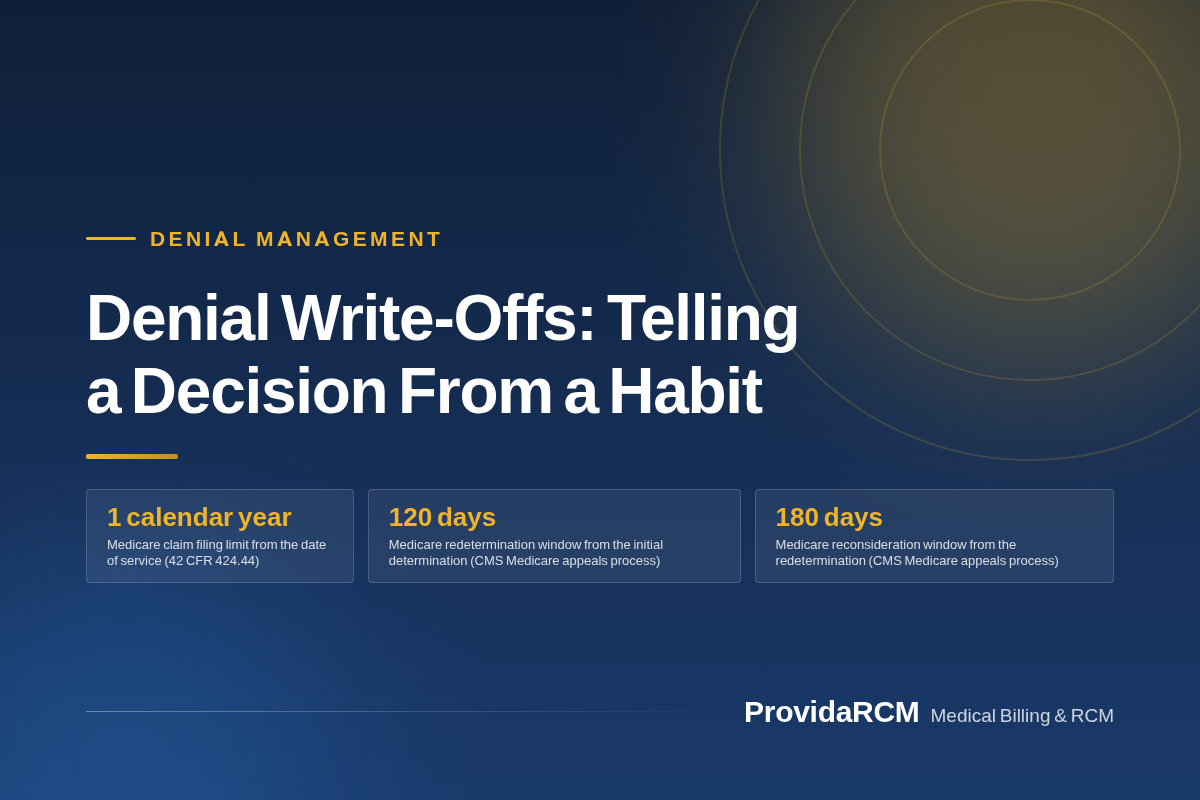
Denial write-offs are not one number, they are four. A contractual adjustment the fee schedule required, a patient responsibility the patient still owes, a true write-off the practice chose, and bad debt that went to collections and failed. The remittance advice already labels each line. Reading those labels is the difference between a decision and a habit.
Denial write-offs are four different numbers wearing one label
Most practices report one write-off figure at month end. That figure is the sum of four unrelated events, and the sum tells you nothing you can act on. Separating them is the first step, because each bucket has a different owner, a different cure, and a different effect on the reports you send to the partners.
The four buckets are the contractual adjustment, the patient responsibility, the true write-off, and bad debt. They arrive on the same remittance, often on the same claim, and they are posted by the same person in the same afternoon. That is exactly why they get collapsed into one line.
| Bucket | What decided it | Where the balance went | Group code on the 835 |
|---|---|---|---|
| Contractual adjustment | The fee schedule or contracted rate | Nobody owes it. It is the gap between the charge and the allowed amount | CO |
| Patient responsibility | The plan benefit design | Still owed by the patient | PR |
| True write-off | A practice policy | The practice chose to stop collecting it | CO or OA |
| Bad debt | A collection effort that failed | Uncollected after normal billing and follow-up | No adjustment line |
A contractual adjustment is not a loss. It is the difference between what you billed and what the contract says you are allowed to collect, and no appeal changes it. CARC 45 carries the rule: charge exceeds the fee schedule, the maximum allowable, or the contracted rate. Posting that gap as revenue and then writing it off overstates your charges and hides whether the rest of the account was ever worked.
A patient responsibility is different in every way that matters. It is money someone still owes, it is not a loss to the practice, and it does not belong in a write-off total at all until the practice decides to stop collecting it. A true write-off is that decision. Bad debt is the same decision made late, after the collection effort already failed.
When contractual adjustments, patient balances and true write-offs all post to one account, the month-end figure can fall while your recoverable money falls with it. The total moves for reasons that have nothing to do with the work your team did.
The remittance tells you which bucket a line belongs to
Every adjustment on an electronic remittance carries a claim adjustment group code, and that code answers the question a write-off report never asks: who is supposed to pay this balance. X12 defines five of them, and CMS states the financial responsibility each one assigns. The current X12 list is the authority on the wording, not a payer crosswalk that goes stale.
CO assigns the balance to the provider. PR assigns it to the patient. PI is a payer-initiated reduction, CR is a correction not used on the 005010 standard and later, and OA covers what the rest do not. That single letter is why two claims with the same dollar value are not the same problem.
Adjustment group codes by who owns the unpaid balance
Source: X12 claim adjustment group code definitions (CO, PR, OA, PI, CR).
| Group code | What X12 calls it | Who owns the balance | Can the patient be billed |
|---|---|---|---|
| CO | Contractual Obligation | The provider | No |
| PR | Patient Responsibility | The patient | Yes. This is what permits it |
| PI | Payer Initiated Reductions | The payer | No |
| OA | Other Adjustment | Depends on the reason code | Depends on the reason code |
| CR | Corrections and Reversal | Correction only, not for 005010 and later | Not applicable |
CMS is explicit about the consequence. A Medicare beneficiary may be billed only when the group code is PR. A line posted as CO is not a patient balance, and treating it as one sends a statement for money the plan has already resolved. The CMS remittance advice guidance puts the responsibility on the group code rather than on your internal posting.
Writing a balance off your books removes it from your receivable. It does not, by itself, settle the patient’s obligation, and CMS ties patient billing to the group code rather than to your posting. Patient balances raise their own questions, and this article stays on the practice’s own books.
Posting everything to one bucket breaks both of your rates
The denial rate is denials divided by claims submitted. The net collection rate is payments divided by charges minus contractual adjustments. Both formulas depend on the buckets being kept apart, and collapsing them corrupts the two in opposite directions.
Post a contractual adjustment as a denial and the denial rate climbs with money that was never collectible. Post a true write-off or a patient balance as a contractual adjustment and the denominator of the net collection rate shrinks, so the rate improves while you collect less. The net collection rate only means something when the adjustments under it are real contractual adjustments and not decisions in disguise.
Cost to work one denied claim
Sources: Premier Inc. for the cost to contest a denial in 2022 and 2023; Change Healthcare rework cost cited by MGMA.
HFMA’s Claim Integrity Task Force wrote definitions to stop exactly this drift. Its metric set includes denial write-offs as a percentage of net patient service revenue, filed under MAP Key AR-6, which only computes on a clean separation of contractual adjustments from the write-offs a practice chose. The task force report lists it beside the initial denial rate, the time from denial to appeal, and the percentage of denials overturned.
| Metric | What it measures | What merging the buckets does to it |
|---|---|---|
| Initial denial rate | Denials on first submission over claims submitted | Counts contractual adjustments as denials, so it reads high |
| Net collection rate | Payments over charges minus contractual adjustments | Shrinks the denominator, so it reads high while cash slips |
| Denial write-offs as a share of net patient service revenue | The money denials actually cost you (HFMA MAP Key AR-6) | Cannot be computed at all if the buckets are merged |
The cost of working a denial is why the same account is a decision at one dollar value and a habit at another. A claim worth less than the work it takes to contest is a reasonable write-off when someone chose it. The same claim written off because the appeal window closed is a different event, and it hides inside the same total. The claim denial codes explained reference shows which codes belong to which owner.
Write-offs that are a decision
A write-off is legitimate when someone decided it, the reason is written down, and the decision would survive a review. Four kinds pass that test, and all four are the practice’s own choice rather than a rule or a payer action.
- A small-balance policy. The practice sets a floor below which the cost of working the account exceeds the balance, and applies it the same way every time.
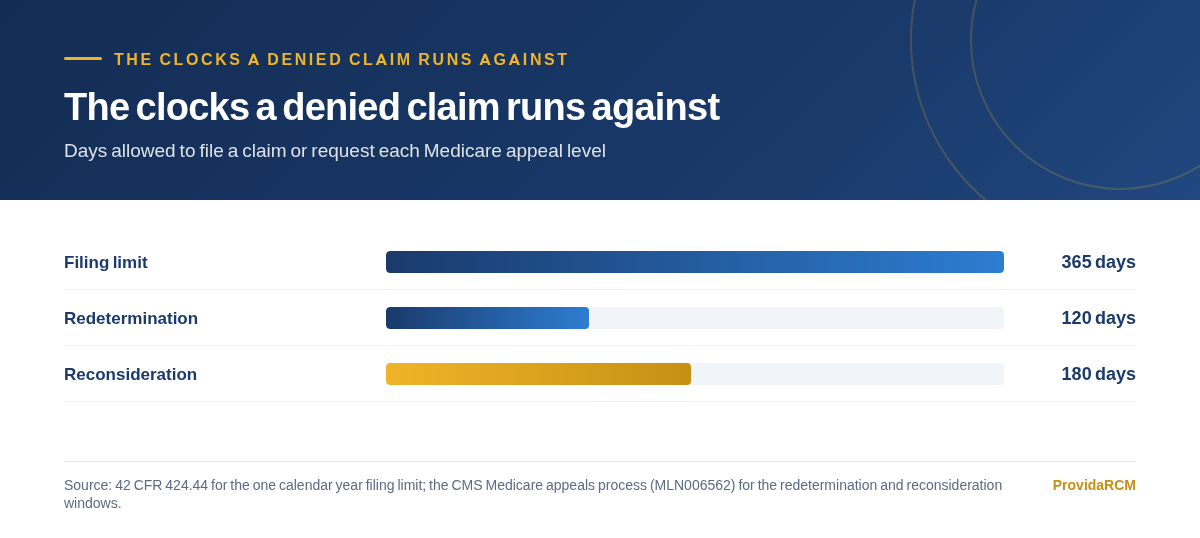
- A filing window that closed with no recourse. Medicare allows one calendar year from the date of service under 42 CFR 424.44, and once it passes the claim is not payable.
- A service the plan does not cover and the patient was told about before it was furnished.
- A good-faith discount written into policy, offered the same way to every patient who qualifies.
Each of these is a decision the practice owns. None is a benchmark, and none is a number a payer sets for you. The floor in a small-balance policy is a figure the practice chooses, and a different practice can choose a different one without being wrong. What separates the policy from the habit is that the policy is written down before the account lands on a desk.
The test is not the size of the write-off. It is whether you can name the person who approved it and the reason it was approved. A decision has both, and it looks the same in March as it did in January.
Write-offs that are a symptom
The other kind of write-off appears when nobody decided anything. It is what is left after a deadline passed, an owner went missing, or the account landed on whichever desk was free that week.
- Denials written off as the appeal deadline approaches, because there is no time and no one to build the appeal.
- A coding problem that recurs every month and has no named owner, so each instance is closed instead of fixed.
- An authorization gap that appears on the same service line month after month.
- Any balance written off by whoever happened to be working the account, with no threshold and no approval.
These write-offs share a signature: they repeat. A decision to write off a small balance looks the same every month and is expected. A symptom grows in a pattern nobody is watching, and it usually shows up first in one payer or one provider rather than across the whole book.
A practice that reviews write-offs by reason sees the pattern in the reasons long before it sees it in the total. The total can stay flat for a year while one cause quietly expands and another shrinks. Sorting by reason is what makes the movement visible, and the denial management workflow is where the reasons get an owner.
The control: an approval threshold, a reason, a monthly review
Three controls separate the decisions from the habits, and none of them needs new software. They need a written policy, a reason on every line, and a review that sorts by reason instead of by amount.
- 01
Write down an approval threshold
Set the dollar amount above which a write-off needs a second signature. The number is a policy choice, not a benchmark. What matters is that it exists and that it is applied to every account the same way.
- 02
Record an adjustment reason with every line
Post the group code and the reason code the remittance already carries, then add the practice-side reason for any write-off you chose. A line without a reason cannot be reviewed later.
- 03
Review write-offs monthly by reason
Sort the month’s write-offs by reason and by who approved them, not by dollar amount. Amounts hide patterns. Reasons expose them, and they point at the process that produced them.
A monthly review by reason turns the write-off report from a single total into two lists: the decisions and the symptoms. Decisions get a policy behind them and stay consistent. Symptoms get an owner and a fix, usually in coding, registration or authorization rather than in accounts receivable.
Every write-off should carry the group code from the remittance, the reason the balance was abandoned, and the name of the person who approved it. A report with those three columns cannot hide a habit behind a total.
The controls are small on purpose. A threshold, a reason and a monthly sort by reason cost almost nothing to run and change which write-offs happen at all. We post every adjustment to the bucket the remittance names through our denial management services, and the reason column is part of the report we send back.
Questions practices ask us about this
What is a denial write-off?
A denial write-off is a balance a practice stops trying to collect after a denial. It can be a contractual adjustment the fee schedule required, a patient responsibility the patient still owes, a true write-off the practice chose, or bad debt that reached collections and failed. The four are usually reported as one figure, which is why the number is hard to act on.
What is the difference between a contractual adjustment and a write-off?
A contractual adjustment is the gap between your charge and the amount your contract allows, and no one can be billed for it. A write-off is a balance the practice chose to abandon, usually because the cost of collecting it exceeds the amount. CARC 45 reports the contractual adjustment; a practice-side write-off is recorded in your own system, not on the remittance.
Does writing off a balance mean the patient no longer owes it?
Not by itself. Writing a balance off your books removes it from your receivable, but it does not settle the patient’s obligation on its own. CMS ties a patient’s billing to the group code on the remittance: a Medicare beneficiary may be billed only when the group code is PR, Patient Responsibility. A line posted as CO is not a patient balance.
What do group code CO and group code PR mean?
CO is Contractual Obligation and assigns the unpaid balance to the provider, which is why a contractual adjustment is not a patient balance. PR is Patient Responsibility and assigns the balance to the patient. The two codes can sit on the same claim with the same dollar value and mean opposite things about who owes the money.
Is CARC 15 still used for a missing authorization?
No. CARC 15 described an authorization number that is missing, invalid, or does not apply, and X12 deactivated it on 1 May 2018. It still appears in denial reports and vendor write-ups. The current code for that situation is CARC 197, precertification, authorization, notification or pre-treatment absent, which X12 modified on the same date.
Should we review write-offs by amount or by reason?
By reason. A monthly review sorted by dollar amount shows you the biggest write-offs and hides the ones that repeat. Sorting by reason shows which process is producing them, whether that is a coding problem with no owner, an authorization gap on the same service line, or appeals abandoned as the deadline nears. Reasons point at the fix; amounts only point at the cost.
Want the write-off report to make sense?
We run denials, coding and A/R for practices across the country, and we post every adjustment to the bucket the remittance names. Send us a few months of claims and we will show you which write-offs were decisions and which ones were habits.
Book a free billing review- X12, Claim Adjustment Reason Codes (current list, group codes and CARC wordings). x12.org/codes/claim-adjustment-reason-codes
- CMS, Health Care Payment and Remittance Advice (group code definitions and patient billing). cms.gov/medicare/coding-billing/electronic-billing/health-care-payment-remittance-advice
- HFMA Claim Integrity Task Force, Standardizing denial metrics for the revenue cycle. hfma.org/guidance/standardizing-denial-metrics-revenue-cycle-benchmarking-process-improvement
- eCFR, 42 CFR 424.44, Time limits for filing claims. ecfr.gov/current/title-42/chapter-IV/subchapter-B/part-424/subpart-C/section-424.44
- CMS Medicare Parts A and B Appeals Process (MLN006562) and Medicare Claims Processing Manual, Chapter 29. cms.gov/files/document/mln006562-medicare-parts-b-appeals-process.pdf
- Premier Inc., average cost to contest a denied claim (2022 and 2023). premierinc.com/newsroom
- MGMA Stat, 6 keys to addressing denials (Change Healthcare rework cost per claim). mgma.com/mgma-stats/6-keys-to-addressing-denials-in-your-medical-practice-s-revenue-cycle