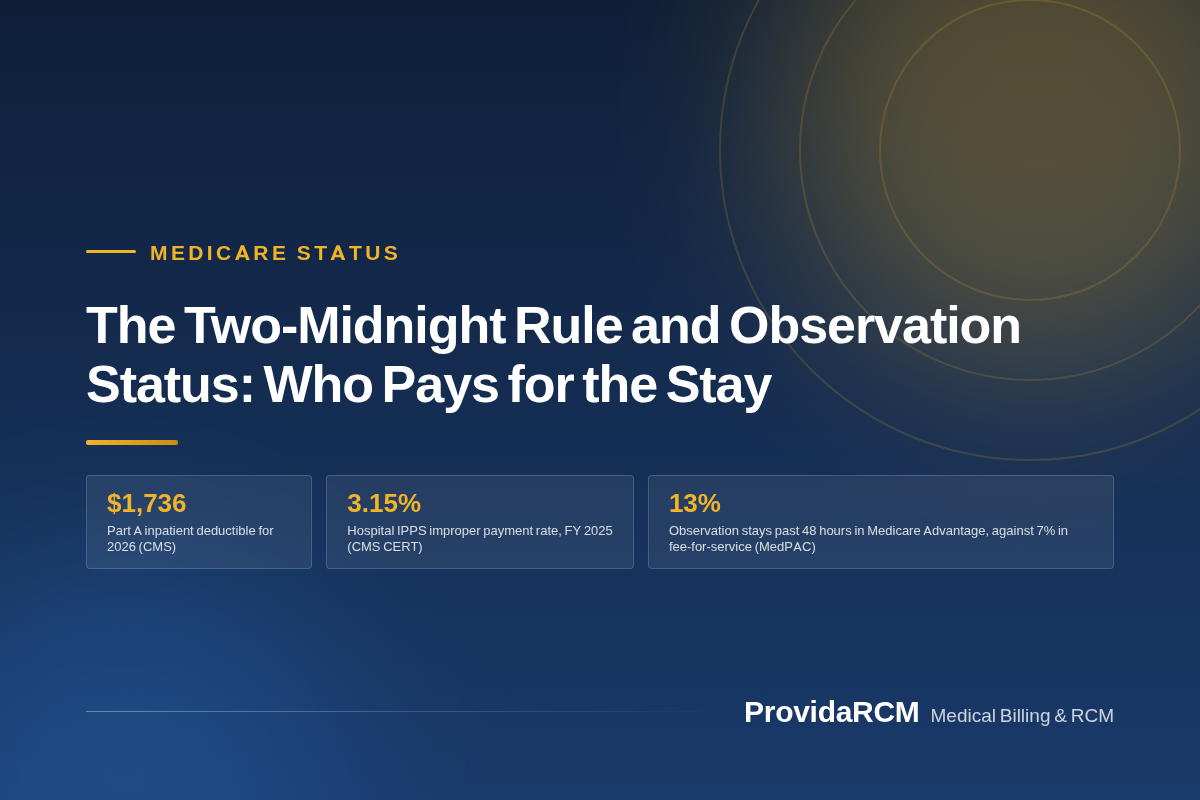
The two-midnight rule is the test Medicare uses to decide whether a hospital stay bills under Part A as an inpatient admission or under Part B as observation. It turns on what the admitting practitioner expected when the order was written, not on how long the patient ended up staying.
The two-midnight rule sets a payment test, not a stopwatch
The regulation is short. Under 42 CFR 412.3(d), an inpatient admission is generally appropriate for Part A payment when the admitting physician expects the patient to need hospital care that crosses two midnights. That expectation has to rest on documented clinical factors: history and comorbidities, the severity of the signs and symptoms, current medical needs, and the risk of an adverse event.
Three other paths exist. An inpatient-only procedure pays under Part A regardless of how long the stay lasts. A stay expected to be shorter can still qualify case by case when the record supports the clinical judgment. And a stay that runs short because of an unforeseen event, such as a transfer or a death, keeps the inpatient payment the physician expected.
| Route to Part A payment | What the record has to show | Where the exposure sits |
|---|---|---|
| Two-midnight expectation | The practitioner expected care across two midnights, with the clinical factors written down at the time of the order | Later notes cannot create an expectation that was never recorded |
| Case-by-case exception | The stay was expected to be short, but severity, comorbidities or risk made inpatient care necessary | Stays under 24 hours rarely qualify |
| Inpatient-only procedure | A procedure on the OPPS inpatient-only list, regardless of expected or actual length of stay | Procedure status, not documentation volume |
| National exception | Newly initiated mechanical ventilation, when the physician orders inpatient care | The only national exception CMS lists |
Two administrative requirements sit around that test, and they get confused. The admission order must come from a practitioner with admitting privileges, at or before the time of admission. The physician certification is separate: under 42 CFR 424.13 it is required only for stays of 20 inpatient days or more or for outlier cases, signed no later than day 20. An order written on day three is a payment problem. A certification written on day 20 is not.
The Medicare Program Integrity Manual tells contractors to judge the stay on the information available when the order was written. Entries added after the fact are read only to interpret what the practitioner knew at that moment, which is why a discharge summary that finally explains the severity of the presentation rarely rescues a thin admission note.
What counts toward the two midnights, and what does not
Time spent in the emergency department, in observation, or in an operating room before the inpatient order does count toward the benchmark. Contractors are instructed to add that contiguous outpatient time when they test whether the expectation was reasonable. The same time does not become inpatient time, so it cannot be used to satisfy the three-day qualifying stay for skilled nursing care.
Two midnights is not the same as 48 hours. A patient admitted at 11 p.m. on Monday and discharged at 1 a.m. on Wednesday has crossed two midnights in 26 hours, and the expectation at the order still decides the payment. A patient admitted at 8 a.m. and discharged at 9 a.m. the next day has crossed one midnight and sits in the case-by-case lane.
Transfers start the clock at the first hospital. When a patient moves from one acute facility to another, the review looks at the time and treatment at the sending hospital, and the receiving hospital is expected to produce that documentation. Delays that exist for convenience, rather than for care, are stripped out of the calculation, and care provided for social reasons does not support Part A payment at all.
A stay that ends early does not automatically fail. CMS lists the events that interrupt a reasonable expectation and keeps the admission payable: an unexpected death, a transfer, a departure against medical advice, a rapid clinical improvement, and the election of hospice instead of continued treatment. Each one has to appear in the record as the reason the stay ended, not as an afterthought in a discharge note.
Moving a patient from inpatient to observation on day two because the discharge is approaching is a status change with billing consequences, and it needs the utilization review committee, the concurring practitioner and the documentation described below. Editing the note so the order reads observation from the start is a different act entirely, and one that auditors treat as falsification rather than correction.
Observation is a billing status, not a clinical one
Observation is the hospital keeping an outpatient under short-term treatment, assessment and reassessment while the team decides whether the patient needs admission or can go home. Under the Medicare Benefit Policy Manual, it requires a physician order, the patient remains an outpatient, and the decision should usually be reachable in less than 24 hours. Only in rare and exceptional cases does reasonable observation run past 48 hours.
On the facility claim, observation is reported with HCPCS G0378, one unit per hour, on a single line. Under the outpatient prospective payment system that line is packaged into the other services on the claim rather than paid on its own. A separate composite observation payment requires at least eight hours plus a qualifying emergency department, clinic or critical care visit the same day or the day before, as the ACEP billing guidance sets out, and hospitals cannot bill the patient for packaged hours.
Observation stays lasting more than 48 hours
Source: MedPAC analysis of MedPAR and Medicare Advantage encounter data, 2019, presented July 2024.
Length is where the patient feels the status. Once observation passes 24 hours, the hospital owes the patient the Medicare Outpatient Observation Notice, form CMS-10611, with a written explanation and an oral one, delivered no later than 36 hours after observation began or sooner if the patient is discharged, transferred or admitted. CMS says the notice reaches more than a million beneficiaries a year. A missing or unsigned notice is a straightforward survey finding and a weak spot in any appeal that follows.
Observation also has a ceiling. CMS calls stays beyond 48 hours rare, and a third day of observation reads as a status nobody revisited. If the patient is still in the building on day three with no plan, the case belongs in front of a physician advisor before the claim is built, not after the denial lands.
What changes for the patient, and for the hospital’s books
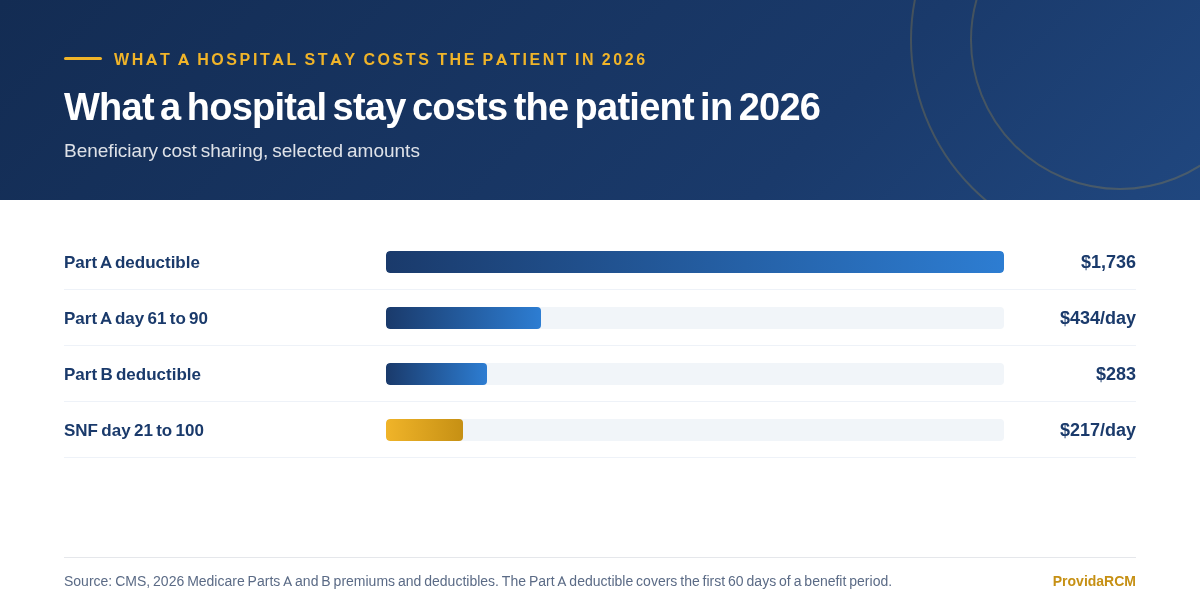
In 2026 the Part A inpatient deductible is $1,736 per benefit period and covers the first 60 days of the stay. Observation bills under Part B instead: the $283 annual deductible plus 20% coinsurance on the outpatient charge. Medicare’s patient guidance says the outpatient bill may come out lower or higher, because 20% of a large charge can exceed a flat deductible. That uncertainty is why status conversations go badly at the discharge desk.
| Item | Inpatient under Part A | Observation under Part B |
|---|---|---|
| Hospital cost sharing | $1,736 deductible, then no coinsurance for days 1 to 60 | $283 annual deductible plus 20% of the outpatient charge |
| Skilled nursing after discharge | Three consecutive inpatient days can qualify the patient | Observation days do not count, so the Part A SNF benefit is not available |
| Notice the patient receives | Standard admission paperwork | MOON within 36 hours once observation passes 24 hours |
| Professional claim | Initial and subsequent hospital care codes, place of service 21 | The same codes since 2023, place of service 22 |
| How Medicare pays the facility | MS-DRG under the inpatient prospective payment system | OPPS, with observation hours packaged into the other services |
The nursing facility rule is the part patients remember. 42 CFR 409.30 requires at least three consecutive calendar days of medically necessary inpatient hospital care, not counting the discharge date, before Medicare pays for posthospital skilled nursing care. Observation days are outpatient days, so a patient who spent four nights in the building under observation can leave with no SNF benefit. Case managers who know this early can sometimes convert the stay correctly instead of explaining the gap afterward.
When Part A is denied, the episode is not always a total loss for the facility. Medicare may still pay for certain Part B services furnished during an inpatient stay, and hospitals report those on a Part B inpatient claim rather than writing the whole account off. The amount recovered is smaller than the DRG, but it is real money on a claim that otherwise posts as a full denial.
Where status denials come from, and how to answer one
Two different events produce the same looking denial. A patient status review is a contractor deciding that a claim already billed as inpatient was not payable under Part A, and it does not change the patient’s status. A status change is the hospital’s own decision, made before discharge, to reclassify the stay. The first is a medical review finding you appeal. The second is a billing correction you document.
Volume on the review side is modest but expensive. CMS puts the hospital inpatient prospective payment system improper payment rate at 3.15% for fiscal year 2025, about $4.61 billion, against 6.55% across the whole fee-for-service program. Those dollars concentrate in short stays where the record never states why the practitioner expected two midnights. The denial usually arrives as CARC 50, medical necessity, or CARC 16, missing information, with a remark code naming the specific defect.
A status change before discharge runs through Condition Code 44, and the conditions are strict. The change must happen while the patient is still in the hospital, no inpatient claim may have been submitted, the practitioner responsible for the patient and the utilization review committee must concur, and that concurrence must be in the record. One physician member of the committee may act for the committee, provided that physician is not the practitioner who concurs. The whole episode then bills as outpatient on a 13X or 85X claim.
- 01
Read the denial type before assigning it
A patient status denial on an 11X claim is a coverage finding, not a coding error. Sending it to a coder wastes the appeal window.
- 02
Pull the record as it stood at the order
Appeal on the admission note, the orders and the progress notes from the first day. The question is what the practitioner knew then, not what the chart says now.
- 03
Match the documentation to the route
Cite the two-midnight expectation, the case-by-case factors, the inpatient-only procedure, or the unforeseen event that ended the stay early.
- 04
File the redetermination inside 120 days
Under 42 CFR 405.942 the clock starts when the notice arrives, presumed five days after its date. Missing it converts a recoverable claim into a write-off.
Patients have their own track now. A beneficiary reclassified from inpatient to observation while still in the hospital gets the Medicare Change of Status Notice, CMS-10868, delivered no later than four hours before discharge, and can request a fast review by the Beneficiary and Family Centered Care quality improvement organization, which decides in about two days. A reversal means the stay bills as inpatient on an 11X claim with condition code C6 and the remark MCSN. CMS closed the separate retrospective filing window on January 2, 2026, so those older requests are now untimely absent good cause.
Running status through the revenue cycle
Medicare Advantage plans have to follow the benchmark, the case-by-case exception and the inpatient-only list, a requirement CMS made explicit for 2024. They do not have to follow the two-midnight presumption, which CMS describes as a medical review instruction for its own contractors. In practice that means a plan can question an admission that fee-for-service would never pull, so the documentation has to be built for a reviewer who is looking at it.
Medicare Advantage share of eligible beneficiaries
Source: MedPAC, using CMS enrollment data, February 2011 to 2024.
The work itself is a handoff problem. Utilization review owns the concurrent decision, the physician advisor owns the disputed ones, case management owns the two notices, and billing owns the claim and the appeal. When those four sit in separate meetings, the same short stay gets argued three times and documented once.
- Review every observation patient at the 24-hour mark and again at 48 hours, with a named owner for the second look
- Require the admission note to state the expected length of stay in clinical terms, not as a formula
- Track Condition Code 44 volume monthly, because a rising count is a front-end admission problem
- Audit MOON and MCSN delivery weekly, including signatures and the four-hour discharge window
- Report status denials by physician and by unit, the same way you report coding denials by coder
None of this is exotic. It is a short regulation with a documentation requirement, two notices, and an appeal clock, run by four teams that rarely share a dashboard. The practices and facilities that win these denials are the ones where the admitting note already answers the reviewer’s question before anyone asks it. If status denials are landing on your remittances and nobody owns the response, our denial management service works them alongside full-cycle medical billing, and this guide to appeal levels covers what happens after the redetermination.
Questions practices ask us about this
What is the two-midnight rule in plain terms?
It is the test Medicare uses to decide whether a hospital stay is paid as an inpatient admission under Part A. If the admitting physician expects the patient to need hospital care that crosses two midnights, the admission is generally payable, provided the clinical reasons for that expectation appear in the record. If the expectation is shorter, the stay can still qualify case by case or through an inpatient-only procedure.
Does time in observation count toward the two midnights?
It counts for the benchmark calculation but not as inpatient time. Contractors add contiguous outpatient time, including emergency department and observation hours before the inpatient order, when they judge whether the expectation was reasonable. That same time cannot satisfy the three consecutive inpatient days required for Medicare skilled nursing coverage after discharge.
Can a hospital change a patient from inpatient to observation after admission?
Only before discharge, only if no inpatient claim has been submitted, and only with the concurrence of the practitioner responsible for the patient and the utilization review committee, both documented in the record. That is Condition Code 44, and the whole episode then bills as outpatient. A change made after discharge runs through a different path and usually means appealing a denial instead.
Why does observation status block skilled nursing coverage?
Medicare requires three consecutive calendar days of medically necessary inpatient hospital care before it pays for posthospital skilled nursing care, and observation days are outpatient days. A patient can spend four nights in a hospital bed under observation and still have no Part A nursing facility benefit. The gap is one of the most common financial shocks in Medicare, and it is why the status conversation belongs at day one.
Does the two-midnight presumption apply to Medicare Advantage?
No. Medicare Advantage plans must follow the two-midnight benchmark, the case-by-case exception and the inpatient-only list, but CMS has said the presumption does not apply to them because it is a medical review instruction for its own contractors. A plan may therefore review an admission that fee-for-service would leave alone, which makes contemporaneous documentation more important, not less.
How long does a hospital have to appeal a status denial?
A redetermination request must be filed within 120 calendar days of receiving the initial determination, and receipt is presumed five days after the notice date. Later levels have their own deadlines, and Medicare Advantage appeals follow the plan’s process instead. The practical risk is not the deadline itself but the weeks lost before anyone opens the denial.
Want this fixed in your practice?
We run full-cycle billing, coding, credentialing and denial work for practices across the country. Send us a few months of claims and we will show you where the money is going.
Book a free billing review- eCFR, 42 CFR 412.3 (admissions). ecfr.gov/current/title-42/chapter-IV/subchapter-B/part-412/subpart-A/section-412.3
- CMS Program Integrity Manual, Chapter 6, section 6.5.2. cms.gov/regulations-and-guidance/guidance/manuals/downloads/pim83c06.pdf
- CMS Benefit Policy Manual, Chapter 6, section 20.6. cms.gov/regulations-and-guidance/guidance/manuals/downloads/bp102c06.pdf
- CMS, 2026 Medicare Parts A and B premiums and deductibles. cms.gov/newsroom/fact-sheets/2026-medicare-parts-b-premiums-deductibles
- CMS CERT improper payment rates, FY 2025. cms.gov/data-research/monitoring-programs/improper-payment-measurement-programs/comprehensive-error-rate-testing-cert
- MedPAC, hospital use in Medicare Advantage and fee-for-service, July 2024. medpac.gov/wp-content/uploads/2024/07/MedPAC-MA-FFS-hospitalization-presentation_v_final_moderator_SEC.pdf
- eCFR, 42 CFR 409.30 (SNF pre-admission). ecfr.gov/current/title-42/chapter-IV/subchapter-B/part-409/subpart-D/section-409.30
- eCFR, 42 CFR 424.13 (certification). ecfr.gov/current/title-42/chapter-IV/subchapter-B/part-424/subpart-B/section-424.13
- ACEP, observation care payments FAQ. acep.org/administration/reimbursement/reimbursement-faqs/observation-care-payments-to-hospitals-faq
- CMS, MLN Matters MM13846 (change of status notice). cms.gov/files/document/mm13846-medicare-change-status-notice-instructions.pdf
- CMS, Original Medicare fee-for-service appeals. cms.gov/medicare/appeals-grievances/fee-for-service
- eCFR, 42 CFR 405.942 (redetermination filing). ecfr.gov/current/title-42/chapter-IV/subchapter-B/part-405/subpart-I/section-405.942