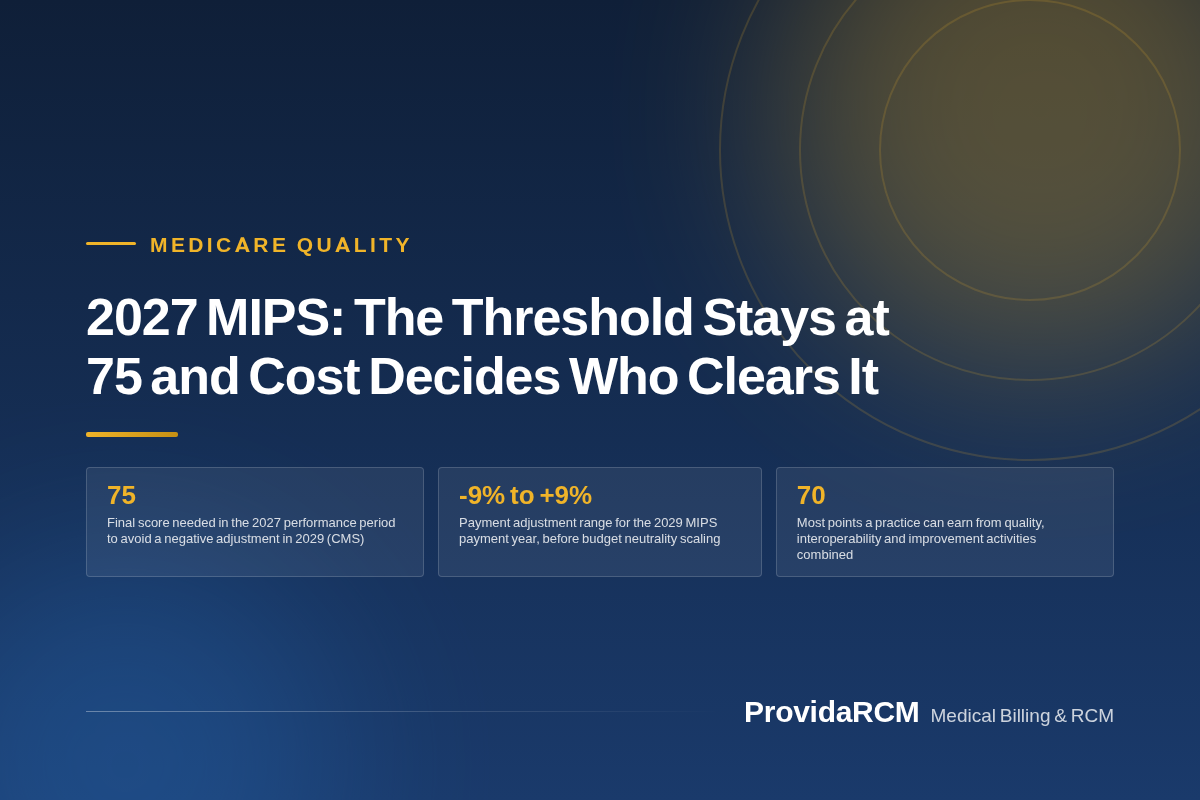
The 2027 MIPS performance period runs January 1 through December 31, 2027, and it keeps the 75-point threshold with the same four weights: quality 30 percent, cost 30, promoting interoperability 25, improvement activities 15. That score sets the 2029 payment adjustment, which runs from minus 9 to plus 9 percent. The measures changed, and two of the changes cost practices points they used to collect by default.
2027 MIPS keeps the 75-point threshold and the same four weights
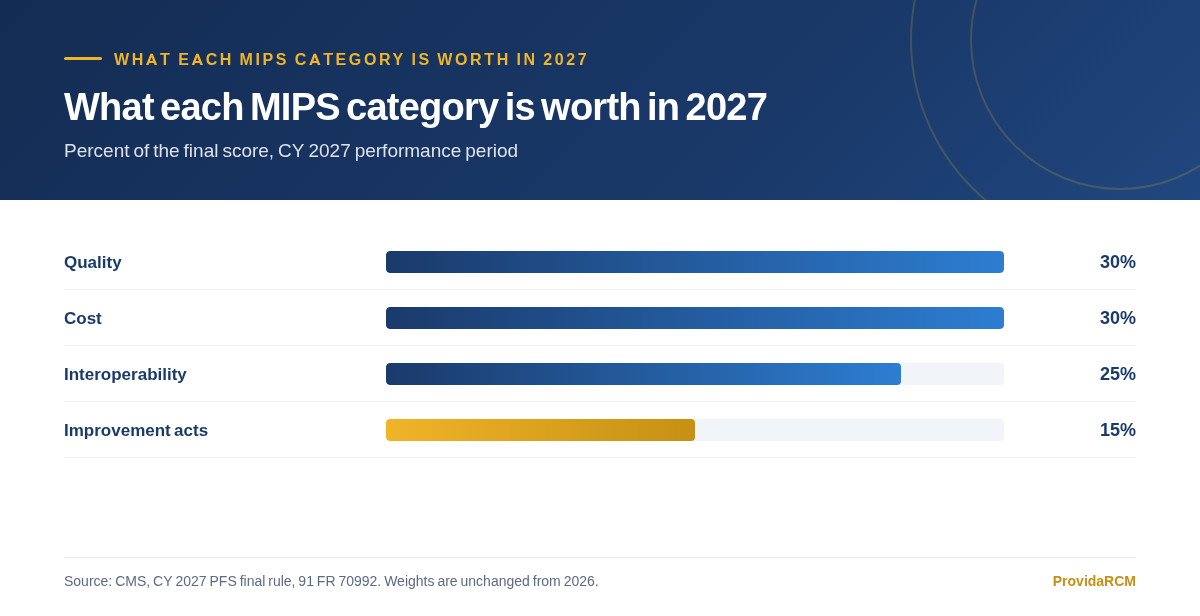
The final score is a weighted sum, and the CY 2027 final rule leaves the weights where they were: 30 percent quality, 30 percent cost, 25 percent Promoting Interoperability, 15 percent improvement activities. It also leaves the threshold at 75 points, which CMS set in the CY 2026 rule and carried through the CY 2028 performance period. Nothing in the arithmetic a practice used last year is wrong for 2027. What moved is which measures earn the points.
| Performance category | Weight | Points at full category score | Who produces the data |
|---|---|---|---|
| Quality | 30% | 30 | Practice or registry, six measures in traditional MIPS |
| Cost | 30% | 30 | CMS, from administrative claims |
| Promoting Interoperability | 25% | 25 | Certified EHR technology |
| Improvement Activities | 15% | 15 | Practice attestation |
| Total | 100% | 100 | Four categories, one final score |
The statute fixes the shape of the exchange, not the size of the check. A score below the threshold produces a negative adjustment, a score at it produces zero, and a score above it produces a positive adjustment scaled to the money the negative side generated. CMS applies the result to Medicare Part B professional services, excluding Part B drugs, for claims paid in the 2029 payment year. Work done in 2027 is priced in 2029.
The bottom band is flat at minus 9 percent because the linear scale between the threshold and zero hits the statutory cap at 18.75 points and stops. A practice that submits nothing takes the same cut as one that submits badly.
A 2027 score decides 2029 revenue. By the time the penalty lands, the fee schedule will have moved at least twice. Quality data cannot be backfilled after December 31, so the work belongs in the first quarter of the performance year rather than the first quarter of the payment year.
Cost carries 30 percent of the score and decides who clears 75
Three of the four categories are things a practice submits. Add their maximums and the total is 70 points: 30 for quality, 25 for interoperability, 15 for improvement activities. The threshold is 75. A practice that earns every point it can report and ignores cost still finishes five points short, so the category with nothing to submit decides whether the year is neutral or positive.
Points available without the cost category
Arithmetic from the CY 2027 category weights (30 plus 25 plus 15) and the 75-point threshold in 91 FR 70992. CMS publishes the weights and the threshold separately and does not publish this comparison.
Five points from a 30 point category is 16.7 percent of the cost score, a low bar on paper. The reason practices miss it is ownership. Cost measures are attributed from claims, scored against episode-based benchmarks, and moved by referral patterns, post-acute spending after a hospitalization and the attributed population. None of that appears on a February checklist, so nobody is accountable for it.
Quality at 90 percent of its maximum is 27 points. Add full interoperability and full improvement activities and the total is 67. Cost still has to deliver 8 points, which is 27 percent of that category. A practice cannot code its way past a bad cost score.
A MIPS core measure now replaces the outcome measure rule
The quality category loses its outcome and high priority measure requirement and gains a core measure requirement. A clinician reporting traditional MIPS has to include at least one measure carrying the core designation among the six reported; an MVP participant has to include one among four. CMS designates more than 70 measures as core, all of them drawn from the MVP inventory.
The size of the change shows up in CMS’s own comment response. The agency reported that 57 percent of MVP submissions in performance year 2024 contained none of the measures that are now core, which means most participants picked measures that will not satisfy the requirement. A measure set that was compliant in 2026 can fail in 2027 without a code changing.
| Element | 2026 performance period | 2027 performance period | Effect on a reporting practice |
|---|---|---|---|
| Measure inventory | 190 measures | 180 measures | A shorter list to choose from |
| Outcome or high priority measure | At least one required | Requirement removed | Replaced by the core measure rule |
| Core measure | No such policy | One required in traditional MIPS and MVPs | Measure selection has to be redone |
| Small practice exemption | Not applicable | Groups of 15 or fewer clinicians exempt | Small groups skip the rule and the attestation |
| Topped out core measures | Capped at 7 achievement points | Scored on the defined benchmark, up to 10 | The best-performing measure is worth more |
Two mechanics matter inside that table. A clinician with no applicable core measure has to attest to that and pick a substitute; skipping the attestation costs 0 out of 10 points on a required measure. And topped out benchmarks price a 97 percent performance rate at 10 percent of the threshold, which is 7.5 achievement points, so a compressed benchmark can pay worse than an ordinary measure at the same rate.
CMS says the 2027 historical quality benchmarks will be posted on the QPP Benchmarks page in late January 2027. Measure selection made in December is a guess until that file exists.
Promoting Interoperability loses the security risk analysis measure
The 25 point interoperability category drops the Security Risk Analysis measure starting with the 2027 performance period. In 2026 an attestation of No on that measure zeroed the whole category rather than one measure, so its removal takes out the single most expensive failure mode in MIPS. The rule is explicit that the HIPAA Security Rule obligation remains: CMS removed a reporting requirement, not a compliance duty.
| Measure or attestation | CY 2026 | CY 2027 |
|---|---|---|
| Security Risk Analysis | Required, and a No zeroed the category | Removed |
| ONC Direct Review attestation | Required through the CY 2026 period | Removed |
| ONC-ACB Surveillance attestation | Optional | Removed |
| Electronic Prior Authorization, items and services | Adopted, not yet scored | Optional, worth 10 bonus points |
| Electronic Prior Authorization, prescription drugs | Does not exist | Adopted, required from CY 2028 |
The 10 bonus points deserve a size check before anyone rebuilds a workflow. Ten points inside a 100 point category that carries 25 percent of the final score is 2.5 points of the final score, and bonus points lift a category score toward 100 rather than past it. A practice already at a full 100 gains nothing.
The bonus also requires certified health IT that supports the payer prior authorization API, one completed request during the year, and a Yes attestation. That is a live transaction against a real payer, so a practice planning to claim it should run one test authorization in the first quarter. CMS makes the measure required in 2028.
Reporting status predicts the score better than specialty does
CMS models the 2029 payment year in the final rule. Under the finalized policies the median final score across all MIPS eligible clinicians is 89.21, about 87.7 percent receive a positive adjustment and 7.55 percent a negative one, with roughly $330 million redistributed through the program. Those averages hide the split that matters to a practice: whether it submitted anything at all.
Median final score by reporting status, CMS simulation
Source: CMS, CY 2027 PFS final rule, 91 FR 70992, simulation results for the CY 2027 performance period. Values are medians from the policies model.
About 15,427 MIPS eligible clinicians are solo practitioners, 2.63 percent of the eligible population, and CMS estimates that 52.51 percent of solo practitioners receiving a payment adjustment submitted no data at all. Non-reporting solo practitioners land at a median of 24.7 points, inside the flat penalty band. Reporting solo practitioners land at 89.61, above the median for all clinicians who submit.
| Final score | 2029 payment adjustment | What it means in practice |
|---|---|---|
| 0.00 to 18.75 | Minus 9 percent | The full penalty, and the floor for every score in the band |
| 18.76 to 74.99 | Between minus 9 and 0 percent | Partial penalty, scaled to the distance below 75 |
| 75.00 | 0 percent | Neutral, and the score CMS assigns when every category is reweighted |
| 75.01 to 100.00 | Positive, after budget neutrality scaling | A share of the money the negative side generated |
Run the range on a real book. A practice with $600,000 of Medicare Part B allowed charges faces $54,000 in 2029 if it lands in the floor band. The best positive adjustment CMS models is 1.34 percent, or $8,040 on the same book. Ignoring the program costs roughly seven times what mastering it earns.
A practice that reports nothing does not sit at zero percent. It falls to the bottom of the scale and pays the maximum penalty in the payment year. The only scores that avoid a cut without submission come from every category being reweighted, which is an exception rather than a default.
Traditional MIPS ends after 2030, so 2027 is a transition year
CMS proposed to sunset traditional MIPS after the CY 2028 performance period and finalized a two-year delay. Traditional MIPS runs through the CY 2030 performance period and the 2032 payment year; from the CY 2031 performance period and the 2033 payment year, a clinician outside a MIPS APM has to report an MVP. Clinicians in a MIPS APM keep the APM Performance Pathway.
The MVP inventory grows from 27 to 30 for 2027 with Diabetic Disease, Hypertension and Hospitalist, and all 27 existing pathways are modified to carry core measure selections. Virtual groups get MVP reporting in the 2029 performance period, two years before it becomes compulsory.
The APP keeps its own weights, and they are not the MIPS weights: quality 50 percent, cost 0 percent, improvement activities 20 percent and interoperability 30 percent under 42 CFR 414.1367. An ACO participant is not scored on cost at all, which makes choosing between an ACO and traditional MIPS a comparison of two different exams rather than two difficulty levels.
That makes 2027 a selection year. A practice that expects to be in an MVP by 2031 should pick 2027 measures that already sit in the pathway it would choose, because the history behind a measure decides where its benchmark lands. Choosing one that disappears with traditional MIPS buys a single easy year.
What to do before January 1, 2027
The rule was published on November 9, 2026, which leaves seven weeks before the performance period opens. That is enough to change a measure list, not a referral network. Sequence the work accordingly.
- 01
Mark the core measures on the 2026 list
List the six quality measures each clinician or group reported in 2026 and mark which carry a core designation. A list without one fails the 2027 requirement unless the group has 15 or fewer clinicians.
- 02
Pull the attributed cost episodes
Identify which cost measures are attributed, then review the post-acute and referral spend inside them before the year starts. Cost decides whether the year is neutral.
- 03
Rebuild the interoperability submission
Remove the Security Risk Analysis and ONC attestations from any file upload or API payload, because CMS says a submission carrying them will be rejected.
- 04
Replace any removed improvement activity
CMS added six activities and removed 11, including MOC Part IV. Attesting a removed activity in 2027 earns no credit, and the attestation is a statement of fact an audit can test.
- 05
Put a name and a date on the calendar
Data for the 2027 period is submitted in the first quarter of 2028. One owner and a monthly quality report separate the 89 point median from the 24.7 median.
- Measure list checked for at least one core measure per clinician or group
- Small practice status confirmed, since the exemption runs to 15 clinicians
- Cost measures identified and the attributed episodes reviewed once
- Interoperability payload stripped of the removed attestations
- Improvement activities re-attested against the 2027 inventory
- Benchmark file checked when CMS posts it in late January 2027
- 2029 revenue model rebuilt at minus 9, zero and plus 1.34 percent
The payment backdrop makes the work worth doing. The 2027 fee schedule cuts most conversion-factor payments by 2.31 percent, 2027 physician fee schedule analysis, as the 2027 physician fee schedule analysis sets out, so a 9 percent quality penalty lands on a smaller base than the one budgeted against. Prior-year mechanics are in MIPS 2026 reporting, and the measure choices rest on documentation at the visit level, which the E/M coding levels guide covers.
Questions practices ask us about this
What is the 2027 MIPS performance period?
The 2027 MIPS performance period is the calendar year from January 1 through December 31, 2027. Data collected during it sets the payment adjustment applied to Medicare Part B professional services in the 2029 payment year, two years later. It is the second year of the 75-point threshold CMS set for the 2026 through 2028 performance periods.
How many points does a practice need in 2027 to avoid a penalty?
Seventy-five points. A final score of exactly 75.00 earns a neutral adjustment, anything above earns a scaled positive adjustment and anything below earns a negative one. Scores from 0 to 18.75 pay the full minus 9 percent, and scores from 18.76 to 74.99 pay a partial penalty scaled to the distance below the threshold.
Did the 2027 MIPS rule change the category weights?
No. Quality stays at 30 percent, cost at 30 percent, Promoting Interoperability at 25 percent and improvement activities at 15 percent, unchanged since 2022. CMS repeated those weights in the final rule at 91 FR 70992 and left the reweighting formulas in place.
What is a MIPS core measure and who has to report one?
A core measure is a quality measure CMS designates as central to a specialty, condition or episode of care, drawn from the MVP inventory and applied to traditional MIPS as well. More than 70 measures carry the designation for 2027. Traditional MIPS participants report one among six measures and MVP participants one among four; groups of 15 or fewer clinicians are exempt.
Does removing the security risk analysis measure end the HIPAA requirement?
No. CMS removed the measure from the MIPS Promoting Interoperability category for the 2027 performance period and said in the rule that clinicians must keep conducting security risk analysis and risk management to protect electronic protected health information under the HIPAA Security Rule. The reporting requirement ended; the compliance obligation did not.
Can a practice still report traditional MIPS in 2027?
Yes. Traditional MIPS, MVPs and the APM Performance Pathway are all available for the 2027 performance period. CMS finalized a sunset of traditional MIPS after the CY 2030 performance period, so MVPs become the only option for clinicians outside a MIPS APM beginning with the CY 2031 performance period and the 2033 payment year.
When does 2027 MIPS data have to be submitted?
In the first quarter of 2028. CMS had not published the exact 2027 window in its November 2026 fact sheet. For scale, the window for CY 2026 data runs from January 4 to March 31, 2027, and quality data, improvement activity attestations and the interoperability submission all have to be inside it.
Want this fixed in your practice?
We run full-cycle billing, coding, credentialing and denial work for practices across the country. Send us a few months of claims and we will show you where the money is going.
Book a free billing review- Federal Register, CY 2027 Payment Policies Under the Physician Fee Schedule, 91 FR 70992, November 9, 2026. federalregister.gov/documents/2026/11/09/2026-22743/medicare-and-medicaid-programs-cy-2027-payment-policies-under-the-physician-fee-schedule-and-other
- CMS, Calendar Year (CY) 2027 Medicare Physician Fee Schedule Final Rule fact sheet, November 4, 2026. cms.gov/newsroom/fact-sheets/calendar-year-cy-2027-medicare-physician-fee-schedule-final-rule
- CMS, CY 2027 PFS Final Rule: Quality Payment Program Fact Sheet and Policy Comparison Table. qpp.cms.gov/content-management/resources/document/2102bc02-f514-4a1f-b318-925bbb6dbe56/download/file
- CMS, press release on the CY 2027 Physician Fee Schedule final rule, November 4, 2026. cms.gov/newsroom/press-releases/cms-finalizes-cy-2027-physician-fee-schedule-shift-sick-care-healthcare-curb-waste
- eCFR, 42 CFR 414.1380, MIPS scoring. ecfr.gov/current/title-42/chapter-IV/subchapter-B/part-414/subpart-O/section-414.1380
- eCFR, 42 CFR 414.1367, APM Performance Pathway category weights. ecfr.gov/current/title-42/chapter-IV/subchapter-B/part-414/subpart-O/section-414.1367