Medicare telehealth coding fails on three fields, not on the technology: the place of service code, which reports where the patient was; the modifier, which reports how the visit happened; and the level of the E/M service, which comes from medical decision making or total time. The temporary rules run through December 31, 2027.
Telehealth coding starts with where the patient was sitting
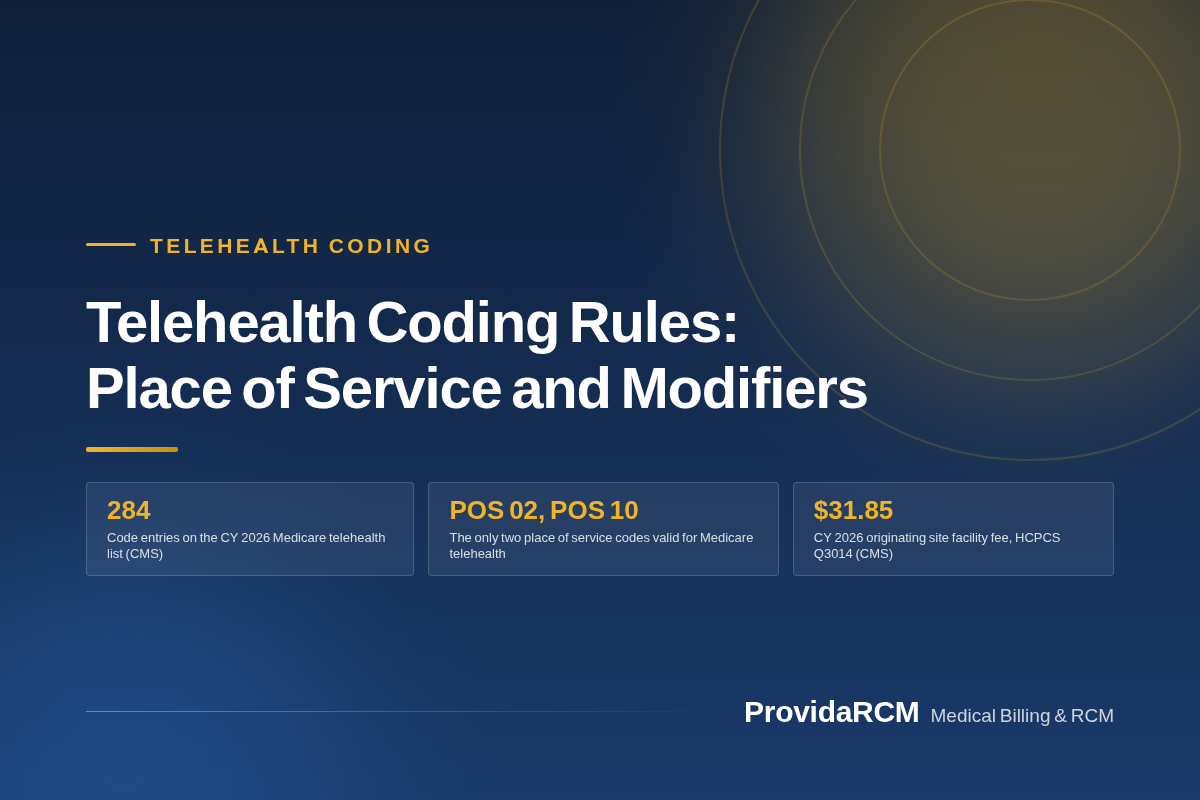
The place of service code reports where the patient was, not where the clinician sat. CMS’s Place of Service Code Set defines POS 02 as Telehealth Provided Other than in the Patient’s Home, effective January 1, 2017 and redefined in 2022, and POS 10 as Telehealth Provided in the Patient’s Home, effective January 1, 2022. Both became available for Medicare claims on April 1, 2022.
A clinician in one state treating a patient in another has two locations in play, and the claim carries one. A therapist working from a spare bedroom while the patient sits in a school office produces POS 02. The same therapist with the same patient at home produces POS 10. The clinician’s address never enters the field.
The two codes pay differently. The Medicare Claims Processing Manual, chapter 26 states that POS 02 pays the facility rate and POS 10 the non-facility rate, and that the telehealth modifier changes neither. CMS confirms in its Telehealth FAQ that home visits are paid at the non-facility rate since January 1, 2024.
| Code | CMS descriptor | Patient location | Rate it carries |
|---|---|---|---|
| POS 02 | Telehealth Provided Other than in Patient’s Home | Anywhere except the patient’s home | Facility rate |
| POS 10 | Telehealth Provided in Patient’s Home | A private residence | Non-facility rate |
| POS 11 | Office | Wrong for a telehealth claim | Office rate, and a mismatch |
A wrong code rarely denies. When a payer catches it, the remittance carries CARC 5, the procedure code or type of bill is inconsistent with the place of service, or CARC 58, treatment was deemed to have been rendered in an inappropriate or invalid place of service, per the current X12 lists. More often nothing is flagged and the claim pays at the rate the code earned.
Most wrong place of service codes are written before the visit, by a scheduler picking the practice address or by an EHR writing its default. Make the field something the clinician confirms at the start of the session.
The modifier says how the visit happened, not where
Two modifiers cover the two ways a telehealth visit reaches a patient, and CMS spells both out in MLN Matters MM14468. Modifier 95 is a synchronous telemedicine service rendered via a real-time interactive audio and video telecommunications system. Modifier 93 is the same service rendered via telephone or another real-time interactive audio-only system.
Modifier 93 is an attestation, not a label. 42 CFR 410.78(a)(3) defines an interactive telecommunications system as audio and video equipment permitting two-way real-time communication, then allows audio-only for any telehealth service furnished to a patient in their home when the practitioner is technically capable of using audio and video and the patient is not capable of, or does not consent to, video.
| Modifier | What it attests | When it applies | Effect on payment |
|---|---|---|---|
| 95 | Real-time audio and video | The visit used two-way audio and video | None. The place of service sets the rate |
| 93 | Real-time audio-only | Patient at home, conditions in 42 CFR 410.78(a)(3) met | None |
| FQ | Audio-only billed by an RHC or FQHC | On top of modifier 93 | None |
| BB | A telehealth virtual platform owned by another entity | The practitioner contracts for it or has a payment arrangement | Required January 1, 2027. No payment effect |
| BC | Telehealth furnished incident to the professional service | Incident-to telehealth claim lines | Required January 1, 2027. No payment effect |
The regulation requires modifier 93 on the claim to verify those conditions, and modifier FQ as well for rural health clinics and federally qualified health centers. The next requirement has its own date: modifiers BB and BC become required on January 1, 2027, with no payment implications.
A wrong modifier usually does not deny. It attests to something the visit did not do. Bill modifier 93 for a visit that had video and the claim states the patient could not use it. Bill modifier 95 for a phone call and the claim states video was used. Neither appears on a denial report, so only an internal audit finds them.
How the level of an E/M service is chosen on a telehealth visit
The level is chosen exactly as it is for a visit in an exam room: by the level of medical decision making, or by total time on the date of the encounter. CMS’s Evaluation and Management Services guide describes code selection by MDM or time, and the telehealth rules replace nothing. All nine office and outpatient codes, 99202 through 99205 and 99211 through 99215, sit on the CY 2026 Medicare telehealth list.
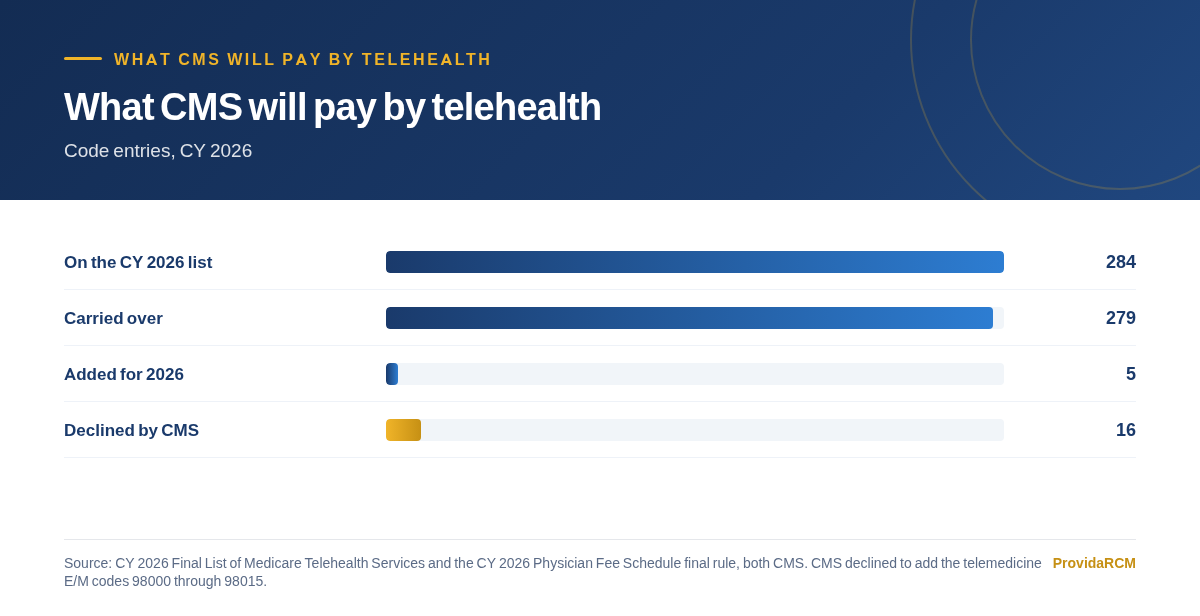
The newer telemedicine family changes nothing for Medicare. The CY 2026 Physician Fee Schedule final rule, published in the Federal Register on November 5, 2025 and effective January 1, 2026, considered a request to add the telemedicine E/M services, CPT 98000 through 98015, to the Medicare list and declined, saying the codes are not separately payable under the Medicare PFS and carry status indicator I, not valid for Medicare purposes.
Two mechanics decide which of the nine codes is right. MDM and time are alternatives and are never combined. If time is the basis, it is the practitioner’s total time on the date of the encounter, not the length of the video connection.
Office E/M codes are a small slice of the list
Source: counted from the CY 2026 Final List of Medicare Telehealth Services, CMS. The list holds 284 code entries.
| Field | What it decides | Where the answer comes from |
|---|---|---|
| Place of service | Facility or non-facility rate | Where the patient was |
| Modifier 95 or 93 | The modality, with no rate change | How the visit happened |
| Level of the E/M code | The amount before the site adjustment | MDM or total time |
| Diagnosis | Medical necessity | The record |
A video visit and a phone call are not the same kind of service
Section 1834(m) of the Social Security Act covers services that substitute for an in-person encounter. CMS says so in its Telehealth FAQ: for services that are inherently non-face-to-face, including chronic care management, behavioral health integration and remote monitoring, the telehealth restrictions do not apply.
The distinction decides the claim. A listed service furnished by real-time audio and video is a telehealth claim: POS 02 or POS 10 with modifier 95. The same listed service furnished audio-only to a patient at home is also a telehealth claim, with modifier 93, when the regulation’s conditions hold. A service that is inherently a phone call is neither.
X12 remark code N776 states that the service is not a covered telehealth service, and it has sat in the current remark code list since November 1, 2016. It is the line to look for when a code was never on the telehealth list for that date of service. A place of service problem reads as CARC 5 or CARC 58 with remark code M77.
What CMS’s telehealth list does and does not do for a claim
The Medicare telehealth services list answers one question: may this code be furnished by telehealth for Medicare? CMS rebuilds it through the annual fee schedule rule, and requests to change it are due by February 10 to be considered for the following calendar year. The CY 2026 final list holds 284 code entries, 279 carried over and 5 added for 2026.
| Question | Does the list answer it | Where the answer lives |
|---|---|---|
| May this code be furnished by telehealth? | Yes | The list, checked against the date of service |
| May this practitioner bill it? | No | Scope of practice and enrollment |
| Is the patient’s location eligible? | No | The place of service code and the current waivers |
| Will a Medicaid or commercial plan pay? | No | That payer’s own policy |
| Was the service medically necessary? | No | The documentation |
The list is narrow on purpose. It does not confirm that the practitioner may bill the service, that the patient was in an eligible location, or that a frequency limit does not apply. Those answers live in the enrollment file, the place of service field, the payer’s policy manual and the record.
What is permanent now, what runs to December 31, 2027, and what ends
Name the period before quoting any rule. The CY 2026 Physician Fee Schedule final rule, CMS-1832-F, was issued October 31, 2025, published in the Federal Register on November 5, 2025 and effective January 1, 2026. It did not extend the temporary flexibilities, because that takes an act of Congress. The extension came in the Consolidated Appropriations Act, 2026, signed February 3, 2026.
The CY 2026 rule made three things permanent, none of them about geography or originating sites. It permanently removed the telehealth frequency limitations on subsequent inpatient visits, subsequent nursing facility visits and critical care consultations, effective January 1, 2026. It permanently adopted a direct supervision definition that allows the supervisor to be present through real-time audio and video, excluding audio-only. It also permanently allows a teaching physician’s virtual presence for Medicare telehealth services.
The originating site facility fee, 2019 to 2026
Source: CMS, Medicare Telehealth Originating Site Facility Fee, HCPCS Q3014 table. The CY 2026 amount is 80 percent of the lesser of the charge or $31.85.
| Provision | Status | Date | What it changes on the claim |
|---|---|---|---|
| Behavioral health: no geographic or site limit, home is an originating site, audio-only permitted | Permanent | Removed for services on or after January 1, 2025 | POS 10 and modifier 93 stay valid with no expiry |
| Non-behavioral: the patient may be anywhere, including home | Temporary | Through December 31, 2027 | POS 02 or POS 10 with modifier 95, or 93 for audio-only |
| Extended practitioner list, including physical and occupational therapists and speech-language pathologists | Temporary | Through December 31, 2027 | They cannot furnish Medicare telehealth after January 1, 2028 |
| RHC and FQHC distant site, non-behavioral | Temporary | Through December 31, 2027, section 6209(c) of the Consolidated Appropriations Act, 2026 | Bill the individual CPT or HCPCS code with modifier 93 or 95 instead of HCPCS G2025 from October 1, 2026 |
| Frequency limits on subsequent inpatient and nursing facility visits and critical care consultations | Permanent | Removed effective January 1, 2026 | No frequency limit on the claim |
| Virtual direct supervision, audio and video only | Permanent | Effective January 1, 2026 | Supervision can be virtual without a 010 or 090 global surgery indicator |
| In-person visit within six months for telemental health | Delayed, not repealed | Applies to services furnished after December 31, 2027 | Build the in-person path or the documented exception now |
The flexibilities are not permanent, and the extension has its own date. Congress carried them through December 31, 2027 in the Consolidated Appropriations Act, 2026, after they lapsed on October 1, 2025 during the funding impasse and were restored retroactively.
The workflow changes that keep a telehealth claim clean
Almost every error here is written before the claim exists: a default place of service, a modifier copied from the previous claim, a level chosen by habit instead of by the documentation.
- Make place of service a field the clinician confirms at the start of the session, not a default the scheduler sets
- Record the patient’s location in the note, so the code on the claim can be checked against it
- Choose the level from medical decision making or total time, and note which one it rests on
- Ask whether the patient can use video, and document the answer whenever a visit runs audio-only
- Keep the current Medicare telehealth list on the billing desk and check it against the date of service
Pull twenty audio-only claims a month and confirm the record states why video was not used. Pull twenty POS 10 claims and confirm the note places the patient at home. Neither audit needs software, and both catch errors that never reach a denial report.
The mechanics sit inside a wider process. A practice that has these fields right still needs insurance verification before the visit and a clean claim rate it can measure. The coding review behind the level of service is the same work that keeps an in-person claim honest, and telehealth billing for behavioral health covers the permanent flexibilities.
Questions practices ask us about this
Which place of service code do I use on a telehealth claim?
The one that matches where the patient was. CMS defines POS 02, telehealth provided other than in the patient’s home, and POS 10, telehealth provided in the patient’s home, and those are the only two valid for Medicare telehealth billing. POS 10 pays the non-facility rate, so a home visit coded as POS 02 pays less.
Is modifier 93 or modifier 95 correct for my visit?
Modifier 95 for a visit furnished by real-time audio and video, modifier 93 for one furnished audio-only. Modifier 93 is an attestation with conditions: under 42 CFR 410.78(a)(3) the patient was at home, the practitioner could use audio and video, and the patient could not use video or did not consent. Neither modifier changes the rate.
Is audio-only still allowed under Medicare in 2026?
Yes, with dates attached. For a patient in their home, two-way real-time audio-only is permitted for any telehealth service on the list through December 31, 2027. Starting January 1, 2028 it remains available for behavioral health under the same conditions. Behavioral health audio-only has been permanent since the Consolidated Appropriations Act, 2021.
How do we choose the level of an E/M service on a telehealth visit?
The same way you choose it in person: by medical decision making or by total time on the date of the encounter, never both. All nine office and outpatient codes, 99202 through 99205 and 99211 through 99215, are on the CY 2026 Medicare telehealth list, so the level comes from the documentation.
Can we bill CPT 98000 for a Medicare telehealth visit?
No. CMS considered a request to add the telemedicine E/M services, CPT 98000 through 98015, to the Medicare telehealth list in the CY 2026 Physician Fee Schedule final rule and declined, stating that the codes are not separately payable under the Medicare PFS and carry status indicator I.
What does the Medicare telehealth list actually guarantee?
One thing: that the code may be furnished by telehealth for Medicare. It does not confirm that the practitioner may bill it, that the patient’s location qualifies, that a frequency limit does not apply, or that the service was medically necessary. Check the list version that covers the date of service.
What changes on January 1, 2028?
Three things, unless Congress acts again. The flexibilities extended through December 31, 2027 end, so non-behavioral telehealth returns to a requirement that the patient be in a medical facility in a rural area. Physical and occupational therapists and speech-language pathologists can no longer furnish Medicare telehealth, and the telemental health in-person rule takes effect.
Want this fixed in your practice?
We run full-cycle billing, coding, credentialing and denial work for practices across the country. Send us a few months of claims and we will show you where the money is going.
Book a free billing review- CMS, CY 2026 Physician Fee Schedule final rule fact sheet (CMS-1832-F), October 31, 2025. cms.gov/newsroom/fact-sheets/calendar-year-cy-2026-medicare-physician-fee-schedule-final-rule-cms-1832-f
- Federal Register, CY 2026 PFS final rule, CMS-1832-F, November 5, 2025. federalregister.gov/d/2025-19787
- CMS, Telehealth FAQ, updated October 8, 2026. cms.gov/files/document/telehealth-faq-updated-10-09-2026.pdf
- CMS, Medicare Telehealth Services List, CY 2026 final list and Q3014 fee table. cms.gov/medicare/coverage/telehealth/list-services
- CMS, Place of Service Code Set. cms.gov/medicare/coding-billing/place-of-service-codes/code-sets
- eCFR, 42 CFR 410.78, Telehealth services. ecfr.gov/current/title-42/chapter-IV/subchapter-B/part-410/subpart-B/section-410.78
- CMS, Medicare Claims Processing Manual, chapter 26. cms.gov/regulations-and-guidance/guidance/manuals/downloads/clm104c26.pdf
- CMS, MLN Matters MM14315, CY 2026 PFS final rule summary. cms.gov/files/document/mm14315-medicare-physician-fee-schedule-final-rule-summary-cy-2026.pdf
- CMS, MLN Matters MM14468, RHC and FQHC distant site telehealth, October 1, 2026. cms.gov/files/document/mm14468-rural-health-clinics-federally-qualified-health-centers-billing-distant-site-telehealth.pdf
- CMS, Medicare Learning Network, Evaluation and Management Services guide (MLN006764). cms.gov/files/document/mln006764-evaluation-management-services.pdf
- X12, Claim Adjustment Reason Codes, current list. x12.org/codes/claim-adjustment-reason-codes
- X12, Remittance Advice Remark Codes, current list. x12.org/codes/remittance-advice-remark-codes