A clearinghouse rejection means the claim never reached adjudication. A denial means a payer adjudicated it and refused to pay. Both look like a problem on a spreadsheet, and only one of them opens an appeal. Rejections have to be corrected at the source field and sent again as a new claim.
Clearinghouse rejections stop before a payer adjudicates anything
Billing offices use the word rejected for three different events. A file can fail at the interchange, a whole batch can fail at the payer’s translator, or a single claim can fail the payer’s front-end business edits. None of those is a denial, because nobody has decided yet whether the service is payable.
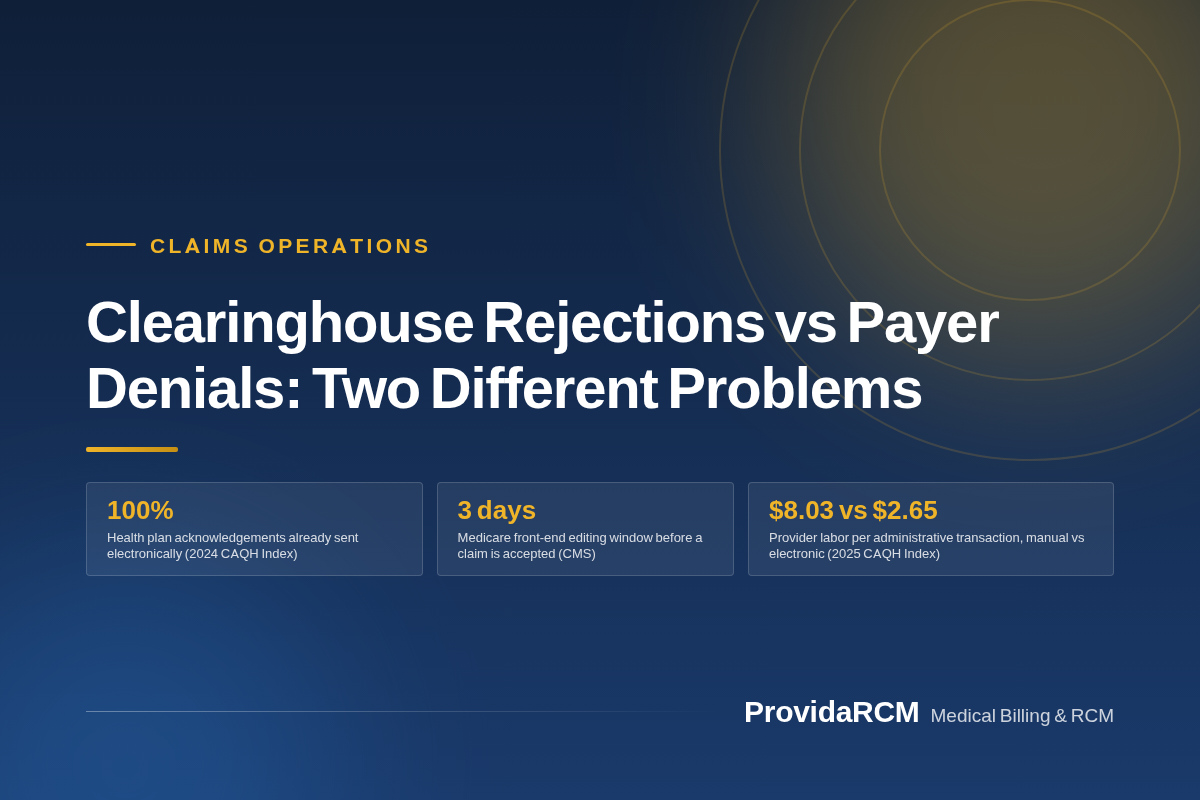
CMS lays out the sequence in its March 2026 fact sheet on claim status. The MAC first runs front-end edits to check that the file is readable and issues a 999 acknowledgement. If that fails, the entire batch comes back for correction. Claims that pass are then tested against the HIPAA implementation guide, and any that fail are rejected one at a time on a 277CA. CMS says the two levels can take up to 3 days, and warns that resubmitting during that window creates a duplicate claim.
The claims processing manual adds a step most billing staff never see. An error that does not justify rejecting the whole transaction set goes to the claims editing module flagged as a 999 Accepted, but Errors Noted, and returns later as a claim level rejection on the 277CA. A clean 999 means the file parsed. It does not mean a claim was accepted.
| Gate | What it reports | Who produces it | What you do |
|---|---|---|---|
| Interchange and implementation edits | Whether the file and its transaction sets parse. A failure rejects the whole batch | Payer translator, or your clearinghouse before it forwards | Fix the file or the submission settings, then send the batch again |
| Claim-level front-end edits | Whether each claim meets the payer’s business rules. A failure rejects that claim only | The payer’s front end, reported on a 277CA | Correct the field named in the status code and resubmit as a new claim |
| Adjudication | Whether the payer will pay, and at what allowed amount | The payer, reported on an 835 remittance | Appeal, correct, or write off. This is the only gate that produces a denial |
If the document carries a claim adjustment reason code, the claim was adjudicated and you are looking at a denial. A rejection carries a claim status category code and a claim status code instead, and there is no payment decision attached to either.
CMS is explicit that a claim should not be resubmitted while it is still inside the editing window, because the resubmission creates a duplicate. Two claims for the same service, both accepted, both adjudicated, is a takeback waiting to happen. Check the 277CA date and the payer’s own processing time before you send a correction.
What the 277CA actually reports, and what it does not
The 277CA is the claim-level acknowledgement that follows the 999. CAQH tracks it as the Acknowledgements transaction and reports that 100% are already sent electronically by auto-generated response, even though no federal standard requires the transaction. The same index counted 9,992 million medical acknowledgements in 2024.
Each claim sits in its own status segment with a category code, a status code and an entity code. The category says what happened to the claim in general terms. The status code names the specific field. The entity code names whose field it is, which is usually the part people skip.
| Code | X12 wording | What it means for the claim |
|---|---|---|
| A1 | Acknowledgement/Receipt. This does not mean that the claim has been accepted for adjudication | The claim arrived. Nothing has been decided, and the claim may still fail the next edit |
| A2 | Acknowledgement/Acceptance into adjudication system | The claim is in. This is the only category that means accepted |
| A3 | Returned as unprocessable claim. Rejected and not entered into the adjudication system | Correct it and resubmit. The claim does not exist downstream and has no claim number |
| A4 | Acknowledgement/Not Found | The claim cannot be located. Usually the wrong payer, the wrong identifier, or a batch that never landed |
| A6 | Rejected for Missing Information | A required value was absent. The status code names the field |
| A7 | Rejected for Invalid Information | A value was present and wrong, such as a member ID that does not match or an NPI the payer cannot use |
| A8 | Rejected for relational field in error | Two fields contradict each other, for example a diagnosis pointer that does not resolve |
There is no middle state. X12 answered this directly in Request for Interpretation 2203, stating that the 277CA has no code for accepted with a warning, and that A3, A6, A7 and A8 all mean the claim was rejected. So a report that groups everything into accepted and flagged is not showing you a payer’s warning system. It is smoothing over a rejection.
| Status code | X12 wording | What usually caused it | Who owns the fix |
|---|---|---|---|
| 33 | Subscriber and subscriber id not found | The member ID was keyed wrong, or the plan changed and nobody rechecked eligibility | Front desk and eligibility |
| 116 | Claim submitted to incorrect payer | The payer ID belongs to a different plan, or the patient’s plan changed since the visit | Front desk |
| 128 | Entity’s tax id | The billing entity’s TIN does not match what the payer has on file for that NPI | Credentialing and billing setup |
| 145 | Entity’s specialty/taxonomy code | The taxonomy on the claim does not match the provider’s enrollment record | Credentialing |
| 158 | Entity’s date of birth | A transposed date, or the subscriber’s date where the patient’s was required | Registration |
| 254 | Principal diagnosis code | A diagnosis code that is invalid for the date of service, or missing from the claim | Coding |
| 562 | Entity’s National Provider Identifier (NPI) | The NPI is not enrolled with that payer, is attached to the wrong entity, or is mistyped | Credentialing and billing setup |
| 496 | Submitter not approved for electronic claim submissions on behalf of this entity | The clearinghouse has no trading partner relationship for that provider and payer | Billing operations |
Four of those codes, 128, 145, 158 and 562, carry the same instruction in the X12 list: the code requires an entity code. That is the report naming the party whose field failed. Reading the NPI code without it is how a practice corrects the rendering provider when the problem sits on the billing entity.
Why rejections disappear from your denial report
The two rates are built from different denominators, and that is the whole problem. A rejection rate divides rejected claims by claims submitted. A denial rate divides denied claims by claims that were adjudicated. A claim that fails a front-end edit is never adjudicated, so it never reaches the second fraction.
That is how a practice can report a denial rate near 4% while a rejection queue sits at the front of the same pipeline with nobody measuring it. The rejection is real work, real delay and real filing window, and it is invisible in the number the owner looks at each month. Our piece on the clean claim rate covers how to define that measure so it cannot flatter you.
| Measure | Numerator | Denominator | What it hides |
|---|---|---|---|
| Rejection rate | Claims returned before adjudication | Claims submitted | Nothing about payment. A rejected claim may still pay in full once corrected |
| Denial rate | Claims denied after adjudication | Claims adjudicated | Every rejection, because rejected claims are not in the denominator |
| Clean claim rate | Claims accepted on first submission | Claims submitted, by your own definition | Depends entirely on whether front-end rejections are counted as unclean |
| First-pass yield | Charges paid without rework | Charges submitted | Rework that happened after acceptance, including appeals |
What providers say about claim rework
Source: Experian Health, The State of Claims 2025. Each figure is the share of surveyed providers who agreed with that statement.
The labor numbers explain why the queue persists. The 2024 CAQH Index prices a claim status inquiry at $13.80 per transaction when it is done by phone and $3.64 when it is electronic, and a claim submission at $6.33 by hand against $3.05 electronically. Every rejection therefore costs at least one resubmission, and usually a status check on top of it.
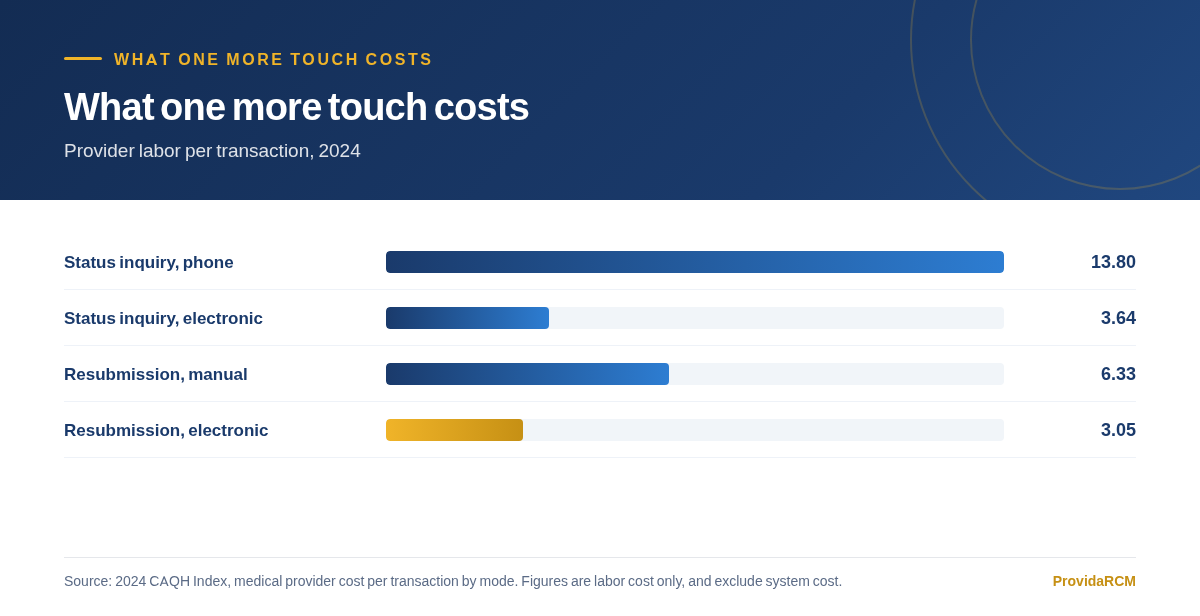
Those numbers look small one claim at a time. The 2025 CAQH Index puts the same gap in aggregate terms: $8.03 of provider labor for a manual administrative transaction against $2.65 for an electronic one. At 200 rejections a month, a queue worked by phone and by hand is a part-time job that produces no payment and no appeal.
The first 48 hours in the rejection queue
A rejection queue fails in the same way a denial queue fails. The work is nobody’s named job, so it gets done in batches when someone notices, and the oldest items are the ones nobody wants to open. Five steps fix most of it.
- 01
Split the queue by source
Your clearinghouse’s own rejections and the payer’s 277CA rejections need different fixes and different owners. One report that mixes them tells you volume and nothing else.
- 02
Read the status code, not the translation
Vendor reports paraphrase X12 wordings, and the paraphrase drops the entity code. Look up the category and status code on the X12 lists before touching the claim.
- 03
Fix the field, not the claim
A taxonomy rejection is a credentialing record problem. Correcting the claim alone guarantees the same rejection on the next patient with the same provider.
- 04
Resubmit as a new claim and confirm it landed
A rejected claim was never entered, so there is nothing to correct. Send it as an original claim and check the new 277CA for an A2 before you close the item.
- 05
Count the top five codes weekly
Five codes will cover most of the volume in any practice. Fix the top one at the source and the queue shrinks by itself rather than being cleared by hand.
Track the age of the oldest open rejection, not the count. Forty items under three days old is healthy. Twelve items with the oldest at 61 days is a cash problem with a filing deadline attached.
This is the same discipline that keeps denials from coming back, and it lives in the same place. Our denial management workflow treats the front end and the appeal desk as one loop, because a rejection corrected without a source fix becomes a denial three weeks later.
A rejection does not pause the filing clock
Under 42 CFR 424.44, a Medicare claim must be filed no later than the close of the period ending one calendar year after the date of service. A rejection does not extend that date. The claim was never accepted, so the only version that can pay is the one that arrives before the window closes.
A denial behaves differently. Once the payer makes an initial determination, a redetermination request must be filed within 120 calendar days of receipt, and each later level carries its own deadline. The rejection queue has no such structure. Nothing arrives to start a clock, which is why a rejected claim can sit until the filing limit closes it.
Filing and appeal clocks, in calendar days
Sources: 42 CFR 424.44 for the filing limit; 42 CFR 405.942, 405.962, 405.1002 and 405.1102 for each appeal level.
Commercial and Medicaid plans set their own filing limits, and many are far shorter than a year. A claim rejected in month four and left until month seven may already be past its window, with no appeal route, because there was never a determination to appeal.
The practical rule is to treat a rejection as a claim that has already used part of its filing window, because it has. Working the queue by age rather than by dollar value is the only ordering that respects that. Our timely filing limits by payer page collects the windows practices ask about most.
Five questions that separate a worked queue from a sorted one
Any billing team or vendor can report a rejection count. These questions show whether the number is being managed.
- Is the rejection rate reported separately from the denial rate, with its own denominator stated? If everything is one percentage, the front end is invisible.
- Who reads the 277CA, and how often? Daily review catches a taxonomy problem before it repeats across a week of claims.
- Are clearinghouse rejections and payer front-end rejections counted separately? The first is a file problem, the second is a data problem.
- What changed at the source after the top rejection code last month? A corrected claim is revenue. A corrected field is margin.
- What is the age of the oldest open rejection, and who is named against it? Age is the leading indicator of write-offs.
We run this as its own queue inside denial management services, alongside eligibility verification and AR management. The point of separating it is that a rejected claim is not a lost cause. It is a claim that has not started yet, and it still has time to pay.
Questions practices ask us about this
What is the difference between a clearinghouse rejection and a payer denial?
A rejection happens before adjudication. The claim failed an edit, either at the clearinghouse or at the payer’s front end, and was returned without a payment decision on a 277CA. A denial happens after adjudication: the payer processed the claim, decided not to pay it, and reported that on an 835 remittance with a claim adjustment reason code. Only the denial has an appeal route.
Does a rejected claim count in our denial rate?
It should not, and in most practices it does not. A denial rate divides denied claims by adjudicated claims, and a rejected claim is never adjudicated, so it never enters that denominator. A practice can therefore report a healthy denial rate while a rejection queue sits unmeasured in front of it. Track the rejection rate separately, with claims submitted as the denominator.
Do we resubmit a rejected claim as a new claim or as a corrected claim?
As a new claim. A rejected claim was never entered into the adjudication system and has no claim number, so there is nothing to correct on the payer’s side. CMS says the same thing in its claim status guidance: rejected claims are corrected and resubmitted as new claims. Confirm the new 277CA shows an A2 acceptance before you close the item.
What does code A7 mean on a 277CA?
A7 is the claim status category code for rejected for invalid information. The claim carried a value the payer would not accept, and the status code that follows names the field, for example 33 for a subscriber ID that does not match or 562 for an NPI the payer cannot use. Correct the named field and resubmit. A7 is final in the sense that no further edits will run on that claim.
Can you appeal a rejected claim?
No. There is no determination to appeal, because the payer never adjudicated the claim, and appeal rights attach to a payment decision. Medicare’s redetermination process begins with an initial determination, which a rejected claim never receives. The remedy is correction and resubmission, which is why a rejection left too long becomes an unrecoverable claim rather than a lost appeal.
Does a rejection extend the timely filing deadline?
It does not. Under 42 CFR 424.44 a Medicare claim must be filed within one calendar year of the date of service, and a rejected claim has not been filed successfully. The resubmitted version still has to arrive inside that window. Commercial and Medicaid plans set their own limits, many of them shorter, so the rejection queue is spending a clock that nobody restarts.
Want this fixed in your practice?
We run full-cycle billing, coding, credentialing and denial work for practices across the country. Send us a few months of claims and we will show you where the money is going.
Book a free billing review- CMS, MLN3171902 Checking Medicare Claim Status (March 2026). cms.gov/files/document/mln3171902-checking-medicare-claim-status.pdf
- CMS Medicare Claims Processing Manual, Chapter 24, section 50.3.3 Acknowledgements. cms.gov/regulations-and-guidance/guidance/manuals/downloads/clm104c24.pdf
- X12, Claim Status Category Codes (current list). x12.org/codes/claim-status-category-codes
- X12, Claim Status Codes (current list, deactivated codes included). x12.org/codes/claim-status-codes
- X12 Request for Interpretation 2203, 277CA non-rejecting issues. x12.org/resources/requests-for-interpretation/rfi-2203-277ca-non-rejecting-issues
- CAQH, 2024 Index Report, medical provider cost per transaction by mode. caqh.org/hubfs/Index/2024%20Index%20Report/CAQH_IndexReport_2024_FINAL.pdf
- CAQH, 2025 Index Report, executive report. index.caqh.org/hubfs/Index/CAQH_IndexReport_2025_Executive%20Report_v6.pdf
- 42 CFR 424.44, time limits for filing claims. ecfr.gov/current/title-42/chapter-IV/subchapter-B/part-424/subpart-C/section-424.44
- 42 CFR 405.942, time frame for filing a request for a redetermination. ecfr.gov/current/title-42/chapter-IV/subchapter-B/part-405/subpart-I/subject-group-ECFR3ec6343ada14c59/section-405.942
- Experian Health, The State of Claims 2025. experian.com/healthcare/resources-insights/thought-leadership/white-papers-insights/state-claims-report