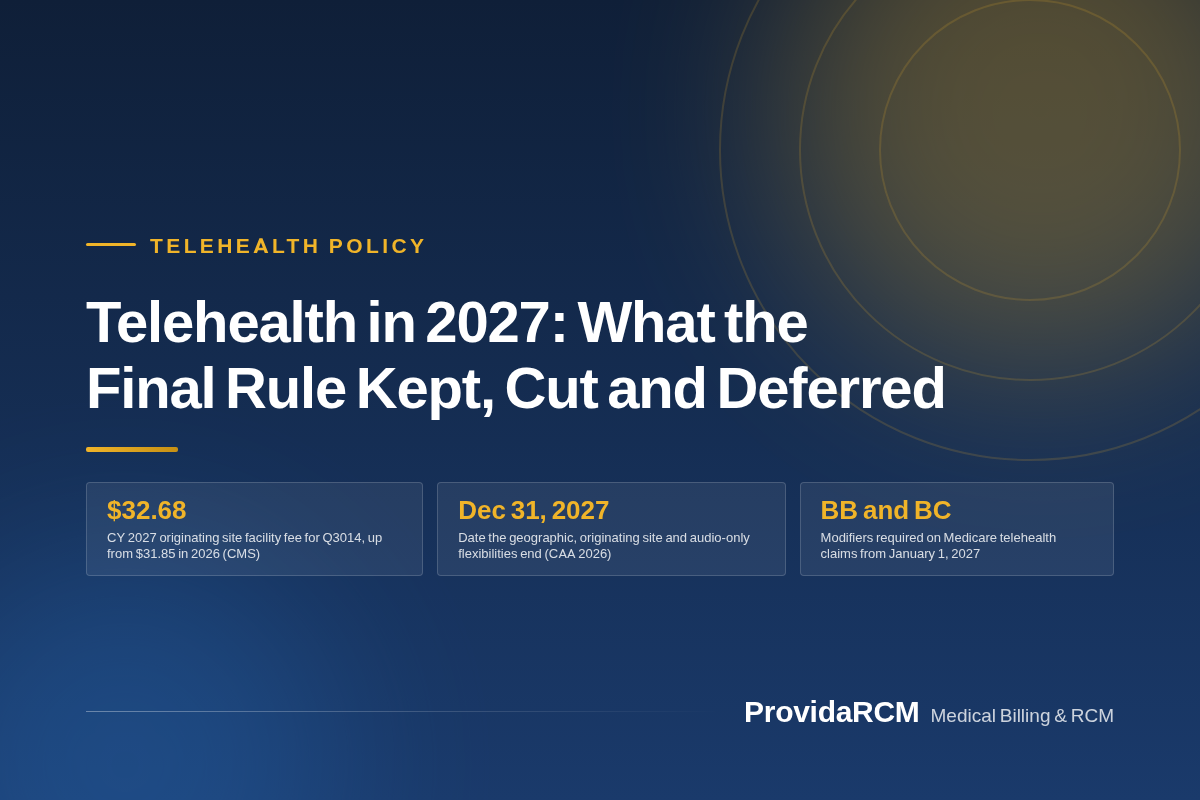
The 2027 telehealth rules keep every major Medicare flexibility through December 31, 2027 and add two required modifiers on January 1. Geography, originating site, practitioner eligibility and audio-only all survive the year. On January 1, 2028 the pre-pandemic rules return unless Congress acts again, so the work now is building claims that stay correct on both sides of that date.
The 2027 telehealth rules keep the waivers, but only through December 31
Section 6209 of the Consolidated Appropriations Act, 2026 wrote the flexibilities into statute for one more year. Through December 31, 2027 a Medicare patient can be anywhere in the United States or its territories, including home, and the geographic and originating site requirements do not apply. An extended range of practitioners may bill as a distant site. Audio-only stays payable under the conditions CMS already published.
The rule CMS finalized on November 4, 2026 does not add these policies. It conforms 42 CFR 410.78 to the statute and states the date plainly: the permanent policies return on January 1, 2028 absent further action from Congress. For a practice, that means two claim builds, not one. The same patient can stand on a different originating site, a different practitioner list and a different payment basis on either side of that date.
Medicare telehealth use, 2020 to 2025
Source: CMS, Medicare Telehealth Trends Snapshot, Medicare fee-for-service Part B claims from January 1, 2020 through March 31, 2026. 2025 data are preliminary and will change as claims complete.
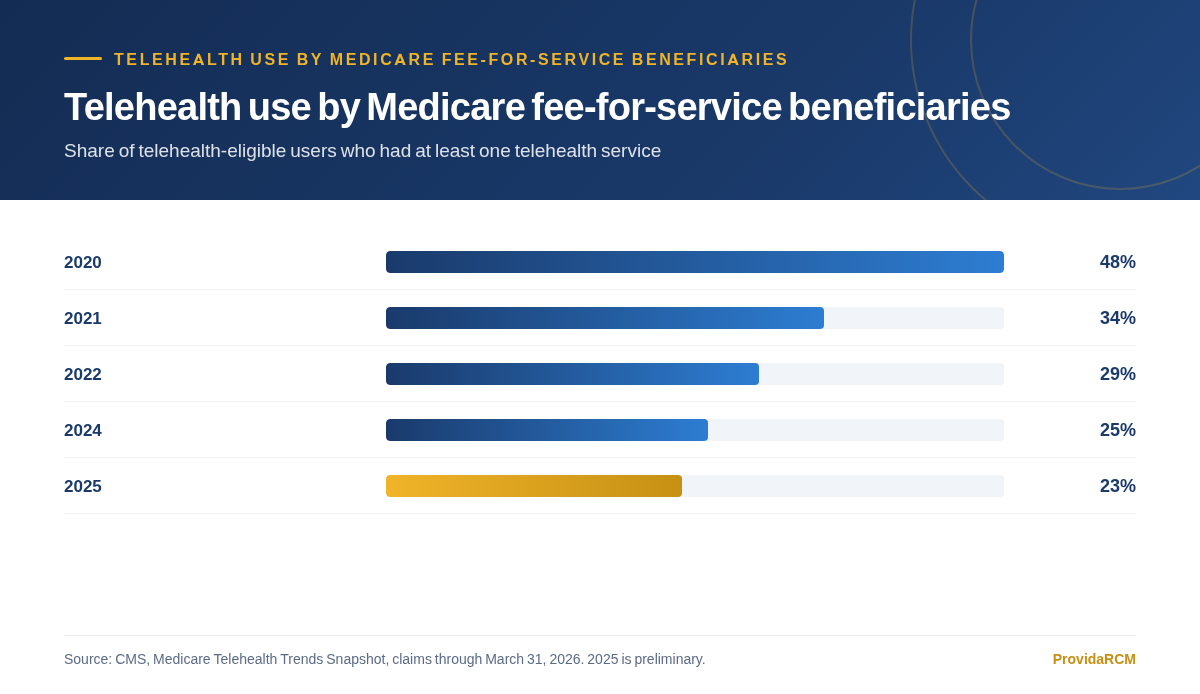
The trend line is the argument for keeping the workflow. In 2020, 14.8 million Medicare fee-for-service beneficiaries had a telehealth service. By 2025 the count was 6.4 million. A fifth of the eligible population is not a rounding error, and the mix has moved toward behavioral health, where the geographic waiver is permanent.
December 31, 2027 is the last date of service under the current flexibilities. January 1, 2028 is the first date under the permanent rules: rural area, medical facility, and no physical therapists, occupational therapists, speech-language pathologists or audiologists as distant sites. Fee schedules, EHR templates and payer contracts all need the second date built in.
Two new modifiers land on January 1: BB and BC
CMS finalized two informational modifiers, both required for dates of service on or after January 1, 2027. Modifier BB identifies a telehealth service furnished through a virtual platform by a practitioner who contracts with the entity that owns the platform, or has a payment arrangement with an entity for its use. That covers most practices that rent video software rather than run it.
Modifier BC identifies a telehealth service furnished incident to a physician’s or practitioner’s professional service. Neither modifier changes the allowed amount, the coinsurance or the RVUs. CMS states that plainly in its telehealth FAQ, questions 17 and 18. The exposure is not the rate. The exposure is a front-end edit that rejects a claim missing a required modifier, and the rework that follows.
| Modifier | What it identifies | Required from | Payment effect |
|---|---|---|---|
| BB | Virtual platform owned by another entity, contracted or paid for use | January 1, 2027 | None |
| BC | Telehealth service furnished incident to a professional service | January 1, 2027 | None |
| 95 | Synchronous audio and video visit | Already in use | None, the place of service sets the rate |
| 93 | Synchronous audio-only visit | Already in use | None, the place of service sets the rate |
Whether BB applies depends on who owns the software, not on who talks to the patient. Read the vendor agreement before January 1. A practice that licensed a platform from a telehealth company, or pays per encounter through a management arrangement, is the case BB was written for.
Three codes came off the telehealth list and six arrived
The list change is a correction, not a policy shift. When the CPT Editorial Panel deleted codes in September 2025, CMS carried the deleted codes forward onto the proposed telehealth list by mistake. The CY 2027 final rule summary records the fix: 0362T, 0373T and 92507 come off, and the codes that replaced them go on.
| Code | Category | Change for 2027 |
|---|---|---|
| 0362T, 0373T | Adaptive behavior assessment and treatment | Removed, replaced by 97148, 97149, 97159, 97160 and 97173 |
| 92507 | Individual speech-language pathology treatment | Removed, replaced by 92654 through 92663 |
| G0572, G0573 | Advance care planning, first 20 minutes and each additional 20 | Added |
| G0576 | Office E/M add-on for vaccine adverse effects | Added |
| G0686, G0687 | Shared medical appointments and the add-on for longer sessions | Added |
| G0903 | Pediatric speech, language and voice treatment | Added |
For an ABA practice the first row matters most. 0362T and 0373T were the adaptive behavior codes the specialty billed by telehealth, and they are gone from both the CPT set and the list. Claims for 2027 dates of service need the replacements, and the authorization on file needs to name them. A payer that approved 0362T units in 2026 will not carry that approval forward.
The critical care pair also changed descriptors. G0508 now reads first 30 to 74 minutes and G0509 reads each additional 30 minutes, which matches the time bands for 99291 and 99292. CMS made that change because it removed the telehealth frequency limits on critical care consultations in the CY 2026 rule and the old wording no longer described what it pays.
CMS publishes the list annually, and the CY 2027 version is what governs a 2027 claim. A code that was payable in December 2026 can be off the list in January. Any request to add a service for the 2028 list had to reach CMS by February 10, 2027, per question 12 of the telehealth FAQ.
The originating site fee is $32.68, and the place of service still sets the rate
HCPCS Q3014 pays the facility that serves as the originating site. The CY 2027 rule raises it from $31.85 to $32.68, an increase tied to the 2.6 percent Medicare Economic Index update. Payment is 80 percent of the lesser of the actual charge or the fee, and the patient owes any unmet deductible plus coinsurance. The MLN telehealth booklet carries the same mechanics for the prior year.
Originating site facility fee, Q3014
Sources: CMS MLN901705 for the CY 2025 and CY 2026 amounts, CMS CY 2027 PFS final rule for the CY 2027 amount. Payment is 80 percent of the lesser of the actual charge or the fee.
The distant site fee is a different number, and it is decided by where the patient sits. POS 10 means the patient is at home and pays at the non-facility rate. POS 02 means the patient is anywhere else and pays at the facility rate. CMS question 8 states both, and the patient’s location decides between them, not the practitioner’s.
That single field is worth real money on a 99214. The non-facility rate covers the practice’s own overhead. A clinic that bills POS 02 for patients at home underpays every one of those visits, and a clinic that bills POS 10 for a patient in a hospital waiting room overpays and invites a takeback. Both errors come from copying the previous claim.
A claim outside the list denies with CO-96 and needs a remark code
The claims processing manual, chapter 12, section 190.7, sets the edit. A service billed with POS 02 or POS 10 whose procedure code is not designated as a covered telehealth service is denied, and the contractor returns group code CO with CARC 96 and RARC N776. The live X12 row for 96 reads non-covered charge, with a note that at least one remark code must be provided.
That is why a telehealth denial often arrives with no clinical reason attached. The code was never covered as telehealth, so documentation in the note changes nothing. The claim is rebilled correctly or written off, and that decision belongs upstream of the coder.
- 01
Check the code against the CY 2027 list
Match the code and the date of service. A code that left the list in January cannot be rescued by a modifier.
- 02
Set the place of service from the patient’s location
POS 10 for home, POS 02 for any other site. Confirm the field maps from the schedule, not from the previous claim.
- 03
Add the modality and the new modifiers
95 for audio and video, 93 for audio-only, plus BB or BC where the arrangement applies. Missing BB is an edit, not a denial of medical necessity.
- 04
Confirm the practitioner is an eligible distant site
Through December 31, 2027 the range is wide. From January 1, 2028 it narrows, and therapy disciplines drop out.
- 05
Record where the patient was
The note should state the patient’s location and the technology used, because the POS on the claim certifies both.
Rural health clinics and FQHCs bill the service code now, at $102.78
The single-code era ended on September 30, 2026. Through that date, RHCs and FQHCs reported HCPCS G2025 for non-behavioral telehealth. From October 1, 2026 they bill the individual CPT or HCPCS code for the service, with modifier 95 or 93 and revenue code 0780, per MM14468. The CY 2027 payment rate for those visits is $102.78.
That rate is an average, not a fee schedule line. CMS builds it from the volume-weighted average of PFS telehealth services, updates it annually and does not adjust it by locality. Coinsurance applies for FQHC services, and both coinsurance and deductible apply for RHC services. Behavioral health visits were never part of this and stay on the all-inclusive rate or the prospective payment system.
Section 1834(m)(8)(B)(i) carries the non-behavioral payment requirement only through CY 2027. A clinic that rebuilt its claim scrubber for October 1, 2026 should expect to rebuild it again, in the other direction, within a year.
Remote monitoring is where the rule deferred, not where it cut
CMS had proposed barring third-party vendors and clinical staff from outside the practice from furnishing remote physiologic and remote therapeutic monitoring. After comment it delayed that policy to January 1, 2029. That delay is the largest piece of breathing room in the telehealth sections of the rule.
Two changes apply from January 1, 2027. Remote therapeutic monitoring joins remote physiologic monitoring in being limited to established patients. Both now require a separately reportable initiating visit at the onset of monitoring, which is the visit where the practitioner assesses whether monitoring is appropriate and obtains consent. Patients already enrolled before January 1, 2027 are exempt from that requirement.
CMS also moved 98978 and 98986 from contractor to national pricing and crosswalked both to 98977 so the three share one practice expense RVU. It declined, after comments, to eliminate the direct practice expense inputs for 99470, 99457, 99458, 98979, 98980 and 98981. A program priced on those codes keeps its cost structure.
A practice that leans on an external monitoring vendor has until January 1, 2029 to move that work in-house or restructure the arrangement. Two years is enough time to change a workflow and not enough time to ignore it, and the Office of Inspector General reports that prompted the proposal have not gone away.
What to change before January 1, and what to leave alone
Most of the 2027 telehealth rules cost nothing to adopt and a great deal to discover late. The modifier build, the POS mapping and the code list are claim-side changes a practice can test in December against a handful of claims. The clinical workflows stay as they are for another year.
- Add BB and BC to the claim scrubber with a January 1, 2027 start date, and decide from the platform contract which encounters get BB
- Replace 0362T, 0373T and 92507 in templates, order sets and prior authorizations with the codes that replaced them
- Audit POS 02 and POS 10 against the patient’s actual location for a sample of 2026 claims
- Confirm the fee schedule carries the CY 2027 conversion factor before the first January remittance
- Update the 2028 scenario now: rural site, medical facility, and the therapy disciplines out
One thing needs no change. Nothing in the rule touches the audio-only conditions, the consent requirement or the documentation standard. A practice that records the modality, the patient’s location and the reason for the visit already meets the 2027 rules. The 2027 fee schedule changes what a visit pays, not what it must contain.
Behavioral health is the different case. Its telehealth never depended on the geographic waiver, so the item to plan for is the in-person visit requirement returning on January 1, 2028: within six months before the first telehealth visit, then annually, with the exceptions at 42 CFR 410.78(b)(3)(xiv)(B). The behavioral health telehealth workflow is where that lands.
Questions practices ask us about this
Are Medicare telehealth flexibilities extended through 2027?
Yes. Section 6209 of the Consolidated Appropriations Act, 2026 extends the geographic and originating site waivers, the expanded practitioner list and audio-only coverage through December 31, 2027. CMS conformed 42 CFR 410.78 to that statute in the CY 2027 final rule. Because the extension is statutory, CMS cannot renew it on its own.
What are modifiers BB and BC, and do they change payment?
BB identifies a telehealth service furnished through a virtual platform owned by an entity the practitioner contracts with or pays for use of. BC identifies a telehealth service furnished incident to a physician’s or practitioner’s professional service. Both are required on claims for dates of service on or after January 1, 2027, and CMS states in questions 17 and 18 of its telehealth FAQ that neither carries a payment implication.
Which codes came off the Medicare telehealth list for 2027?
CMS removed 0362T and 0373T, the adaptive behavior assessment and treatment codes, and 92507, individual speech-language pathology treatment. It added the codes that replaced them in the CPT set: 97148, 97149, 97159, 97160 and 97173 for behavior services, and 92654 through 92663 for speech. The deletion was a correction for codes CPT had already retired in September 2025.
How much is the originating site fee in 2027?
The CY 2027 originating site facility fee, HCPCS Q3014, is $32.68, up from $31.85 in 2026 and $31.04 in 2025. CMS pays 80 percent of the lesser of the actual charge or that amount, and the patient owes any unmet deductible plus coinsurance. The annual increase follows the Medicare Economic Index, which rose 2.6 percent for 2027.
What happens to telehealth on January 1, 2028?
The permanent rules return. For non-behavioral services the patient generally has to be in a medical facility in a rural area. Therapists, speech-language pathologists and audiologists can no longer be distant sites, and hospitals cannot bill certain therapy and nutrition services furnished remotely to a patient at home. Behavioral health keeps its geographic flexibility, with an in-person visit requirement attached.
Do rural health clinics and FQHCs still bill G2025 in 2027?
No. G2025 stopped on September 30, 2026. From October 1, 2026, RHCs and FQHCs bill the individual CPT or HCPCS code for the distant site service with modifier 95 or 93 and revenue code 0780. The CY 2027 payment rate for non-behavioral distant site telehealth is $102.78, and the authority for that payment ends on December 31, 2027.
Did the 2027 rule change remote monitoring billing?
Partly. Remote therapeutic monitoring is now limited to established patients, like remote physiologic monitoring, and both require a separately reportable initiating visit from January 1, 2027, with an exemption for patients already enrolled. The proposal to bar third-party vendors and outside clinical staff from furnishing monitoring was delayed to January 1, 2029 rather than finalized.
Want this fixed in your practice?
We run full-cycle billing, coding, credentialing and denial work for practices across the country. Send us a few months of claims and we will show you where the money is going.
Book a free billing review- CMS, Telehealth FAQ, updated October 8, 2026. cms.gov/files/document/telehealth-faq-updated-10-09-2026.pdf
- CMS, Calendar Year (CY) 2027 Medicare Physician Fee Schedule Final Rule fact sheet, CMS-1848-F. cms.gov/newsroom/fact-sheets/calendar-year-cy-2027-medicare-physician-fee-schedule-final-rule
- CMS, MLN901705, Telehealth and Remote Monitoring, December 2025. cms.gov/files/document/mln901705-telehealth-remote-patient-monitoring.pdf
- Center for Connected Health Policy, Final CY 2027 Physician Fee Schedule fact sheet, Fall 2026. cchpca.org/2026/11/FINAL-CY-2027-PHYSICIAN-FEE-SCHEDULE-FINAL.pdf
- CMS, Medicare Telehealth Trends Snapshot, claims through March 31, 2026. data.cms.gov/sites/default/files/2026-09/Medicare%20Telehealth%20Trends%20Snapshot%2020260914_508.pdf
- CMS, FQHC and RHC news and announcements, distant site telehealth billing and the CY 2027 rate. cms.gov/fqhc-rhc-news-announcements
- CMS, Medicare Claims Processing Manual, chapter 12, section 190.7, editing of telehealth claims. cms.gov/regulations-and-guidance/guidance/manuals/downloads/clm104c12.pdf
- CMS, MM14468, RHCs and FQHCs billing distant site telehealth services, effective October 1, 2026. cms.gov/files/document/mm14468-rural-health-clinics-federally-qualified-health-centers-billing-distant-site-telehealth.pdf
- eCFR, 42 CFR 410.78, telehealth services. ecfr.gov/current/title-42/chapter-IV/subchapter-B/part-410/subpart-B/section-410.78