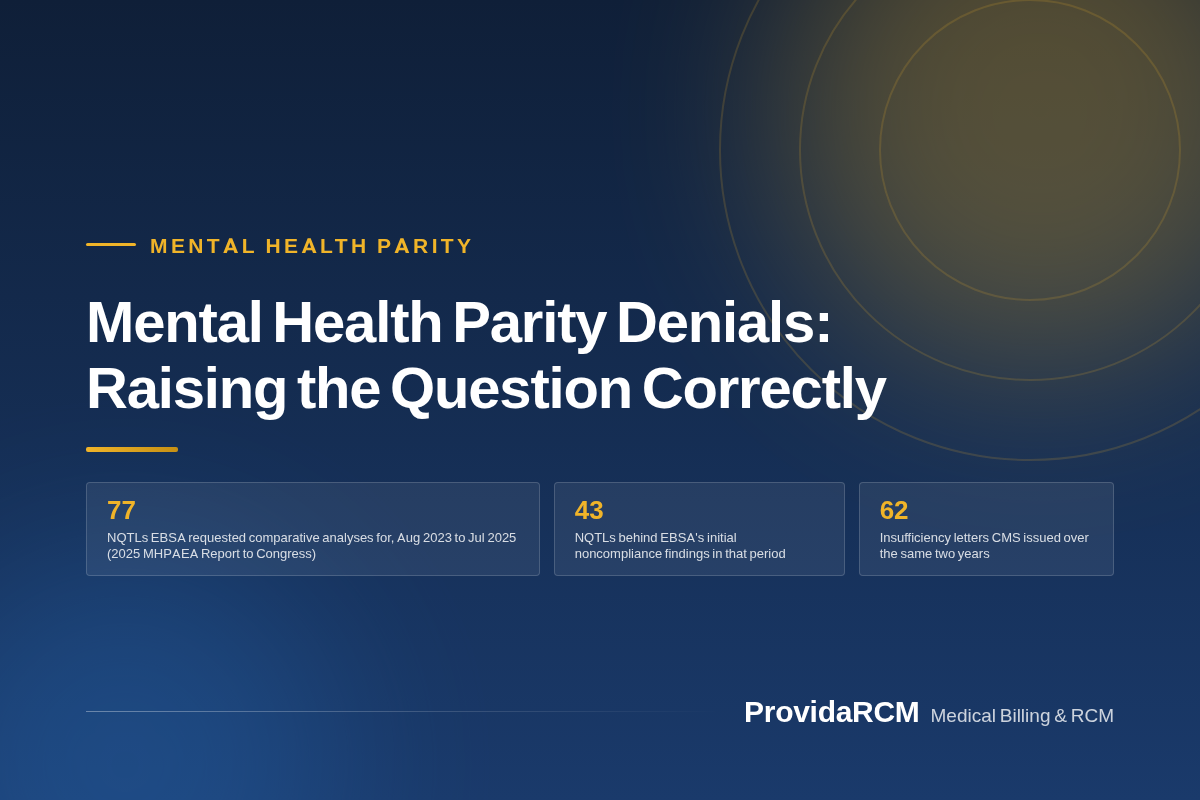
Mental health parity asks one narrow question: does the plan run the behavioral health benefit the same way it runs medical and surgical care? When a therapy claim is denied on a limit you cannot find on the medical side, that question belongs in the appeal, and a federal regulator can make the plan answer it.
What mental health parity actually requires of a plan
Parity is a comparison, not a coverage mandate. The Mental Health Parity and Addiction Equity Act does not require a plan to cover behavioral health at all. It requires that when a plan offers mental health and substance use disorder benefits next to medical and surgical benefits, the financial requirements and the treatment limitations it puts on the behavioral side are no more restrictive than the ones it puts on medical and surgical care in the same benefit classification (CMS, MHPAEA).
Financial requirements are the countable half: copays, coinsurance, deductibles and out-of-pocket maximums. Treatment limitations come in two kinds. A quantitative limitation is a number, such as a cap of 20 therapy visits a year. A non-quantitative treatment limitation is a rule the plan applies instead of a number: the medical necessity criteria, the prior authorization requirement, the concurrent review, the step therapy protocol, the network admission standard, the way a non-participating clinician gets paid.
The second duty is the one practices miss. It is not enough that a rule exists. The processes, strategies, evidentiary standards and other factors used to apply it to behavioral health have to be comparable to, and applied no more stringently than, the ones used to apply it to medical and surgical care.
| Limitation | What it controls on the behavioral side | What parity asks the plan to show |
|---|---|---|
| Network composition | Whether a patient can actually find a therapist or prescriber who takes the plan | The standard used to admit behavioral health clinicians, set against the standard for the medical panel |
| Medical necessity criteria | The clinical standard a reviewer applies to a therapy request | That the criteria, and the way they are applied, track the standard used for a comparable medical service |
| Prior authorization | Whether therapy needs approval before it is delivered | That the same review reaches comparable medical services, or the plan explains why it does not |
| Concurrent review | Continued approval while care is already in progress | Whether behavioral care is reviewed mid-course more often or more strictly than medical care |
| Step therapy | A sequence of treatments a patient has to complete first | That the plan uses the same step structure for comparable medical conditions |
| Out-of-network reimbursement | What the plan pays a clinician who is not in the network | The methodology, and whether it was built from a data source comparable to the medical side |
Two points decide most arguments. A plan may hand the behavioral health benefit to a different company, and that alone is not a parity problem. And a plan may apply a limitation that has no tidy medical equivalent. Both are answered by the comparative analysis, not by the denial letter.
The 2024 parity rule is paused. The statutory duty is not.
The rule in circulation is the 2024 final rule, published September 23, 2024 and effective November 22, 2024 (89 FR 77586). The ERISA Industry Committee challenged it in the U.S. District Court for the District of Columbia on January 17, 2025. On May 15, 2025 the Departments of Labor, Health and Human Services, and the Treasury said they would not enforce it, or pursue enforcement for a failure to comply, before a final decision in that case plus 18 months (Departments statement, May 15, 2025).
The relief is narrower than it reads. It reaches only the parts of the 2024 rule that are new compared with the 2013 rule. On September 8, 2026 the Labor Department’s Employee Benefits Security Administration made the position explicit and named the three areas it will still pursue, in Field Assistance Bulletin No. 2026-03.
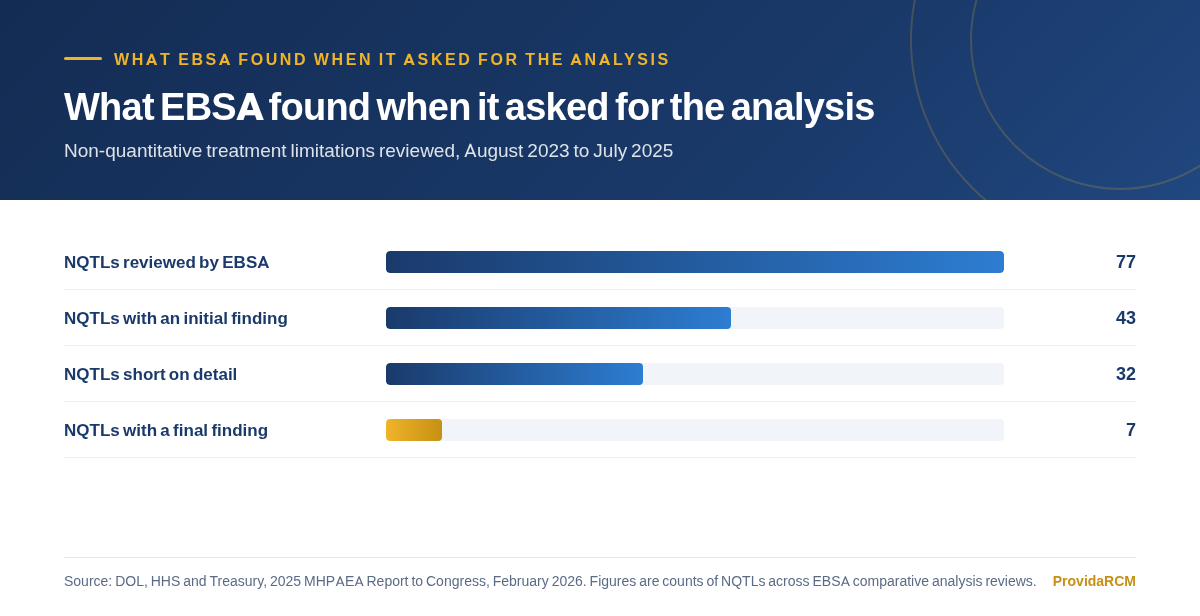
EBSA parity enforcement actions, August 2023 to July 2025
Source: DOL, HHS and Treasury, 2025 MHPAEA Report to Congress, February 2026.
What continues regardless is the statute. MHPAEA, as amended by the Consolidated Appropriations Act, 2021, requires a plan that imposes a non-quantitative treatment limitation on behavioral health benefits to perform and document comparative analyses of the design and application of those limitations, and to make them available on request. That duty took effect February 10, 2021 (CMS review of NQTL comparative analyses) and the litigation does not touch it.
CMS parity enforcement actions, August 2023 to July 2025
Source: DOL, HHS and Treasury, 2025 MHPAEA Report to Congress, February 2026. CMS reviews non-Federal governmental plans and issuers in states where it enforces MHPAEA directly.
The May 2025 policy pauses enforcement of the newer rule provisions. It does not remove the statutory comparative analysis duty, and the same departments kept working parity cases while the rule sat idle. A plan that reads the pause as permission to stop documenting is exposed on the statute, not on the rule.
What a plan must produce when you ask for the analysis
The comparative analysis is work the plan already owes, not a favor it can decline. The statute lists what it has to contain, and the list is specific enough to quote back to the plan.
| Element | What it covers | Source in the statute |
|---|---|---|
| The plan terms | The specific terms applying the limitation, and every benefit each term touches in each classification | ERISA section 712(a)(8)(A)(i) |
| The factors | What the plan considered in deciding the limitation applies to behavioral health and to medical benefits | Clause (ii) |
| The evidentiary standards | The standards behind those factors, defined rather than named | Clause (iii) |
| The comparison | The analysis showing the process is comparable to, and applied no more stringently than, the medical side | Clause (iv) |
| The conclusions | The plan’s own finding, including any result showing it is or is not in compliance | Clause (v) |
A general statement of compliance does not satisfy it. Guidance to plans is explicit that conclusory statements, recitations of the legal standard, and a document dump with no explanation are all insufficient. The analysis has to say how the limitation was defined, how it was applied in operation, and why that application is comparable to the medical side.
Ask for the criteria at the same time. A plan has to make the medical necessity criteria it applies to behavioral health benefits available to a participant or a contracting provider on request. That is a different right from the comparative analysis, and it is the faster of the two to exercise, because it asks for the standard rather than for the plan’s reasoning about the standard.
Signals that a denial is a parity question
Most behavioral health denials are ordinary and should be worked as medical necessity disputes. The note did not carry the severity, the authorization expired, the service billed did not match the order. There is a published playbook for those at medical necessity denial appeals.
A smaller group looks different, and the difference is usually a limit you cannot find on the medical side. Five shapes recur.
| What you see | Why it points at parity | What it does not prove |
|---|---|---|
| A session cap with no medical equivalent | A limit behavioral health carries alone, where medical care carries a comparable one | That the limit is unlawful; a plan may apply limits that mirror the medical side |
| Criteria applied to therapy but not to a comparable medical service | A medical necessity standard reaching one benefit only | That the note was inadequate; the criteria may still have been met correctly |
| An authorization required for therapy, none for a comparable medical service | A prior authorization rule that may not be comparable | That the authorization was unnecessary; the plan still runs its own benefit |
| A network with no behavioral clinician taking new patients | A network admission standard that may not be comparable | That out-of-network payment is owed automatically |
| A blanket exclusion of one treatment type | A separate treatment limitation applied only to behavioral health | That you can assert it as fact in a letter |
No single denial proves a parity problem, and a practice that writes a violation into an appeal gives the reviewer a reason to reject the letter rather than answer it. The signals tell you which question to ask and which document to request.
Run the check across claims rather than one at a time. The same limit from the same payer on the same service across a quarter of claims is a pattern. One denied claim is an argument about one patient. For the arithmetic of which denials deserve the work at all, see which denials to appeal.
Asking the question in an appeal without overclaiming
An appeal that announces a parity violation invites a one-line response. The reviewer denies the violation and upholds the denial. An appeal that asks for a document the plan is required to have built is harder to wave away.
- 01
Name the limit and the claim
Identify the term the plan applied, the date of service and the service billed. Keep the letter on the denial in front of you rather than on a general grievance about the payer.
- 02
Ask for the comparison
Ask the plan to identify the comparable medical or surgical benefit and to explain how the same limitation applies there. That is a question the plan has to answer, not an accusation.
- 03
Ask for the criteria
Request the medical necessity criteria the reviewer applied to this service. A plan has to make those available on request, and the answer often decides the appeal on its own.
- 04
Keep the answer in the file
Save whatever comes back. A written statement about how the plan applies the limit is the material a regulator can act on later, and most practices throw it away.
- 05
Reserve the escalation
Say plainly that you are requesting the analysis rather than conceding the denial, and that a missing answer becomes the practice’s next step with the plan’s compliance office or a regulator.
Send the request at the appeal level, not to member services. A written request for the comparative analysis asks the plan for a document it either has or does not, and either answer is useful. A verbal inquiry about a limit produces a recollection and no record.
An appeal argues about one claim. A complaint about a documented pattern asks the department to request the plan’s comparative analysis, which is a document the plan was already supposed to have built. The statute lets the Secretary demand those analyses, and the annual reports to Congress name each plan that reaches a final determination of noncompliance.
Escalating a pattern to the right regulator
If the plan will not produce the analysis, the question moves to whoever enforces the benefit. File with the entity that insures it, because a complaint sent to the wrong office is closed without a review.
- Employer-sponsored group health plan: the Employee Benefits Security Administration takes the complaint. For a self-funded plan this federal route is usually the only one open to a practice or a member.
- Fully insured coverage: the state insurance department is the primary enforcer, and the federal departments have said they will not treat a state as failing for taking the same enforcement pause.
- Individual or marketplace coverage: CMS and the state department of insurance split the work, so file with both when the responsible entity is unclear.
- Medicaid managed care: the state Medicaid agency, using its own grievance and appeal process rather than the commercial appeal path.
- Medicare Advantage: the plan’s own appeal process first, then the independent review entity named on the denial notice.
A complaint carries further than a complaint letter. Attach the denial notices, the payer identifier from each eligibility response, the limitation you were told applied, and the dates. Ninety claims summarised with documents reads differently to an investigator than a narrative about one bad denial.
Our mental health billing services run behavioral health and ABA accounts end to end, and prior authorization services handle the authorization side before a denial ever happens. When the pattern is already on the books, denial management services is where the appeal work sits. Adjacent reading: behavioral health billing carve-outs for which company owns the benefit, and behavioral health diagnosis coding for the claim-level failures that are not parity questions.
Questions practices ask us about this
What does mental health parity require of a health plan?
It requires that the financial requirements and treatment limitations a plan applies to mental health and substance use disorder benefits be no more restrictive than the ones it applies to medical and surgical benefits in the same classification. Non-quantitative treatment limitations, such as prior authorization, medical necessity criteria, concurrent review and network admission standards, have to be applied comparably and no more stringently on the behavioral side.
Is the 2024 mental health parity final rule still in effect?
It is still on the books but not being enforced. The three departments announced on May 15, 2025 that they would not enforce the parts of the 2024 final rule that are new compared with the 2013 rule, before a final decision in the ERIC litigation plus 18 months. The Department of Labor restated that position on September 8, 2026. The statutory comparative analysis requirement is unaffected.
What is a non-quantitative treatment limitation?
It is a rule a plan uses to manage a benefit that is not a number. Examples are the medical necessity criteria, the prior authorization requirement, concurrent review, step therapy, the standard for admitting a clinician to the network, and the method used to pay a clinician who is not in the network. A quantitative limitation, by contrast, is a number such as a visit cap.
Can a plan require prior authorization for therapy but not for medical care?
It can use prior authorization on behavioral health, and it may apply it differently, but the processes, strategies and evidentiary standards behind the requirement have to be comparable to and applied no more stringently than those used for medical and surgical benefits. Where the requirement has no counterpart on the medical side, that is the comparison to ask the plan to produce.
How does a practice raise a parity question in an appeal?
Name the specific limitation applied to the claim, ask the plan to identify the comparable medical or surgical benefit and to explain how the same limitation applies there, and request the medical necessity criteria it used. Ask whether a comparative analysis exists for that limitation. Frame it as a request for information, keep the response, and escalate the pattern rather than the single claim.
Where does a practice send a parity complaint?
For an employer-sponsored group health plan, the Employee Benefits Security Administration takes the complaint. For fully insured coverage, the state insurance department is the primary enforcer. Individual and marketplace coverage goes to CMS or the state department, and Medicaid managed care goes to the state Medicaid agency. Send the denial records and the dates with it.
Does parity mean a plan has to cover behavioral health?
No. MHPAEA does not require a plan to offer mental health or substance use disorder benefits. It constrains how a plan that does offer them may manage them, and it does not stop a plan from using a different company to run the benefit. An exclusion of a treatment type that is covered on the medical side is a separate question worth asking about.
Want the parity pattern found for you?
We verify the behavioral health benefit, work the authorization and appeal paths that own the claim, and log the limits that repeat. Send us 90 days of behavioral health denials and we will show you where the pattern sits.
Book a free billing review- DOL Employee Benefits Security Administration, Field Assistance Bulletin No. 2026-03, September 8, 2026. beta.dol.gov/system/files/media/policy-regulations/guidance-search/ebsa-field-assistance-bulletin-no-2026-03.pdf
- DOL, HHS and Treasury, Statement regarding enforcement of the final rule on requirements related to MHPAEA, May 15, 2025. dol.gov/agencies/ebsa/laws-and-regulations/laws/mental-health-parity/statement-regarding-enforcement-of-the-final-rule-on-requirements-related-to-mhpaea
- DOL, HHS and Treasury, 2025 MHPAEA Report to Congress, February 20, 2026. beta.dol.gov/research-data/surveys-reports-publications/2025-mhpaea-report-congress
- CMS, The Mental Health Parity and Addiction Equity Act (MHPAEA). cms.gov/marketplace/private-health-insurance/mental-health-parity-addiction-equity
- CMS, MHPAEA comparative analysis review, presentation for health insurance issuers. cms.gov/files/document/mhpaea-nqtl-presentation-health-insurance-issuers.pdf
- Federal Register, Requirements Related to the Mental Health Parity and Addiction Equity Act, 89 FR 77586, September 23, 2024. federalregister.gov/documents/2024/09/23/2024-20612/requirements-related-to-the-mental-health-parity-and-addiction-equity-act