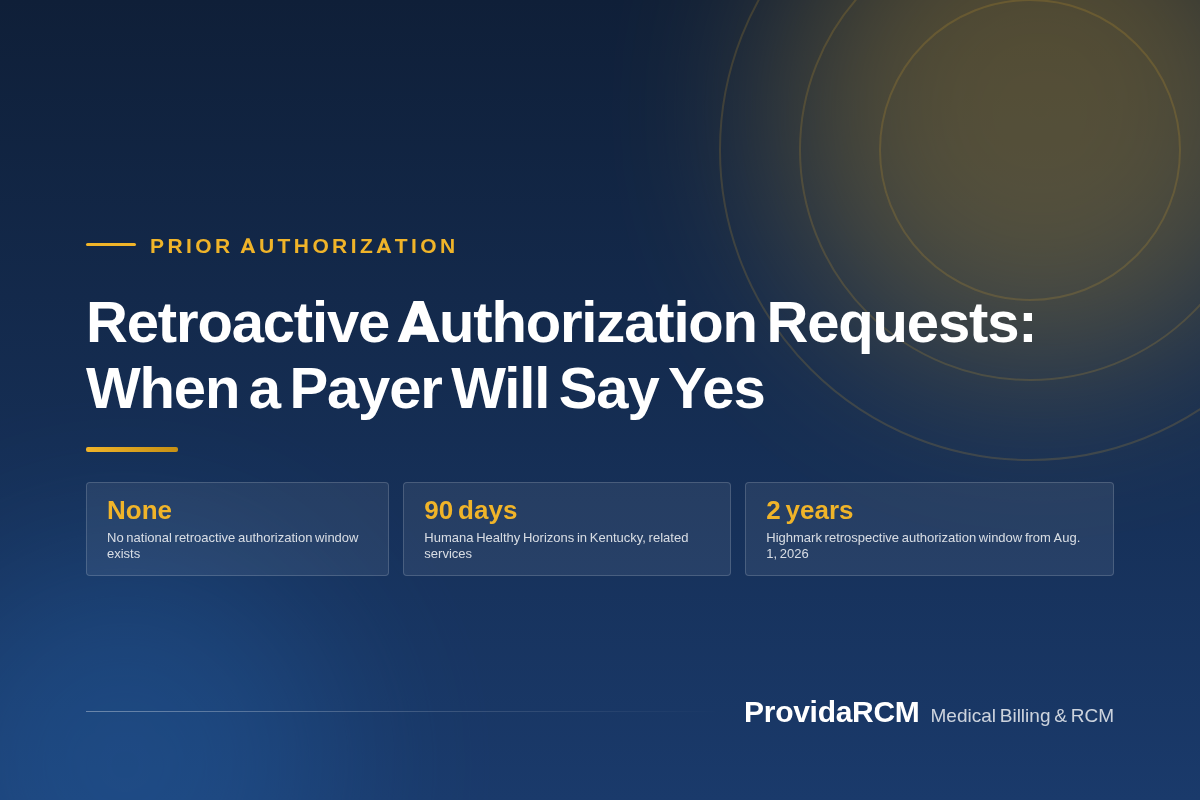
There is no national window for a retroactive authorization request. Each payer writes its own rule, and the payers that publish one say plainly what they will review after the fact: an emergency, a service nobody could foresee until the procedure was underway, a patient who arrived unable to give you information, or a plan that enrolls the member retroactively.
There is no national window for a retroactive authorization
Nothing in Medicare sets a deadline for asking a payer to approve a service you have already furnished. What exists is a policy written by each payer, and the ones that publish it set their own terms. Fallon Health allowed one up to 120 days after the date of service, then closed it, a policy choice that binds nobody else. Highmark kept its window open and, from Aug. 1, 2026, capped it at two years.
Medicare Advantage has one federal piece worth knowing, because it decides which process you are in. An organization determination, the plan’s coverage decision, includes the plan’s refusal to provide or pay for a service pre-service or post-service (42 CFR 422.566(b)(3)). A request for payment must be in writing unless the plan has chosen to accept verbal payment requests (42 CFR 422.568(a)(2)). CMS describes the review, not a filing window.
Every row below is language that payer published, and no row in it applies to a different payer.
| Payer | What its document says | Window or trigger it names | Where it is written |
|---|---|---|---|
| Fallon Health | No retroactive requests for any product except Summit ElderCare | Formerly 120 days after the date of service | Retroactive Authorization Requests policy, effective Jan. 1, 2025 |
| Highmark | Every retrospective request goes through Availity | Two years from the date of service, from Aug. 1, 2026 | Provider bulletin, April 2026 |
| Humana Healthy Horizons in Kentucky | Named situations only: retroactive eligibility or a related service | 12 months from the eligibility update, 90 days for a related service | Expanded retrospective review policy, April 2024 |
| Nevada Medicaid | On request, with a synopsis of medical necessity per date of service | 10 business days during an inpatient stay, 90 days after discharge | Web Announcement 3958, July 2026 |
| Aetna | When approval existed but the claim dates do not match, or when Aetna becomes the primary payer | No filing window. The availability list is the rule | Retrospective review, provider site |
The four situations a payer will actually review
An emergency has a federal floor under it. A Medicare Advantage plan is financially responsible for emergency and urgently needed services regardless of whether prior authorization was obtained, and it may not instruct members to seek prior authorization for emergency care (42 CFR 422.113(b)(2)(ii)). UnitedHealthcare states in its own Medicare Advantage list that prior authorization is not required for emergency or urgent care (UHC list, effective Apr. 1, 2026). That is UHC’s statement about UHC.
The second situation is a service that could not be foreseen until the procedure was underway. Humana Healthy Horizons in Kentucky lists two versions: the service relates to another that already received prior approval and was not needed when the first one was performed, or the need for the new service was determined during the prior-authorized procedure (Humana policy, April 2024). Louisiana Healthcare Connections allows a review when the physician cannot determine the exact procedure until after it is performed.
The third is a patient who arrived unable to give you what a check requires. Louisiana’s Medicaid policy grants a review when the record documents that the member refused or was physically unable to provide the Recipient ID number. Nevada Medicaid covers the inpatient version: eligibility found during the stay gives 10 business days from that decision, and after discharge 90 calendar days (Nevada Medicaid announcement).
The fourth is a plan whose own policy permits post-service review, and some of those policies are narrow on purpose. Aetna publishes an availability test rather than a deadline: retrospective review is not available for elective services on its precertification lists when precertification did not happen first (Aetna, retrospective review).
The document, the evidence and the fact pattern decide it
Three things decide a retrospective review: the document the payer will accept, clinical evidence measured against that payer’s own criteria, and a fact pattern explaining why prior authorization was impossible. Practices usually get one of the three wrong.
Humana’s Kentucky policy asks for three items: the patient’s name and Humana ID, the authorization number of the related approved service, and clinical information supporting the service. Nevada Medicaid asks for a synopsis of medical necessity for every date of service requested, the records supporting that synopsis, and a discharge summary. Nevada states that voluminous documentation will not be reviewed.
Necessity is measured against the criteria the payer says it applies. Clover Health’s Part C policy states that its utilization management uses CMS criteria, national and local coverage determinations, the plan’s own policies and MCG. A letter that argues the case the way a clinician would, without quoting the criteria the reviewer has to apply, gives that reviewer nothing to approve.
The fact pattern is where documentation written after the fact shows. Louisiana Healthcare Connections will consider a statement that the provider was told no authorization was required, but only when the record gives the date, the time and who gave the information. A note written three weeks later carries less weight.
A payer that denies a request filed one day late is applying its own published policy. Humana’s Kentucky document says so plainly: requests that exceed the time frame are denied and ineligible for appeal. The date of service starts that count whether or not the office knew the policy existed.
| Piece | What it has to show | Where it comes from |
|---|---|---|
| The document | The exact items the payer names, labeled the way that payer labels them | Humana ID and the related approval number; Nevada synopsis and discharge summary |
| The clinical evidence | Severity, failed conservative treatment and the payer’s own criteria, answered in order | The note, the studies and the payer’s medical policy |
| The fact pattern | Why prior authorization could not have happened before the service | A same-day chart entry: who said what, when, and what the member could not provide |
| The timeline | Filing date, date of service and the window the payer states for that trigger | The payer’s policy document, printed and dated |
| The decision record | What came back, on what date, and under which code | The payer’s notice and the 835 remittance advice |
The time limit is set by the payer, not by Medicare
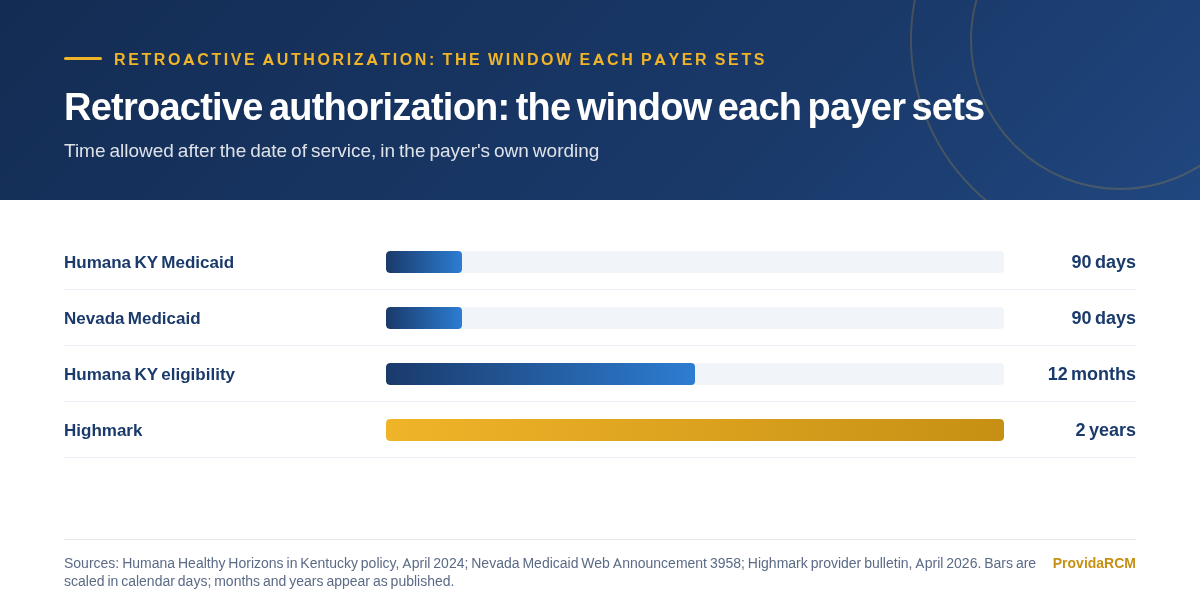
Every published window here is different, and the differences are not noise. Humana Healthy Horizons in Kentucky allows 12 months when the cause is retroactive Medicaid eligibility and 90 calendar days when the cause is a service related to one already approved. Nevada Medicaid allows 10 business days when eligibility is found during an inpatient stay and 90 calendar days when the finding comes after discharge. Highmark allows two years from the date of service. Fallon Health allows none.
A window can be anchored to a document rather than a visit. Humana counts 90 days from the date of the primary payer’s explanation of payment or authorization denial when that paper shows the service was not covered.
How long the payer has to decide once you file
Sources: 42 CFR 422.568(b)(1); Anthem Blue Cross provider news, December 2025.
A retroactive authorization request is not an appeal
The two processes answer different questions. A retrospective request asks the payer to decide coverage on a service it has not decided. An appeal asks it to reverse a decision it already made. In Medicare Advantage the first question still runs through the organization determination process, because 42 CFR 422.566(b)(3) includes the plan’s refusal to provide or pay for a service pre-service or post-service. The appeal is a reconsideration, filed within 60 calendar days after receipt of the written determination notice (42 CFR 422.582(b)).
Original Medicare runs a different clock. A redetermination must be filed within 120 calendar days from the date the party receives the notice of the initial determination (42 CFR 405.942(a)). Neither window pauses because a retrospective request is sitting in a review queue.
Filing the wrong one costs appeal rights. Clover Health’s Part C policy states that a retrospective request may be dismissed for untimely notification, and that a contracted provider who furnished a service without prior authorization will not have appeal rights. Humana’s Kentucky policy says a request outside the time frame is denied and ineligible for appeal. Fallon Health allows a provider appeal only for extenuating circumstances.
The clocks that keep running while the wrong request waits
Sources: 42 CFR 405.942(a); 42 CFR 422.582(b); Humana Healthy Horizons in Kentucky policy, April 2024.
When an appeal deadline is closer than a retrospective review decision, the review is not a substitute for it. The payer’s own document is the only place that says how the two requests are sequenced. Humana and Nevada describe their retrospective process and state no preference for it over an appeal, so do not assume one.
Tracking that shows whether the payer’s process is real
A retrospective process you cannot measure is a story you tell at a monthly meeting. Log six fields on every request: the date you filed, the date of service, the trigger you claimed, the payer’s decision, the days from filing to decision, and the claim adjustment reason code on whatever came back. That log becomes a grant rate, payer by payer.
The per-payer cut is the only one that means anything, because the policy is per payer. An overall grant rate can hide one payer that approves nine of ten requests and another that dismisses all of them as untimely. CMS’s interoperability rule requires the affected payers to expose prior authorization information through APIs, with operational provisions generally beginning January 1, 2026 (CMS-0057-F fact sheet), so more of that record can be checked against your own log.
Read the refusals together, because the pattern names the fix. Refusals that cite a missing document point at intake. Refusals that reject the trigger point at how the note describes the encounter. A payer that refuses without naming a window or a document is telling you the process does not exist for that service line.
| Field | What it tells you | Where the number comes from |
|---|---|---|
| Requests filed per payer | Whether the process is being used at all | Your authorization log, by payer and product |
| Grant rate per trigger | Whether the payer accepts your fact pattern or only the narrowest version of it | Decisions divided by filings, grouped by the trigger you claimed |
| Days filed to decision | Whether the payer answers inside its own stated timeframe | Filing date against the determination date |
| Refusal reasons | Which single step in the file needs rebuilding | The payer’s notice and any CARC or RARC on the remittance |
| Claims paid after a grant | Whether an approved review becomes money | The 835, matched to the authorization number |
Take the three payers that deny the most of your authorization claims and file one retrospective request with each, on a service where the fact pattern is documented on the day. The responses tell you which of the three has a process you can use.
What to fix before the next claim goes out
- 01
Give the appeal clock an owner
One person owns every determination notice date and every payer filing window. A retrospective request filed while an appeal clock runs is how a recoverable claim is lost.
- 02
Write the fact pattern at the encounter
If prior authorization was impossible, the note has to say why while the reason is still in the room: who told the office what, when, and what the member could or could not provide.
- 03
Keep the synopsis short and pointed
Nevada Medicaid states in writing that voluminous documentation will not be reviewed. Lead with the medical necessity of each date of service and attach only the records that support it.
- 04
Report grant rate by payer, monthly
Track filings and grants per payer. The payer with the lowest grant rate is either the one to stop filing with or the file that needs rebuilding.
The filing side of this work lives in prior authorization tracking, and the appeal side of a denial for absent authorization is covered in medical necessity denial appeals. The code definitions on the remittance are in claim denial codes explained. We run both halves through prior authorization services and denial management services.
Questions practices ask us about this
What is a retroactive authorization request?
It is a request that a payer review a service after it was furnished, where authorization was required and was not obtained beforehand. Humana Healthy Horizons in Kentucky defines it that way in its own policy. It is not an appeal, because the payer has not yet decided that service.
How long do we have to request a retroactive authorization?
There is no national window, and each payer sets its own. Humana Healthy Horizons in Kentucky allows 90 calendar days for a related service and 12 months for retroactive Medicaid eligibility. Nevada Medicaid allows 10 business days when eligibility is decided during an inpatient stay. Highmark allows two years from Aug. 1, 2026. Fallon Health allows none.
Is a retroactive authorization request the same as appealing a denial for no authorization?
No, and the difference is the clock. A retrospective request asks the payer to make a coverage determination it has not made. An appeal asks it to reverse a decision it already issued. In Medicare Advantage a reconsideration is filed within 60 calendar days of the determination notice, and an original Medicare redetermination within 120 calendar days. Filing the review instead does not extend either window.
What documentation does a payer require with a retrospective request?
The payer’s document lists it. Humana’s Kentucky policy asks for the patient name and Humana ID, the authorization number of the previously approved service, and clinical information supporting it. Nevada Medicaid asks for a synopsis of medical necessity for every date of service requested, the records supporting that synopsis, and a discharge summary.
What do the CARC codes on an authorization denial mean?
CARC 197 is precertification, authorization, notification or pre-treatment absent. CARC 198 is that same requirement exceeded. CARC 285 reports that appeal procedures were not followed, which is what a claim carries when the wrong process was used. The older code for an authorization number that is missing or invalid, CARC 15, was retired on 05/01/2018.
Does Medicare set a retrospective authorization window for Medicare Advantage?
No. CMS defines the process rather than a provider deadline. Under 42 CFR 422.566(b)(3) an organization determination includes the plan’s refusal to pay for a service pre-service or post-service, and a request for payment must be in writing unless the plan accepts verbal requests. What the regulation sets is the plan’s decision timeframe: 14 calendar days, or 7 from Jan. 1, 2026 for a service subject to its prior authorization rules.
Want the authorization work and the appeal work on one calendar?
We handle prior authorization, denial management and appeal deadlines for practices across the country as a single workflow. Send us a few months of authorization denials and we will show you which payers have a retrospective process worth using.
Book a free billing review- X12, Claim Adjustment Reason Codes (live list). x12.org/codes/claim-adjustment-reason-codes
- 42 CFR 422.566, Organization determinations. law.cornell.edu/cfr/text/42/422.566
- 42 CFR 422.568, Standard timeframes for determinations. law.cornell.edu/cfr/text/42/422.568
- 42 CFR 422.582, Request for a reconsideration. law.cornell.edu/cfr/text/42/422.582
- 42 CFR 422.113, Emergency and urgently needed services. law.cornell.edu/cfr/text/42/422.113
- 42 CFR 405.942, Time frame for a redetermination. law.cornell.edu/cfr/text/42/405.942
- Humana Healthy Horizons in Kentucky, retrospective review policy, April 2024. assets.humana.com/is/content/humana/KY_PRV_UM_Expanded_Retrospective_Review_Policypdf
- Nevada Medicaid, Web Announcement 3958. medicaid.nv.gov/Downloads/provider/web_announcement_3958_20260706.pdf
- Highmark, Retrospective auth requests within two years, April 2026. providers.highmark.com/communications-hub/news-and-updates/retrospective-auth-requests-must-be-submitted-within-two-years
- Fallon Health, Retroactive Authorization Requests policy, Jan. 1, 2025. fallonhealth.org/-/media/Files/ProviderPDFs/PaymentPolicies/RetroactiveAuthReq010125.ashx
- Clover Health, Part C Retrospective Review Policy UM-022. cdn.cloverhealth.com/filer_public/6c/24/6c24f74c-2f97-4dbd-9f11-8571e4348a43/_part_c_retrospective_review_2_1.pdf
- Aetna, Retrospective review. aetna.com/health-care-professionals/utilization-management/retrospective-review.html
- Anthem Blue Cross, Medical necessity review process, December 2025. providernews.anthem.com/california/articles/an-overview-of-our-medical-necessity-review-process-27412
- Louisiana Healthcare Connections, Retrospective review policy. ldh.la.gov/assets/medicaid/MCPP/4.26.21/499_LHCC_LA.UM.05.01_Retrospective_Review_For_Services_Requiring_Authori….pdf
- CMS, CMS-0057-F final rule fact sheet, Jan. 2024. cms.gov/newsroom/fact-sheets/cms-interoperability-prior-authorization-final-rule-cms-0057-f
- UnitedHealthcare, Medicare Advantage prior authorization list, Apr. 1, 2026. uhcprovider.com/content/dam/provider/docs/public/prior-auth/pa-requirements/medicare/Med-Adv-Dual-Eff-4-1-26.pdf