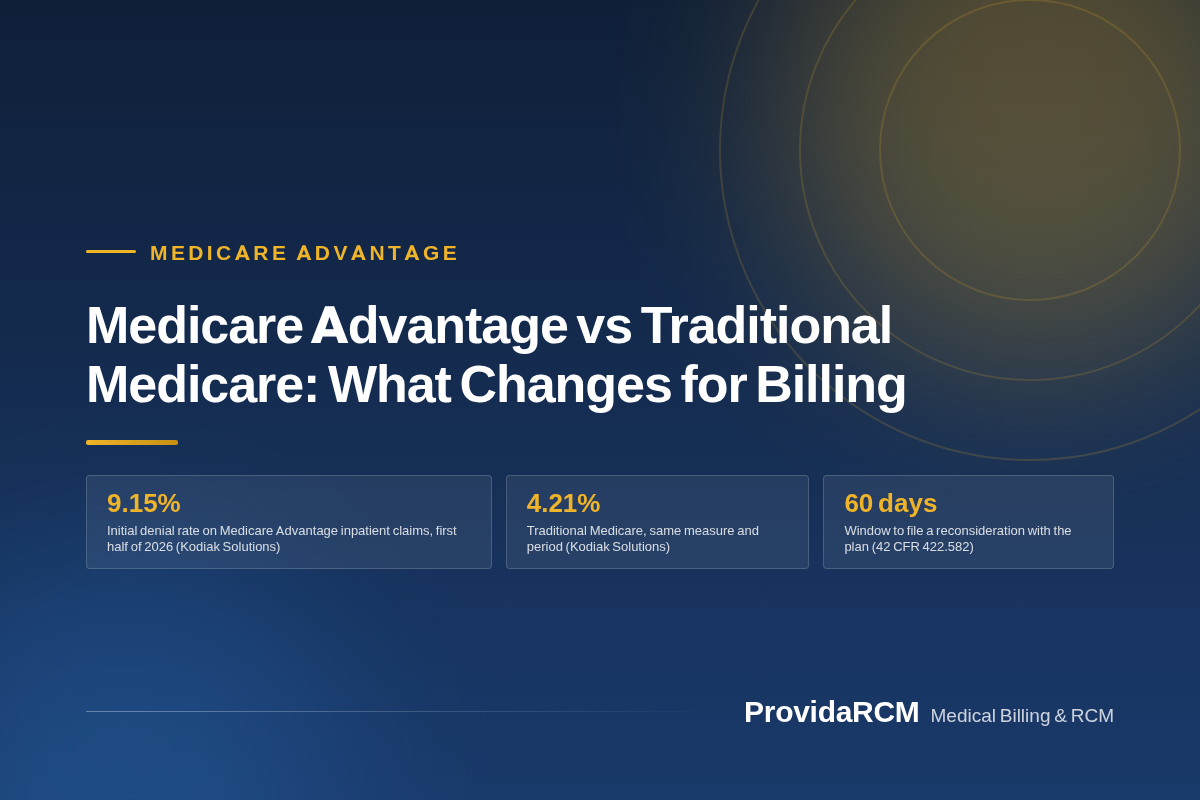
A patient who moves from fee-for-service Medicare into a Medicare Advantage plan changes the payer, the coverage rulebook, the prior authorization workload and the appeal ladder. Medicare Advantage billing also changes who owes the copay. The federal surprise-billing protections do not follow the patient into the plan, and that is the part most practices get wrong.
Who decides coverage and payment once a patient is in a plan
In traditional Medicare a Medicare Administrative Contractor makes the first decision on a claim, working from national and local coverage determinations, the Medicare benefit conditions and the fee schedule. In Medicare Advantage the plan makes that decision itself. An organization determination covers whether the item or service is covered, how much is covered, and what the enrollee owes (42 CFR 422.566).
The plan cannot invent coverage. It must apply national coverage determinations, the general coverage and benefit conditions in traditional Medicare law, and the local coverage decisions written for its service area. Where Medicare criteria are not fully established it may apply its own internal criteria, published with the evidence and rationale behind them (42 CFR 422.101). Its necessity decisions must account for the enrollee’s history, the treating physician’s recommendation and the clinical notes.
Calling a plan’s internal criterion a Medicare coverage rule misstates the law. Quote the criterion the plan cited in its own notice and show how the record meets it.
Where Medicare beneficiaries get coverage, 2026
Source: KFF, Medicare Advantage in 2026. Base: 35.2 million of 64.2 million beneficiaries with Parts A and B. CMS projects about 48 percent on the different base of everyone in Medicare.
| Decision | Traditional Medicare | Medicare Advantage | Rule |
|---|---|---|---|
| First decision | The MAC applies Medicare coverage rules and the fee schedule | The plan makes an organization determination | 422.566 |
| Coverage criteria | National and local coverage determinations | The same Medicare criteria, plus the plan’s published internal criteria where Medicare is not fully established | 422.101(b) |
| Prior authorization | No blanket requirement across Part B | The plan’s own published authorization list | 422.122 |
| Claim destination | The MAC for the practice’s jurisdiction | The plan, under its own payer identifier | MLN8659122 |
| How payment is set | The Medicare Physician Fee Schedule | The plan contract, or the original Medicare amount with no contract | 422.214 |
Prior authorization is the biggest Medicare Advantage billing change
Original Medicare does not route most Part B services through an authorization. A coordinated care plan may, and the services it covers that way are listed by the plan. Since January 1, 2026 a denial of an authorization request must state the specific reason, and each plan must publish its authorization metrics, including approval, denial and overturn rates, by March 31 for the prior year (42 CFR 422.122).
The clocks are shorter than anything in fee-for-service and they start when the request arrives, not when it is finished. A standard decision on a service that needs authorization is due in 7 calendar days from January 1, 2026. Other standard requests get 14 days. An expedited request gets 72 hours, or 24 hours for a Part B drug. An extension of up to 14 days is allowed only for reasons the regulation names.
How long the plan has to answer
Source: 42 CFR 422.568, 422.572 and 422.590. The 7-day standard clock applies to prior authorization requests received on or after January 1, 2026.
Authorization may be used only to confirm the presence of diagnoses or other medical criteria, or to establish that a service is medically necessary. An approval stays valid as long as it is medically reasonable and necessary, and a patient who switches plans mid-treatment gets a 90-day transition period in which the new plan may not require authorization for the active course of treatment (CMS-4201-F fact sheet).
- Pull each plan’s published authorization list in January and again when a plan revises it
- Log the exact time an authorization request was sent, because the plan’s clock starts then
- Flag every patient whose plan changed mid-treatment for the 90-day transition period
Where the claim goes, and who pays it
A claim for a patient in a plan is not a Medicare claim. It goes to the plan under the plan’s payer identifier, its clearinghouse enrollment and its own filing rules. CMS states that MACs process Original Medicare claims while Medicare Advantage plans process all claims through their own claims and payment procedures and send a remittance advice of their own (MLN8659122). The patient gets an explanation of benefits, not a Medicare Summary Notice.
Payment timing is regulated. A plan must pay 95 percent of clean claims within 30 days when they come from or on behalf of an enrollee of a private fee-for-service plan, or when they are for services not furnished under a written agreement, and interest runs on late clean claims. Any other claim from a provider with no contract must be paid or denied within 60 calendar days.
A practice with no contract must accept, as payment in full, the amount it could collect if the patient were enrolled in original Medicare (42 CFR 422.214). The fee schedule is still the reference point there, while a contracted practice is paid whatever its agreement says. A contract rate below Medicare is a contract question, not a billing error (Medicare Physician Fee Schedule 2026).
The plan’s own filing and appeal rules, and the ladder you filed before
A denial is appealed through the plan. The first level is a reconsideration the plan performs on its own determination, filed within 60 calendar days after receipt of the written notice, with receipt presumed 5 calendar days after the notice date unless there is evidence to the contrary (42 CFR 422.582). The plan then has 30 calendar days for a service reconsideration or 60 for a payment.
If the plan affirms any part of the denial it must send the case file to the CMS-contracted independent review entity inside the same window. That second level is automatic, and the practice does not file it. From May 1, 2026 the Part C independent review entity is C2C Innovative Solutions (CMS managed care appeals).
| Level | Traditional Medicare | Medicare Advantage | Authority |
|---|---|---|---|
| First review | Redetermination by the MAC | Reconsideration by the plan | 422.582 |
| Window to file | 120 days from the initial determination notice | 60 days from the plan’s notice | 405.942(a); 422.582(b) |
| Second review | Reconsideration by the quality improvement contractor | Review by the CMS-contracted independent review entity | 422.592 |
| Who starts it | A party files the request | The plan forwards the file when it affirms | 422.590(a)(2) |
| Above that | Administrative law judge, then the Medicare Appeals Council, then federal court | Administrative law judge when the amount in controversy is met, then the Council and federal court | 422.600, 422.608, 422.612 |
Who can appeal is narrower than in fee-for-service. The parties are the enrollee, an assignee who furnished a service and formally waived payment from the enrollee, a deceased enrollee’s estate, and any provider the plan finds has an appealable interest. A contracted practice whose payment request is settled with no liability left on the enrollee is outside subpart M, and its remedy is the contract (Medicare Advantage denials).
Cost sharing, and who is responsible for collecting it
The 20 percent coinsurance belongs to fee-for-service. In a plan the enrollee pays the plan’s copayment or coinsurance, often a flat dollar amount for a routine visit. Plan cost sharing for basic benefits must be actuarially equivalent to Medicare fee-for-service cost sharing, may not exceed 50 percent coinsurance where the regulation sets no lower limit, and must cap in-network cost sharing for Part A and Part B services at or below the annual limit CMS calculates from fee-for-service projections (42 CFR 422.100).
Emergency care carries its own protection. The plan pays for emergency and urgently needed services whether or not the patient is in network and whether or not authorization exists, and the enrollee’s share is limited to the lower of the plan’s in-network cost sharing or a per-visit maximum.
| Situation | Traditional Medicare | Medicare Advantage |
|---|---|---|
| Routine office visit | 20 percent coinsurance after the Part B deductible | The plan’s copayment or coinsurance, often a flat amount |
| Annual limit | None under original Medicare alone, unless a supplement supplies one | Capped at or below the limit CMS calculates |
| Emergency care | 20 percent coinsurance for the visit | Covered regardless of network, with a capped enrollee share |
| Who collects the patient share | The practice bills after Medicare and any supplemental insurer pay | The practice bills the copay or coinsurance on the plan’s remittance advice |
The patient owes what the plan’s remittance advice says, not the Medicare coinsurance. Billing the old amount produces a refund and, with a contracted plan, a contract problem. The plan’s explanation of benefits is the document to reconcile against.
What the practice can and cannot do when the plan denies a covered service
Start with the reason, because a plan denial must now carry one. Read the notice, and ask the plan in writing for the internal criterion it applied if the notice does not name it. If the plan used a criterion it never published, or cited a Medicare rule that governs some other service, that is the appeal.
Then work the levels in order: a reconsideration with the plan inside 60 days, an expedited review where the standard clock could seriously jeopardize the patient’s health, and a peer-to-peer review beside the reconsideration rather than instead of it. When the plan affirms, the file reaches the independent review entity without the practice filing anything.
- You can request an organization determination, a plan reconsideration and an expedited review, and file for the enrollee with the enrollee’s agreement
- You can ask for the criterion the plan applied and test it against the Medicare criteria the plan must follow
- You cannot route the claim to the MAC, to the quality improvement contractor or to any fee-for-service appeal level
CARC 197 is an absent authorization, CARC 50 is medical necessity and CARC 22 is another payer. CARC 15, the old code for a missing authorization number, was deactivated by X12 on 1 May 2018 and still appears in vendor code lists (claim denial codes explained).
Do the federal surprise-billing protections cover a Medicare Advantage plan?
No. CMS states directly that the No Surprises Act protects people with group health plan coverage, group or individual health insurance, Federal Employees Health Benefits coverage, Marketplace coverage or a plan bought from an insurer, and that its protections do not apply to consumers covered through Medicare, including Medicare Advantage, Medicaid, the Children’s Health Insurance Program, the Indian Health Service, the Department of Veterans Affairs or TRICARE (The No Surprises Act at a Glance).
So there is no federal balance-billing protection for a plan enrollee, no notice-and-consent paperwork, and no federal independent dispute resolution route for a plan claim. CMS notes that these programs generally have their own protections against balance billing, and for Medicare Advantage those sit in part 422 and in state law.
What exists instead is narrower but real. Emergency and urgently needed services must be covered regardless of network, cannot be made subject to prior authorization, and carry a capped enrollee cost share. A practice with no contract must accept the original Medicare amount as payment in full, which caps what it can collect for the service from anyone (42 CFR 422.113).
That shapes what the front desk can say. A patient can be told that emergency care cannot require prior authorization and that their share of it is capped, and that a plan decision can be reviewed first by the plan and then by an independent reviewer. A practice should not promise that the federal surprise-billing law governs their bill, and it should check the state’s balance-billing rules before deciding what can be billed after a denial.
A plan population therefore needs different front-end work from a fee-for-service one: an eligibility check that confirms the plan and the payer identifier, an authorization tracker, and an appeal calendar built on the plan’s 60-day window rather than Medicare’s (insurance verification checklist). We run that as prior authorization services and eligibility verification on top of full-cycle medical billing.
Questions practices ask us about this
Does the No Surprises Act protect patients in a Medicare Advantage plan?
No. CMS states that the No Surprises Act protections do not apply to consumers covered only through Medicare, including Medicare Advantage, or through Medicaid, the Children’s Health Insurance Program, the Indian Health Service, the Department of Veterans Affairs or TRICARE. For Medicare Advantage the protections come from part 422 and from state law, so a practice should not tell a patient the federal Act governs their bill.
Where do we send a claim for a patient in a Medicare Advantage plan?
To the plan, not to the MAC. CMS states that MACs process Original Medicare claims while Medicare Advantage plans process all claims through their own claims and payment procedures. The plan’s payer identifier, clearinghouse enrollment and filing rules therefore apply, and the plan issues its own remittance advice. The patient gets an explanation of benefits rather than a Medicare Summary Notice.
How long do we have to appeal a Medicare Advantage denial?
A reconsideration must be filed with the plan within 60 calendar days after receipt of the written organization determination notice, and receipt is presumed 5 calendar days after the notice date. The plan then has 30 calendar days to decide a service reconsideration or 60 for a payment request. When it affirms, the case goes to the independent review entity automatically.
Can we bill a patient for a service the plan denied?
It depends on the contract, the code and whether the enrollee has any liability left. A contracted practice is usually barred from billing for a denial the contract writes off. A practice with no contract must accept the original Medicare amount as payment in full. Emergency services are the plan’s responsibility with a capped enrollee share. Read the remittance advice before sending a statement.
Does prior authorization apply to emergency care in Medicare Advantage?
No. The plan is financially responsible for emergency and urgently needed services whether the patient is in network or out, and instructions to seek prior authorization for emergency care may not appear in enrollee materials or provider contracts before the patient is stabilized. The prudent layperson standard decides whether the visit was an emergency, so the final diagnosis does not control the coverage decision.
Are Medicare Advantage rates the same as the Medicare Physician Fee Schedule?
No. A contracted practice is paid the rates in its agreement with the plan, which may sit above or below the fee schedule, so a fee schedule variance report does not measure a plan claim. Where there is no contract, 42 CFR 422.214 requires the practice to accept, as payment in full, the amount it could collect if the patient were in original Medicare.
Want this fixed in your practice?
We run full-cycle billing, coding, credentialing and denial work for practices across the country. Send us a few months of claims and we will show you where the money is going.
Book a free billing review- CMS MLN8659122, Original Medicare vs. Medicare Advantage, July 2026. cms.gov/files/document/mln8659122-original-medicare-vs-medicare-advantage.pdf
- CMS, The No Surprises Act at a Glance (scope of the protections). cms.gov/files/document/nsa-at-a-glance.pdf
- eCFR, 42 CFR part 422 subpart M, Organization Determinations and Appeals. ecfr.gov/current/title-42/chapter-IV/subchapter-B/part-422/subpart-M
- eCFR, 42 CFR 422.101, Requirements relating to basic benefits. ecfr.gov/current/title-42/chapter-IV/subchapter-B/part-422/subpart-C/section-422.101
- eCFR, 42 CFR 422.100, General requirements (cost sharing and out-of-pocket limits). ecfr.gov/current/title-42/chapter-IV/subchapter-B/part-422/subpart-C/section-422.100
- eCFR, 42 CFR 422.113, Emergency and urgently needed services. ecfr.gov/current/title-42/section-422.113
- eCFR, 42 CFR 422.214, Services furnished by noncontract providers. ecfr.gov/current/title-42/section-422.214
- eCFR, 42 CFR 405.942, Filing a request for a redetermination. ecfr.gov/current/title-42/section-405.942
- CMS, Medicare Managed Care Appeals and Grievances. cms.gov/medicare/appeals-grievances/managed-care
- CMS fact sheet, 2024 Medicare Advantage and Part D Final Rule (CMS-4201-F). cms.gov/newsroom/fact-sheets/2024-medicare-advantage-and-part-d-final-rule-cms-4201-f
- Federal Register, Contract Year 2024 final rule, 88 FR 22120, April 12, 2023. federalregister.gov/documents/2023/04/12/2023-07115/medicare-program-contract-year-2024-policy-and-technical-changes-to-the-medicare-advantage-program
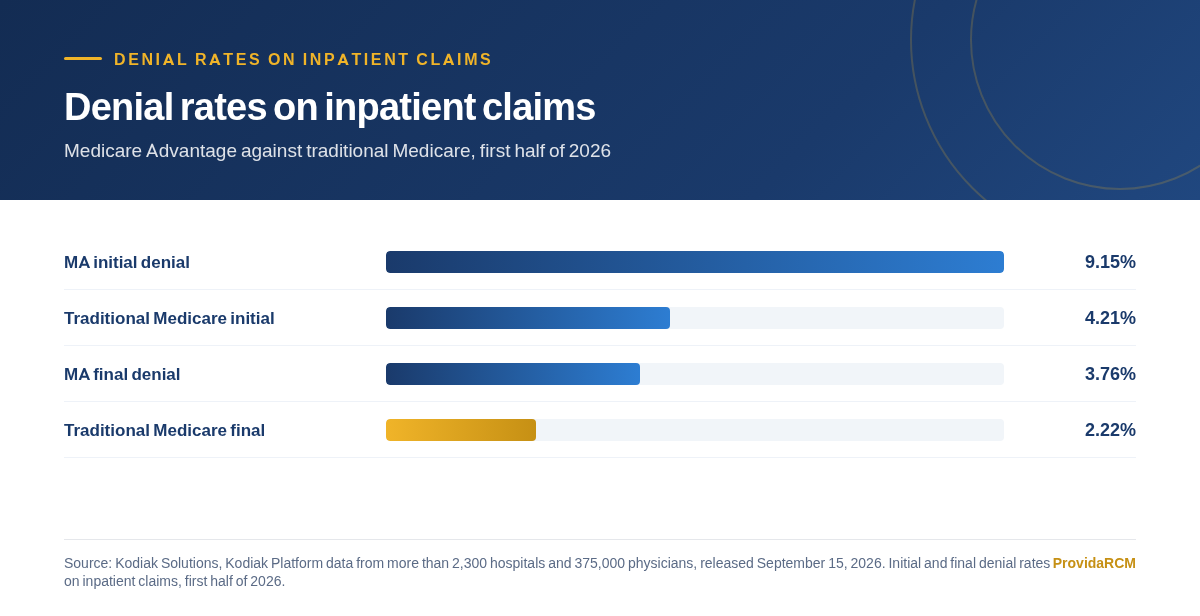
- Kodiak Solutions denial analysis, first half 2026, released September 15, 2026. finance.yahoo.com/healthcare/articles/falling-rates-insurance-claim-denials-150000715.html
- KFF, Medicare Advantage in 2026: Enrollment Update and Key Trends. kff.org/medicare/medicare-advantage-in-2026-enrollment-update-and-key-trends
- X12, Claim Adjustment Reason Codes. x12.org/codes/claim-adjustment-reason-codes