An out-of-network claims file is built before the claim is submitted, not after it is denied. It proves three things a payer checks: the patient was eligible, the provider held no contract, and the patient was told what the bill could be. Get that file right and the dispute has a foundation.
The out-of-network claims file starts before the claim does
A payer adjudicates a claim, and later an appeal, on the record in front of it. For an out-of-network claim that record has three load-bearing parts: proof the patient was eligible, proof the provider held no contract with the plan, and proof the patient was told the bill could exceed in-network cost sharing. Miss any one and the file cannot answer the question the payer is asking.
How early the notice and consent must reach the patient
Source: 45 CFR 149.420(c)(1)(iii) and the CMS sample notice and consent form.
| Document | What it must prove | Owner | Primary authority |
|---|---|---|---|
| Eligibility and benefits verification | Coverage was active on the date of service and the plan is the correct payer | Front desk | Plan eligibility response kept in the chart |
| Network status confirmation | The provider had no contract with that plan for that service | Credentialing and contracting | Plan directory and the contract list |
| Notice and consent form | The patient chose the out-of-network provider and signed the federal form where a waiver is allowed | Provider and patient access | 45 CFR 149.420(c) and (d), the CMS form |
| Good faith estimate | The uninsured or self-pay patient received expected charges before care | Scheduling and billing | 45 CFR 149.610 |
| Balance bill consent | The patient agreed to a bill above in-network cost sharing where that is lawful | Billing | 45 CFR 149.420, or the named state statute where one applies |
| Clinical documentation | The service met the plan’s medical policy and the codes match the note | Coding | Payer medical policy |
The file is not a folder of documents. It is a sequence of confirmations with dates attached: an eligibility check run on the date of service, a directory record showing the provider as non-participating, a signed federal form, and an estimate that matches the codes billed. Each one closes a gap a payer would otherwise use to deny the claim or pay it at a lower rate.
- Verify eligibility on the date of service and keep the plan’s own response, not a note that it was checked
- Save the directory or contract evidence showing the provider is non-participating for that plan and product
- File the signed federal notice and consent form with the claim when waiving surprise billing protections is allowed
- Attach the good faith estimate for uninsured or self-pay patients and confirm the billed codes match it
- Record who obtained the consent, the date and the time, because the window is measured in hours
What a payer’s remittance must carry now
Under the 2026 final rule, a plan has to use claim adjustment reason codes and remittance advice remark codes when it answers an out-of-network claim, so the provider can tell whether the payment dispute is even eligible for the federal process. The CMS guidance of July 17, 2026 names nine remark codes and the circumstance for each.
| RARC | What it tells the provider | Dispute eligible for the federal IDR process? |
|---|---|---|
| N877 | The initial payment follows the No Surprises Act. The provider may open negotiation for a higher rate | Yes, after the open negotiation period |
| N876 | Covered but no payment. This is a notice of denial of payment under the Act, not a benefit denial | Yes, after the open negotiation period |
| N871 | The payment was set by a specified state law, so the rate dispute is not a federal one | No |
| N872 | A final payment calculated under a specified state law | No |
| N873 | A final payment calculated under an All-Payer Model Agreement | No |
| N874 | A final payment agreed on through open negotiation | No |
| N875 | A final payment equal to the amount a certified IDR entity selected | No |
| N944 | Covered but no payment, with cost sharing set by a state law or All-Payer Model Agreement | No |
| N943 | The item or service is not subject to the surprise billing provisions at all, including where notice and consent was valid | No |
The regulation at 45 CFR 149.100 leaves the reason code to the plan’s judgment. What is mandatory is the remark code. Read them against the code reference on this site rather than a payer crosswalk, because the guidance sets an effective date and an application date that differ.
The nine required No Surprises Act RARCs
Source: CMS, Guidance on Required Remittance Advice Remark Codes Related to the No Surprises Act, July 17, 2026.
N943 and N944 take effect November 1, 2026, so they are absent from the X12 remark code list as this is written. N871 through N877 have been live since March 1, 2022 and appear there as current, not deactivated. Check any code against the live list before you build a denial report on it, because retired codes keep circulating.
On an electronic 835 the remark code sits in the LQ segment in Loop 2110, one per line item. On paper it has to be inside the remittance itself and tied to the line it explains. If a plan skips the codes, the provider keeps the right to open negotiation within 30 days of the initial payment or denial and can ask the Departments for an extension.
Three dates that govern the remittance rules
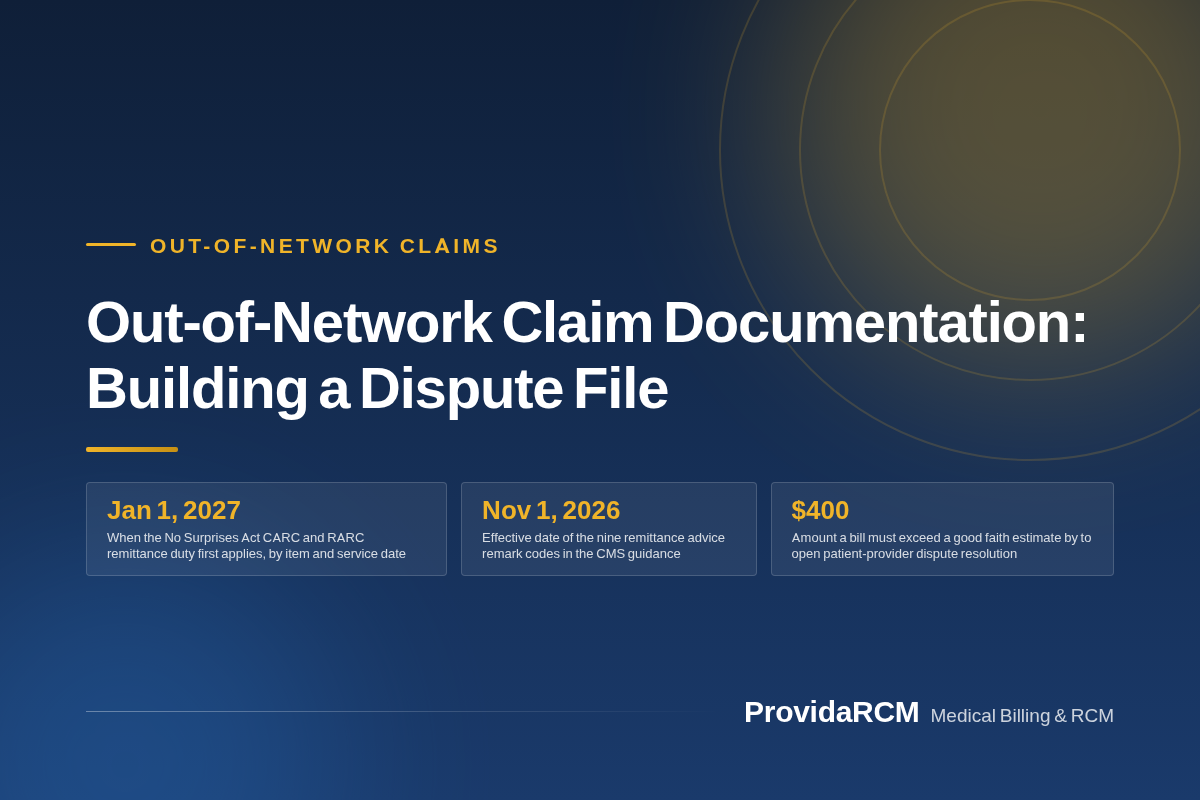
Rules about out-of-network payment carry three separate dates, and blurring them is how a practice builds a deadline into its worklist that does not exist. The final rule published on June 4, 2026. Its regulations took effect August 3, 2026. The nine remark codes take effect November 1, 2026, and the duty to use them attaches to item and service dates from January 1, 2027.
| Milestone | Date | What it governs |
|---|---|---|
| Final rule published | June 4, 2026 (91 FR 33900) | The Federal Independent Dispute Resolution Operations rule |
| Regulations effective | August 3, 2026 | 45 CFR 149.100 and the parallel rules on CARC and RARC use |
| Nine remark codes effective | November 1, 2026 | The remittance advice remark codes named in the CMS guidance |
| CARC and RARC duty applies | January 1, 2027 | Item and service dates, not claim or payment dates |
The distinction is operational. A claim furnished in December 2026 does not carry the new remark codes, even if it is adjudicated in 2027. A rate dispute over that claim still runs the full open negotiation and dispute clock. The calendar in your denial workflow has to key off the date of service, not the date the remittance lands in the lockbox.
The rule itself is the Federal Independent Dispute Resolution Operations rule at 91 FR 33900. It rebuilt the dispute process from the fee to batching. The adjacent article on the 2026 overhaul covers those mechanics. This piece stays with the claim file that feeds them.
Working the denial: which track does the file take?
A denial for missing information and a payment below the out-of-network rate are not the same problem, and they do not travel the same path. A notice of denial of payment under the No Surprises Act is not an adverse benefit determination, so it does not open the plan’s internal appeal. Treating the two as one queue is how files sit untouched until a window closes.
| What the record shows | Where the file goes | The clock | Owner |
|---|---|---|---|
| Information missing or inconsistent (CARC 16) | A corrected claim, then the plan’s own process if it denies again | The plan’s filing window | Billing and front end |
| Authorization absent (CARC 197) | A retro-authorization request, then the appeal | The plan’s appeal window | Prior authorization and clinical |
| Paid below the out-of-network rate (RARC N877 or N876) | Open negotiation, then the federal IDR process if it fails | 30 business days of open negotiation | Dispute team |
| Payment set by a specified state law (RARC N871 or N872) | The state process named in that law | The state’s own clock | Dispute team and counsel |
| Not subject to the Act (RARC N943) | The plan’s internal appeal, if the plan covers the service | The plan’s appeal window | Appeals |
The split is worth stating plainly. The federal process decides the out-of-network rate, not whether the service was covered. If the plan says the service was not medically necessary, or was never authorized, that is an internal appeal and the outcome turns on clinical documentation. Open negotiation and the dispute process only come into play when the plan covered the service and the fight is about how much it paid.
It does not decide medical necessity. It does not cover ground ambulance, Medicare, Medicaid, CHIP or TRICARE claims. It applies to emergency services including post-stabilization care, non-emergency services from an out-of-network provider at certain in-network facilities, and air ambulance. Confirm the claim is a federal one before you file.
The CMS applicability chart sorts states into those where the federal process applies and those where a specified state law or an All-Payer Model Agreement may take over. Six states let self-insured plans opt into the state process: Georgia, Maine, Nevada, New Jersey, Virginia and Washington. Check the plan’s status, not the state’s alone.
Open negotiation and IDR sit on their own clock
When the fight is about the rate, the file moves onto a federal clock that runs separately from the plan’s appeal calendar. The plan owes an initial payment or a notice of denial, with the qualifying payment amount and the contact for open negotiation, within 30 calendar days of a clean claim. Open negotiation must then be opened within 30 business days of receiving that notice or payment.
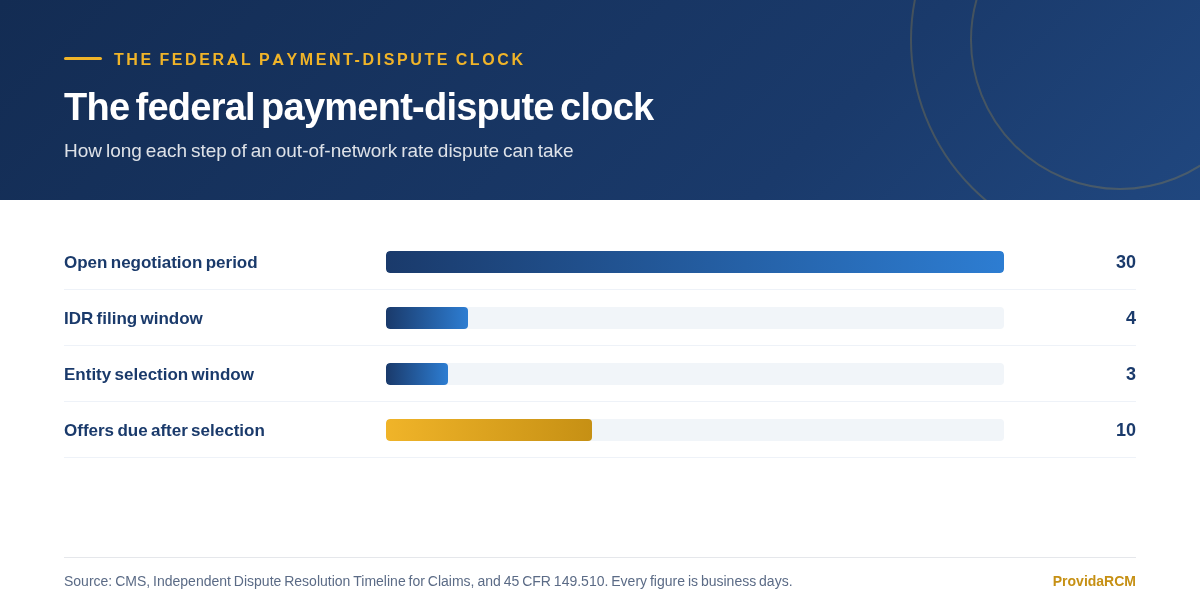
The open negotiation period itself runs 30 business days. The parties then have 4 business days to file, the other side has 3 business days to agree to or object to the certified entity, and offers are due within 10 business days of selection. The regulation at 45 CFR 149.510 sets each one of those windows.
The certified entity has 30 business days from selection to pick one of the two offers, and the losing side pays the entity fee. The determined amount is due within 30 calendar days after the determination. Our prior authorization service tracks the authorization side of this, because a missing authorization is the most common reason a covered service turns into a fight.
A dispute file that holds up under review
A file that is complete at submission is a file that can be defended months later, by a reviewer who never touched the claim. That means a date on every confirmation, the payer’s own words on every coverage decision, and the payer’s own policy quoted on every necessity question.
- 01
Log the initial payment or denial the day it arrives
Note the date, the qualifying payment amount and the open negotiation contact. That date starts the 30 business day window, and it is easy to lose.
- 02
Sort by what the remittance says
A remark code that says the rate dispute is eligible goes one way. A code that says a state law set the payment goes another. The routing follows the code.
- 03
Quote the payer’s own criteria in every appeal
A necessity appeal that does not answer the plan’s medical policy rarely wins. Put the policy language and the chart note side by side.
- 04
Keep the market rate evidence with the file
Contracted rates for the same service in the same market, plus acuity and complexity. This is what a certified entity weighs on a disputed rate.
- 05
Diary every deadline with an internal buffer
Business days pass faster than calendar days. Hold a five day internal buffer before each federal deadline so one late document does not cost the claim.
We build these files every day through our out-of-network billing service, alongside denial management, eligibility verification and full-cycle medical billing. If your out-of-network aging is parked in the 90 day bucket, start with a review of what is still inside the filing window.
Questions practices ask us about this
What has to be in an out-of-network claim file before we submit?
Proof the patient was eligible on the date of service, evidence the provider held no contract with that plan for that service, and the consent trail where balance billing is lawful. For uninsured or self-pay patients, include the good faith estimate. Attach the clinical documentation that establishes the service was covered. The file should read as a sequence of dated confirmations, because that is how a payer reviews it months later.
What codes must a payer put on an out-of-network remittance?
Under the 2026 final rule, plans must send claim adjustment reason codes and remittance advice remark codes on out-of-network claims. CMS guidance issued July 17, 2026 names nine required remark codes, N871 through N877 plus N943 and N944. The reason code is left to the plan’s judgment. The remark code is what tells you whether the rate dispute can go to the federal independent dispute resolution process.
Are the new No Surprises Act remark codes required yet?
Not for services furnished before January 1, 2027. The regulations took effect August 3, 2026, and the nine remark codes take effect November 1, 2026, but the duty to use them attaches to items and services furnished on or after January 1, 2027. A claim furnished in 2026 will not carry the new codes even if it is adjudicated later.
Does an out-of-network payment denial go through the plan’s appeal?
Only if the denial is about coverage or medical necessity. A notice of denial of payment under the No Surprises Act is not an adverse benefit determination, so a rate dispute does not run through the plan’s internal appeal. It runs through open negotiation and, if that fails, the federal independent dispute resolution process. A denial for missing information goes back as a corrected claim.
How long do we have to open negotiation or file a federal dispute?
A provider has 30 business days from receiving the initial payment or notice of denial to open negotiation. The open negotiation period itself runs 30 business days, and the dispute must be filed within 4 business days after that period ends. Missing the window generally ends the federal route. The certified entity then has 30 business days to decide between the offers.
When do we need a good faith estimate or a signed consent form?
A signed notice and consent form is needed only for certain non-emergency services from an out-of-network provider at a participating facility. The notice must go out at least 72 hours before a scheduled appointment, or 3 hours before a same-day service, and it must include the estimated charge. A good faith estimate is separate and covers uninsured or self-pay patients.
Does the federal dispute process apply in every state?
No. The federal process does not apply where a specified state law or an All-Payer Model Agreement sets the out-of-network rate, and it never applies to Medicare, Medicaid, CHIP or TRICARE. The CMS applicability chart sorts states accordingly. Six states let self-insured plans opt into the state process: Georgia, Maine, Nevada, New Jersey, Virginia and Washington.
Want this fixed in your practice?
We run full-cycle billing, coding, credentialing and denial work for practices across the country. Send us a few months of claims and we will show you where the money is going.
Book a free billing review- CMS, Guidance on Required Remittance Advice Remark Codes Related to the No Surprises Act, July 17, 2026. cms.gov/cciio/programs-and-initiatives/other-insurance-protections/caa-nsa-rarc-codes.pdf
- Federal Register, Federal Independent Dispute Resolution Operations, 91 FR 33900, June 4, 2026. federalregister.gov/documents/2026/06/04/2026-11140/federal-independent-dispute-resolution-operations
- eCFR, 45 CFR 149.100, Use of claim adjustment reason codes and remittance advice remark codes. ecfr.gov/current/title-45/subtitle-A/subchapter-B/part-149/subpart-B/section-149.100
- eCFR, 45 CFR 149.510, Independent dispute resolution process. ecfr.gov/current/title-45/subtitle-A/subchapter-B/part-149/subpart-F/section-149.510
- eCFR, 45 CFR 149.420, Balance billing in cases of non-emergency services. ecfr.gov/current/title-45/subtitle-A/subchapter-B/part-149/subpart-E/section-149.420
- eCFR, 45 CFR 149.610, Good faith estimates for uninsured or self-pay individuals. ecfr.gov/current/title-45/section-149.610
- CMS, Independent Dispute Resolution Timeline for Claims. cms.gov/files/document/independent-dispute-resolution-idr-timeline-claims.pdf
- CMS, Chart for Determining the Applicability for the Federal IDR Process. cms.gov/files/document/caa-federal-idr-applicability-chart.pdf