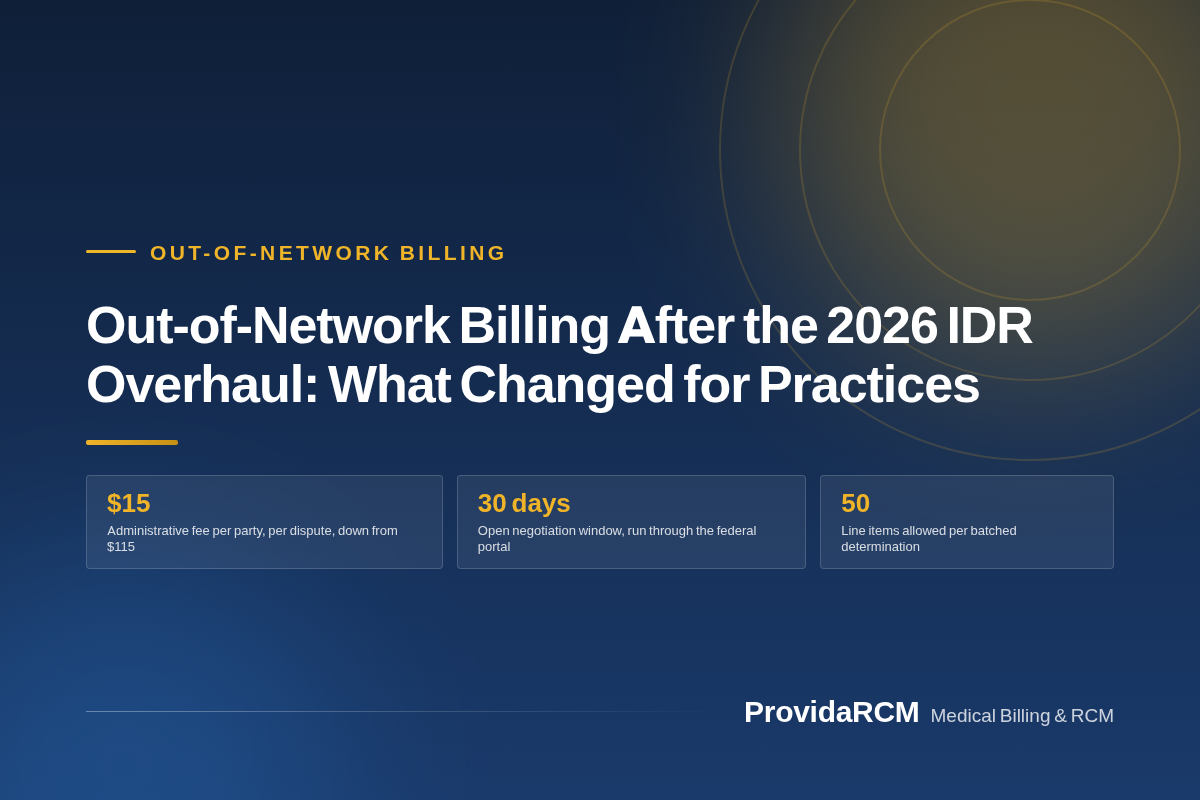
The federal process for disputing out-of-network payments changed on 11 June 2026. The administrative fee dropped from $115 to $15 per party, open negotiation moved into the federal portal, batching was rewritten with a 50 line item cap, and payers now have to identify surprise billing situations through standard claim adjustment reason codes on the remittance advice.
What the No Surprises Act actually protects
The No Surprises Act limits what an out-of-network provider can bill a patient in specific situations, and gives the provider a federal route to dispute the payment when it disagrees with the plan. Both halves depend on the situation, and a claim that falls outside the protected situations is not a federal dispute at all.
| Situation | Covered by the No Surprises Act | Practical effect |
|---|---|---|
| Emergency services from a non-participating provider | Yes | Patient cost sharing is limited and balance billing is prohibited |
| Non-emergency services at a participating facility with an out-of-network provider | Yes | Same protections when the provider did not give notice and consent |
| Air ambulance from a non-participating provider | Yes | Cost sharing limits apply and the federal dispute process is available |
| Ground ambulance | No | Protections do not apply, so the patient is not held harmless |
| Services where the patient gave valid notice and consent | No | Balance billing is permitted under the consent rules |
The practical reading is that your out-of-network volume is not one bucket. It is protected claims, consents, and self-pay balances, and only the first group travels the federal dispute path. Reviewing the federal overhaul without first sorting claims into those buckets creates work that goes nowhere.
For the detail on consent and notice requirements, the CMS No Surprises Act guidance is the reference to work from, not a summary.
The 2026 rule on one page
The rule is called Federal Independent Dispute Resolution Operations and runs to a full Federal Register notice at 91 FR 33900, issued 28 May 2026 and effective 3 August 2026. Four provisions matter to a practice’s day to day work. The rest is plumbing between plans and the departments.
| Provision | Before | From 11 June 2026 |
|---|---|---|
| Administrative fee to open a dispute | $115 per party | $15 per party |
| Open negotiation | Run between the parties, loosely tracked | 30 day period conducted through the federal IDR portal |
| Batching | Prior rules vacated in litigation | Up to 50 line items per determination |
| Remittance information for out-of-network claims | Inconsistent across plans | Standard CARC and RARC codes required |
| Finding the right plan contact | Provider had to work it out | Plans must register in a searchable federal IDR registry |
| Entity selection when parties disagree | Disputed between the parties | HHS Secretary selects a certified entity at random |
One thing the rule does not fix is worth stating plainly, because it affects how much a dispute is worth. The departments did not change the qualifying payment amount methodology or the weight a certified entity gives it, and providers have argued for years that the QPA itself sits too low. The final rule also does not create an enforcement mechanism for late payment after a determination comes down. Both gaps are the subject of pending legislation, the No Surprises Act Enforcement Act, which would attach penalties to missed payment deadlines.
The fee cut changes which claims are worth disputing
At $115 per party, opening a federal dispute was a decision about claim value. Radiology, pathology, emergency medicine and other specialties that bill many moderate-dollar claims had to leave recoverable money on the table, because the administrative fee alone could exceed the difference in dispute. Dropping that fee to $15 changes the arithmetic more than the 87% reduction suggests.
Administrative fee per party, per dispute
Source: Federal Independent Dispute Resolution Operations, 91 FR 33900. The certified IDR entity fee is separate and is set by each entity.
The $15 administrative fee is one line on the invoice. Each certified IDR entity charges its own fee, and the departments estimated the technology and process changes behind this rule at $11 million in 2026 rising to $18 million a year from 2028. Build the business case on total cost, then decide what your floor claim value is.
A workable threshold comes from the other side of the ledger. If the administrative fee, the entity fee, and the staff time to assemble a dispute add up to a few hundred dollars, then the federal process is worth using on any claim where the gap between the billed rate and the plan’s offer clears that number with room to spare. Practices that never ran that calculation now have a reason to.
Open negotiation now runs through the portal
Before the rule, open negotiation happened between the provider and the plan on whatever channel each side preferred, and a large share of disputes died there because nobody could establish who the counterparty was. A provider with a claim and a remittance often had no reliable way to learn which issuer or plan was responsible.
Two changes address that. Plans and issuers must register in a new federal IDR registry, which works as a searchable contact database, and the 30 day open negotiation window now runs through the portal. Both matter for the same reason: they shorten the front of the dispute, which is the part where claims quietly expire.
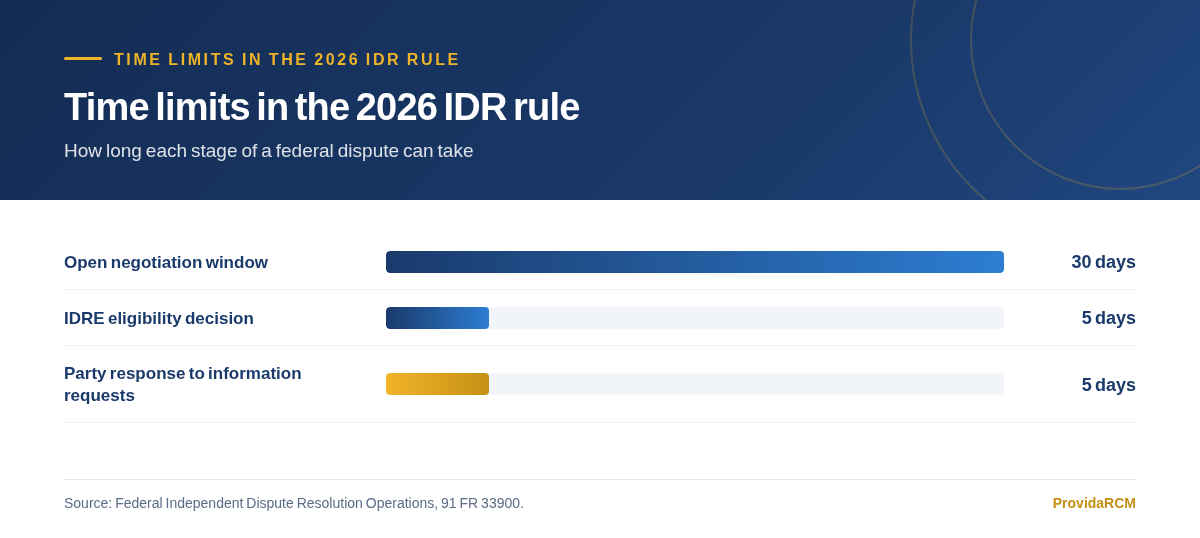
Once open negotiation closes, the certified entity has five business days from final entity selection to determine whether the dispute is eligible. Parties then have five business days to answer an information request. Missing either deadline is the same as conceding the point, so the calendar belongs to whoever is running the disputes.
Batching, and why the line item cap matters
Batching is how a practice turns fifty small disputes into one. Related line items go into a single determination, share one administrative fee, and get decided together. The rule sets the cap at 50 line items per determination and replaces the earlier batching provisions.
The reason this needed rewriting is litigation. The US District Court for the Eastern District of Texas vacated parts of the earlier implementing regulations, including the qualifying payment amount methodology and the weight given to it, along with the batching provisions that had restricted how providers could group items. As the Holland & Knight analysis of the final rule sets out, the portal shut down more than once while the departments rebuilt, and the backlog that formed is the reason disputes were slow through 2025.
Practices that bill high volumes of similar out-of-network claims, imaging, pathology, anesthesia and emergency medicine among them, get the most out of batching discipline. Grouping by plan, by service category and by the same payment dispute is what keeps a determination clean. Grouping by convenience is what gets a batch rejected and the fee spent twice.
Prior authorization decision windows for affected plans
Source: CMS Interoperability and Prior Authorization final rule, CMS-0057-F.
Batching also interacts with the prior authorization side of the house. Plans subject to the interoperability rule have to answer expedited authorization requests within 72 hours and standard requests within seven calendar days, and the authorization APIs are due at the start of 2027. A dispute that turns on whether an authorization existed is easier to win when the payer’s own decision window is documented. Our prior authorization service tracks those windows for the practices we bill for.
Build the dispute file on documentation, not argument
A certified entity decides a disputed rate from the qualifying payment amount and whatever credible information both sides submit. Providers cannot change the method by arguing about it. They can out-document the other side, which is where determinations are actually won.
- 01
Confirm the claim is a federal dispute at all
Check whether a specified state law or an all-payer model agreement governs the payment. If one does, the federal process is not the route, and filing there wastes the window.
- 02
Read the remittance before writing anything
Plans now have to use standard CARC and RARC codes on remittance advice for out-of-network claims. Those codes tell you whether the claim was treated as surprise billing at all.
- 03
Assemble the comparable claims data first
Contracted rates for the same service in the same market, the patient acuity, the facility and the modifier complexity. This is the evidence an entity weighs.
- 04
State the offer in the portal, not in an attachment
The determination follows the offer on the record. A supporting narrative that never reaches the right field is not in the record.
- 05
Diary the payment deadline after the determination
The rule does not enforce post-determination payment. Practices have to chase the payment themselves and escalate when the clock runs.
The documentation that decides most disputes is not a legal brief. It is a clean claim, a matching authorization where one applies, and market rate evidence that a reviewer can check.
What to change in your process this quarter
- Sort out-of-network volume into protected claims, consents, and self-pay balances before anything else
- Register for the federal IDR portal and use the registry to identify the correct counterparty on every dispute
- Pull remittance advice and check whether new CARC and RARC codes are arriving for out-of-network claims
- Recalculate the minimum claim value worth disputing now that the administrative fee is $15
- Group prospective disputes by plan and service category against the 50 line item cap
- Check state law on every claim before filing federally, and document the answer
Most of this is bookkeeping rather than strategy, which is the point. The rule made the federal process cheaper and more predictable. It did not make it automatic, and the practices that gain are the ones that rebuilt their workflow around the new clock instead of waiting for the old backlog to clear.
We handle out-of-network claims, appeals and dispute preparation through our out-of-network billing service, working alongside full-cycle medical billing, denial management and AR management. If your out-of-network aging has been sitting in the 90 day bucket waiting for the process to settle down, start with a review of what is still inside the filing window.
Questions practices ask us about this
How much is the federal IDR administrative fee now?
It is $15 per party per dispute for disputes initiated on or after 11 June 2026, down from $115. The administrative fee is separate from the certified IDR entity fee, which each entity sets and charges on top. The departments waived the usual delayed effective date so providers would get the lower fee immediately.
How long does the open negotiation period last?
Thirty days, and it now runs through the federal IDR portal rather than on whatever channel the two sides happen to use. If the parties do not settle inside that window, the dispute moves to entity selection, and the certified entity has five business days from final selection to decide eligibility.
How many claims can be batched into one dispute?
Up to 50 line items per determination under the batching framework in the 2026 final rule, which replaces the earlier provisions that litigation had vacated. Batching lets related line items share one administrative fee and one decision, so grouping by plan and service category is worth the effort.
Does the No Surprises Act cover ground ambulance?
No. The surprise billing protections cover emergency services, non-emergency services delivered at a participating facility by a non-participating provider, and air ambulance services. Ground ambulance is excluded, so patients are not held harmless on those bills. A congressional advisory committee recommended extending coverage, but no change has taken effect.
How do I know whether a dispute belongs to the federal process or my state?
Check for a specified state law or an all-payer model agreement that sets the payment method for the item or service. If one applies, the federal process is not the route to use. The new federal IDR registry helps here because it tells you which entity the plan uses and whether a state rule overrides the federal path.
What happens if the IDR fees are not paid on time?
A payment offer is treated as not received if the party has not paid the administrative fee and the certified entity fee by the time its offer is due, and the liability for those fees continues. In practice, missing the fee deadline removes that party’s offer from consideration, which hands the determination to the other side.
Want this fixed in your practice?
We run full-cycle billing, coding, credentialing and denial work for practices across the country. Send us a few months of claims and we will show you where the money is going.
Book a free billing review- Federal Independent Dispute Resolution Operations, final rule, 91 FR 33900. federalregister.gov/documents/2026/06/04/2026-11140/federal-independent-dispute-resolution-operations
- Holland & Knight, Federal IDR Process Overhaul Finalized, June 2026. hklaw.com/en/insights/publications/2026/06/federal-idr-process-overhaul-finalized
- CMS, No Surprises Act dispute resolution. cms.gov/nosurprises/help-resolve-payment-disputes
- CMS, Interoperability and Prior Authorization final rule (CMS-0057-F). cms.gov/newsroom/fact-sheets/cms-interoperability-prior-authorization-final-rule-cms-0057-f