

No single rule limits physical therapy billing. Medicare repealed the hard therapy caps in 2018 and replaced them with an annual threshold: $2,480 for 2026 for physical therapy and speech-language pathology combined. Cross it and the KX modifier is required, the plan of care must be certified, and the record has to prove the treatment was skilled and necessary.
What actually limits physical therapy billing: the annual threshold
For two decades Medicare capped how much outpatient therapy one beneficiary could receive in a year. Section 4541(c) of the Balanced Budget Act of 1997 set that limit. Section 50202 of the Bipartisan Budget Act of 2018 repealed the hard cap and kept the dollar figure as a threshold instead. The amount is indexed every year, so a number from an old article is worse than no number at all.
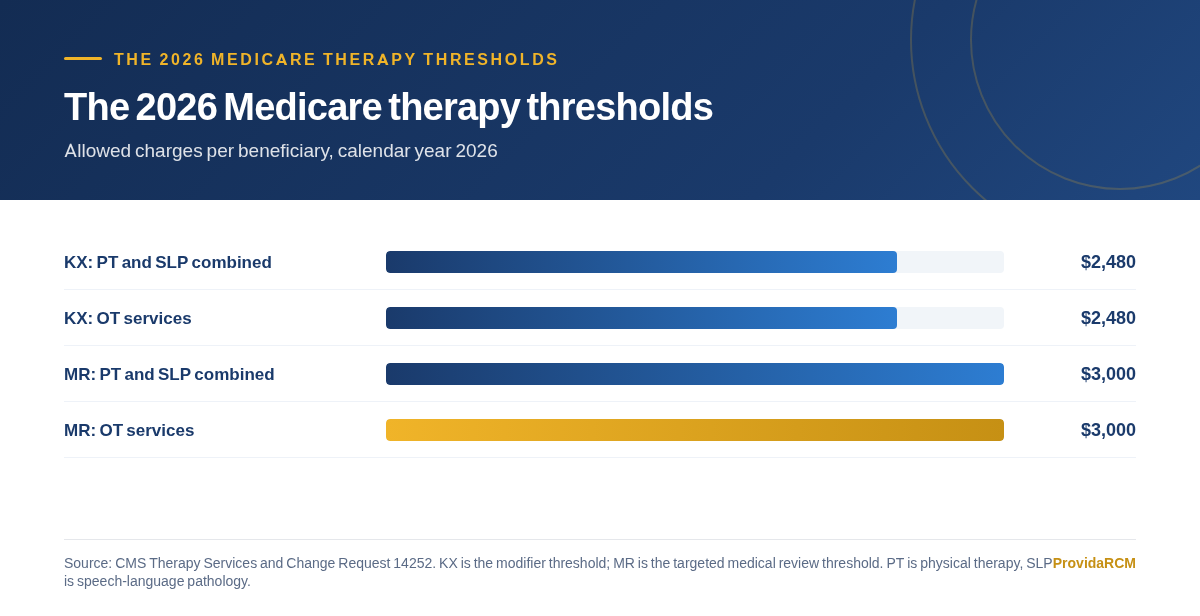
For calendar year 2026 the KX modifier threshold is $2,480 for physical therapy and speech-language pathology services combined, and a separate $2,480 for occupational therapy. Those figures come from CMS Change Request 14252 and the 2026 Physician Fee Schedule final rule. A claim that crosses the threshold without the KX modifier is denied, and no clinician judgment enters into that denial.
The KX modifier threshold, PT and SLP combined
Source: CMS annual therapy threshold updates, including Change Request 14252 for CY 2026; prior-year amounts as compiled by APTA.
The threshold is one number. A second, higher number matters more. At $3,000 in allowed charges for the same beneficiary, a targeted medical review process begins. That amount stays at $3,000 through 2027 and is indexed by the Medicare Economic Index starting in 2028. Not every claim over $3,000 is pulled for review. Enough of them are that the KX modifier stops being a formality.
| Threshold | CY 2026 amount | What triggers it | What you must do |
|---|---|---|---|
| KX modifier threshold | $2,480 for PT and SLP combined; $2,480 for OT | The beneficiary’s allowed charges cross the amount | Append the KX modifier and hold documentation that justifies the services |
| Targeted medical review threshold | $3,000 for PT and SLP combined; $3,000 for OT | Allowed charges reach $3,000 | Expect a records request; the KX attestation and the chart have to agree |
| Repealed hard cap | No longer applies | Nothing, the old cap ceased to exist in 2018 | Stop coding to a hard visit or dollar ceiling that Medicare removed |
CMS sets the therapy threshold each year in the Physician Fee Schedule and publishes it through a recurring Change Request. For 2026 that is CR 14252, which puts the KX modifier threshold at $2,480. Read the current transmittal, not a vendor post from a prior year.
The KX modifier and the documentation that has to sit behind it
The KX modifier is an attestation. Append it to a line and you are telling Medicare that the service at or above the threshold is medically necessary and that the medical record supports it. That is one piece of claim data carrying an entire clinical argument. It does nothing for the claim unless the argument actually exists in the chart.
The Medicare Recovery Audit Program lists therapy claims billed with the KX modifier as an approved audit topic. Reviewers check whether the services met coverage criteria, were coded correctly, and were reasonable and necessary. An unsupported KX modifier turns a paid claim into a recoupment with interest.
What has to sit behind the modifier is the same thing that makes any therapy service covered. The service has to be a specific and effective treatment for the condition, and it has to be skilled: complex enough that it can be performed safely and effectively only by a therapist or under a therapist’s supervision. Exercise a patient could carry out alone at home is not a covered service.
The documentation carries four things: the treatment actually given on each date of service, the patient’s response to it, the functional progress or decline, and an explanation of why the continued care is skilled and cannot be managed independently. Progress reports are due at least every 10 treatment days. Treatment notes are due every visit. When the threshold is crossed, the record has to answer the reviewer’s question, not restate the plan.
- State the skilled intervention performed that day, rather than the activity the patient did
- Record objective, measurable change in function, or the reason function is not improving
- Show why the patient cannot yet perform the work independently or in a home program
- Tie the day’s treatment back to a long-term goal already written in the plan of care
The plan of care: who writes it, who certifies it, and by when
Under 42 CFR 410.61, outpatient rehabilitation services must be furnished under a written plan of treatment. The plan has to be established before treatment starts, by a physician, a non-physician practitioner, or the therapist who will provide the care. Establishing the plan is not the same act as certifying it. Only a physician or an NPP can certify.
The regulation sets a short minimum. The plan must state the diagnosis and the anticipated goals, and prescribe the type, amount, frequency, and duration of the therapy. Each discipline needs its own plan. A physical therapist cannot treat a patient under an occupational therapy plan, and the claim has to carry the modifier for the plan the service falls under.
| Item | Requirement | Authority |
|---|---|---|
| Who establishes it | A physician, an NPP, or the therapist providing the service | 42 CFR 410.61; Medicare Benefit Policy Manual Ch.15 section 220.1.2 |
| Who certifies it | A physician or NPP by dated signature; a verbal order must be signed within 14 days | Medicare Benefit Policy Manual Ch.15 section 220.1.3 |
| Initial certification timing | Within 30 calendar days of the first treatment day, including the evaluation | Medicare Benefit Policy Manual Ch.15 section 220.1.3.B |
| How long certification lasts | The plan’s own duration, or 90 calendar days from the first treatment, whichever is shorter | Medicare Benefit Policy Manual Ch.15 section 220.1.3.B |
| Recertification | When a significant change occurs, or at least every 90 days after treatment under the plan began | Medicare Benefit Policy Manual Ch.15 section 220.1.3.C |
| Minimum content | Diagnosis, long-term goals, and type, amount, frequency and duration of services | 42 CFR 410.61(c) |
Recertification follows the same logic. A significant change, such as a new long-term goal or a new condition to treat, needs the certifying provider’s approval and a certification of the modified plan within 30 days of treatment under it. Absent a significant change, recertify at least every 90 days. A missing certification is a technical denial: the care can be entirely appropriate and the claim still fails.
Starting January 1, 2025, a signed and dated order or referral can stand in for the signature on the initial plan of care when a therapist established the plan, provided the practice documents that the plan reached the referring provider within 30 days. That shortcut does not apply to recertification, and a recertification still needs a physician or NPP signature.
Assistant and student services: CQ, CO and the 85 percent rate
Every therapy claim carries a discipline modifier: GP for physical therapy, GO for occupational therapy, GN for speech-language pathology. These say nothing about who physically performed the service. They tell the payer which plan of care the line belongs to. When a physical therapist assistant furnishes the service, a second modifier is required on the same line.
| Modifier | Applies to | What it tells the payer | Payment effect |
|---|---|---|---|
| GP | Physical therapy | The service is under a PT plan of care | Identifies the discipline; no rate change |
| GO | Occupational therapy | The service is under an OT plan of care | Identifies the discipline; no rate change |
| GN | Speech-language pathology | The service is under an SLP plan of care | Identifies the discipline; no rate change |
| CQ | Physical therapy | Furnished in whole or in part by a physical therapist assistant | Pays 85 percent of the otherwise applicable rate |
| CO | Occupational therapy | Furnished in whole or in part by an occupational therapy assistant | Pays 85 percent of the otherwise applicable rate |
| KX | All therapy disciplines | Services at or above the annual threshold are medically necessary | Required for payment above the threshold |
Payment rate by who furnishes the service
Source: CMS MLN Matters MM12397 and the CY 2022 Physician Fee Schedule final rule.
The CQ modifier is required when a PTA furnishes all the minutes of a service, or furnishes more than 10 percent of a unit of service independently of the supervising therapist. That 10 percent line is the de minimis standard CMS finalized in the CY 2020 rule. Cross it and the line pays at 85 percent of the otherwise applicable Part B rate, a reduction in place since January 1, 2022.
There is no student modifier, because student services are not separately payable. Medicare pays only for the service of the qualified practitioner. A student may take part when the supervising therapist is in the room, directing the service, making the skilled judgment, and not treating another patient, and that therapist signs the documentation. Student time is billed as the therapist’s service, and no assistant modifier attaches to it.
Medical necessity denials are won or lost in the record
A therapy claim denied for medical necessity is not a billing error. The claim met the format rules and failed a clinical test. On the remittance the payer reports CARC 50, the code for a service the payer does not deem necessary. The treatment may have been excellent. If the note does not show why it was skilled and why continued care was required, the reviewer has nothing to overturn.
Frequency and unit denials land differently. CARC 151 reports that the information does not support this many or this frequency of services. CARC 119 reports that a benefit maximum for the period has been reached. Both point at the units billed against the documentation, so the work starts by reconciling billed units to treatment minutes before anything is appealed.
| Code | X12 wording | What it usually means in therapy | Where the fix lives |
|---|---|---|---|
| CARC 50 | Non-covered services because this is not deemed a medical necessity by the payer | The record did not establish skilled, necessary care | Clinical documentation |
| CARC 151 | Payer deems the information submitted does not support this many or frequency of services | Units or visit frequency outrun the note | Coding and treatment notes |
| CARC 119 | Benefit maximum for this time period or occurrence has been reached | A plan or policy maximum was reached; check the threshold and the KX modifier | Billing and eligibility |
| CARC 16 | Claim or service lacks information or has a submission or billing error | Required data is missing; a remark code identifies which field | Front end and billing |
CARC 15, the old authorization-number code, was deactivated on May 1, 2018. It still shows up in therapy denial write-ups as a current reason. Verify every code against the live X12 list before you build a scrub rule around it. The codes in the table above were checked against the current list.
- 01
Read the payer’s coverage policy first
Pull the local coverage determination or medical policy that applies and list the criteria the payer states. The appeal has to answer those criteria in order.
- 02
Match the record to each criterion
Quote the treatment note, the functional measurements, and the failed conservative care that satisfy each criterion. Do not summarize the whole encounter.
- 03
Reconcile units before you appeal
For a CARC 151 denial, check billed units against documented minutes. If they disagree, correct the claim rather than appealing a number the note cannot support.
- 04
Fix the plan of care, then resubmit
A missing certification is a technical denial. Get the physician’s dated signature, document the reason for any delay, and resubmit with the corrected record.
A therapy documentation routine that holds up under review
Most therapy denials are preventable at the moment of documentation, not at the moment of appeal. The practices that keep clean claims run three checks: the plan of care is current and certified, every treatment note stands on its own, and the billing team reconciles units to minutes before the claim leaves.
- Confirm the plan of care is signed and dated by a physician or NPP before the first claim goes out, with the certifying provider’s NPI on the claim
- Track the 30-day certification and 90-day recertification clocks on a shared calendar, not in a therapist’s memory
- Write each treatment note so a reviewer with no history of the patient can see why the care was skilled that day
- Reconcile billed units against documented minutes each week, before a CARC 151 denial does it for you
- Apply the KX modifier at the threshold and keep the justification in the record, because the modifier alone pays nothing
- Apply CQ or CO whenever an assistant furnishes more than 10 percent of a unit, and expect the 85 percent rate
We run this work for therapy practices through physical therapy billing services, sitting on top of medical coding and denial management. The same team that scrubs the claim reads the certification status, so a missing signature is caught before it becomes a write-off. To size the problem first, a review of your recent denials shows which of these failures costs the most.
Questions practices ask us about this
What is the Medicare therapy threshold for 2026?
For calendar year 2026 the KX modifier threshold is $2,480 for physical therapy and speech-language pathology services combined, and $2,480 for occupational therapy. CMS set the amount in Change Request 14252 and the 2026 Physician Fee Schedule final rule. It is indexed by the Medicare Economic Index each year, so the figure changes annually and last year’s number no longer applies.
Was the Medicare therapy cap repealed?
Yes. Section 50202 of the Bipartisan Budget Act of 2018 repealed the hard therapy caps that began under the Balanced Budget Act of 1997. What replaced them is an annual threshold. Once a beneficiary’s allowed charges cross the threshold, the claim must carry the KX modifier and the record must justify the services, but there is no longer a fixed dollar ceiling that stops payment.
When do I use the KX modifier?
You append KX when a beneficiary’s allowed charges for therapy reach the annual threshold, which is $2,480 for 2026 for physical therapy and speech-language pathology combined. The modifier attests that services at and above the threshold are medically necessary and supported by the record. You do not submit special documentation with the claim, but you are responsible for having it.
Who can certify a physical therapy plan of care?
Only a physician or a non-physician practitioner can certify the plan of care. A physical therapist can establish the plan but cannot certify it. A physician is a doctor of medicine, osteopathy, or podiatric medicine, or an optometrist for low vision care. NPPs are nurse practitioners, physician assistants, and clinical nurse specialists. Chiropractors and dentists cannot certify therapy plans.
What does the CQ modifier do to payment?
CQ tells Medicare that an outpatient physical therapy service was furnished in whole or in part by a physical therapist assistant. When a PTA provides more than 10 percent of a unit of service independently of the therapist, the claim pays at 85 percent of the otherwise applicable rate. That 15 percent reduction has applied to dates of service since January 1, 2022.
Can I bill for services a physical therapy student provides?
No. Services performed by a therapy student are not separately reimbursed under Medicare Part B, even under line-of-sight supervision. Medicare pays only for the qualified practitioner’s service. A student may take part when the supervising therapist is in the room directing the care and signs the documentation, and the visit is billed as the therapist’s service, not the student’s.
Want the therapy claims cleaned up?
We handle plan-of-care tracking, KX and assistant modifiers, and medical necessity appeals for therapy practices across the country. Send us a few months of claims and we will show you where the money is going.
Book a free billing review- CMS, Therapy Services, CY 2026 KX modifier thresholds. cms.gov/medicare/coding-billing/therapy-services
- CMS Change Request 14252 (Transmittal R13437CP), 2026 Annual Update of Per-Beneficiary Threshold Amounts. cms.gov/files/document/r13437cp.pdf
- CMS MLN Matters MM14315, Medicare Physician Fee Schedule Final Rule Summary: CY 2026. cms.gov/files/document/mm14315-medicare-physician-fee-schedule-final-rule-summary-cy-2026.pdf
- CMS MLN905365, Complying with Outpatient Rehabilitation Therapy Documentation Requirements (September 2025). cms.gov/files/document/mln905365-complying-outpatient-rehabilitation-therapy-documentation-requirements.pdf
- CMS MLN Matters MM12397, Reduced Payment for Services Furnished by a PTA or OTA. cms.gov/files/document/mm12397-reduced-payment-physical-therapy-and-occupational-therapy-services-furnished-whole-or-part.pdf
- eCFR, 42 CFR 410.61, Plan of treatment requirements for outpatient rehabilitation services. ecfr.gov/current/title-42/chapter-IV/subchapter-B/part-410/subpart-B/section-410.61
- eCFR, 42 CFR 410.60, Outpatient physical therapy services: Conditions. ecfr.gov/current/title-42/chapter-IV/subchapter-B/part-410/subpart-B/section-410.60
- X12, Claim Adjustment Reason Codes (current list). x12.org/codes/claim-adjustment-reason-codes