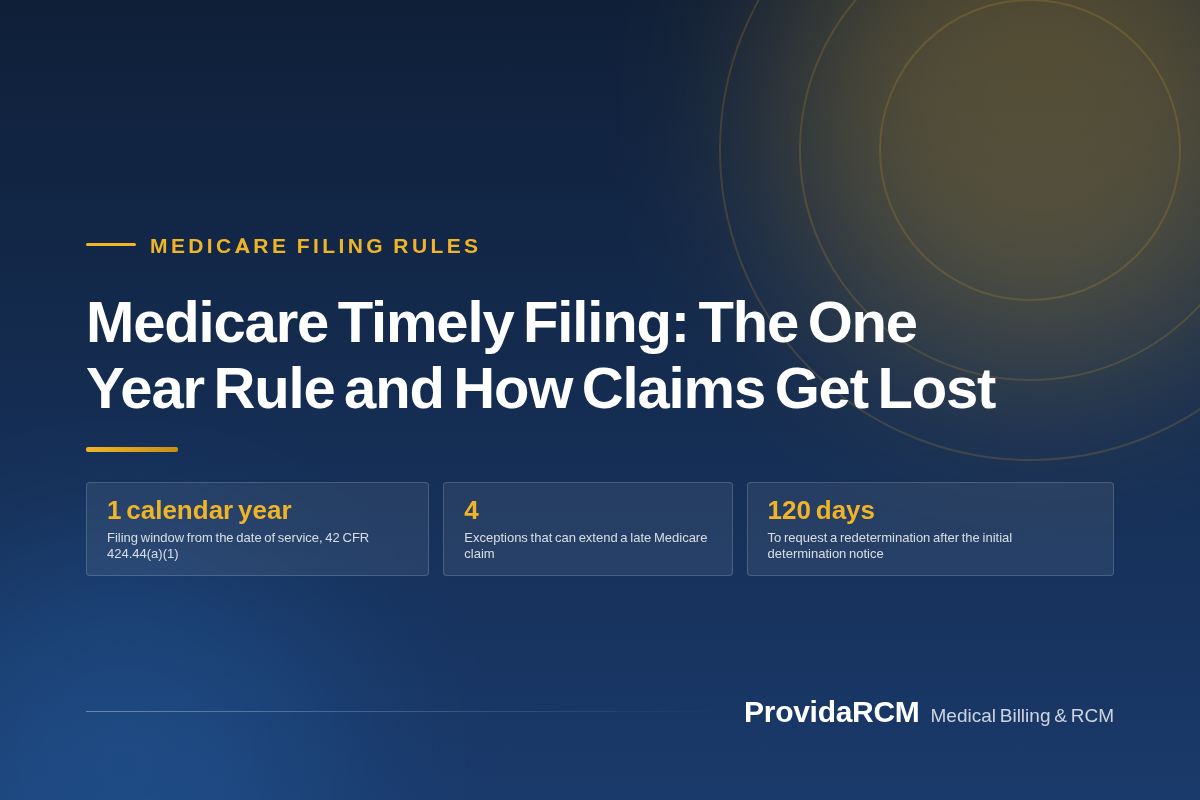
Medicare timely filing is one calendar year from the date of service, and the clock does not pause for a rejected submission, a clearinghouse queue or an unread remittance. Four narrow exceptions can reopen a late claim. Appeals then run on shorter clocks of their own. Most lost revenue sits in the gap between those facts.
Medicare timely filing gives you one calendar year, to the day
42 CFR 424.44(a)(1) sets the Medicare timely filing limit at the close of the period ending one calendar year after the date of service for anything furnished on or after January 1, 2010. A visit on March 22, 2025 is late on March 23, 2026. The regulation carries no grace period, no billing-date exception and no allowance for an invoice that sat unsent on a desk.
The deadline is a receipt date, not a postmark. Section 70.3 of the CMS Medicare Claims Processing Manual defines the filing date as the day the submission reaches the correct contractor and clears its completeness and validity edits. A claim still queued in a clearinghouse on the anniversary has not been filed, and a returned submission never becomes one.
What the clock measures from depends on the claim. An institutional claim that carries a From and Through span uses the Through date. A professional claim uses the line item From date, which matters for DME rentals and any service that spans a month end. If the From date is untimely but the To date is timely, the contractor splits the line and denies the untimely portion.
| Claim type | What counts as the date of service | What that means for the deadline |
|---|---|---|
| Institutional claim with span dates (CMS-1450, 837I) | The Through date on the claim | One calendar year from the last day of the span |
| Professional claim with span dates (CMS-1500, 837P) | The line item From date | One calendar year from the first day of that line |
| Any claim with a February 29 date of service | February 29 | February 28 of the following year, per manual section 70.1 |
| A line where the From date is late and the To date is timely | The From date for the late portion | The contractor splits the line and denies the untimely part |
Two smaller rules operate at the edges. If the last day falls on a Saturday, Sunday or Federal nonworkday, 42 CFR 424.44(c) moves the deadline to the next workday. The window also used to be far longer. Before January 1, 2010 it ran 15 to 26 months depending on the month of service, which is why billers with long tenure still talk as though a claim has two years to reach Medicare.
The four exceptions, and what each one has to prove
42 CFR 424.44(b) names four situations in which a late claim can still be honored. Each one is a determination by CMS or its contractor, not a right, and each requires documentation the contractor can verify. A late claim submitted with no explanation attached is treated as the provider’s own fault, and manual section 70.6 tells the contractor to assume exactly that.
| Exception | What has to be true | What the extension runs to | What you have to send |
|---|---|---|---|
| Administrative error | An employee, Medicare contractor or HHS agent acting within its authority caused the failure | The last day of the 6th calendar month after the month the error was corrected | A written agency report, a copy of the letter, or a statement from an employee with knowledge of the error |
| Retroactive Medicare entitlement | The patient was not entitled to Medicare when the service was furnished and was later notified of entitlement retroactive to that date | The last day of the 6th calendar month after the month of that notification | An official SSA letter, or the contractor reads the CWF accretion and entitlement dates |
| Retroactive entitlement with Medicaid recoupment | Both entitlement conditions are met and a State Medicaid agency recovered its payment 6 or more months after the service | The last day of the 6th calendar month after the month Medicaid recovered the money | Proof of the recovery date, proof of the entitlement, and the service documentation |
| Retroactive MA or PACE disenrollment | The patient was in a Medicare Advantage plan or PACE, was disenrolled retroactively, and the plan recovered its payment 6 or more months later | The last day of the 6th calendar month after the month the plan recovered the money | Proof of enrollment, the disenrollment date, and the plan’s recovery |
The administrative error exception carries its own outer limit. Under 42 CFR 424.44(b)(5)(i), no extension is granted when the request reaches CMS or its contractor more than four years after the date of service. That is the only fixed ceiling among the four, and it is a request deadline rather than a filing deadline.
Read the exceptions carefully. Three of the four measure their extension from the month of a notification or a recoupment rather than from the date of service. The extension therefore starts when the event happens, which can be years after the encounter, and it can expire before anyone on the billing team notices the trigger arrived.
Documentation is where most exception requests fail. The contractor wants a written report from the agency or contractor that made the error, or copies of its letter, or a statement from an employee with personal knowledge. A billing team’s own narrative about what went wrong does not satisfy the rule, and there has to be a clear and direct relationship between the error and the late filing.
How claims get lost inside the one-year window
Most late claims are not late because a biller was slow. They are lost by a submission that never met the definition of a claim. Under manual section 70.2.3, a submission missing required information is incomplete, and one carrying illogical or invalid information is invalid. Neither is a filing, so neither starts or stops the clock.
Contractors return those submissions to the provider. The electronic record is held in temporary storage, typically 60 days or less, and then purged. No remittance advice reflects it, no permanent record survives, and the filing clock has been running the entire time. That is how a claim disappears without anyone being able to point at a denial.
- A date of service recorded as the billing date, which quietly shortens the window by however long the charge sat in a report
- A line item From date left untimely inside a span, where splitting the charge before submission would have kept the claim paid
- A retroactive eligibility problem discovered late, after the patient turned out to have been Medicare-eligible on an earlier date
- A clearinghouse rejection worked as a denial, so a fixable claim went into an appeals queue instead of back out inside the window
- A February 29 date of service, which gives you February 28 of the following year and not one day more
The pattern that surprises practices most is a claim that was submitted, caught by an edit, and then parked in a work queue while someone chased the missing piece. By the time the piece arrived, the anniversary had passed. The submission had never been a claim, so the untimely denial was the first payment determination the practice ever saw.
Appeals and reopenings run on clocks of their own
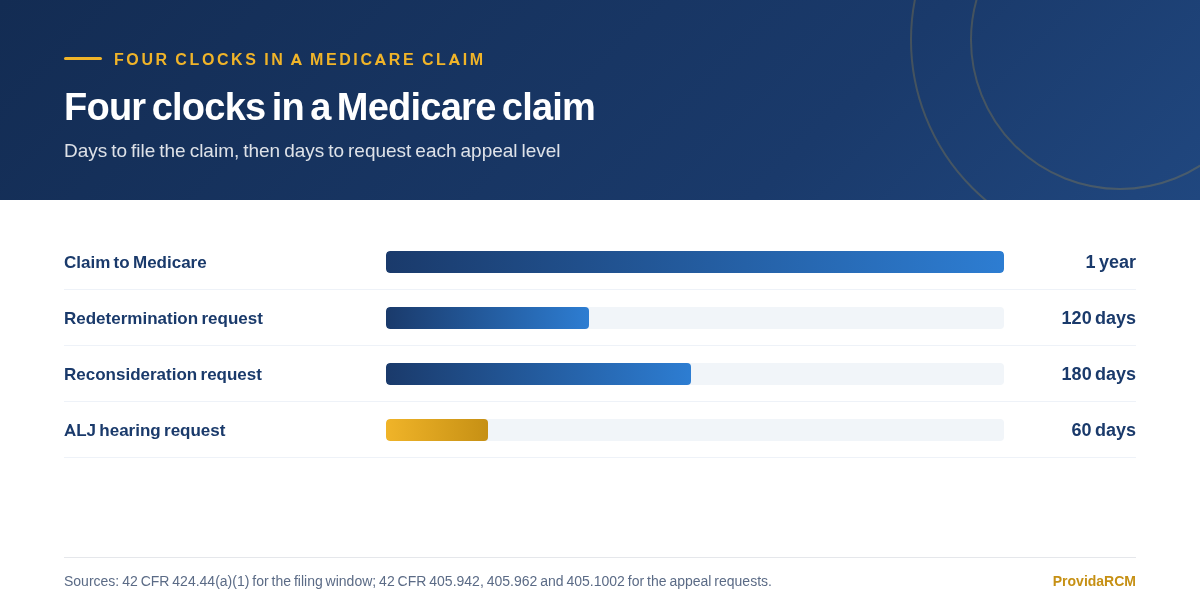
A denial that is a real payment determination starts a new set of deadlines that have nothing to do with the one-year filing window. Medicare resolves these disputes at four levels, and each level carries its own request deadline measured from the notice the party received.
Days you have to request each level of Medicare appeal
Source: 42 CFR 405.942(a), 405.962(a), 405.1002(a)(1) and 405.1102(a)(1).
| Level | Who decides it | Deadline to request it | Rule |
|---|---|---|---|
| Redetermination | The Medicare Administrative Contractor that processed the claim | 120 calendar days from receipt of the initial determination notice | 42 CFR 405.942(a) |
| Reconsideration | A Qualified Independent Contractor | 180 calendar days from receipt of the redetermination notice | 42 CFR 405.962(a) |
| Administrative law judge hearing | An administrative law judge or attorney adjudicator | 60 calendar days from receipt of the reconsideration | 42 CFR 405.1002(a)(1) |
| Medicare Appeals Council | The Medicare Appeals Council | 60 calendar days from receipt of the ALJ decision | 42 CFR 405.1102(a)(1) |
Each clock starts when you receive the notice, and Medicare presumes receipt five days after the notice date unless there is evidence to the contrary. That presumption is written into all four sections, and it is why a 120-day window can behave like 115 days in a dispute. Date-stamp the notice the day it lands in your office.
Every one of these deadlines can be extended for good cause, and every extension is discretionary. The contractor, the Qualified Independent Contractor, the judge and the Council each decide whether your reason for being late is good enough. Treat the published number as the deadline you plan around rather than the one you fall back on.
A reopening is the other path, and it changes a determination that was already made rather than appealing it. 42 CFR 405.980 gives a party one year to ask a contractor for a reopening for any reason and four years to ask for good cause. It is the right route for a claim that was filed on time but paid or denied on the wrong basis.
How long a reopening stays available
Source: 42 CFR 405.980(c)(1), (c)(2) and (e)(1). The QIC reconsideration window is 180 calendar days.
When the claim itself is late, there is nothing to appeal
This is the part that catches practices out. A denial for untimely filing is not an initial determination. 42 CFR 405.926(n) lists a finding that a provider or supplier failed to submit a claim timely among the determinations that are not initial determinations, which means the denial carries no appeal rights at all.
Medicare’s own instructions say the same thing. MLN006976 tells suppliers that a timely filing denial is not the same as an initial determination and cannot be appealed. The remittance carries CARC 29, the current X12 wording for a claim whose time limit for filing has expired, alongside RARC N211, which reads: you may not appeal this decision.
Three consequences follow. The only route back is one of the four exceptions, and those are determinations rather than entitlements. Where the provider is at fault, it cannot bill the patient for the service beyond the deductible and coinsurance that would have been owed, and manual section 70.4 says so directly.
The third one is easy to skip. File the no-payment claim anyway. Manual section 70.6 tells a provider that accepts responsibility for a late filing to submit a no-payment claim so the encounter still updates the beneficiary’s utilization record, the deductible and any spell of illness. It pays nothing, and it keeps the clinical history accurate.
No appeals team, clearinghouse or payer relationship recovers a claim that missed the window. The money moved from recoverable to gone at the moment the anniversary passed, which is why the only control that works is an internal deadline set well before the 12-month mark.
The calendar discipline that keeps claims inside the window
The fix is not a policy reminder. It is a second, internal deadline that fires well before Medicare’s. Practices that stop losing claims to timely filing run a filing clock of 90 days from the date of service and treat anything older as an exception someone has to explain.
- 01
Set the internal deadline at 90 days
Every charge gets 90 days from the date of service to reach the payer. Anything still open at day 60 goes on a worklist by owner, not by date.
- 02
Report the age of unbilled charges
Days in A/R measures what you already billed. The aging of charges that have not gone out is the number that predicts a timely filing loss, and most systems can produce it.
- 03
Treat a rejection as a rejection
A clearinghouse rejection is neither a claim nor a denial. It needs the correction and a second submission inside the original window, and it should never enter the appeals queue.
- 04
Date-stamp every notice on arrival
Appeal and reopening clocks run from receipt, and Medicare presumes receipt five days after the notice date. A stamped date is the difference between an argument and a dismissal.
- 05
Give the exception triggers an owner
Retroactive entitlement, a Medicaid recoupment and an MA disenrollment each start a six-month clock. Those triggers arrive in the mail, not in the claim system, so assign them.
We run filing calendars, rejection handling and denial management inside full-cycle medical billing work, so the internal deadline and the AR management review come out of the same system. If you would rather check the other Medicare dates first, start with revalidation and the claim denial code reference, then put the calendar against your last 90 days of claims.
Questions practices ask us about this
How long do I have to file a Medicare claim?
One calendar year from the date of service. 42 CFR 424.44(a)(1) requires the claim to be filed no later than the close of the period ending one calendar year after the date of service for services furnished on or after January 1, 2010. A February 29 date of service has to be filed by February 28 of the following year.
What are the exceptions to the Medicare timely filing rule?
There are four. Administrative error by an employee, a Medicare contractor or an HHS agent acting in scope. Retroactive Medicare entitlement. Retroactive entitlement where a State Medicaid agency recovers its payment six or more months after the service. And retroactive disenrollment from a Medicare Advantage plan or PACE provider organization that later recovers its payment. Each extends the deadline to the end of the sixth calendar month after the triggering event.
Can a claim denied for timely filing be appealed?
No. A denial for untimely filing is not an initial determination, so it carries no appeal rights. Medicare states this in the MLN article on CMS-1500 and 837P billing and in section 70.4 of the Claims Processing Manual. The remittance shows CARC 29 with remark code N211, which reads that you may not appeal the decision.
How long do I have to appeal a Medicare denial?
It depends on the level. A redetermination request must reach the contractor within 120 calendar days of your receipt of the initial determination notice. A reconsideration gets 180 calendar days from the redetermination notice. An administrative law judge hearing and an Appeals Council review each get 60 calendar days from the notice before them.
What is RARC N211?
N211 is the remittance advice remark code that reads, you may not appeal this decision. X12 lists it as a current code. Medicare pairs it with CARC 29, the current wording for a claim whose time limit for filing has expired. If a denial report still reports CO-15, that code was deactivated on May 1, 2018 and has no place in a current report.
Does the one-year clock start over if my claim is rejected?
No. A submission that fails the contractor’s completeness or validity edits is not a claim, so it never had a filing date and the clock keeps running from the date of service. The returned record sits in temporary storage, typically 60 days or less, and is then purged with no remittance and no permanent record.
What can we do when the filing window has already closed?
Two things, and neither is an appeal. Submit the exception request with the documentation the contractor needs, if one of the four situations applies. Otherwise file a no-payment claim so the encounter still updates the beneficiary’s utilization and deductible records. The provider also cannot bill the patient for the service when it was at fault for the late filing.
Want this fixed in your practice?
We run full-cycle billing, coding, credentialing and denial work for practices across the country. Send us a few months of claims and we will show you where the money is going.
Book a free billing review- eCFR, 42 CFR 424.44, Time limits for filing claims (current text, October 2026). ecfr.gov/current/title-42/chapter-IV/subchapter-B/part-424/subpart-C/section-424.44
- CMS Medicare Claims Processing Manual, Pub. 100-04, Chapter 1, sections 70.1 to 70.7 (time limits and exceptions). cms.gov/Regulations-and-Guidance/Guidance/Manuals/Downloads/clm104c01.pdf
- CMS MLN, Medicare Billing: CMS-1500 and 837P (MLN006976), Time Limits for Filing Claims. cms.gov/files/document/mln006976-medicare-billing-cms-1500-837p.pdf
- CMS Change Request 12909, Pub. 100-04, Chapter 1, section 70.4 to 70.7 revisions, October 2024. cms.gov/files/document/r12909cp.pdf
- X12, Claim Adjustment Reason Codes (current list, code 29 reviewed October 2026). x12.org/codes/claim-adjustment-reason-codes
- X12, Remittance Advice Remark Codes (current list, code N211 reviewed October 2026). x12.org/codes/remittance-advice-remark-codes
- eCFR, 42 CFR part 405 subpart I, Medicare appeals and request time frames. ecfr.gov/current/title-42/part-405/subpart-I