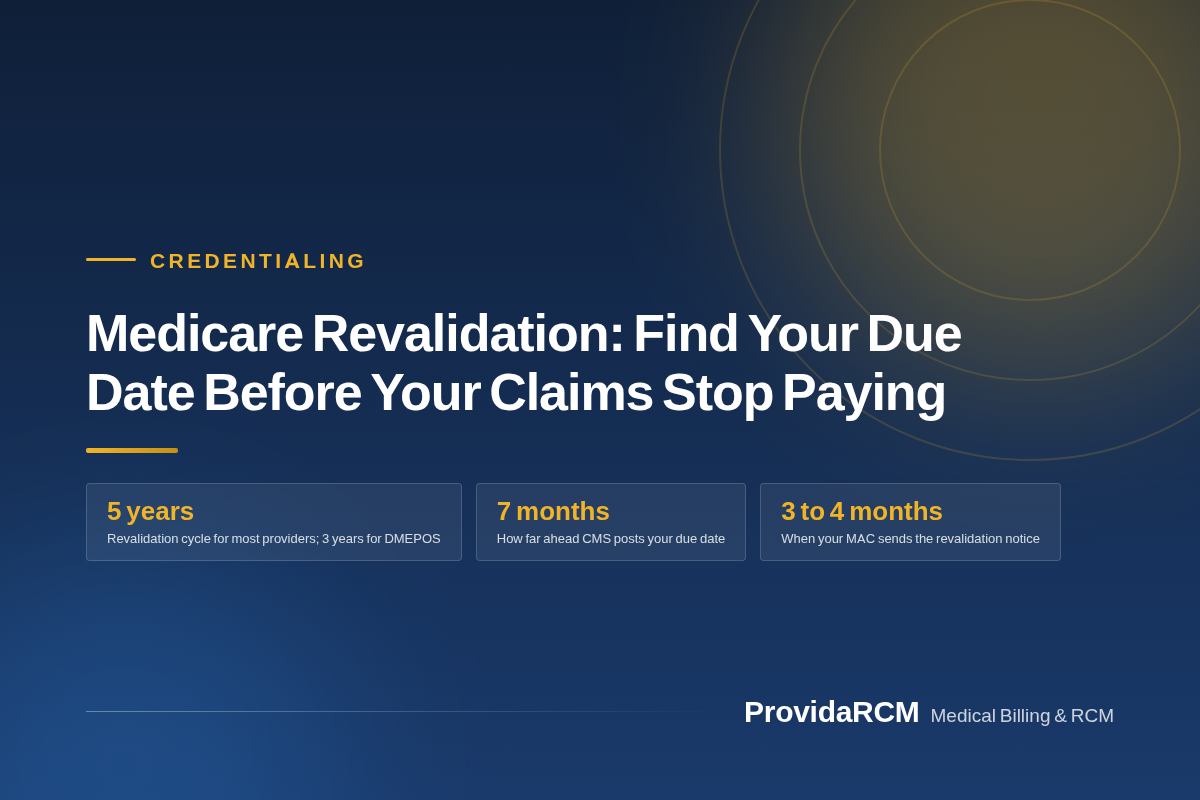
Medicare revalidation is the periodic recertification of your Medicare enrollment, and for most practices it runs on a five year clock. CMS posts your due date about seven months ahead, you file through PECOS inside that window, and missing the date can stop your claims. Here is how to find the date and protect it.
What Medicare revalidation actually is
Every provider and supplier enrolled in Medicare has to recertify that enrollment on a schedule. That recertification is Medicare revalidation. The authority is 42 CFR 424.515, and CMS restates the process in the Program Integrity Manual, publication 100-08, chapter 10. It is not an application for a new PTAN. It is CMS asking you to confirm the record it already holds and to correct anything that has drifted.
The record lives in PECOS, the Provider Enrollment, Chain, and Ownership System. Your NPI lives in NPPES. Those are separate databases, and neither one updates the other. A revalidation is often the first time a mismatch surfaces, which is why a practice that moved offices, added a provider or changed its group structure tends to find the problem here rather than at the front desk.
| Enrollment type | How often | Application |
|---|---|---|
| Physicians and non-physician practitioners (Part B) | Every 5 years | CMS-855I, or a PECOS revalidation |
| Clinics, group practices and other Part B suppliers | Every 5 years | CMS-855B, or a PECOS revalidation |
| Institutional providers (hospitals, SNFs, home health) | Every 5 years, plus off-cycle requests | CMS-855A |
| DMEPOS suppliers | Every 3 years | CMS-855S |
| Ordering, certifying or prescribing only (CMS-855O), and Medicare opt-outs | No revalidation required | None; not listed on the lookup tool |
CMS reserves the right to request an off-cycle revalidation at any time, well before the five year mark. The published cycle sets the routine date. It does not limit what CMS can ask for, and it does not limit what a MAC asks for when it wants to confirm the enrollment record.
How often Medicare revalidation comes around
Most enrolled providers and suppliers revalidate every five years. DMEPOS suppliers revalidate every three years. The three year exception is written into the regulation itself, and CMS repeats it on its Revalidations page. More than one practice has assumed its group and every physician in it share a single date. They do not.
CMS assigns the due date to each enrollment, not to your practice as a whole. A group has an organizational due date, and each practitioner has an individual one. The date generally stays with the enrollment through later cycles, so a practice that revalidates on time tends to see the same calendar slot come back five years later.
Revalidation cycle length by enrollment type
Source: CMS, Revalidations (Renewing Your Enrollment); 42 CFR 424.515.
Two groups are off the routine schedule. Providers enrolled only to order, certify or prescribe through the CMS-855O application do not revalidate, and providers who have opted out of Medicare do not revalidate either. CMS does not ask them to, and they do not appear on the lookup tool. If your credentialing file treats a 855O enrollment as something to track on a five year clock, it is being tracked for nothing.
Find your Medicare revalidation due date on the CMS list
The Medicare Revalidation List is a public database you can search by NPI or by organization name. It covers every enrolled provider and supplier. If an enrollment is on the clock, the tool prints a due date. If it is not, the tool prints TBD, which means CMS has not set the date yet.
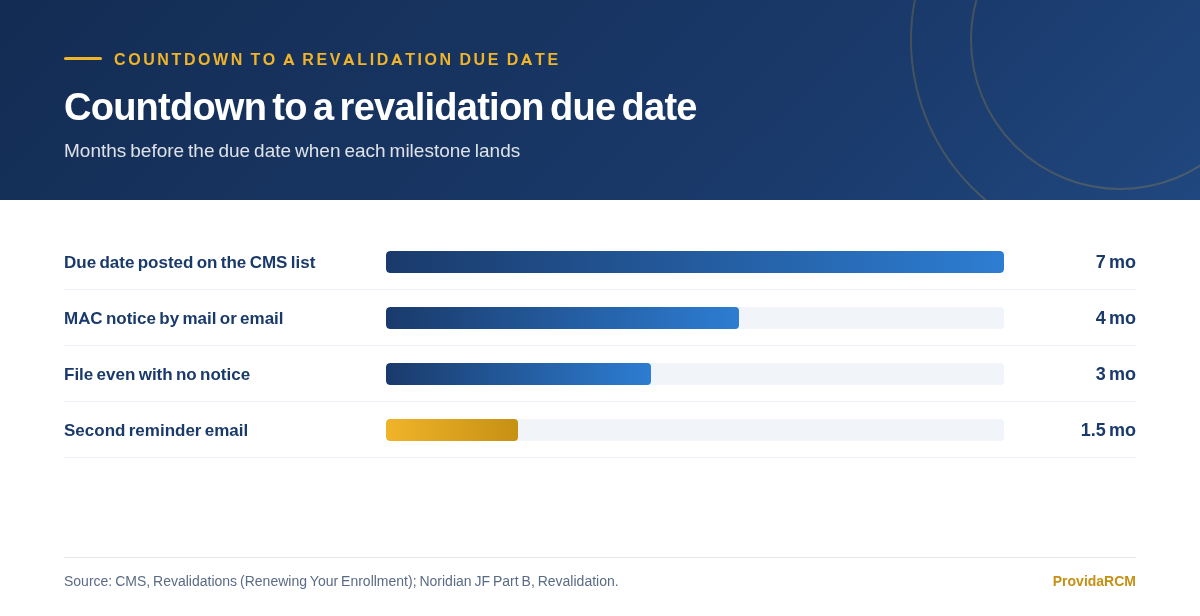
Two properties of the list matter operationally. CMS posts a due date about seven months ahead, and the tool will not show a date before that, which is the TBD a practice sees when it checks too early. The list also refreshes at the start of each month, so a TBD can become a date between one review and the next. A group with a few dozen enrollments should check monthly, not once a year.
- The revalidation due date, or TBD when CMS has not assigned one
- The enrollment type, such as Non-DME Part B, Part A or DME
- The specialty and the state on the enrollment record
- For an organization, the individuals who reassign benefits to it and their own due dates
Your MAC sends a notice three to four months before the due date, by email or postal mail. CMS states that the notice is a reminder and that you remain responsible for tracking the date yourself. If the envelope went to a correspondence address nobody checks, or the email reached a coordinator who has since left, the due date is unchanged and the clock keeps running.
The seven month window, and why filing early backfires
The filing rule has a top end and a bottom end. Submit your revalidation application to your Medicare Administrative Contractor within seven months of the due date. Anything the contractor receives earlier than that is returned as unsolicited. A practice trying to be diligent by filing a year out simply gets its paperwork back and has to file again.
The bottom end is the due date itself, and it does not move. The CMS Revalidations page says there are no exemptions from revalidation and that CMS does not grant extensions. The public due date, the MAC notice and the reminder emails are the entire accommodation. Once you are inside the window, earlier is better, because it leaves room to answer a development request without running past the deadline.
- 01
When the due date appears
The list starts showing a date roughly seven months out. Open the file then and start collecting whatever has changed since the last cycle, because nothing about the schedule will wait.
- 02
When the notice lands
The MAC notice arrives three to four months before the due date. Treat it as confirmation that the date is right, not as the start of the work.
- 03
Inside the last three months
If no notice has arrived and you are within three months of the date, CMS tells practices to revalidate anyway. A lost letter does not move the deadline.
- 04
Before you submit
Update NPPES first, verify access and roles in I&A, then complete the revalidation in PECOS. Filing in the middle of the window leaves time to answer questions.
Miss the due date and the claims stop paying
Two things can happen when a revalidation slips. The MAC can place a stay of enrollment, which keeps you enrolled but rejects claims for dates of service inside the stay. Or it can deactivate the enrollment outright, which is the outcome a practice remembers. A stay normally runs up to 60 days, and it is not treated as an adverse legal action.
Noridian’s JF Part B guidance says that if no revalidation application is submitted at all, Medicare will deactivate the enrollment, typically within 60 to 75 days after the due date. Under 42 CFR 424.540, a supplier cannot be paid for services furnished while it is deactivated. The comment period on the claim is over by the time this happens.
Contractor processing target in days
Source: CMS Program Integrity Manual, Pub. 100-08, Chapter 10, section 10.5.
| Stage | What it means | Effect on payment |
|---|---|---|
| Stay of enrollment | A temporary pause while you correct a non-compliance; you stay enrolled | Claims with dates of service inside the stay are rejected, for up to 60 days |
| Deactivation | Billing privileges stop; typically 60 to 75 days after an unfiled due date | Medicare pays nothing for services furnished while deactivated |
| Reactivation | You submit a complete enrollment application and the contractor processes it as a new enrollment | Effective on the date the contractor received the processed submission, with no payment for the gap |
CMS states that the reactivation date is the date it receives a complete application. There is no retroactive billing back to the deactivation date. You keep the original PTAN, so it is the same provider with a hole in the record, and the services furnished during the gap become the practice’s liability.
What has to match in NPPES and PECOS
A revalidation is only clean if the records underneath it agree. NPPES holds your NPI and the public record behind it. PECOS holds the Medicare enrollment record. Noridian’s enrollment systems guidance is direct that updates in one do not carry to the other, and that mismatches across NPPES, I&A and PECOS are a common cause of development requests and rejections.
The order of operations matters. Update NPPES first, confirm that the right people have Identity and Access roles and connections, then complete the revalidation in PECOS. The fields that generate the most friction are the legal business name, the practice locations, the specialty or taxonomy code, and the reassignment links that tie an individual practitioner to the group.
- Legal business name matches the name on the IRS record
- Every practice location on the enrollment is a location you still operate
- Specialty and taxonomy agree across NPPES and PECOS
- Reassignments name the group that actually bills for the work
- Correspondence and special payments addresses are current, because the notice goes there
A few changes cannot be made in PECOS at all and need a paper CMS-855, including a change of Social Security number, a change of tax identification number, and a change in business structure. Reporting rules carry their own clock under 42 CFR 424.516: physicians, non-physician practitioners and their organizations must report a change of ownership, an adverse legal action, or a change of practice location within 30 days, and all other changes within 90 days.
Make the next Medicare revalidation cycle boring
Practices that are never surprised by revalidation treat it as a calendar item, not a project. One person owns the enrollment file. The CMS list gets checked on a schedule. Every move, hire, departure and address change updates NPPES and PECOS in the same week rather than waiting for the next cycle to expose it.
The application fee is worth a mention here because it surprises people at the worst moment. For calendar year 2026 the fee is $750 for institutional providers that are enrolling, revalidating or adding a practice location. Physicians, non-physician practitioners, and physician and non-physician practitioner organizations do not pay it. Noridian lists the suppliers that do owe the fee, including hospitals, ambulatory surgery centers, independent clinical labs and portable X-ray suppliers.
- Keep one enrollment tracker listing every NPI, PTAN, group and due date
- Check the CMS Revalidation List monthly and log any date that appears
- Update NPPES and PECOS together whenever a location or a provider changes
- Answer every development request from your contractor, because failing to furnish complete information is itself a listed reason for deactivation
Revalidation is one piece of credentialing, and the record hygiene that keeps Medicare happy is the same hygiene commercial payers want. We run enrollment and medical credentialing services next to full-cycle medical billing and AR management, so a due date is a planned task and not something a denied claim reveals. If a revalidation has already slipped, the fastest start is a consultation.
Questions practices ask us about this
How do I find my Medicare revalidation due date?
Search the CMS Medicare Revalidation List at data.cms.gov by NPI or by organization name. If your enrollment is on the clock, the tool shows a due date. If it shows TBD, CMS has not set one yet and you should not file. CMS posts dates about seven months in advance and refreshes the list at the start of the month.
How often does Medicare revalidation come around?
Most providers and suppliers revalidate every five years. DMEPOS suppliers revalidate every three years. CMS also reserves the right to request an off-cycle revalidation at any time, so the published cycle is a floor rather than a guarantee. After a successful revalidation, the next date usually stays on the same calendar slot.
What happens if I submit my revalidation too early?
It comes back. A revalidation submitted more than seven months before the due date is returned as unsolicited and does not count as a filing. CMS is explicit that you should not revalidate when the due date is more than seven months away unless you have received a notice. Filing inside the window avoids the round trip.
What happens if I miss my Medicare revalidation deadline?
Your MAC may place a stay of enrollment, which rejects claims for dates of service during the stay, or deactivate your billing privileges. Noridian says a completely unfiled revalidation is typically deactivated within 60 to 75 days after the due date. Getting back in means submitting a complete enrollment application, and Medicare pays nothing for the deactivated period.
Do physicians pay the Medicare enrollment application fee at revalidation?
Usually not. The CY 2026 fee is $750, and CMS applies it to institutional providers that are enrolling, revalidating or adding a practice location. Physicians, non-physician practitioners, and physician and non-physician practitioner organizations are exempt. Noridian lists the suppliers that do owe the fee, which include hospitals, ambulatory surgery centers, independent clinical labs, FQHCs and portable X-ray suppliers.
Can CMS ask me to revalidate before my five year date?
Yes. CMS reserves the right to perform off-cycle revalidations in addition to the routine five year cycle, and it can request one when it wants to confirm the enrollment information it holds. The three year DMEPOS cycle is a shorter schedule, and CMS can also move a supplier type to more frequent revalidation if it sees noncompliance.
Want this fixed in your practice?
We run full-cycle billing, coding, credentialing and denial work for practices across the country. Send us a few months of claims and we will show you where the money is going.
Book a free billing review- CMS, Revalidations (Renewing Your Enrollment). cms.gov/medicare/enrollment-renewal/providers-suppliers/revalidations
- CMS Data, Medicare Revalidation List lookup tool. data.cms.gov/tools/medicare-revalidation-list
- eCFR, 42 CFR 424.515, periodic revalidation of Medicare enrollment information. ecfr.gov/current/title-42/chapter-IV/subchapter-B/part-424/subpart-P/section-424.515
- eCFR, 42 CFR 424.540, deactivation of Medicare billing privileges. ecfr.gov/current/title-42/chapter-IV/subchapter-B/part-424/subpart-P/section-424.540
- eCFR, 42 CFR 424.516, requirements for maintaining active enrollment status. ecfr.gov/current/title-42/chapter-IV/subchapter-B/part-424/subpart-P/section-424.516
- CMS Program Integrity Manual, Pub. 100-08, Chapter 10 (Medicare Enrollment). cms.gov/regulations-and-guidance/guidance/manuals/downloads/pim83c10.pdf
- Noridian Medicare JF Part B, Revalidation. med.noridianmedicare.com/web/jfb/enrollment/revalidation
- Noridian Medicare JF Part A, Medicare Provider Enrollment Systems: NPPES, I&A, and PECOS. med.noridianmedicare.com/web/jfa/enrollment/medicare-provider-enrollment-systems
- Noridian Medicare JF Part B, Application Fee. med.noridianmedicare.com/web/jfb/enrollment/application-fee
- CMS MLN Connects Newsletter, December 11, 2025 (CY 2026 institutional enrollment fee, SNF deadline suspension). cms.gov/training-education/medicare-learning-network/newsletter/mln-connects-newsletter-december-11-2025