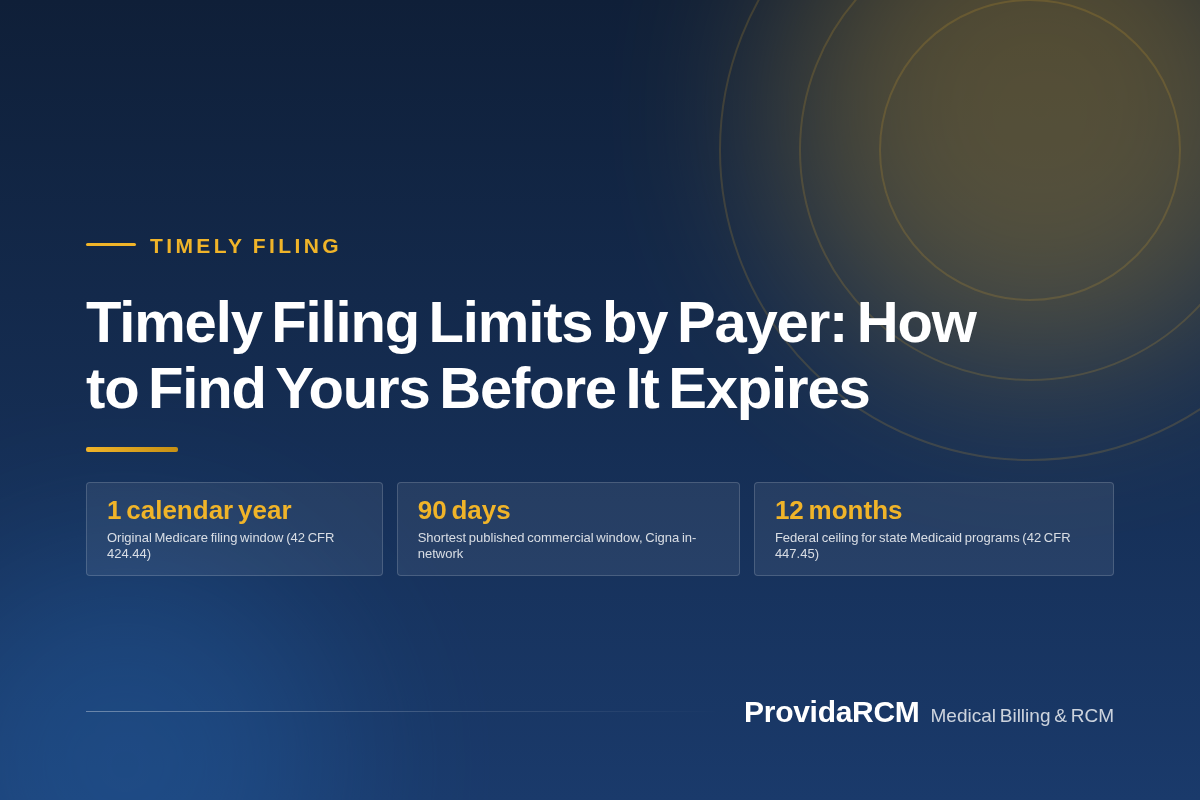
Timely filing limits are the deadlines a payer sets for a claim to reach it, and the number changes by payer, by program and by contract. Medicare gives one calendar year from the date of service. Medicaid states can require as little as 90 days. Commercial plans often allow 90 to 180. Here is how to find yours.
What a timely filing limit is, and why the number changes by payer
A timely filing limit is the deadline a payer sets for a claim to reach it. The clock usually starts on the date of service. Miss the window and the payer denies the claim for late filing, and because a late claim is not a coverage dispute, there is usually no appeal and no option to bill the patient for the balance. Timely filing limits are an operations control, not a coding one.
There is no single national number. Original Medicare runs on a federal rule at 42 CFR 424.44. Medicaid runs on a federal ceiling with a shorter state deadline inside it. Commercial payers set their own windows, and the plan you signed with can differ from the number a colleague quotes. Every figure below is traced to the regulation, payer document or state manual it comes from.
Before you file, identify the document that sets the deadline on this claim. If the answer is a contract, a general table will not save you. The lookup, not the memory, is what keeps a claim inside its window.
Medicare fee-for-service: one calendar year, counted to receipt
Original Medicare gives a provider one calendar year, or 12 months, from the date of service to file a claim. The rule is written into 42 CFR 424.44, and it took effect for services furnished on or after January 1, 2010, under section 6404 of the Affordable Care Act. Before that law, the window ran as long as 27 months, depending on the date of service.
The date that counts is the day the Medicare Administrative Contractor receives the claim. It is not the day you submitted it, not the date the claim was created in the billing system and not the postmark. Noridian, one of the MACs, states it plainly: to be timely, a claim has to make it to the payment floor.
| Claim type | Form | Anchor date for the clock | Source |
|---|---|---|---|
| Part B professional | CMS-1500 | The line item from date, or the claim from date | Noridian, JF Part B |
| Part A institutional with span dates | UB-04 | The through date on the claim | Noridian, JF Part B |
| Physician and supplier claims with date spans | CMS-1500 | The line item from date | Noridian, JF Part B |
| A service dated February 29 | Either | Filed by February 28 of the following year | Noridian, JF Part B |
If the last day of the window lands on a Saturday, Sunday, federal holiday or other federal nonworkday, the deadline moves to the next workday under 42 CFR 424.44(c). Paper filings create the most risk, because a claim mailed on the final day can arrive a day late and be denied.
Medicare Secondary Payer claims carry the same 12-month limit. The clock starts on the date of service and keeps running while the primary payer processes its claim, so waiting on a primary payment can burn the secondary window before the first claim is even filed.
Timely filing limits by payer: the working table
The table gives the published window for the largest programs and a sample of commercial plans. Read the last column before you use any number, because that column is where the number comes from. Where a payer publishes no single figure, the table says so instead of guessing at one.
| Payer or program | Published window | Clock starts | Where the number comes from |
|---|---|---|---|
| Original Medicare (Part A and B) | 1 calendar year (12 months) | Date of service; through date on span institutional claims | 42 CFR 424.44 |
| Medicare Advantage | Set in the plan participation agreement, often 90 to 180 days for contracted providers | Per the plan provider manual | Medicare plan provider manuals |
| Medicaid, fee-for-service | 12 months is the federal ceiling; states may set less | Date of service | 42 CFR 447.45(d)(1) |
| TRICARE | 1 year; 3 years for services received overseas | Date of service, or inpatient discharge | 32 CFR 199.7(d) |
| Cigna, commercial participating | 90 days | Date of service | Cigna claims submission page |
| Cigna, commercial out-of-network | 180 days | Date of service | Cigna claims submission page |
| Aetna, national dispute standard | 180 days; state exceptions differ | Per the Aetna state supplement | Aetna provider appeals page |
| Blue Cross Blue Shield of Massachusetts | 90 days for HMO, POS and PPO; 1 year for indemnity | Date of service or discharge | BCBSMA timely filing guidelines |
| UnitedHealthcare, commercial | No single number; your participation agreement controls | Per your agreement | 2026 UHC Administrative Guide |
Two patterns are worth naming. The Blue Cross Blue Shield system is a federation of independent companies, so a deadline that holds at one affiliate does not hold at the next. And a commercial window is a contract term. Cigna publishes 90 days for participating providers and 180 for out-of-network providers, and both give way to a longer period when a law or your agreement requires it.
Filing windows, selected payers (days)
Sources: 42 CFR 424.44 for Original Medicare; 32 CFR 199.7 for TRICARE; the Cigna claims submission page; the Blue Cross Blue Shield of Massachusetts timely filing guidelines. All windows measured in days from the date of service.
Aetna publishes a 180-day dispute filing standard and then lists state exceptions, such as 120 days to submit a claim in New York. UnitedHealthcare does not print a number at all. Its administrative guide tells providers to refer to their participation agreement, which is the honest answer for most commercial work.
Medicaid: one federal ceiling, fifty different deadlines
Federal rules set the outer edge for state Medicaid programs. Under 42 CFR 447.45, a state agency must require providers to submit all claims no later than 12 months from the date of service. A state can set a shorter limit, and many do.
The table shows how wide that range runs. New York allows 90 days, Texas 95 and Washington a full year. Every figure comes from that state’s own billing manual or provider guide, because Medicaid deadlines change whenever the manual is revised.
| State Medicaid program | Initial filing window | Clock starts | Source |
|---|---|---|---|
| New York (eMedNY) | 90 days | Date of service | eMedNY Information for All Providers |
| Texas (TMHP) | 95 days | Each date of service on the claim | Texas Medicaid Provider Procedures Manual, Section 6 |
| Washington Apple Health | 365 days | Date of service | HCA ProviderOne Billing and Resource Guide |
| Federal ceiling | 12 months | Date of service | 42 CFR 447.45(d)(1) |
Medicaid filing windows, selected states (days)
Sources: 42 CFR 447.45(d)(1) for the federal ceiling; the HCA ProviderOne billing and resource guide for Washington; the Texas Medicaid Provider Procedures Manual for Texas; the eMedNY general billing guide for New York.
Managed care adds a second layer. Most Medicaid members are enrolled in a managed care organization, and the plan contract can set a shorter deadline than the state fee-for-service rule. When a member is in an MCO, the plan manual controls, not the state table.
The four Medicare exceptions, and what they do not cover
Medicare allows four exceptions to the 12-month rule, all listed in 42 CFR 424.44(b). Each has to be documented, and each is submitted as a reopening request rather than a standard appeal. There is no fifth exception for a busy month, a staffing gap or a delayed vendor.
| Exception | What triggers it | Extension runs through |
|---|---|---|
| Administrative error | An error or misrepresentation by a Medicare contractor or HHS employee acting in scope | Last day of the sixth calendar month after the error is corrected |
| Retroactive Medicare entitlement | The patient was not entitled when the service was furnished, then received retroactive entitlement | Last day of the sixth calendar month after the month of notification |
| Retroactive entitlement with a Medicaid takeback | A state Medicaid agency recouped its payment six months or more after the service | Last day of the sixth calendar month after the month of recoupment |
| Retroactive disenrollment from an MA plan or PACE | The plan recouped its payment six months or more after the service | Last day of the sixth calendar month after the month of recoupment |
An approved exception extends the window to the last day of the sixth calendar month after the month that triggered it. No exception can push a valid filing past December 31 of the third calendar year after the year of service, except that a service furnished in October through December can extend to the end of the fourth year.
A Medicare claim denied for missing the filing deadline is not an initial determination, so the standard appeals ladder never opens. The only route is a reopening, and it works only when one of the four exceptions applies. Filing a redetermination on a late claim uses up time you cannot get back.
Reading a timely filing denial on the remittance
When a claim misses the window, the payer explains it on the 835 remittance with a claim adjustment reason code. The live wording comes from the X12 code list, not from a payer crosswalk or a vendor blog, because both go stale and neither shows deactivations.
| Code | Official X12 wording | Status on the X12 list | What it tells you |
|---|---|---|---|
| CARC 29 | The time limit for filing has expired | Current | The payer received the claim after its window closed |
| CARC 15 | The authorization number is missing, invalid, or does not apply to the billed services or provider | Deactivated as of 1 May 2018 | A retired code still quoted as a current filing reason |
| CARC 197 | Precertification, authorization, notification or pre-treatment absent | Current | The live authorization code; X12 updated it the day CARC 15 stopped |
| RARC N390 | This service or report cannot be billed separately | Current | Often mislabeled online as a late filing remark |
CARC 15, once the code for an authorization number that is missing or invalid, was deactivated on 1 May 2018, and the X12 list still shows that stop date. Vendor pages and denial dashboards keep reporting CO-15 as a live 2026 reason, which means the mapping behind them is years out of date. The live authorization code is CARC 197.
The same caution applies to remark codes. Some sources label N390 as a late filing remark. On the current X12 list, N390 reads as a service that cannot be billed separately, which is a different problem with a different fix. Check the code against the live list before you build a workflow on it.
A corrected or adjusted claim follows separate rules from an original. Under Medicare, an adjustment to a claim that was filed on time can still be processed after the 12-month window, because the original claim already met the limit. Late filing is the failure to file at all, not the later effort to fix a filed claim.
How to find your own timely filing limit before it expires
The limit that applies to a claim is not a number you memorize. It is a number you look up per payer and per contract, then track against a calendar. The routine below is what keeps a filing deadline from arriving unnoticed in the middle of a busy week.
- 01
Start with the contract, not a table
For any payer that is not Original Medicare, open the participation agreement and the current provider manual. The published window and your contracted window are often different numbers.
- 02
Set an internal deadline well inside the legal one
Work to a cutoff that leaves room to fix a rejection and refile, because the clock keeps running through every rejection and every returned claim.
- 03
Track receipt, not submission
A clearinghouse transmission is not a filed claim. Confirm the payer accepted it and store the acknowledgment as your proof of timely filing.
- 04
Log the anchor date by claim type
Use the date of service for professional claims and the through or discharge date for span institutional claims, and record it where the aging report can see it.
- 05
Check exceptions the week the denial posts
When a claim does miss, review the four Medicare exceptions or the payer’s own exception rule at once, while the supporting documentation is still easy to gather.
- Keep the participation agreement and current provider manual on file for every payer you bill
- Set a written internal filing cutoff per payer, not one number for the whole practice
- Save every payer acceptance acknowledgment as proof of timely filing
- Review aged, unbilled and rejected claims on a fixed weekly schedule
- Recheck state and commercial deadlines when a provider manual is revised
Operationally, late filing sits inside denial management and the wider AR management calendar. The clean-claim work that prevents most late filings belongs to medical billing and medical coding.
What to ask a billing partner about filing deadlines
A partner that loses claims to filing deadlines will often report a denial rate that looks fine, because a late claim is written off rather than appealed. Four questions separate a team that tracks deadlines from one that discovers them after they have passed.
- Ask how filing deadlines are tracked per payer and per contract. A team that owns the calendar can show you the calendar.
- Ask for the internal cutoff on each payer, and how far it sits inside the legal deadline.
- Ask what share of claims carry a stored acceptance acknowledgment, because that is the proof of timely filing when a payer disputes receipt.
- Ask what changed in the front end after the last late-filing denial, since a deadline missed twice is a process problem rather than bad luck.
We run this work across full-cycle medical billing, denial management and prior authorization. If late filings are eating into collections, a revenue cycle health check or a closer read of your days in A/R will show where the time is going. The claim denial codes reference covers the remittance side in more depth.
Questions practices ask us about this
What is the timely filing limit for Medicare?
One calendar year, or 12 months, from the date of service, under 42 CFR 424.44. The limit applies to Part A and Part B fee-for-service claims in every Medicare Administrative Contractor jurisdiction. Medicare counts the day the contractor receives the claim, not the day you submitted it and not the postmark. A service dated February 29 must be filed by February 28 of the following year.
How long do I have to file a claim with Medicaid?
It depends on the state. Federal rules set a ceiling of 12 months from the date of service under 42 CFR 447.45, and states may require less. New York allows 90 days, Texas 95 days and Washington a full year. Check the current state provider manual or the managed care plan contract, because the deadline changes when the manual is revised.
Do all commercial payers use the same timely filing limit?
No. Commercial windows are contract terms, so they differ by payer, by network status and by state. Cigna publishes 90 days for participating providers and 180 days for out-of-network providers. Aetna publishes a 180-day dispute standard with state exceptions. Blue Cross Blue Shield plans differ by affiliate. When a payer publishes no single number, your participation agreement controls.
Can I appeal a claim denied for timely filing?
Usually not. A Medicare claim denied for missing the filing deadline is not an initial determination, so the standard appeal ladder does not open. The only route is a reopening request, and it works only when one of the four exceptions in 42 CFR 424.44(b) applies. Commercial plans set their own dispute process, so check the payer provider manual.
What does CARC 29 mean?
CARC 29 means the time limit for filing has expired. The payer received the claim after its filing window closed. On the current X12 list the wording is exactly that, and the code is active. A CARC 29 denial is generally final unless the payer accepts proof of an earlier, timely submission or a documented exception applies.
What is CO-15 and why does it still appear on denial reports?
CO-15 was the code for an authorization number that is missing, invalid or does not apply to the billed services. X12 deactivated it on 1 May 2018. It still shows up in denial analyses and vendor articles because older code mappings were never updated. The live authorization code today is CARC 197.
Does the filing clock stop when I submit a claim?
No. Submitting a claim is not the same as filing it. The clock runs until the payer receives and accepts the claim. A claim rejected by a clearinghouse for missing data has not been filed and does not satisfy the deadline. Keep the payer acceptance acknowledgment, because it is the only reliable proof of timely filing if the payer later disputes the receipt date.
Want this fixed in your practice?
We run full-cycle billing, coding, credentialing and denial work for practices across the country. Send us a few months of claims and we will show you where the money is going.
Book a free billing review- eCFR, 42 CFR 424.44, Time limits for filing claims. ecfr.gov/current/title-42/chapter-IV/subchapter-B/part-424/subpart-C/section-424.44
- eCFR, 42 CFR 447.45, Timely claims payment (Medicaid 12-month ceiling). ecfr.gov/current/title-42/chapter-IV/subchapter-C/part-447/subpart-A/section-447.45
- eCFR, 32 CFR 199.7, TRICARE claim filing deadline. ecfr.gov/current/title-32/subtitle-A/chapter-I/subchapter-M/part-199/section-199.7
- CMS, Medicare Claims Processing Manual, Pub 100-04, Chapter 1, Section 70 (timely filing). cms.gov/Regulations-and-Guidance/Guidance/Manuals/Downloads/clm104c01.pdf
- X12, Claim Adjustment Reason Codes (current list, checked October 2026). x12.org/codes/claim-adjustment-reason-codes
- Noridian Healthcare Solutions, Timely Filing, JF Part B. med.noridianmedicare.com/web/jfb/topics/claim-submission/timely-filing
- Cigna Healthcare, Submit and Pay Claims for Providers. cigna.com/health-care-providers/coverage-and-claims/submit-claims
- Aetna, Provider Appeals (dispute filing standard and state exceptions). aetna.com/health-care-professionals/disputes-appeals/provider-appeals.html
- Aetna, Provider Manual State Supplement (New York claim submission window). aetna.com/content/dam/aetna/pdfs/aetnacom/healthcare-professionals/documents-forms/ProviderManual-StateSpplmt.pdf
- UnitedHealthcare, 2026 Administrative Guide for Commercial and Individual Exchange plans. uhcprovider.com/content/dam/provider/docs/public/admin-guides/2026-UHC-Administrative-Guide.pdf
- TRICARE, How long do I have to file a claim. tricare.mil/FAQs/General/GEN_Claimsdeadline
- Texas Medicaid Provider Procedures Manual, Section 6, Claims Filing (TMHP). tmhp.com/sites/default/files/file-library/resources/provider-manuals/tmppm/pdf-chapters/2026/2026-06-june/1_06_claims_filing.pdf
- Washington Health Care Authority, ProviderOne Billing and Resource Guide. hca.wa.gov/assets/billers-and-providers/providerone-billing-and-resource-guide.pdf
- Blue Cross Blue Shield of Massachusetts, Timely Filing Guidelines. provider.bluecrossma.com/ProviderHome/wcm/connect/ea311336-dbf4-4cd0-a23f-021c7fbf8237/MPC_052218-1H_Timely_Filing_Guidelines.pdf?MOD=AJPERES
- eMedNY, Information for All Providers, General Billing (New York Medicaid). emedny.org/providermanuals/allproviders/pdfs/information_for_all_providers-general_billing.pdf