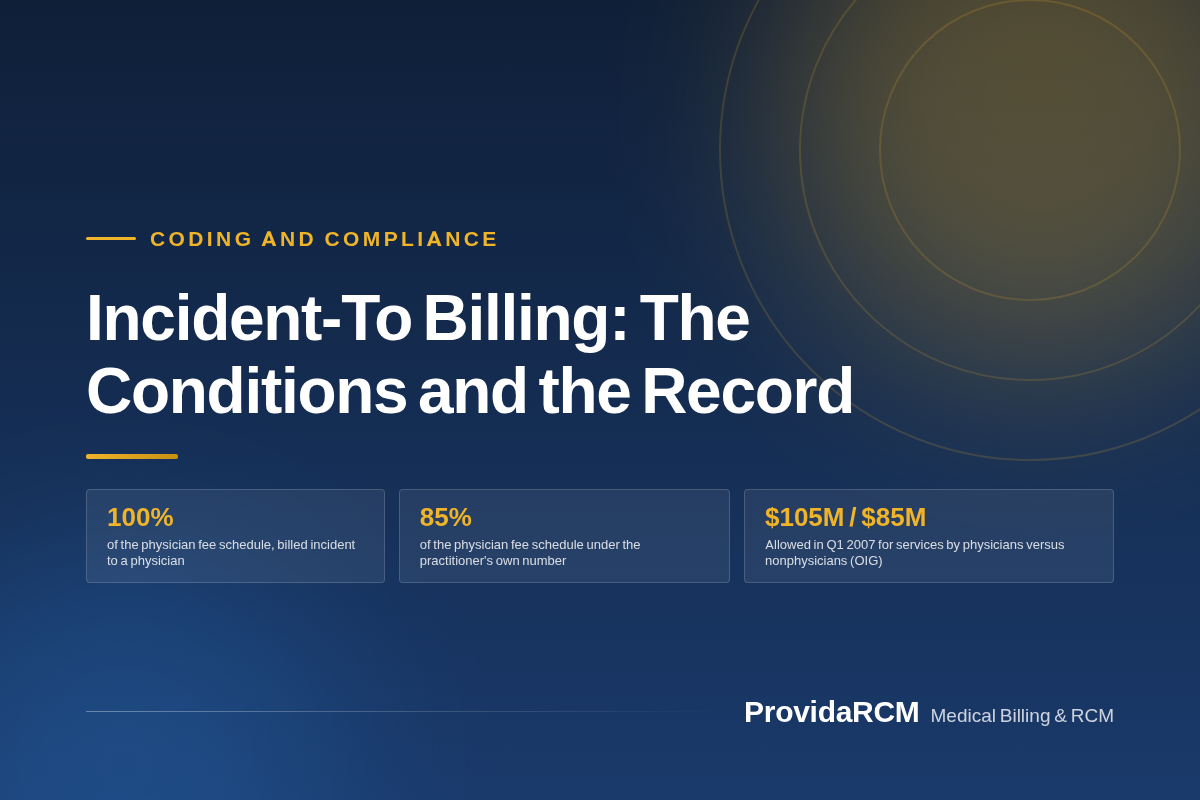
Incident to billing lets a practice bill a visit an auxiliary practitioner furnished under the physician’s own number, at 100 percent of the Medicare fee schedule instead of 85 percent. Medicare allows it only when four conditions hold at the same time. Miss one and the service is no longer the physician’s, and the payment difference is the practice’s loss.
Incident to billing in one paragraph and four conditions
Incident to billing is a payment rule, not a visit type. Section 1861(s)(2)(A) of the Social Security Act lets Medicare pay for a service furnished under a physician’s number when auxiliary personnel, including a nurse practitioner or physician assistant, perform it as an integral part of the physician’s own care. The conditions sit in 42 CFR 410.26 and in the Medicare Benefit Policy Manual, Chapter 15, Section 60.
Billed this way, the visit is paid as though the physician performed it: 100 percent of the Medicare Physician Fee Schedule. Billed under the practitioner’s own national provider identifier, the same visit pays 85 percent. CMS states both rates on its Incident To Services and Supplies page. On a visit that allows $120, the spread is $18.
What Medicare pays for the same visit
Sources: CMS, Incident To Services and Supplies; CMS MLN Matters SE0441.
| Condition | Where it comes from | What it requires | How it fails in practice |
|---|---|---|---|
| Part of the physician’s plan | 42 CFR 410.26(b)(2) | The service is an integral, though incidental, part of the physician’s service for a diagnosis or treatment | Auxiliary staff add a service the physician never planned or ordered |
| Initial service by the physician | Benefit Policy Manual, Section 60.2 | A direct, personal, professional service by the physician initiated the course of treatment | The first visit for a new problem was the practitioner’s, not the physician’s |
| Direct supervision | 42 CFR 410.26(b)(5); Manual Section 60.1(B) | The physician is in the office suite and immediately available for the whole service | The physician is reachable by phone or is somewhere else in the building |
| The setting | 42 CFR 410.26(a)(6) and (b)(1) | A noninstitutional setting, and a patient who is not an inpatient | The visit happened in the hospital or during a covered skilled nursing stay |
Medicare’s rule does not travel to other payers. Incident to billing is a Medicare construct, and many commercial and Medicare Advantage plans do not recognize it at all. A contract that prices a nurse practitioner visit at 85 percent of the physician rate will not pay the physician rate because a note records supervision. Read the fee schedule attachment before billing that way.
The service has to sit inside the physician’s plan of care
The manual’s first condition is also its definition. Section 60.1 says a service or supply is incident to a physician’s professional services when it is an integral, although incidental, part of the physician’s personal professional services in the course of diagnosis or treatment of an injury or illness.
The plan also has to stay alive. Section 60.2 requires subsequent services by the physician of a frequency that reflects the physician’s continuing active participation in and management of the course of treatment. One physician visit followed by nine practitioner visits and no further physician contact fails that test.
- A practitioner adds a service the physician never ordered, such as a screening test or a new therapy
- A visit is billed for a problem the physician’s note never mentions, even if the patient is established
- Follow-up continues for months while the chart holds one physician note from the first visit
Read the physician’s notes for the period and ask who set and managed the plan. If the practitioner did, the service is the practitioner’s.
Condition two: the physician performed the initial service
Section 60.2 states the rule in one sentence: there must have been a direct, personal, professional service furnished by the physician to initiate the course of treatment of which the service performed by the nonphysician practitioner is an incidental part. The physician has to be the person who started treating the problem.
This is why a new patient rarely qualifies. If the first visit for a new problem is performed by the nurse practitioner alone, there is no physician service for the practitioner’s work to hang from. The next visit is billable incident to only after the physician personally performs an initial service for that problem.
MLN Matters SE0441 walks through an anticoagulation monitoring clinic inside a physician group. The group’s other physician may not bill the monitoring, because that physician is not treating the patient for the underlying condition. If the same physician performs an initial evaluation and orders the monitoring, the monitoring becomes billable incident to that initial service. An order alone is not enough.
The same reading catches the common failure. A long-standing patient seen for a brand new problem by the practitioner alone is a new problem, and the first visit for it is not incident to anything.
Condition three: direct supervision is a defined standard
Direct supervision has a definition, and it is short. The Benefit Policy Manual, Section 60.1(B), says direct supervision in the office setting does not mean that the physician must be present in the same room with the aide, but the physician must be present in the office suite and immediately available to provide assistance and direction throughout the time the aide is performing services.
The availability of the physician by telephone and the presence of the physician somewhere in the institution does not constitute direct supervision.
Medicare Benefit Policy Manual, Chapter 15, Section 60.1(B)
The current regulation adds one option. 42 CFR 410.26(a)(2) defines direct supervision by cross reference to 42 CFR 410.32(b)(3)(ii) and allows that presence to include virtual presence through real-time audio and video communications technology, excluding audio only, for services without a 010 or 090 global surgery indicator. The CY 2026 Physician Fee Schedule final rule made it permanent.
Two details. In a group practice, any physician member may be the supervising physician in the suite, and need not be the one treating the patient, but only the supervising physician may bill the service. At a patient’s home, the physician generally has to be there too, with a narrow exception for homebound patients in medically underserved areas.
Condition four: the setting decides which rule you are in
Incident to billing lives in the noninstitutional setting. The regulation defines that term as all settings other than a hospital or skilled nursing facility, and it requires the services to be furnished in a noninstitutional setting to noninstitutional patients. A hospital outpatient department is outside the rule.
For hospital patients and for skilled nursing facility patients who are in a Medicare covered stay, Section 60.1(B) says there is no Medicare Part B coverage of the services of physician-employed auxiliary personnel as services incident to a physician’s services. Those services are bundled into the facility payment, which is what MLN Matters SE0441 means when it says incident to services are not separately billable to the Part B contractor.
| Arrangement | Setting | Whose number the claim goes out under | What decides the payment |
|---|---|---|---|
| Incident to a physician | Noninstitutional | The supervising physician’s NPI | The four conditions, paid at 100 percent of the fee schedule |
| Split or shared E/M visit | Facility | The practitioner who performed the substantive portion | More than half of the total time, or a substantive part of medical decision making |
| Locum tenens (fee-for-time compensation) | Any, during an absence | The regular physician’s NPI, with modifier Q6 or Q5 | A continuous period of absence, per the Claims Processing Manual, Chapter 1 |
| The practitioner’s own service | Any | The practitioner’s own NPI | Paid at 85 percent of the fee schedule |
Split or shared visits are the arrangement most often confused with incident to billing, and the setting separates them. CMS defines a split or shared visit as an E/M visit a physician and a practitioner in the same group perform in a facility setting, billed by whoever performed the substantive portion. Its definition notes that a facility setting is one where payment incident to a physician’s services is prohibited.
When a condition fails the visit reverts to the practitioner
If the four conditions are not met, the service is not the physician’s service. It is payable, if at all, under the practitioner’s own number at 85 percent of the fee schedule. The 15 point difference is the practice’s loss, and it rarely stops at one claim, because the same pattern usually produced the visit before it.
The Office of Inspector General has returned to this repeatedly. Project OAS-25-01-003, announced on November 15, 2024, is active and asks whether Part B payments for services performed incident to physicians’ services complied with Medicare requirements. The project description states that prior OIG work found improving the transparency of incident to services to be critical to program integrity.
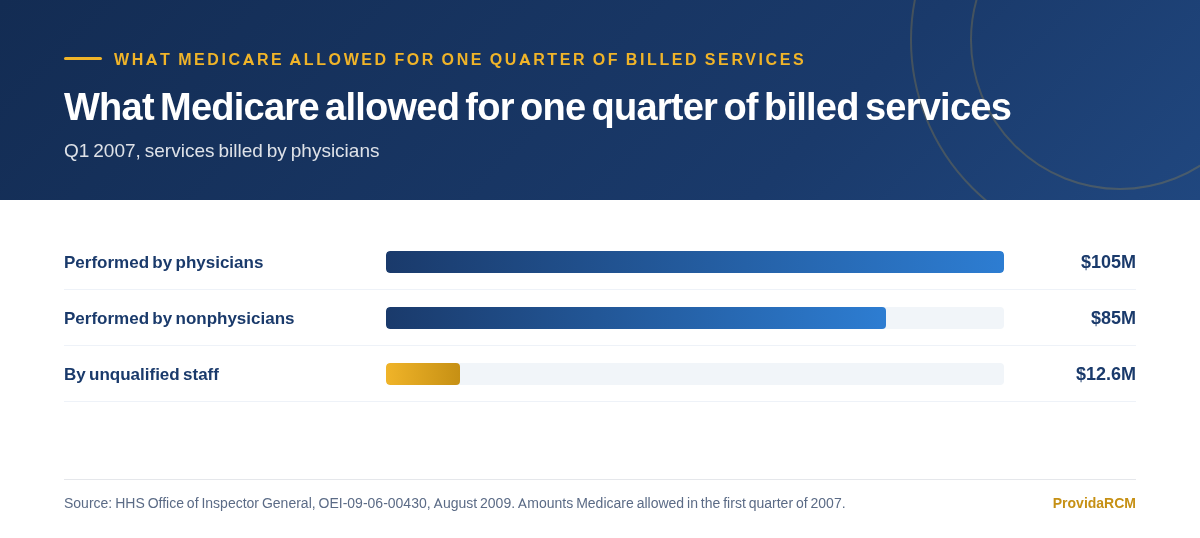
Medicare allowed per service, Q1 2007
Source: HHS OIG, OEI-09-06-00430. Averages computed from the allowed amounts and service counts reported for the first quarter of 2007.
OIG pulled Part B claims for the first quarter of 2007 and identified days where a single physician was allowed more than 24 hours of physician work time. It sampled 250 of those physician day combinations and asked the physicians who performed each service. Physicians personally performed about half. Medicare allowed $105 million for roughly 934,000 services they performed, and $85 million for roughly 990,000 services nonphysicians performed.
OIG’s physical therapy review found the same record problem. Report OEI-09-02-00200 reviewed 70 physical therapy line items billed by physicians in the first half of 2002 and found 91 percent did not meet program requirements, valued at $136 million in improper payments. It also notes a limit that still applies: physicians are not required to indicate on the claim whether a service was furnished incident to.
What the record has to show and the control that keeps it honest
MLN Matters SE0441 puts the documentation standard in one line: the patient record should document the essential requirements for incident to service. The record has to carry the physician’s plan and continuing involvement, not merely a clean note for the service that was actually furnished.
| Record element | What has to be there | Where the requirement comes from |
|---|---|---|
| The plan of care | The physician’s diagnosis and treatment plan for the problem, in the physician’s own note | Benefit Policy Manual, Section 60.1 |
| The initial service | A dated physician visit that initiated treatment of that problem | 42 CFR 410.26(b)(2); Manual Section 60.2 |
| Continued involvement | Physician notes at intervals showing management of the treatment course | Benefit Policy Manual, Section 60.2 |
| The supervising physician | The physician in the suite for the session, with that physician’s signature or attestation | 42 CFR 410.26(a)(2); Manual Section 60.1(B) |
Compliance here is an operating routine rather than a documentation rule, because the claim itself carries no marker of the arrangement. Nothing on the 1500 says a nurse practitioner saw the patient under supervision. The control that keeps the arrangement honest is a written rule about which visits qualify, plus the schedule checked against the supervision requirement before the session starts.
- Write the rule down: one signed page naming the conditions and which problems sit inside a physician plan
- Put the supervising physician on the daily schedule next to the room, not in a separate assignment sheet nobody reconciles
- Check the schedule at the start of each session. No physician in the suite means no incident to claim
- Have the physician document the plan and sign the same day, not at week end
- Report incident to volume by practitioner and payer monthly, against the physician’s own visit count
A visit that cannot be billed incident to is not a lost visit. It is a visit billed at the practitioner’s rate, or one that needs the physician to start the plan. The 2026 Medicare Physician Fee Schedule shows what each rate is worth, and the Modifier 25 documentation guide covers what happens when a physician and a practitioner both bill for one encounter. Our medical billing service reconciles incident to volume against the schedule monthly.
Questions practices ask us about this
Can a practice bill incident to for a new patient?
No, not for the first visit. Incident to billing requires a direct, personal, professional service by the physician to initiate the course of treatment. If the nurse practitioner performs the first visit for a new problem, there is no physician service for the work to hang from, and the visit is billable under the practitioner’s own number at 85 percent. Later visits qualify once the physician performs an initial service for that problem.
What does direct supervision mean in incident to billing?
The Medicare Benefit Policy Manual, Section 60.1(B), says the physician must be present in the office suite and immediately available to provide assistance and direction throughout the time the aide is performing services. The physician does not have to be in the room. Telephone availability and presence somewhere else in the building do not count. The current regulation also allows presence through real-time audio and video, excluding audio only, for services without a 010 or 090 global surgery indicator.
Can a nurse practitioner bill a physician’s patients incident to the physician?
Yes. A nurse practitioner can act as auxiliary personnel under a supervising physician, and the physician bills the service under their own number at 100 percent of the fee schedule when the four conditions are met. The reverse case is priced differently. When a nurse practitioner supervises other staff and bills that work incident to their own service, Medicare pays 85 percent.
Does incident to billing work in a hospital or a skilled nursing facility?
No. The regulation defines a noninstitutional setting as all settings other than a hospital or skilled nursing facility, and requires the service to be furnished in a noninstitutional setting to a noninstitutional patient. For hospital patients and for skilled nursing facility patients in a covered stay, there is no Part B payment for physician-employed auxiliary personnel as services incident to a physician’s services. Those services are bundled into the facility payment.
Do commercial payers and Medicare Advantage plans follow Medicare’s incident to rule?
Many do not recognize the arrangement at all, and Medicare Advantage plans generally set payment in the contract rather than by the Medicare Benefit Policy Manual. A contract that pays a nurse practitioner visit at 85 percent of the physician rate will not pay the physician rate because a note records supervision. Read the fee schedule attachment and the supervision language in the provider agreement before billing a visit that way.
How is a split or shared visit different from incident to billing?
The setting separates them. CMS defines a split or shared visit as an evaluation and management visit a physician and a practitioner in the same group perform in a facility setting, billed by whoever performed the substantive portion, which since January 1, 2024 means more than half of the total time, or a substantive part of medical decision making. Incident to billing is a noninstitutional rule that bills the supervising physician, who may not have seen the patient at all.
Want this fixed in your practice?
We run full-cycle billing, coding, credentialing and denial work for practices across the country. Send us a few months of claims and we will show you where the money is going.
Book a free billing review- CMS Medicare Benefit Policy Manual, Publication 100-02, Chapter 15, Section 60 (services and supplies furnished incident to a physician’s or NPP’s professional service). cms.gov/regulations-and-guidance/guidance/manuals/downloads/bp102c15.pdf
- 42 CFR 410.26, Services and supplies incident to a physician’s professional services: Conditions. ecfr.gov/current/title-42/chapter-IV/subchapter-B/part-410/subpart-B/section-410.26
- CMS MLN Matters SE0441, Incident to Services (revised August 2016). cms.gov/outreach-and-education/medicare-learning-network-mln/mlnmattersarticles/downloads/SE0441.pdf
- CMS Medicare Physician Fee Schedule, Incident To Services and Supplies. cms.gov/medicare/payment/fee-schedules/physician-fee-schedule/advanced-practice-non-physician-practitioners/incident-services-supplies
- CMS MLN Matters MM13592, Updates for Split or Shared Evaluation and Management Visits (effective January 1, 2024). cms.gov/files/document/mm13592-updates-split-or-shared-evaluation-management-visits.pdf
- CMS Medicare Claims Processing Manual, Publication 100-04, Chapter 1, Sections 30.2.10 and 30.2.11 (reciprocal billing and fee-for-time compensation arrangements). cms.gov/regulations-and-guidance/guidance/manuals/downloads/clm104c01.pdf
- HHS Office of Inspector General, OEI-09-06-00430, Prevalence and Qualifications of Nonphysicians Who Performed Medicare Physician Services, August 2009. oig.hhs.gov/oei/reports/oei-09-06-00430.pdf
- HHS Office of Inspector General, OEI-09-02-00200, Physical Therapy Billed by Physicians, May 2006. oig.hhs.gov/oei/reports/oei-09-02-00200.pdf
- HHS Office of Inspector General Work Plan, Medicare Part B Payments for Incident To Services, project OAS-25-01-003, announced November 15, 2024. oig.hhs.gov/reports/work-plan/browse-work-plan-projects/medicare-part-b-payments-for-incident-to-services