A CAQH profile is one shared record of your professional and practice data, and every payer you authorize pulls from it. When the attestation behind it lapses, those payers stop seeing current information and the credentialing file stalls. The fix is a named owner, a trigger list and a review date set against the enrollment deadlines you already track.
What a CAQH profile is for, and who actually reads it
CAQH ProView is one record that a provider fills in once and then authorizes other organizations to read. The portal’s own description says providers enter, update and verify professional and practice information and share it with the organizations they authorize, and that payers use it for credentialing, network and referral management, provider directories and more. One profile replaces a packet faxed to every plan separately.
The scale is why it matters. DataSpring, the company that now publishes what CAQH used to, reports 2.5 million healthcare providers and more than 1,000 health plans, hospitals and organizations participating, and says more than 1,000 of those organizations have asked their network providers to keep a portal record. A payer that works that way is not going to read your CV from a fax.
Payers say it plainly. Aetna’s provider network FAQ states that the company uses CAQH ProView for credentialing and recredentialing, and that a provider who registers has to authorize Aetna to review the information before the process starts. If you are already registered, the same page says you will get no other correspondence, which makes the authorization step the one that moves the file.
| What the profile feeds | Who reads it | What they do with it |
|---|---|---|
| Credentialing and recredentialing | Health plans and their credentialing committees | Build the file, then check licenses and certifications at the source |
| Provider directories | Payers, and the vendors that publish for them | Show members your locations, phone numbers and specialties |
| Claims administration and network setup | Plan operations teams | Configure the provider record your claims are paid against |
| Hospital and health system privileging | Medical staff offices | Match affiliations and admitting privileges against your profile |
The profile is a data source, not a verification. The portal’s data set is built to meet the data collection requirements of NCQA, URAC and the Joint Commission, and the payer’s own verification still has to run afterwards. What the profile decides is whether you enter the queue at all. A plan cannot work from data it has not been authorized to see.
The re-attestation cycle, and what lapses when it lapses
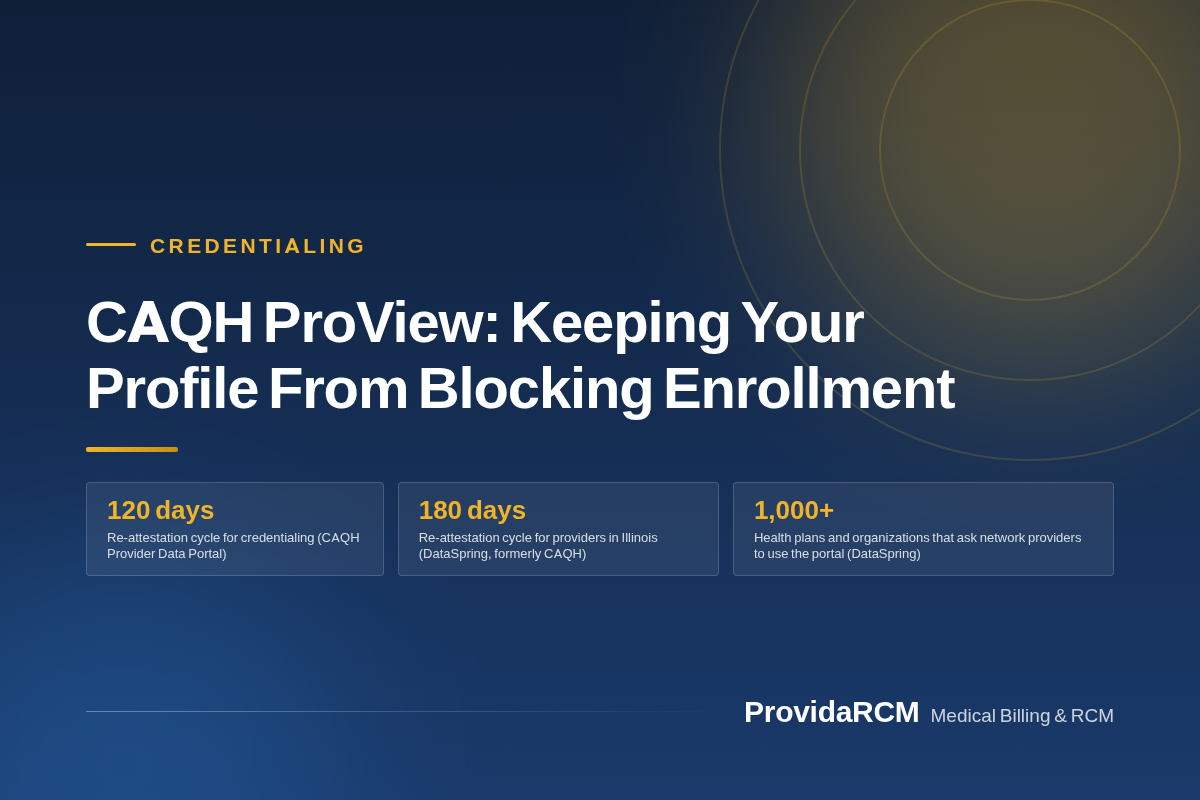
Attestation is the step where you certify that everything in the profile is true, correct and complete. The portal’s current published rule is every 120 days, or every 180 days for providers who practice in Illinois, and the same page says a provider who does not attest inside that window has their status changed to Expired. The company publishes this material under the DataSpring name now. The portal and the schedule are unchanged.
One more number sits underneath the cycle. Health plans started sending quarterly directory confirmation emails through the portal, and a provider who clears all the confirmation steps each quarter is in effect re-attesting every 90 days. That path is optional. The 120-day requirement is the floor, not the habit.
How often the portal has you confirm your data
Source: DataSpring (formerly CAQH), CAQH Provider Data Portal resources and FAQs.
What changes when the status reads Expired is access, not content. The portal sends reminders when it is time to confirm or update information, including to providers who are already expired: DataSpring says it emails every provider on a plan’s roster regardless of status and phones the ones who do not answer, with a target of at least one call every six months. None of that outreach restores the record. Only the attestation does.
The attestation interval belongs to the portal, has changed more than once, and varies by practice state, so a vendor post quoting an old figure can send a practice into a review cycle that no longer exists. Read the number on the portal’s own resource page, note the date you read it, and put the reminder dates on the credentialing calendar.
The profile fields that stop an attestation
The portal’s Correct Errors screen sorts problems into required fixes and suggested fixes. Required fixes are items that must be fixed before the profile is complete. Suggested fixes are values that look irregular or inconsistent, and CAQH advises reviewing them even though they do not block the attestation. The suggested pile is where a profile that passed last quarter quietly stops matching the license record.
| Profile field | What the portal expects | What goes wrong | Who owns it |
|---|---|---|---|
| Practice locations | Every location you practice at, with the group name as it appears on claims | A practice state with no matching active location returns a required fix | Credentialing coordinator |
| Specialty and taxonomy | A specialty consistent with your grouping, license and locations | The taxonomy does not match the license or the services you bill | Provider and credentialing |
| Hospital affiliations | An answer for each affiliation, including admitting privileges | An affiliation the plan already holds sits with no answer recorded | Provider |
| Professional liability insurance | Carrier, policy number, limits, and effective and expiry dates | Coverage history has a gap, or a new carrier was never entered | Credentialing coordinator |
| Employment and work history | Positions with dates that match the CV | A gap in the dates with no explanation, or a start date that disagrees with the CV | Provider |
| NPI and license linkage | Type 1 NPI, license state and number, and active status | A license renewed under a new number, or an NPI the profile never picked up | Credentialing coordinator |
Practice locations carry the most weight. The portal reconciles your profile against locations that health plans already hold in their directories, and CAQH’s own guide is blunt that you cannot re-attest until every location on that list has been reviewed and accepted or rejected, with a reason recorded for each rejection. That is also the step that changes what patients see, because practice location errors are the largest single source of directory errors.
What the federal review found in plan directories
Source: CMS online provider directory review, November 2018, as summarized in CAQH’s 2019 ProView Symposium deck.
Taxonomy is the quiet one. The grouping, provider type, practice setting and practice state you select drive which questions the system asks and which state application your profile generates. Choose a specialty that does not match the license and the profile can look complete while producing a record an analyst cannot use. Malpractice and work history fail for a duller reason: the dates.
A policy renewed with a new carrier, a limit raised mid-term, or a two-year stretch between positions that never made it onto the profile all read as inconsistencies to a committee reading your CV beside it. The profile and the CV have to tell the same story, and the profile is the version that travels to every plan you authorize.
How a payer reacts to a profile that has gone stale
The first reaction is silence. Aetna’s FAQ tells providers who are already registered that they will receive no further correspondence once the application request is in, so the absence of a letter is not evidence that anything moved. What the plan is waiting on is an authorized, attested profile that it can pull.
The second is procedural, and the extract rule explains it. DataSpring states that CAQH Provider Data Portal data extracts include only those providers who have attested since the last extract was received. A plan whose pull runs after your attestation lapsed does not receive a stale copy with a warning label on it. The provider it is credentialing is simply missing from that update, and the plan is left holding whatever it had.
The third is a request rather than a denial. What a plan asks for is a current attestation, an authorization it can see, or both, and the credentialing clock you are already tracking keeps running while that happens. Nothing in the portal’s published material says a claim is denied because a profile is unattested, so treat the enrollment file and the directory entry as the exposure, not the remittance advice.
Keep the claim denial story out of it. A stale profile stalls credentialing, directory listings and network setup, and if a contract requires you to keep your CAQH data current, the failure is a contract issue. It is worth reading that clause before relying on a profile sitting unattended for a year.
The practical consequence shows up in the calendar, not the explanation. A plan that was ready to review your file in March asks again in June, and by then the payer’s own credentialing timeline has restarted. The two months you thought you had are gone, and the effective date moves with them.
One owner, a trigger list and a date on the calendar
CAQH maintenance fails for a boring reason: it belongs to nobody until it is an emergency. Name one person who holds the profile. It can be the provider, an office manager or an outside credentialing service, but it has to be a named person with their own login and the primary email address on the account.
Then list the events that force a review, because the attestation date is not the only thing that changes the record. Any one of these makes the profile wrong the moment it happens, whether or not a re-attestation is due.
- A license renewal, including a new license number or an added state
- A practice location opening, closing, or moving within the same city
- A hospital affiliation starting or ending, including admitting privileges
- A malpractice carrier change, a limit change, or a policy that lapses and restarts
- A tax ID change, a new group NPI, or a move between practice entities
- Being added to a new payer roster, which is when the profile gets read
- A new service line or specialty that changes how the practice should be listed
Email is the failure point. The portal sends notices to the primary address on the account and to as many as two more if they are listed. Confirm the primary address is one the practice controls rather than a personal account that leaves with a departing employee, and add the person who covers the calendar as a second address.
Put the confirmation dates on the credentialing calendar the moment an attestation completes. The attestation date and the payer’s file review date are two different things, and both of them go wrong quietly, which is why the billing side usually hears about it last.
Timing re-attestation against the payer cycles you already track
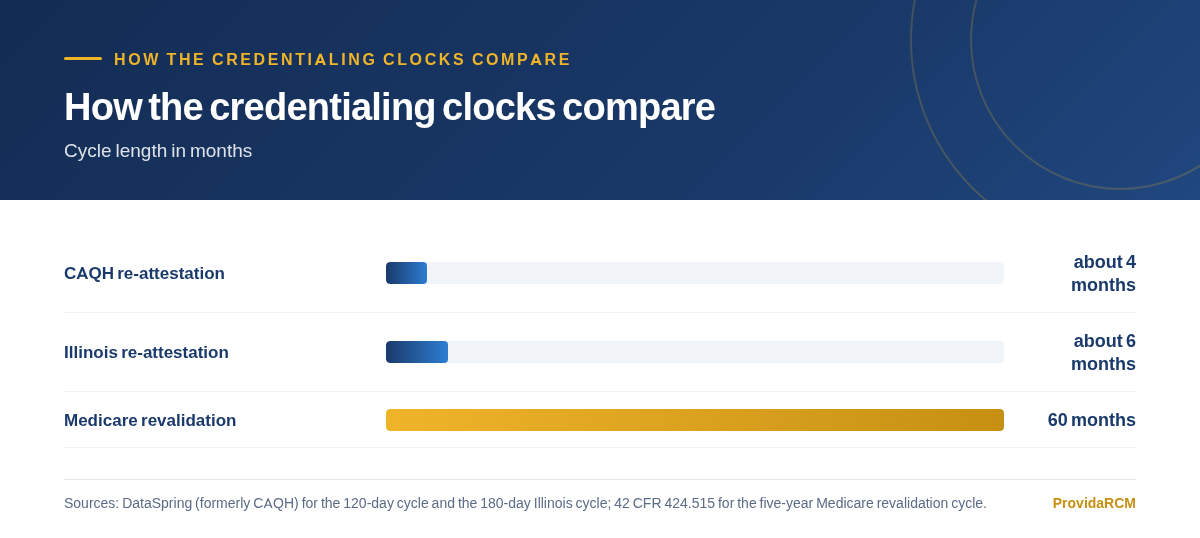
The clocks run at different speeds. Medicare enrollment runs on a five-year revalidation cycle under 42 CFR 424.515, and CMS contacts you directly when the cycle comes due. Payer credentialing runs on each plan’s own schedule, and the portal attestation runs on 120 days. A practice that manages only the last one still gets surprised by the first two.
| Clock | Who owns the rule | Cycle | What stops when it lapses |
|---|---|---|---|
| CAQH re-attestation | DataSpring, formerly CAQH | 120 days, or 180 days in Illinois | Payers stop receiving your data in the next extract and the file stalls |
| Payer credentialing and recredentialing | Each health plan | Set by the plan on its own file cycle | Network participation has to be renewed or rebuilt |
| Medicare enrollment revalidation | CMS | Five years, with off-cycle revalidations allowed | Medicare billing privileges depend on the resubmission being filed |
| Directory data | Payers and the vendors publishing for them | Refreshed from the confirmed profile | Patients call a number that no longer reaches anyone |
Sequence the attestation to the front of any application. When a plan pulls your data during credentialing, it takes whatever was attested last, so an attestation that lands two weeks before the committee meets is worth more than one that lands a week after. This is also the reason Medicare revalidation belongs in the same calendar rather than an enrollment folder nobody opens.
- Attest before you apply, not after, so the plan gets a complete record on its first pull instead of sending a follow-up request
- Never attest a profile you know is wrong just to reset the clock, because an attested error is now a certified error
- Refresh anything with an expiry date in the same sitting, since a document that fails review can leave the profile short of complete status
Questions practices ask us about this
How often do I have to re-attest to my CAQH profile?
Every 120 days under the portal’s current published rule, or every 180 days if you practice in Illinois. DataSpring, the company that publishes the CAQH Provider Data Portal today, states both figures on its resource page. The interval is the portal’s to set and it has changed over time, so check that page rather than a vendor article quoting an older number.
What happens when a CAQH attestation lapses?
The status changes to Expired when a provider does not attest inside the required window. The portal keeps sending reminders and DataSpring also phones providers who do not answer email, but outreach does not restore the record. Until you attest, the plan’s next data extract leaves you out, because extracts include only providers who have attested since the last one was sent.
Which CAQH fields cause the most rejections?
Practice locations top the list, because a practice state with no matching active location is a required fix that blocks the attestation entirely. Specialty and taxonomy come next, along with hospital affiliations left unanswered, malpractice coverage history with a gap, work history dated differently from the CV, and a license or NPI that changed without the profile being updated.
Can a payer deny a claim because my CAQH profile is not attested?
Nothing in the portal’s published material says that, and it is not a claim-editing rule. The exposure sits on the enrollment side: a stale profile stalls credentialing, directory listings and network setup, and a contract clause requiring current data turns into a compliance problem. Check the payer’s contract language rather than assuming a denial rule exists.
Who should own the CAQH account in a practice?
One named person with their own login and the primary email address on the account, plus a backup who sees the calendar. The portal sends notices to the primary address and to as many as two others if they are listed. An account pointed at a personal email leaves the practice when the employee does, and the reminders go with it.
Does re-attesting reset the clock even if the data is stale?
Attesting certifies that the profile is true, correct and complete as of that date, so re-attesting a profile you know is wrong certifies the error and restarts the same review later. Fix the field first, then attest. A profile held back by a required fix will not become complete until that item is cleared.
Want the CAQH dates off your desk?
We run credentialing, payer enrollment and CAQH maintenance for practices across the country, including re-attestation tracking, application follow-up and the directory corrections that come after them. Send us your provider list and we will show you where the dates are landing.
Book a free credentialing review- DataSpring (formerly CAQH), CAQH Provider Data Portal resources and FAQs (attestation cycle, expired status and extract rules). dataspring.com/resources
- CAQH Provider Data Portal, Provider User Guide (profile sections, authorization and attestation). caqh.org/hubfs/43908627/drupal/solutions/proview/guide/provider-user-guide.pdf
- CAQH ProView, Provider Quick Reference Guide. caqh.org/hubfs/43908627/drupal/solutions/proview/guide/PR-QuickRef.pdf
- CAQH, Practice Location Reconciliation Quick Reference Guide. caqh.org/hubfs/43908627/drupal/solutions/proview/resource/practice-location-reconciliation.pdf
- CAQH, Machine Learning and the Future of Provider Data Quality, ProView Symposium 2019 (summarizing the November 2018 CMS online provider directory review). caqh.org/sites/default/files/solutions/proview/machine-learning-and-data-quality.pdf
- Aetna, Joining the provider network FAQs (credentialing through CAQH ProView). aetna.com/faqs-health-insurance/health-care-professionals-join-network.html
- eCFR, 42 CFR 424.515, periodic revalidation of Medicare enrollment information. ecfr.gov/current/title-42/chapter-IV/subchapter-B/part-424/subpart-E/section-424.515