Payer enrollment is two approvals inside one file. Credentialing clears the clinician to treat a plan’s members. The contract sets the rates, effective date, termination rights and delegation. When the contract answers nothing about filing limits, appeals routing or behavioral health ownership, the provider manual and the fee schedule addendum own those answers. Ask for them in writing before you sign.
Credentialing, contracting and payer enrollment are three decisions
A practice usually treats the payer packet as one process. It is three, and they finish on different dates. Credentialing is the clinical review: the plan checks licensure, work history and malpractice history, then approves the clinician to treat its members. Contracting is the business document that sets rates, effective date, termination rights and delegation. Enrollment is the administrative load of your NPI, TIN and location so a claim can adjudicate.
| Step | What it decides | Who owns it | What silence costs |
|---|---|---|---|
| Credentialing | Whether the clinician may treat plan members | The plan’s credentialing committee or its delegate | Patients you see and cannot bill for |
| Contracting | Rates, effective date, termination, delegation | The plan’s network and contracting staff | No enforceable rate and no notice period |
| Enrollment | Whether your NPI, TIN and location load correctly | The plan’s provider data and claims team | Denials for provider not on file |
The order matters. A signed contract does not create a payable claim until the payer loads the provider record, and a credentialing approval does not create a rate. Medicare publishes all three steps, from the CMS-855 applications and PECOS to the effective-date rule in 42 CFR 424.520. Commercial payers publish less. We run the credentialing side of that work through medical credentialing services.
- Decide which of the three steps a question belongs to before you email the payer
- Get the team that owns the provider record named in the agreement
- Track the approval date, the signature date and the claims load date separately
What a payer enrollment application commits the practice to
An application is a signed certification. On the Medicare side, the CMS-855B used by a group practice asks for the practice location and the requested effective date, requires disclosure of ownership and managing control, and must carry a signature from an authorized or delegated official. CMS states that a missing signature or missing supporting documentation delays or returns the application.
Commercial applications copy that structure. You attest to licensure and sanctions status, disclose who owns the practice, name every location and tax identification number, and accept a duty to keep provider data current. Aetna’s provider manual puts a cadence on that duty: it states that federal and applicable state law require the provider and the plan to keep information current and confirm accuracy at least every 90 days.
The commitment that costs money sits in the paragraph nobody reads aloud. You agree to accept the contracted rate for every member in that product, to treat the plan’s payment as payment in full, and to hold the patient harmless for the balance. Sign on behalf of a group and the clinicians who never opened the application are bound by it too.
- Note who signs, and whether that authority covers every provider in the practice
- List the locations, tax identification numbers and products the application covers
- Read the hold harmless clause before you sign, not after a patient complaint
Effective-date mechanics decide whether you can bill backwards
Medicare’s effective date is a published rule rather than a negotiation. For physicians, non-physician practitioners and their organizations, 42 CFR 424.520 sets the effective date at the later of the date of filing of an application that is later approved, or the date the provider first began furnishing services at the enrolled location. Notice which date is absent from that test: the approval date.
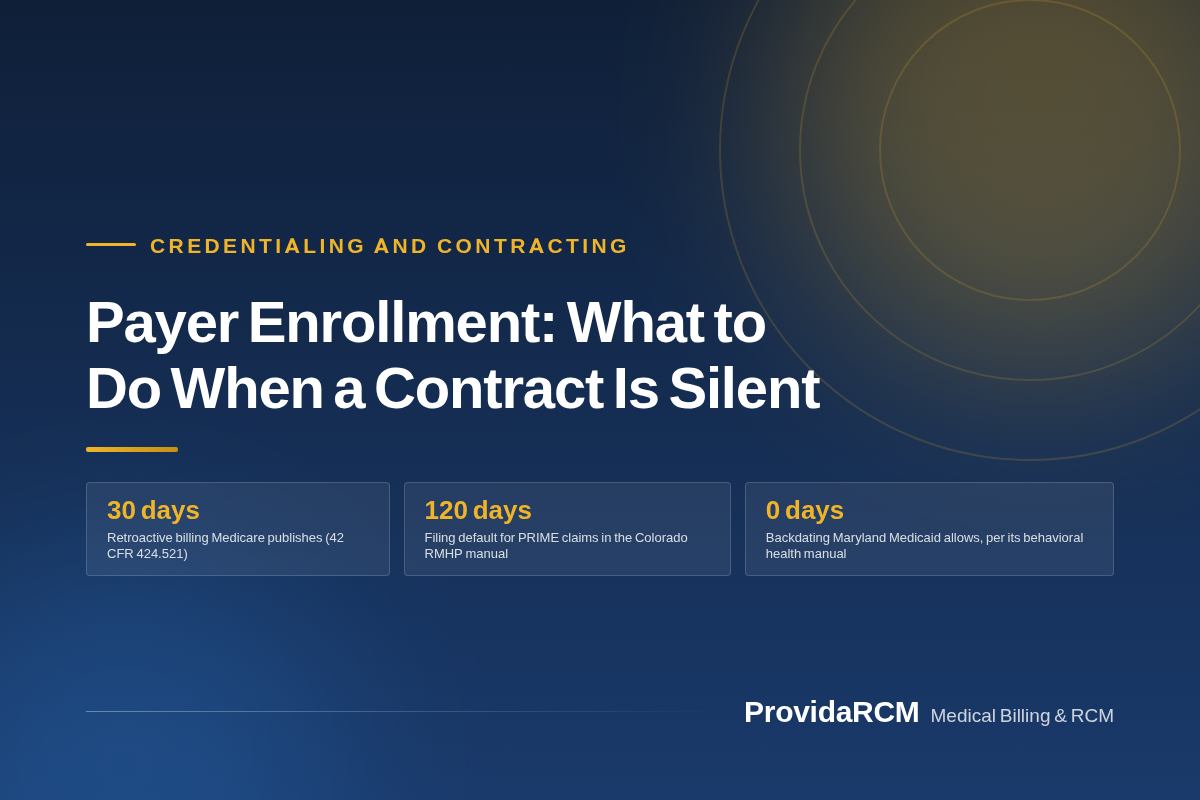
42 CFR 424.521 then permits retrospective billing for up to 30 days before that effective date, extended to 90 days when a presidentially declared disaster precluded enrolling in advance. Documentation establishes both dates. The application receipt date stamped by the contractor, the license effective date, and the service records showing where and when care was furnished are the three pieces that decide the outcome.
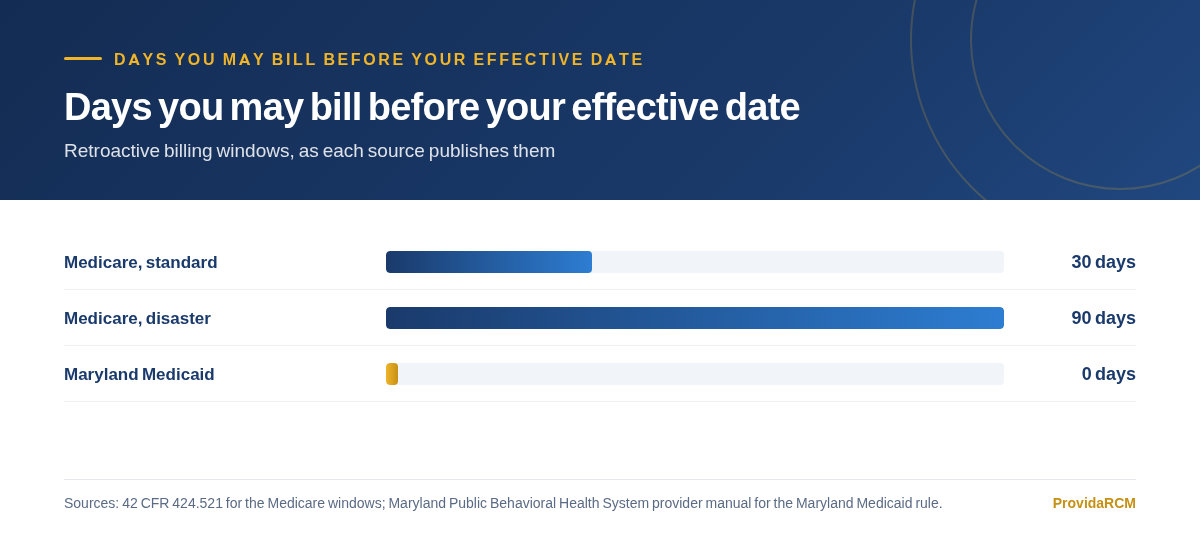
Commercial payers are a different matter. No federal rule governs a commercial effective date, so the number comes from the participation agreement, and a payer can shorten or drop its retroactive window without announcing it. Maryland’s behavioral health provider manual shows how blunt the other posture can be: it states that Maryland Medicaid does not backdate applications, and that the effective date is the date the completed application was processed.
So put the date in the agreement. Ask for the effective date to be tied to the credentialing approval date instead of the signature date, and ask for the retroactive window in the same paragraph. If the payer will not move the date, the answer to get in writing is the earliest payable date of service.
A representative can tell you the effective date is the first of next month. That answer cannot be billed against and will not survive an appeal. Ask for the date in the executed document or on the payer’s own provider record, and keep the reply with the contract.
Why the fee schedule is usually an addendum, not the contract
The agreement says you will be paid per the fee schedule. The schedule is an exhibit or addendum, held outside the signature pages, which is how a negotiated rate can change while the contract sits unchanged. Rates also arrive on request: Aetna’s state supplement asks providers who need allowable fees for 11 or more codes to send a spreadsheet and tells them to expect results within 30 business days.
| Term | Where it lives | Who can change it | What to ask for |
|---|---|---|---|
| Reimbursement rate | Fee schedule exhibit or addendum | The plan, on notice to you | A dated schedule by CPT code |
| Timely filing limit | Provider manual, or nowhere | The plan, by manual update | The window stated in the agreement |
| Appeals address | Provider manual or a reference guide | The plan | Confirmation of the current address |
| Termination notice | The agreement, or state law | Both parties, or a legislature | A notice period and a written reason |
Two habits keep this manageable. Date every fee schedule the moment it arrives and store it beside the agreement, because the addendum you were paid under in March is the evidence in a rate dispute in September. Then request rates only for codes you bill, so the payer can answer inside its own published turnaround instead of leaving the request open.
Silence one: the contract has no timely filing term
A missing filing term is the most expensive silence, because the payer still denies under a number nobody gave you. Highmark’s provider manual states the structure plainly: claims not submitted within the time frame established in your contract will be denied for untimeliness, and where the contract is silent, claims must be received within 365 days of the last date of service in Pennsylvania and West Virginia, and within 180 days in Delaware.
UnitedHealthcare’s Wisconsin guide takes the other route. It tells participating providers to file within the time frame specified in the participation agreement, and reserves the 365 day figure for providers outside the network. The Rocky Mountain Health Plans manual, its Colorado plan, names a number for one product: 120 days for standard PRIME claims when the provider agreement does not specify one.
Filing defaults published for a silent contract
Source: 42 CFR 424.44; Highmark provider manual chapter 6; UnitedHealthcare Rocky Mountain Health Plans care provider manual.
The written ask is one sentence. Please confirm the timely filing limit that applies to our participation agreement, in days from date of service, and confirm whether corrected claims and coordination of benefits claims carry a separate window. A written answer also fixes the date it was given, which matters when the manual is updated and the number moves. We track those numbers per payer in a timely filing limits reference.
Email the provider relations or network representative named in the agreement and keep the sent copy. Log the manual page and revision date you worked from. Highmark’s manual tells providers who deny on timeliness but filed inside the window to resubmit the claim and the denial with the appeal, so the request email becomes part of that file.
Silence two: no appeals address and no owner for behavioral claims
Two questions decide where a claim goes, and a silent contract answers neither. The first is the appeals address and the appeal window. Aetna Better Health of Virginia publishes both the appeals address and the 60 day window in its provider quick reference guide: provider appeals go to a named post office box within 60 days of the original denial, and the guide lists a separate address for member appeals. Confirm the current version rather than last year’s copy.
The second question is who adjudicates the claim. Behavioral health is often carved out to an entity other than the medical plan. Maryland’s behavioral health provider manual describes an administrative services organization model in which specialty behavioral health services are carved out of the managed care benefit package and run by a single state-contracted entity that manages authorizations and claims processing. We cover where those claims land in behavioral health carve-outs.
Medicare splits the same way from the other direction. Drug claims covered under the Part D benefit are handled by the Part D sponsor or its pharmacy benefits manager rather than by the medical plan, as CMS describes in its Part D materials. A practice that sends a behavioral health visit or a drug claim to the medical plan’s address is sending it to an entity that cannot pay it.
| Silence | The written question | The document that answers it | Fallback if no answer comes |
|---|---|---|---|
| No filing limit | Confirm the window in days from date of service | The claim submission chapter of the manual | Log the manual date and appeal with filing proof |
| No appeals address | Confirm the provider appeals address and window | A reference guide or an appeals chapter | Use the last published address and keep returned mail |
| No behavioral owner | Confirm which entity adjudicates behavioral claims | The carve-out or vendor guide for that product | Get the entity name from the eligibility response |
| No pharmacy owner | Confirm the pharmacy benefits manager and its address | Formulary or pharmacy benefit material | Bill the vendor named on the member’s card |
Silence three: no termination-without-cause notice period
A contract that lets either party terminate without cause, and states no notice period, lets the payer end your participation on short notice. Where a state has legislated, the number is published. New Jersey’s administrative code requires a carrier to give a health care professional at least 90 days written notice before terminating network participation off a renewal date.
Florida requires a health maintenance organization to give 60 days advance written notice to a provider before canceling without cause, and to give a written reason for the termination. Illinois sets 60 days for the plan’s notice to the provider, and 90 days for a provider terminating without cause. Three states, two different numbers, and nothing that applies nationally.
Notice a plan owes a provider before canceling without cause
Sources: N.J.A.C. 11:24B-5.3; Fla. Stat. 641.315; 50 Ill. Adm. Code 4520.50.
Because no national rule exists, the term belongs in your agreement. Ask for 90 days written notice, a written reason on request, and payment at the contracted rate for services already authorized or under way. Continuity for patients in an active course of treatment is worth naming in the same request, since that is the term a plan is most likely to grant.
If the payer refuses the term and then uses it against you, the escalation route runs through the state department of insurance, and it works better with a paper trail. The Texas Department of Insurance publishes a provider complaint route and a clean claims portal, and its prompt pay bulletin cites the Texas Insurance Code chapters that allow 30 days to determine an electronic claim and 45 days for a non-electronic one.
Questions practices ask us about this
What is the difference between credentialing and payer enrollment?
Credentialing is the clinical approval that a clinician may treat a plan’s members, decided by the plan’s credentialing committee or its delegate. Enrollment is the administrative registration that loads your NPI, tax identification number and location into the claims system so a claim can adjudicate. Contracting is the separate business document that sets rates, effective date, termination rights and delegation.
Do commercial payers have to backdate our effective date?
No. Nothing in federal law requires a commercial payer to backdate a participation effective date, so the window comes from the agreement. Medicare publishes its own rule: up to 30 days of retrospective billing before the effective date under 42 CFR 424.521, extended to 90 days when a presidentially declared disaster prevented enrolling in advance. Maryland Medicaid states that it does not backdate applications at all.
Where do I find the timely filing limit if my contract does not state one?
Start with the payer’s provider manual, then confirm the number in writing, because manuals change. Highmark publishes a fallback for a silent contract: 365 days from the last date of service in Pennsylvania and West Virginia, and 180 days in Delaware. UnitedHealthcare’s Wisconsin guide points participating providers to the participation agreement and gives 365 days only to out-of-network providers.
Who processes behavioral health and pharmacy claims?
Often not the medical plan. Maryland’s behavioral health provider manual describes specialty behavioral health services carved out of the managed care benefit and administered by a single state-contracted entity. On the Medicare side, CMS describes drug claims covered under the Part D benefit as handled by the Part D sponsor or its pharmacy benefits manager. Confirm the entity before you submit.
How much notice does a payer owe us before terminating the contract?
It depends on the state and the product. New Jersey requires at least 90 days written notice to a health care professional before terminating network participation off a renewal date. Florida requires 60 days advance written notice from an HMO before canceling without cause, and Illinois sets 60 days for the plan’s notice to the provider. Not every state publishes a number, so the notice period often has to be negotiated into the agreement.
What should we get in writing before signing a participation agreement?
Five items: the effective date and the earliest payable date of service, the timely filing window in days from date of service, the current provider appeals address and window, the entity that adjudicates behavioral health and pharmacy claims, and the notice period for termination without cause. Ask in one email to the network representative named in the agreement.
Want this fixed in your practice?
We run full-cycle billing, coding, credentialing and denial work for practices across the country. Send us a few months of claims and we will show you where the money is going.
Book a free billing review- 42 CFR part 424 subpart P, Medicare billing privileges. ecfr.gov/current/title-42/chapter-IV/subchapter-B/part-424/subpart-P
- 42 CFR 424.44, time limits for filing claims. ecfr.gov/current/title-42/chapter-IV/subchapter-B/part-424/subpart-C/section-424.44
- CMS, Medicare enrollment applications and PECOS. cms.gov/medicare/enrollment-renewal/providers-suppliers/chain-ownership-system-pecos/enrollment-applications
- CMS, Medicare Part D direct and indirect remuneration. cms.gov/newsroom/fact-sheets/medicare-part-d-direct-indirect-remuneration-dir
- Highmark provider manual, general claim submission guidelines. providers.highmark.com/resources-and-education/highmark-provider-manual/chapter-6-billing-and-payment/unit-1-general-claim-submission-guidelines.html
- UnitedHealthcare Community Plan of Wisconsin, claim and appeal time frames. uhcprovider.com/content/dam/provider/docs/public/commplan/wi/qrg/WI-Timeframes-Claim-Submissions-Appeals-QRG.pdf
- UnitedHealthcare, Rocky Mountain Health Plans care provider manual. uhcprovider.com/content/dam/provider/docs/public/admin-guides/comm-plan/CO-RMHP-Care-Provider-Manual.pdf
- Aetna Better Health of Virginia provider quick reference guide. aetnabetterhealth.com/content/dam/aetna/medicaid/virginia/provider/pdf/Quick%20Reference%20Guide.pdf
- Aetna provider manual. aetna.com/content/dam/aetna/pdfs/aetnacom/health-care-professionals/office-manual-hcp.pdf
- Maryland Public Behavioral Health System provider manual. maryland.carelonbh.com/wp-content/uploads/sites/75/carelon-maryland-pbhs-provider-manual.pdf
- New Jersey Administrative Code 11:24B-5.3. law.cornell.edu/regulations/new-jersey/N-J-A-C-11-24B-5-3
- Florida Statutes 641.315. flsenate.gov/Laws/Statutes/2026/0641.315
- Illinois Administrative Code 4520.50. law.cornell.edu/regulations/illinois/Ill-Admin-Code-tit-50-SS-4520.50
- Texas Department of Insurance, prompt payment of clean claims. tdi.texas.gov/hmo/mcqa/promptpay.html