Most payer contract negotiation fails before the first call, because nobody converted the contract into numbers. A fee schedule is not one document, and the percentage on its cover is not the rate you get paid. Read three things first: which schedule governs, which year of Medicare it points to, and what your top codes actually allow.
The fee schedule you were sent is not the one you signed
A practice signs an agreement and receives a PDF with a few thousand CPT codes and dollar figures attached. That PDF might be an exhibit to the contract, which makes it enforceable. It might be the payer’s proprietary schedule, which the payer can revise. Those are different documents, and one of them can move under you mid-term.
The difference lives in the payment clause. Language that anchors to the payer’s fee schedule as amended from time to time lets the payer reprice without asking. Language that incorporates a dated exhibit, or a fixed percentage of a named year of Medicare, holds. Ask for the executed payment exhibit, not the provider manual summary.
Medicare’s schedule is the third artifact, and it earns its role because it is public, versioned, and computed the same way for everyone. Payment runs through relative value units for work, practice expense and malpractice, adjusted by geographic indices, then multiplied by a conversion factor (CMS describes the mechanics). That consistency is why Medicare works as a denominator and a payer’s own table does not.
| Document | Who sets the numbers | What it tells you | Where it misleads |
|---|---|---|---|
| Contract payment exhibit | Both parties, at signing | The enforceable rate per code | Often missing from the copy the practice keeps |
| Payer proprietary schedule | The payer, and it can be updated | Current allowed amounts, if the file is accurate | Silent repricing when the contract references it loosely |
| Medicare physician fee schedule | CMS, annually, through a final rule | A public benchmark for every code and locality | Not a target by itself; specialty mix decides |
Some contracts state that payment equals a percentage of the payer’s fee schedule. That reads like a rate and functions like an open amendment, because the payer controls the base. The same sentence with a dated exhibit or a named year of Medicare attached cannot drift. Read the clause that allows the schedule to change as closely as the clause that states the rate.
Convert every rate to a percentage of Medicare
Take the allowed amount on the remittance for a code, divide by the Medicare allowed amount for the same code in the same locality, and you have a figure you can compare across every payer. Do that for the codes carrying most of your revenue, then weight by volume. One weighted multiplier per payer is a negotiating position. A stack of dollar amounts is a spreadsheet.
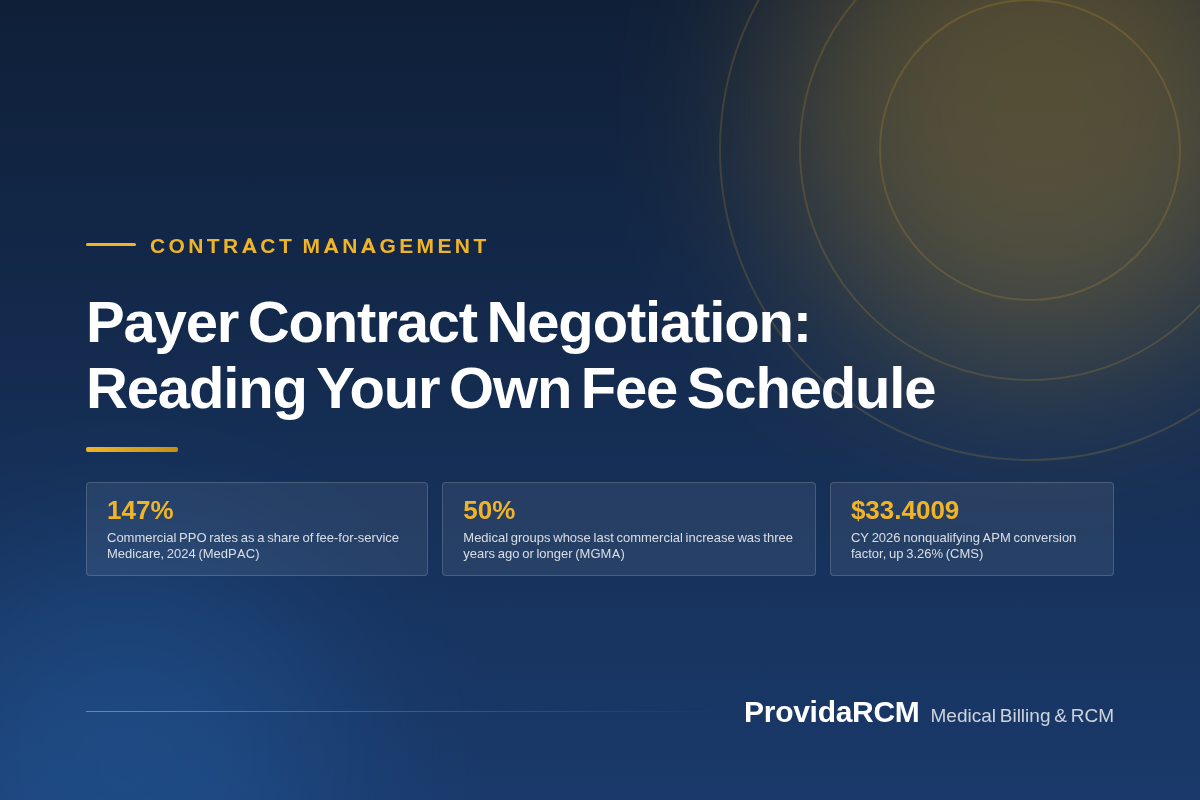
MedPAC puts commercial PPO payment rates at 147% of fee-for-service Medicare in 2024, up from 140% in 2023 and 136% in 2022 (January 2026 payment adequacy materials; December 2025 meeting transcript). That is a national average across all clinicians, built from one large insurer’s PPO claims. It says where the market sits. It does not say what your practice should accept.
Commercial PPO rates as a share of Medicare
Sources: MedPAC, December 2025 public meeting transcript for 2022 and 2023; January 2026 physician payment adequacy materials for 2024.
The average hides a wide spread. MGMA’s contract analysis guidance notes that some payers build their own schedules, and some of those land as low as 72% of the CMS fee schedule (MGMA). A practice holding one payer at 105% and another at 72% is not running one contract problem. It is running two, with different arguments.
Two mechanical details break the comparison if you skip them. Medicare pays differently for the same code in a facility and a non-facility setting, and geographic indices shift the number by locality. Compare your allowed amount to the Medicare rate for the setting you bill in, from the same year as the claim.
Suppose a payer allows $92 on a code where Medicare allows $74 in your locality. That is 124% of Medicare. Raise the Medicare rate 2.5% while the contract pays a flat $92 and the same code drops to 121% without a single contract change. Track the ratio, not the dollar figure.
Which Medicare year you point at matters more than the percentage
CMS set the 2026 nonqualifying conversion factor at $33.4009, up 3.26% from $32.3465, and the qualifying APM factor at $33.5675 (CMS CY 2026 final rule). A contract written as a percentage of current year Medicare rose with it. A contract written as a code-level dollar table from 2021 did not, and nothing in that document requires anyone to revisit it.
The 2026 increase carries a catch that shapes 2027. CMS’s proposed 2027 rule states that a one-year 2.50% conversion factor increase from Public Law 119-21 expires after 2026, so current law requires a 2.50% reduction against 2026, with a proposed nonqualifying factor of $32.84 (CMS CY 2027 proposed rule). A percentage-of-Medicare clause follows that number down unless the contract says otherwise.
Medicare conversion factor, nonqualifying APM
Sources: CMS CY 2026 Physician Fee Schedule final rule and CY 2027 proposed rule fact sheets. The 2027 figure is proposed, not final.
| Contract language | What happens each January | How to fix it at renewal |
|---|---|---|
| Percentage of current year Medicare | Rate moves with the conversion factor, up or down | Add a floor and name the base year |
| Percentage of the payer’s own schedule | Payer reprices when it updates the schedule | Attach a dated exhibit as the enforceable rate |
| Flat dollar table, no escalator | Nothing moves, and the gap compounds | Add a stated increase tied to a published index |
That is the case for a floor. A percentage-of-Medicare clause with a stated minimum, or one that fixes the Medicare base year and applies the escalator to that base, keeps the benchmark useful without handing the payer an automatic cut through federal law. Without either, the practice absorbs every conversion factor swing.
Half your market has been billing on a rate set three years ago
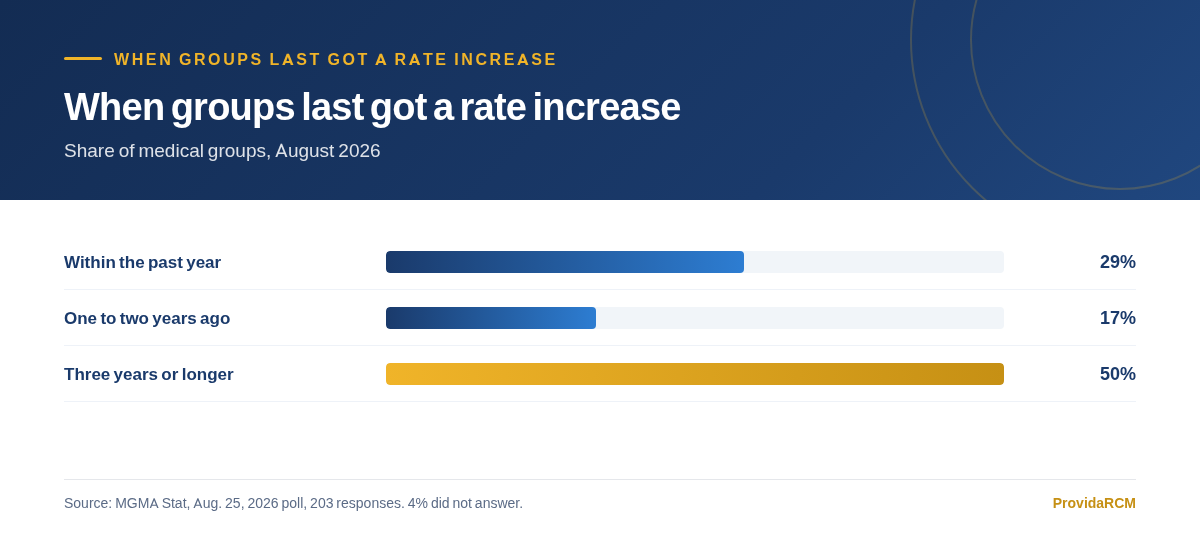
MGMA asked group leaders in August 2026 when their most recent commercial rate increase landed. Twenty-nine percent said within the past year, 17% said one to two years ago, and half said three years or longer (MGMA Stat, 203 responses). More than eight in ten reported higher year-to-date operating costs, and fewer than half reported revenue keeping pace.
The same poll asked what worked. Groups that secured an increase cited market position, benchmarking data, quality metrics, and a willingness to push, with a threat to terminate among the most frequently named tactics. Groups stuck at three years or longer named payer refusal and lack of leverage. The distance between them is mostly preparation.
Review frequency is the cheapest fix. An August 2023 MGMA Stat poll found 58% of groups reviewed payer contracts annually and 17% never reviewed them on a regular schedule, out of 389 responses. Renewal dates pass quietly when nobody owns the calendar. Put every agreement’s expiration, notice period and escalator date into one list.
Compression: where the blended rate looks fine and the money is not
A contract can pay 120% of Medicare overall and still lose money, because the mix decides the outcome. If a payer allows 140% on office visits and 88% on the procedures your clinicians actually perform, the blended figure looks fine while cost per procedure does not. Rank codes by net revenue, then read the ratio code by code.
Multiple procedure logic is the usual hiding place. Medicare pays the highest valued procedure in a session at 100% and the second through fifth at 50% (Medicare Claims Processing Manual, chapter 12). Commercial contracts vary: some mirror that rule, some apply their own reduction. When the contract is silent, the payer applies its own logic and an appeal has nothing to stand on.
The same pattern runs through add-on codes, assistant surgeon percentages, bilateral rules, and buy-and-bill drugs priced at a percentage of average sales price. A contract paying 106% of ASP on a drug that costs 104% plus handling leaves a margin that disappears when the mix shifts. Ask about the stop-loss threshold on a single high-cost case.
- Top twenty codes by net revenue, with volume, allowed amount and the Medicare rate for each
- Setting and locality used for the Medicare rate, so the comparison matches the claim
- Multiple procedure, bilateral and assistant rules as written, not as assumed
- Drug and supply lines with ASP percentage, handling allowance and any stop-loss threshold
Pull that comparison from remittances, not from the fee schedule the payer sent. The schedule shows intent. The remittance shows what happened, including the codes the payer bundled and the rates never loaded at renewal.
Payer contract negotiation: the clauses that outrank the rate
A point of rate is worth what the contract lets the payer do to it afterward. Practices spend the negotiation on the percentage and sign whatever sits in the boilerplate, which is where the rate gets spent.
| Clause | What to ask for | What it costs when missing |
|---|---|---|
| Payment base | A dated exhibit, or a named Medicare year with the conversion factor identified | Silent repricing whenever the payer updates its schedule |
| Annual escalator | A stated percentage or a published index with a floor, applied to that base | Rates flat while input costs rise |
| Amendment rights | No unilateral change to rates without written notice and an opt-out | Mid-term cuts delivered as policy updates |
| Clean claim definition | Contract text, not the payer’s manual incorporated by reference | Denials for documentation nobody specified in advance |
| Payment timeframe | A stated number of days with interest accruing on late payment | Cash sits with the payer and your days in A/R carry it |
| Termination without cause | A defined notice period the practice can actually use | No leverage at renewal, the tactic MGMA members cite most |
Two definitions do more work than the rate. Medicare regulation defines a clean claim as one with no defect or impropriety, including any lack of required substantiating documentation, that would prevent timely payment (42 CFR 405.902). Commercial contracts often incorporate the payer’s manual by reference instead. When the definition lives in a document the payer can revise, each added requirement becomes a legitimate denial.
The escalator is quantifiable. MedPAC projects Medicare Economic Index growth of 2.1% in 2027, the index built to track clinicians’ input costs. An escalator below that is an annual cut with a friendly name, and a three-year agreement with no escalator is a cut signed in advance.
Reconcile the remittance before you make the call
A contract rate that is not being paid is worse than a low rate, because the shortfall arrives disguised as a contractual adjustment. Underpayments hide inside CARC 45, the code reporting that the charge exceeded the fee schedule or contracted rate. Most systems post that line straight to a write-off. When the payer’s loaded schedule is wrong, the difference arrives already labeled as legitimate.
- 01
Build the rate table once
One row per code per payer with the expected allowed amount and the Medicare rate for that code and locality. Load it from the executed exhibit, not a portal export.
- 02
Pull six months of remittances
Extract allowed amounts by code and payer. Six months shows a pattern and stays recent enough to argue about.
- 03
Flag variance past a dollar threshold
Set the threshold in dollars, not percentages. A 2% shortfall on a high-volume visit code outweighs 20% on a rare procedure.
- 04
Separate the causes
Wrong schedule loaded, wrong modifier logic, bundling, or a rate never updated at renewal. Each has a different fix and a different person to call.
- 05
Send the variance with the exhibit
A repriced claim with the contract page attached gets reprocessed. A complaint that rates feel low does not.
That reconciliation doubles as the strongest document you carry into a renewal. A payer that has underpaid a code for two years owes a specific number. Our underpayment recovery work runs this test across payers, and the revenue cycle health check sizes the problem first.
For the call, bring four things: the executed agreements with expiration and notice dates, a full year of payer mix and gross collections, CPT-level fee schedules for the codes generating at least 80% of revenue, and your cost per visit. MGMA’s contracting guidance puts the same four at the top of its checklist. A rate request without them is a preference.
If your payment clause points at Medicare, check the year against the 2026 fee schedule summary before the renewal letter goes out. Practices lose more to a stale base year than to a hard negotiation, and the base year is the part you can fix alone.
Questions practices ask us about this
What is a payer fee schedule and how do I read it?
It is the document that sets the allowed amount for each code under a contract, and it comes in three forms: an enforceable exhibit, the payer’s proprietary schedule, or the Medicare physician fee schedule used as a benchmark. Start with the payment clause in the executed agreement to learn which one governs, then pull that exhibit.
How do I compare what a payer pays with Medicare?
Divide the allowed amount on the remittance by the Medicare allowed amount for the same code, locality and year. Do it for the codes that generate most of your revenue, then weight the results by volume. The output is one multiplier per payer, which compares across contracts in a way that dollar amounts cannot.
Is 147% of Medicare a good commercial rate?
It is a national average, not a target. MedPAC calculated that figure from one large insurer’s PPO claims across all clinicians, so it blends specialties with very different cost structures. A primary care practice and a surgical group at the same multiplier are not in the same position. Use it to locate yourself in the market, then argue from your own cost per visit.
Can a payer change my contracted rates mid-term?
Often yes, if the contract allows it. Language tying payment to the payer’s fee schedule as amended from time to time grants that right, and many agreements add unilateral amendment clauses for material policies. Check the amendment and reference clauses before renewal. A dated exhibit, or a named Medicare year with a floor, closes the gap.
How often should we review payer contracts?
Annually at minimum, and starting several months before the renewal date so there is time to gather CPT-level data and model the rate. MGMA found 58% of groups review annually and 17% have no regular schedule. Quarterly checks of paid amounts against contracted rates catch loading errors between renewals, which is where underpayments accumulate.
What can we do if a payer pays less than the contracted rate?
Rebuild the claim using the contract rate, attach the relevant exhibit page, and send it for reprocessing rather than filing a clinical appeal. Those are different processes, and a clinical appeal usually fails on an administrative issue. Track the variance by code and payer so the request carries a number. Underpaid lines are often posted as CARC 45 write-offs and never reviewed.
What escalator should we ask for in a multi-year contract?
Something at or above the growth in your input costs, stated in the contract rather than implied. MedPAC projects Medicare Economic Index growth of 2.1% in 2027, so an escalator below that is a real annual cut. If the payer will not move on the percentage, trade for a shorter term or a carve-out on the codes that carry your margin.
Want this fixed in your practice?
We run full-cycle billing, coding, credentialing and denial work for practices across the country. Send us a few months of claims and we will show you where the money is going.
Book a free billing review- MedPAC, Assessing payment adequacy and updating payments: physician and other health professional services, January 2026. medpac.gov/wp-content/uploads/2025/08/Tab-C-Physician-update-Jan-2026.pdf
- MedPAC, December 2025 public meeting transcript (commercial rates as a share of Medicare). medpac.gov/wp-content/uploads/2025/12/December-2025-public-meeting-transcript-SEC.pdf
- CMS, Calendar Year 2026 Medicare Physician Fee Schedule final rule fact sheet (CMS-1832-F). cms.gov/newsroom/fact-sheets/calendar-year-cy-2026-medicare-physician-fee-schedule-final-rule-cms-1832-f
- CMS, Calendar Year 2027 Medicare Physician Fee Schedule proposed rule fact sheet. cms.gov/newsroom/fact-sheets/calendar-year-cy-2027-medicare-physician-fee-schedule-proposed-rule
- MGMA Stat, Most medical groups have gone years without a commercial payer rate increase, August 2026. mgma.com/mgma-stat/most-medical-groups-have-gone-years-without-a-commercial-payer-rate-increase
- MGMA Stat, Is it time to review your medical group’s payer contracts, August 2023. mgma.com/mgma-stat/is-it-time-to-review-your-groups-payer-contracts
- MGMA, Don’t let tight resources hinder contract analysis and optimization. mgma.com/articles/don-t-let-tight-resources-hinder-contract-analysis-and-optimization
- 42 CFR 405.902, definition of a clean claim. ecfr.gov/current/title-42/section-405.902
- CMS Medicare Claims Processing Manual, chapter 12, multiple procedure payment rules. cms.gov/Regulations-and-Guidance/Guidance/Manuals/downloads/clm104C12.pdf