An underpayment is a claim a payer processed and paid at an allowed amount below the rate in your contract. The claim is closed, the remittance looks ordinary, and the gap appears only when someone compares the allowed amount to the contracted fee schedule. Underpayment recovery depends on three things: the contract page, the line-level variance, and the clock that payer runs on.
Underpayment recovery starts with one line of the 835
An underpayment is not a denial. Something was paid, the claim closed, and the remittance posted like any other. The shortfall sits in the allowed amount, which came back below the fee schedule your contract attaches to that code. One line at a time is the only way to see it, because a claim total can look plausible while three of its ten lines are short.
The 835 has no field labelled allowed amount. You derive it from the charge minus the contractual adjustment, which is the CAS segment carrying CARC 45 under group code CO. Group code CO means a contractual write-off. PR means the patient owes the amount. OA means another payer’s adjudication. Post a CO adjustment as patient responsibility and the shortfall disappears into a column nobody audits, which is the failure mode behind most payment posting errors.
| What the 835 shows | What it usually means | What to do |
|---|---|---|
| CO-45 for less than the contract difference | Paid at the contracted rate | Post it and move on |
| CO-45 far larger than the contract difference | Allowed amount below contract | Quantify the variance and dispute it |
| CO-45 equal to the whole charge, nothing paid | A denial wearing a contractual code | Treat it as a denial and appeal it |
| No CO-45, paid below the billed amount | An unexplained reduction | Request the fee schedule the payer used |
| OA-23 with a payment from another payer | Coordination of benefits | Reconcile the primary payer’s 835 first |
Charge minus allowed equals the contractual adjustment. If that adjustment is larger than the contract permits for the code, the date of service and the place of service, you have a variance. Nothing else in the file matters until that number is on paper.
Why the allowed amount comes back low
Six causes account for most line-level shortfalls, and each leaves a different fingerprint on the remittance. Sorting by cause matters, because a fee schedule error is a contract dispute while a bundling edit is a coding dispute, and the two go to different reviewers with different evidence.
- The wrong fee schedule year. The payer loaded last year’s rates or a superseded amendment, so every line on the claim is short by the same small percentage.
- A missing modifier. The second procedure of a pair falls under CARC 97 and gets no separate allowance, though the documentation supports it.
- A multiple procedure reduction borrowed from another contract. The payer cuts the second surgical line by half when your contract excludes that reduction.
- Units cut without a code. Ten units billed, four allowed, no remark. That is a review decision dressed up as arithmetic.
- Capitation. CARC 24 means the service sits inside a managed care capitation agreement, and a fee-for-service rate never applied to it.
- Coordination of benefits. CARC 23 under group code OA records another payer’s adjudication, not your contract’s rate.
| Cause | What the 835 shows | Document that settles it |
|---|---|---|
| Outdated fee schedule | A uniform percentage shortfall across the claim | The amendment with the effective date and attached schedule |
| Bundling edit | CARC 97 or 234 on the second line | The operative note and the payer’s own edit policy |
| Multiple procedure reduction | A near-50 percent cut on the second line | The contract clause on multiple procedures |
| Unit reduction | Allowed units below billed units, with a remark | The note and the review rationale in writing |
| Capitation | CARC 24 with no fee-for-service allowance | The capitation agreement and its service list |
| Coordination of benefits | CARC 23, group code OA | The primary payer’s 835 |
The current X12 description reads: charge exceeds fee schedule/maximum allowable or contracted/legislated fee arrangement. The usage note beside it says the adjustment cannot equal the total charge, and must not duplicate prior payer adjustments. A zero-paid line with the whole charge in CO-45 contradicts both sentences. Quote the note in the dispute, because it is the payer’s own standard.
One pattern is worth naming. A payer that applies the same wrong rate to the same code, at the same place of service, across a month is usually running an outdated contract load, not making claim-level decisions. That is the easiest underpayment to recover, because the proof is a spreadsheet instead of a medical record, and the fix applies to the whole batch.
The payment clocks, and which ones reach your payer
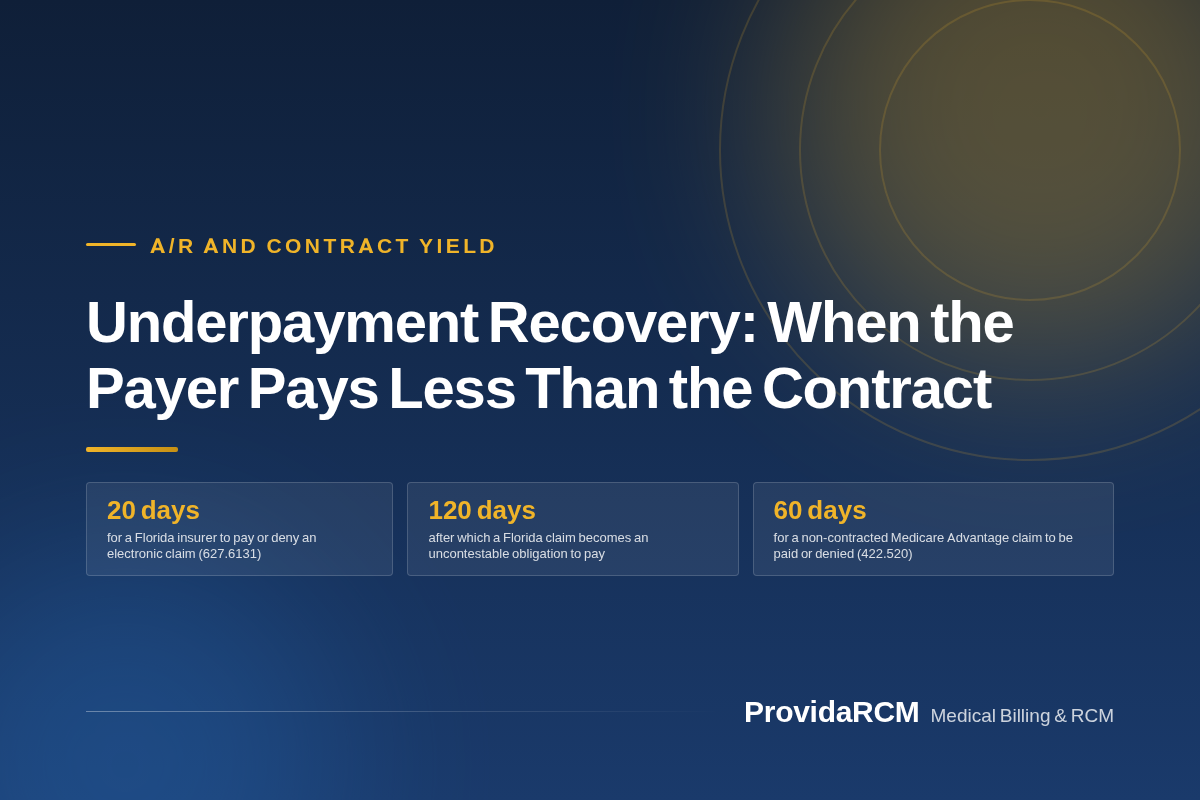
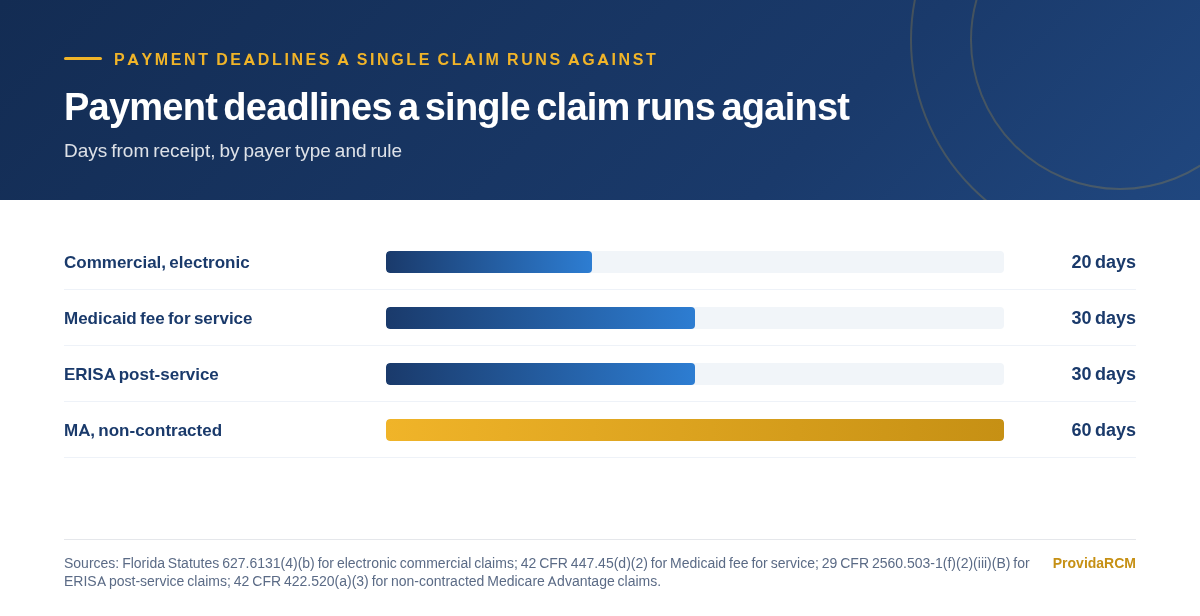
Prompt payment rules differ by payer type, and the difference decides whether a short or late payment is a compliance problem or a contract problem. Florida is the clearest statute to read. An insurer must pay or deny an electronic claim within 20 days of receipt, and a paper claim within 40. A claim the insurer has not paid or denied within 120 days becomes an uncontestable obligation to pay, and an overdue payment carries simple interest at 12 percent a year.
| Payer type | Federal rule | State prompt pay | Where the payment term sits |
|---|---|---|---|
| Medicare Advantage, contracted | 422.520(b): the contract must contain a prompt payment provision | Superseded by 422.402 | Your contract |
| Medicare Advantage, non-contracted | 422.520(a): pay or deny within 60 calendar days | Superseded by 422.402 | Federal regulation |
| Medicaid fee for service | 447.45(d): 90 percent of clean claims in 30 days | State plan, same rule | Federal regulation |
| Medicaid managed care | 438.400(b)(3): a partial payment denial is an adverse benefit determination | Depends on the state contract | Contract and 42 CFR part 438 |
| Commercial, fully insured | None | Applies, and varies by state | State insurance code and contract |
| Self-funded employer plan | ERISA claims procedure, 29 CFR 2560.503-1 | Generally does not apply | Plan document |
42 CFR 422.402 provides that the Medicare Advantage standards supersede state law, with exceptions only for state licensing and solvency rules. A state deadline argument against an MA plan gets rejected on preemption and burns the review window. The enforceable term is the prompt payment provision the contract was required to carry under 422.520(b)(1).
That provision is negotiated, which is why two contracts inside one practice can carry different clocks. Read the clause before the dispute, not after. A contract that says nothing about interest pays no interest, and a clause that sets 45 days is not improved by a state statute written for a different product line. The federal floor is 42 CFR 422.520.
Filing in the right forum, inside the right window
Each payer type has one door and a clock beside it. File in the wrong forum and the request comes back without a decision, which spends the window you needed. The four windows below are set in regulation, so they do not move when a representative says the review takes 45 days. Decide early whether you are disputing a rate or an edit, because which denials to appeal and which variances to price are two different lists.
Days to file a payment dispute, by payer type
Sources: 42 CFR 405.942(a) for Medicare redetermination; 42 CFR 422.582(b) for Medicare Advantage reconsideration; 42 CFR 438.402(c)(2)(ii) for Medicaid managed care appeals; 29 CFR 2560.503-1(h)(3)(i) for group health plan appeals.
| Payer | File with | Window | Authority |
|---|---|---|---|
| Medicare fee for service | The MAC that made the initial determination, on CMS-20027 | 120 calendar days from receipt | 42 CFR 405.942(a) |
| Medicare Advantage | The plan, on its own reconsideration form | 60 calendar days from the written determination | 42 CFR 422.582(b) |
| Medicaid managed care | The MCO, on the enrollee’s behalf with authorization | 60 calendar days from the notice date | 42 CFR 438.402(c)(2)(ii) |
| Self-funded employer plan | The plan administrator | 180 days after the adverse determination | 29 CFR 2560.503-1(h)(3)(i) |
| Commercial, fully insured | The insurer’s provider dispute unit, then the state regulator | State statute and contract | State insurance code |
A Medicare fee-for-service shortfall travels the same path as a denial: a redetermination request filed within 120 calendar days of receipt, with receipt presumed five days after the notice date. CMS-20027 is the form, and the argument is arithmetic plus the fee schedule, not medical necessity. Attach the notice and the remittance, because the reviewer works from those two documents.
Medicare Advantage is different. The federal reconsideration process is framed around the enrollee’s entitlement, and a provider can be a party when the plan determines it has an appealable interest. For a contracted claim the cleaner door is the dispute clause your contract was required to carry.
In Medicaid managed care the regulation treats a denial of payment in whole or in part as an adverse benefit determination, and a provider may request the appeal on the enrollee’s behalf. That is a real route with a 60 day window, and it needs a signed authorization in the file before the window closes. The exception is a claim that fails the clean claim definition, which is handled as a resubmission.
A self-funded employer plan must decide a post-service claim within 30 days, with one 15 day extension, and give the claimant 180 days to appeal an adverse determination. Practices holding an assignment of benefits can use that route directly. Practices without one are asking the plan for a courtesy, and should send the request through the patient.
Building the variance file that gets paid
Payers answer documents, not complaints. A phone call about underpayment gets a reference number. A one-page letter with a claim number, a contracted rate and a subtraction reaches the unit that can reprice the claim.
- 01
Pull one claim, not a summary
Start with a single claim and a single code. A summary invites a claim-level answer, and a claim-level answer hides the line you are actually disputing.
- 02
Quantify line by line
Record billed, allowed, paid, patient responsibility and the contractual adjustment. Multiply the per-unit shortfall by the units paid, not the units billed, then total the claim.
- 03
Attach the contract, not a screenshot
Send the page with the rate, its effective date and the signature block. A fee schedule without its amendment is the most common reason a payer reprices at the old rate and closes the file.
- 04
Write the calculation into the letter
State the expected allowed amount, the actual allowed amount, the difference, and the clause or regulation behind it. One page, one claim number, one figure to pay.
- 05
Ask for interest in the same letter
It is rarely automatic. Claim it, cite the rate that applies, and show the date the clock started, which is the date the claim was received.
Simple interest on a $1,000 underpayment at 12 percent
Source: 12 percent simple interest per Florida Statutes 627.6131(7), calculated on a $1,000 principal that remains unpaid.
Small balances become rational to chase when interest runs. Thirty dollars on a $1,000 shortfall is not the point. The point is a payer with 400 such lines owing $12,000 in interest alone, and a letter that recites the rate tends to get answered before the deadline it names.
- Claim number, date of service, rendering provider and place of service on every page
- The contracted allowed amount for each disputed code, with the source page cited
- The allowed amount the payer produced, and the arithmetic between the two
- The 835 claim and service line, with the CAS segment and group code identified
- The clause, regulation or statute that supports the request, quoted rather than paraphrased
- A payment date you are asking for, which turns a complaint into a deadline
Controls that find the shortfall in days
Recovery work is reactive by nature. The control that makes it cheap is a variance review inside the posting cycle, run on a sample of every remittance rather than on a quarterly audit that arrives after the contract year has closed. Sampling finds the payer-level pattern faster than a full review.
- Compare allowed to your fee schedule at posting, so a short line is flagged before the batch closes rather than at month end.
- Score every payer monthly on variance dollars as a percentage of allowed dollars. One payer drifting upward is a contract load problem.
- Re-test the contract load after every amendment, using five codes you know cold, before the new rate goes into production.
- Keep an escalation calendar for open disputes, with the filing window and the date the payer promised an answer.
The number to report is variance dollars over allowed dollars, by payer, for the month. Underpayments that nobody measures get booked as contractual write-offs, and the write-off percentage then reads as a model of efficiency while the practice is funding someone else’s margin.
Put recovered dollars and interest recovered on the same page as denials worked. A practice that can see $9,400 recovered from contract variances in a month will fund the half-time analyst who found it.
None of this replaces the contract. It only makes the contract enforceable one line at a time, with paper a reviewer can act on. Practices that treat the fee schedule as a reference document recover less than practices that treat it as the invoice behind every claim.
Questions practices ask us about this
What is an underpayment in medical billing?
It is a claim the payer processed and paid at an allowed amount below the contracted rate for that code, place of service and date of service. Something was paid, so the claim is not a denial and it drops out of the denial queue. The difference shows up only when someone compares the allowed amount, which is the charge minus the contractual adjustment, against the fee schedule the contract attaches.
How long do I have to dispute an underpayment?
It depends on the payer. Medicare fee for service allows 120 calendar days from receipt of the initial determination for a redetermination. Medicare Advantage gives 60 calendar days from the written determination for a reconsideration. Medicaid managed care appeals run 60 calendar days from the notice date, and a self-funded ERISA plan must allow 180 days to appeal an adverse determination.
Is an underpayment the same as a denial?
No. A denial is a refusal to pay, and it starts an appeal clock that the remittance usually names. An underpayment is a payment below the contracted rate, and nothing in the remittance tells you it happened. The same claim can carry both: one line paid short under CARC 45, another denied under CARC 197. They go to different reviewers with different evidence.
Can I bill the patient for the difference when a payer underpays?
No, not when the difference is contractual. A CO-45 adjustment is the amount you agreed to write off when you signed the contract, and moving it to the patient breaches that contract. Only the patient responsibility fields are billable, which means deductible, coinsurance and copay reported under group code PR. If the reduction is not contractual, dispute it as a denial rather than invoicing the patient.
What if the payer says the claim was paid at the contracted rate?
Ask for the fee schedule version, its effective date and the amendment it came from, in writing. Compare it to your copy line by line, because a payer running an outdated load will produce a schedule that looks plausible and is a year behind. If the versions match and the rates do not, the dispute has moved from arithmetic to contract interpretation.
Does interest apply when a payer pays late?
Sometimes, and rarely unless you ask. Florida requires simple interest at 12 percent a year on an overdue claim payment, and several other states set their own rate. A Medicare Advantage contract has to contain a prompt payment provision, and whatever interest term that provision carries is the one you can enforce. Claim interest in the same letter as the variance, with the rate and the start date.
Find out what your contracts are actually paying
We review a sample of remittances against your fee schedules, price the variance by payer, and file the disputes with the contract page attached. You get the recovered dollars and the payer scorecard that shows where the pattern sits.
Book a free billing review- 42 CFR 422.520, Prompt payment by MA organization (eCFR). ecfr.gov/current/title-42/section-422.520
- 42 CFR 422.402, Federal preemption of State law (eCFR). ecfr.gov/current/title-42/section-422.402
- 42 CFR 447.45, Timely claims payment and the clean claim definition (eCFR). ecfr.gov/current/title-42/section-447.45
- 42 CFR 438.400, Medicaid managed care adverse benefit determinations (eCFR). ecfr.gov/current/title-42/section-438.400
- 42 CFR 405.942, Time frame for filing a request for a redetermination (eCFR). ecfr.gov/current/title-42/section-405.942
- CMS-20027, Medicare Redetermination Request Form, first level of appeal (PDF). cms.gov/medicare/cms-forms/cms-forms/downloads/cms20027.pdf
- 29 CFR 2560.503-1, ERISA claims procedure timing and appeal periods (eCFR). ecfr.gov/current/title-29/section-2560.503-1
- Florida Statutes 627.6131, Payment of claims, including the 12 percent interest rate. leg.state.fl.us/statutes/index.cfm?App_mode=Display_Statute&URL=0600-0699/0627/Sections/0627.6131.html
- X12, Claim Adjustment Reason Codes, current list. x12.org/codes/claim-adjustment-reason-codes