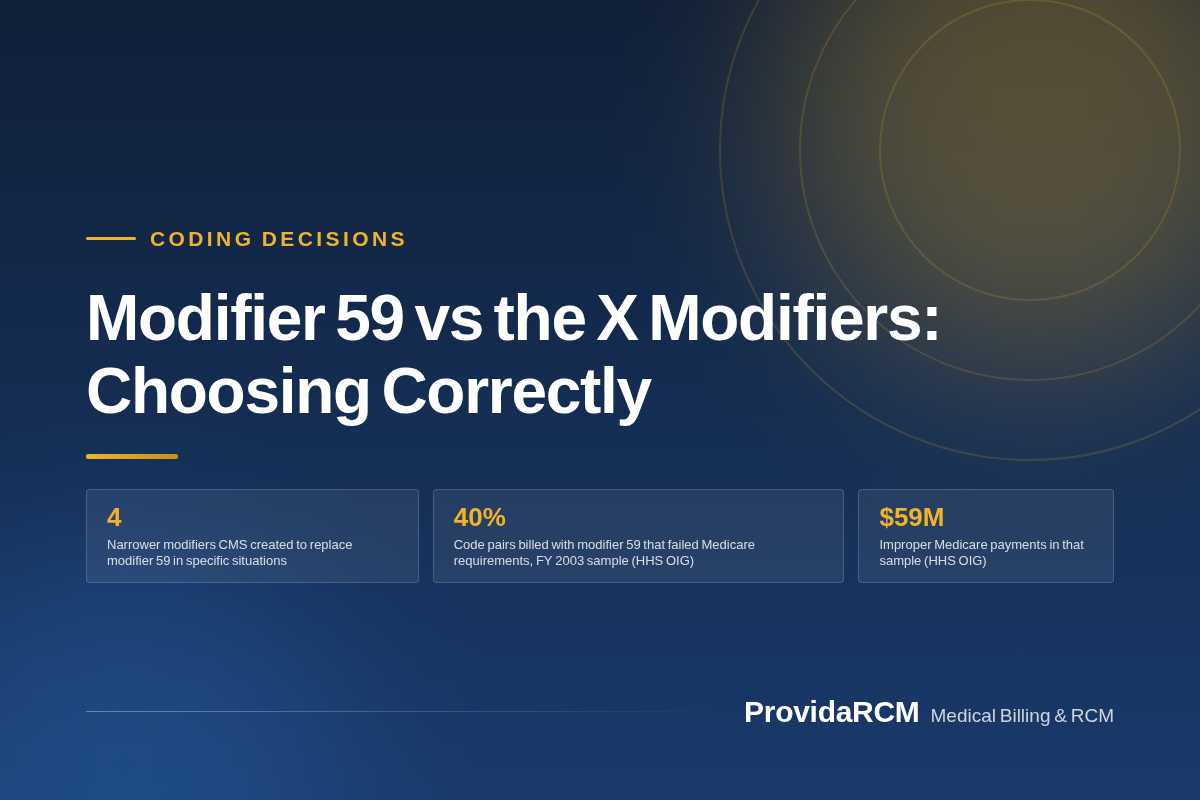
The four X modifiers, XE, XS, XP and XU, are not alternatives to modifier 59. CMS created them because modifier 59 was standing in for four different situations, and CMS instructs billers to use the narrower modifier whenever one fits. Modifier 59 stays for cases none of them describes.
Why CMS stopped relying on modifier 59 alone
CMS does not treat modifier 59 as an interchangeable label. Its MLN booklet on these modifiers states the position directly: the X modifiers give greater reporting specificity where modifier 59 was previously reported, they should be used instead of 59 whenever possible, and 59 is only for cases where no more specific modifier is appropriate.
The X set took effect on 1 January 2015 under CMS Transmittal 1422, change request 8863. Chapter I of the NCCI Policy Manual says the same thing from the other direction: these modifiers were developed to provide greater reporting specificity and may be used in lieu of modifier 59 whenever possible. It then puts the residual rule on 59: it shall only be used if no other modifier more appropriately describes the relationship between the codes.
Four questions were being answered with one code. Did the patient have two encounters that day? Was a separate structure treated? Did a different practitioner perform the second service? Or is the second service something the main service does not include? Each X modifier answers one of those and points a reviewer at a specific part of the record.
Modifier 59 and the X modifiers are not interchangeable. A claim carrying 59 where XS describes the anatomy has told the payer less than the record supports, and the reviewer’s first question is why the narrower characterisation was not used.
The four situations the X modifiers were built for
Read the four as a short checklist rather than a set of synonyms. XE covers separate encounters with the same patient on one date of service. XS covers a separate organ or structure. XP covers a service performed by a different practitioner. XU covers a service that does not overlap the usual components of the main service.
| Modifier | The situation it describes | What the documentation has to show | How it fails |
|---|---|---|---|
| XE | Two encounters with the same patient on one date | When each began and ended, and the separate work in each | The second visit is the first service continuing |
| XS | A separate organ or structure, or non-contiguous lesions | The site of each procedure, named so a reader can see they are not contiguous | The sites are contiguous, or RT, LT or E1 to E4 fits |
| XP | A service performed by a different practitioner | Which practitioner did which service, with a note from each | One note names one practitioner for both services |
| XU | A service that does not overlap the usual components of the main service | The services separated in time, and why the second sits outside the main code | The second service is what the main code includes |
| 59 | A distinct procedural service none of the four describes | The same standard the X modifiers carry, since the record justifies the pair either way | Appending it by habit where XS or XU fits |
XS is the one most often confused with the anatomic set. CMS says the X modifiers are for relationships the anatomic modifiers cannot describe, which puts laterality and digit modifiers first when they apply. Where two procedures fall on contiguous structures in the same organ or region, no modifier separates them and the pair stays bundled.
XP and XU carry the subtler tests. XP depends on the practice’s own schedule: two practitioners in one group can produce a bypassable pair, but each service needs its own note and the claim has to name who did what. XU is the narrowest of the four, because CMS warns that the descriptors of an edit pair almost always describe different procedures and that the two codes cannot be reported together on that basis alone.
XU fits when the second service genuinely sits outside what the main code includes, which is a clinical judgement rather than a coding preference.
59 remains valid and CMS keeps it. What it cannot do is stand in for a narrower modifier that fits the situation.
The edit pair and its indicator decide whether a modifier helps at all
An NCCI edit is a pair of codes, a column one code and a column two code, that generally should not be reported together. Bill the pair without a modifier and column one is eligible for payment while column two is denied. Every pair carries a Correct Coding Modifier Indicator in the same file, and that indicator is the first thing to read.
A CCMI of 0 means NCCI PTP-associated modifiers cannot bypass the edit at all. A 1 means they may be used under appropriate circumstances. A 9 means their use is not specified, and CMS assigns it to pairs whose deletion date matches their effective date. The values sit in the NCCI PTP edit files.
An indicator of 1 is not permission. CMS writes that a modifier shall not be appended to a code solely to bypass an edit when the clinical circumstances do not justify it, and that the record must satisfy the criteria required by whichever associated modifier is used. Most paired-organ edits carry a 1 because the pair may be reported on contralateral organs. On the same side, and on contiguous structures in one organ, leave the modifier off.
The associated modifier list is short: the anatomic modifiers, the global surgery set of 24, 25, 57, 58, 78 and 79, and then 27, 59, 91, XE, XS, XP and XU. The anatomic group runs E1 through E4, FA, F1 through F9, TA, T1 through T9, LT, RT, LC, LD, RC, LM and RI. Modifiers 22, 76 and 77 are not on the list and will not move an edit.
Two diagnoses do not make two services. CMS states that a different diagnosis is not required for these modifiers, and that different diagnoses are not adequate criteria for using them.
What the record has to show before either modifier is defensible
The modifier is a claim line assertion and the note is what proves it. CMS puts the burden in two places: the criteria for the modifier must be met, and the documentation has to satisfy them. One sentence about what was separate does more work than a template repeating the definition.
- For XE, both encounters: the time each began and the separate work performed in each
- For XS, each site by name: the organ, the anatomic region, and why the two are not contiguous
- For XP, both practitioners: who performed which service, with two notes and one date of service
- For XU, the sequence: what the main code already includes and what the second service added
CMS describes three limited exceptions where a service in the same encounter is still separate and distinct. Two timed services count when they run in separate, unmixed blocks and one finishes before the next begins, reported with 59 or XE. A diagnostic procedure before a therapeutic one counts when it decided whether to proceed, reported with 59 or XU. A diagnostic procedure after a completed therapeutic one counts when it is not the expected follow-up, also with 59 or XU.
Anything outside those paths has to stand on its own facts. Two procedures at one site, in one encounter, with one set of instruments are one service on the claim no matter which modifier is attached. There, the answer is the comprehensive or combination code CMS publishes for the situation.
How an auditor tests the claim a year later
A modifier review is a small, repeatable test. The reviewer opens the claim, then the note, then the order or the timer. Four questions decide it, and they are the same four for a Medicare contractor, a payer or a compliance team.
| What the reviewer opens | A defensible claim shows | What sinks it |
|---|---|---|
| The two services | The code pair, the correct modifier on the secondary service, and a note describing both | The modifier sits on the main service, or the note describes only one procedure |
| The site for each service | Anatomic detail specific enough to place the two procedures apart | A diagnosis difference, with both services performed at one site |
| The timing | Encounter times, or time blocks, that show the two services did not overlap | One time block, with the second service described inside it |
| The note itself | A statement in the provider’s own words of what made the service separate | A template line that asserts distinctness without any detail |
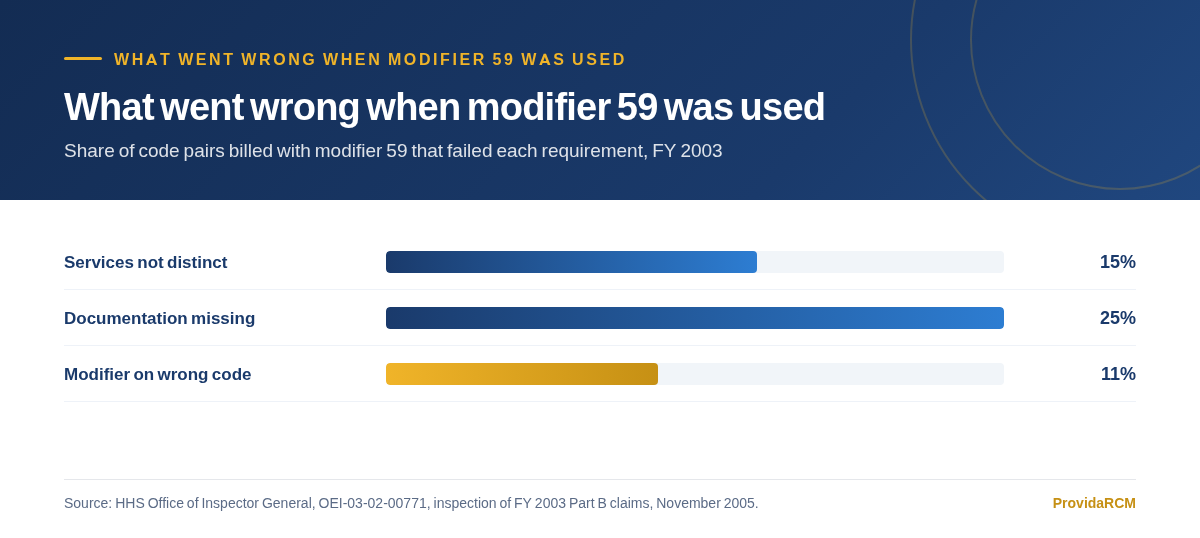
There is a public record of what happens when this test is skipped. In 2005 the HHS Office of Inspector General published an inspection of modifier 59 use covering fiscal year 2003 claims. It found that 40 percent of the code pairs billed with modifier 59 did not meet program requirements, producing about $59 million in improper payments. Fifteen percent were not distinct services and 25 percent were not adequately documented.
Dollars allowed on code pairs that failed the test
Source: HHS Office of Inspector General, OEI-03-02-00771, FY 2003 claims. Amounts allowed for services that bypassed NCCI edits using modifier 59.
Check the version before citing a code. The live X12 list has CARC 4 as the procedure code being inconsistent with the modifier used, a wording last modified in March 2020, and some crosswalks still append a phrase about a missing required modifier that the listing no longer carries. CARC 236 is the National Correct Coding Initiative denial. CARC 15 was deactivated on 1 May 2018 and still circulates as a live authorization denial.
Where the X modifiers and modifier 59 do not belong
Modifier 59 has one rule that catches new billers, and CMS states it outright: it should not be appended to an evaluation and management service. When a separately identifiable E/M service is performed on the same day as a procedure, the modifier for that is modifier 25, which carries its own documentation standard.
Chapter I names one other prohibition. Modifier 59 shall not be used with code 77427, the radiation treatment management code for five treatments. That is a flat rule, so no note makes it work.
Rural health clinics and federally qualified health centers have their own boundary. A single RHC or FQHC visit is payable as one visit, no matter how long it ran or how many practitioners the patient saw. CMS allows modifier 59 in narrow cases, including a second illness or injury later the same day, a medical visit plus a mental health visit, and for RHCs an initial preventive physical exam with a separate visit.
Anesthesia has a similar edge. Preparation and monitoring services are not separately reportable with an anesthesia code when they are part of that service, but CMS allows them with 59, XE or XU when performed before and unrelated to the anticipated anesthesia, or after the patient was released from postoperative care.
The default habit that causes trouble, and what to do instead
The failure pattern is predictable. Claim scrubbing software flags the pair, the coder appends 59 to clear the edit, and the claim leaves with a modifier chosen by an exception list rather than by the service that was performed. That is the practice CMS names directly: a modifier shall not be appended solely to bypass an edit if the clinical circumstances do not justify its use.
Who was checking modifier 59 use
Source: HHS OIG, OEI-03-02-00771. Every carrier that completed a review found inappropriate use of modifier 59.
The same inspection looked at how closely anyone was watching. Between 2002 and 2004, 11 of Medicare’s 56 carriers conducted a review of modifier 59 use, and every carrier that completed one found inappropriate use. One third of those reviews reported error rates of 40 percent or more.
- 01
Read the indicator first
Open the PTP edit file and read the CCMI for the pair. A 0 ends the discussion: no modifier bypasses it, and the claim needs the codes billed correctly instead of an override.
- 02
Name which of the four situations this is
Separate encounter, separate structure, separate practitioner, or an unusual non-overlapping service. If none of the four fits, 59 has to earn its place on its own facts.
- 03
Get the sentence into the note
Have the provider record what made the service separate. If the note cannot produce that sentence, the modifier comes off before the claim goes out.
- 04
Put the right modifier on the right service
CMS allows 59 and the X modifiers on either code of the pair. The OIG found the modifier on the wrong code in 11 percent of claims it reviewed.
- 05
Sample your own claims each quarter
Pull twenty claims carrying an X modifier and read them against the notes. The problems you find are the ones a payer review would have found later.
The habits that hold up are unglamorous. Read the indicator before the modifier, write the reason into the note before the claim is built, and sample the result. The NCCI edits post covers how the pairs are published and updated, the modifier cheat sheet shows where each rule lives, and claim denial codes explained covers what comes back when the call was wrong. Our coding team works that sequence on every claim.
Questions practices ask us about this
Can I use modifier 59 instead of XE, XS, XP or XU?
No. CMS says to use XE, XS, XP or XU whenever one of them describes the situation, and to reserve modifier 59 for distinct procedural services that none of the four describes. Chapter I of the NCCI Policy Manual states that modifier 59 shall only be used if no other modifier more appropriately describes the relationships of the procedure codes.
Does a bypassable edit mean both services get paid?
No. A Correct Coding Modifier Indicator of 1 means an NCCI PTP-associated modifier may be used under appropriate circumstances, which is not the same as a payment decision. CMS also requires that the modifier not be appended solely to bypass the edit and that the record satisfy the criteria for the modifier used.
What has to be in the note to support XS?
The specific structure or site for each procedure, named in a way that shows the two are not contiguous. CMS treats contiguous structures in the same organ or anatomic region as one anatomic site, so a note naming two separate organs or two distinct regions supports XS, while a note describing one area does not.
Why did the OIG look at modifier 59?
The OIG inspected whether modifier 59 was being used inappropriately to bypass NCCI edits and whether Medicare carriers were reviewing it. Its November 2005 report OEI-03-02-00771, covering fiscal year 2003 claims, found that 40 percent of the code pairs billed with the modifier did not meet program requirements. That is a historical finding about claims paid in 2003, not a current error rate.
Which denial code shows an unbundling problem?
CARC 236 reports a procedure or a procedure and modifier combination that is not compatible with another one on the same day according to the National Correct Coding Initiative. CARC 4 reports that the procedure code is inconsistent with the modifier used. Check the live X12 list rather than a payer crosswalk, because the wordings change.
Modifier decisions audited before they leave the practice
We run full cycle billing, coding and denial work for practices across the country. Send us a few months of claims and we will show you where the modifier decisions are costing you.
Book a free billing review- CMS, MLN1783722, Proper Use of Modifiers 59, XE, XP, XS & XU (April 2026). cms.gov/files/document/mln1783722-proper-use-modifiers-59-xe-xp-xs-xu.pdf
- CMS, Medicare NCCI Policy Manual for Medicare Services, Chapter I, General Correct Coding Policies, section E, revision January 1, 2026. cms.gov/files/document/01-chapter1-ncci-medicare-policy-manual-2026-final.pdf
- CMS, Medicare NCCI Procedure to Procedure (PTP) edits, the quarterly files carrying the Correct Coding Modifier Indicator. cms.gov/medicare/coding-billing/national-correct-coding-initiative-ncci-edits
- HHS Office of Inspector General, OEI-03-02-00771, Use of Modifier 59 to Bypass Medicare’s National Correct Coding Initiative Edits (November 2005). oig.hhs.gov/reports/all/2005/use-of-modifier-59-to-bypass-medicares-national-correct-coding-initiative
- X12, Claim Adjustment Reason Codes (current list, checked for CARC 4, 236 and 15). x12.org/codes/claim-adjustment-reason-codes