Payment posting is the step between a payer’s remittance and your ledger, and most of the money lost in it comes from four places: a contractual adjustment booked as patient responsibility, a provider-level adjustment that belongs to no claim, an allowed amount never compared to the contract, and a remittance that was never delivered. The 835 states all four.
Payment posting starts with an equation the 835 has to balance
An 835 arrives attached to a payment, and it answers one question: what happened to the charge you submitted. CMS states the rule in Chapter 22 of the Medicare Claims Processing Manual. The total paid amount must equal the total submitted charges plus or minus the payment adjustments, and the transaction has to balance at the service line, the claim and the provider level. When your ledger disagrees with the remittance, one of those three levels has been read wrong.
Four parts of the file carry that arithmetic. Each one fails in its own way once the remittance leaves the payer’s system.
| Part of the 835 | What it carries | What posting gets wrong |
|---|---|---|
| BPR header | The total payment for the whole remittance, and the payment method used | Banked as a lump and allocated later, from memory |
| CLP, claim level | Submitted charge, paid amount, patient responsibility and the payer’s claim control number | The patient responsibility is never separated from the payment |
| CAS, adjustment level | Group code, reason code and amount, at claim or line level | A contractual adjustment is booked as patient responsibility, or the reverse |
| PLB, provider level | Recoupments, interest and penalties that belong to no single claim | Dropped, or applied to whichever claim looked closest |
The header total is not the sum of the claim payments, and treating it as one is the first mistake of the day. CMS describes the construction precisely: the check amount is the sum of all claim-level payments, less any provider level adjustments. That last clause is where recoupments live, and it is why a clean set of claims can still produce a check that is short.
A practice that banks the deposit and allocates it afterward is working from a number it cannot defend. The ledger balances because someone made it balance, and the remainder moves into an adjustment account nobody reconciles. Three months later the aging looks reasonable and the cash is genuinely missing.
Pull the 835 first, then the bank deposit. If the two totals disagree by more than a penny, find the reason before a single line is applied. Every line posted after that point inherits the error, and finding it later means rebuilding the deposit from scratch.
The CO and PR split decides who owes the difference
Every adjustment carries a group code, and the group code is the payer telling you who is financially responsible for the amount. CMS defines the two that matter in terms a posting rule can be built from. CO, contractual obligation, applies when a contract or a regulation produced the adjustment, and those amounts are generally considered a write off for the provider and are not billed to the patient. PR, patient responsibility, is an amount that may be billed to the patient or insured, typically deductible and copay.
The two point in opposite directions. Swapping them is a quiet loss that repeats on every remittance until someone reads a sample of posted lines against the 835 that produced them.
| Group code | What CMS says it means | Where the dollar belongs | When it is posted wrong |
|---|---|---|---|
| CO | A contractual or regulatory adjustment, generally a provider write-off that cannot be billed to the patient | Written off against the claim at the contracted rate | Booked as PR, so the patient is billed a discount and staff spend weeks collecting a billing error |
| PR | An amount that may be billed to the patient or insured, typically deductible and copay | Moved to the patient balance, and to the secondary claim where the plan allows it | Booked as CO, so the balance is written off and never collected |
| OA | An adjustment where no other group code applies | Held for review against the reason code on the line | Absorbed as a write-off because nobody reads the reason code |
| PI | A payer-initiated reduction | Investigated as a payer decision rather than a contract term | Accepted silently, year after year |
Take a charge of $240 on a contracted service that allows $126. The payer pays 80% of the allowed amount, or $100.80, and the patient owes 20%, or $25.20. The contractual adjustment is $114, and the line balances back to $240. Post the full $139.20 as CO with zero patient responsibility and $25.20 of patient money disappears into a write-off that looks like a contract term. Post it the other way and the patient is billed $139.20 for a discount they never agreed to, which on an assigned Medicare claim is a compliance question rather than an accounting one.
X12 describes code 45 as a charge that exceeds the fee schedule, maximum allowable or a contracted or legislated fee arrangement, and its usage note adds that the adjustment amount cannot equal the total service or claim charge. A line showing CO-45 for the entire charge with nothing paid sits outside the code’s own definition. Route it to a payer inquiry rather than the write-off column, because something else is being described with the wrong code.
Provider-level adjustments belong to no claim at all
The PLB sits below the claims and above the payment total. It carries money the payer moved for reasons that have nothing to do with one service: overpayment recovery, interest, penalties, tax withholding. X12 lists WO as an overpayment recovery amount and L6 as an interest amount, and those are the two a practice meets most often, from a commercial payer or a Medicare contractor.
CMS gives the sign convention, and it runs against intuition. Positive adjustment amounts reduce the payment and negative amounts increase it. A recoupment therefore shows up as a positive PLB on a check whose claims were all paid correctly, and the deposit is smaller than the claim payments add up to. A practice that posts the claims first and looks at the check second has to invent an explanation for the gap.
The usual invention is a claim. Someone applies the difference to the claim that looks closest to the amount, that claim shows a credit, the overpayment record stays open, and the next recoupment arrives for the same dollars. Two years of that produces a credit balance list nobody can explain and a payer relationship that opens with an accusation.
Interest runs the same way in reverse. Medicare owes interest at the rate set in 31 U.S.C. 3902(a) when a clean claim is not paid within 30 calendar days (42 CFR 405.922). That money arrives as an L6 line, not as payment for the service. Applied to a claim, a few dollars of interest make the claim look overpaid and create a refund obligation to the wrong party.
- Post every PLB line to a provider-level account before touching claims
- Match the PLB amount to the recoupment letter or demand notice before accepting it
- Keep interest in its own income account so claim-level A/R stays honest
- Reconcile the PLB total to the gap between claim payments and the deposit, every remittance
An underpayment looks exactly like a correct payment
The allowed amount is arithmetic you can do from the remittance: the billed charge minus the contractual adjustments on the line. What the 835 does not carry is the rate that allowed amount was supposed to match. There is no field for your contracted fee, so the CO-45 amount is the only evidence the payer gives you that a fee schedule was applied at all.
That is why underpayments survive for years. A denial announces itself with a zero payment and a code that starts a workflow. An underpaid line arrives paid, balanced and unremarkable.
| What to compare | Where your number comes from | What a miss looks like |
|---|---|---|
| Contracted rate for the code | The fee schedule exhibit in the payer contract, by year | Allowed amount below the exhibit on a clean claim |
| Multiple procedure reduction | Contract language on secondary and subsequent procedures | Second procedure paid at a percentage nobody agreed to |
| Place of service differential | The contract’s facility and non-facility rates | A non-facility service paid at the facility rate |
| Modifier-driven reduction | The payer’s own modifier policy | A reduction applied with no reason code on the line |
| Annual fee schedule update | The payer’s rate notice and your renewal letter | January rates still in force in July |
Two percent on $3 million of annual allowed charges is $60,000. It will not appear as a denial, an aging bucket or a write-off, because nothing failed. It appears as a net collection rate that sits below what the contracts say it should be, and it repeats every month the fee schedule goes unread.
The remittances that never arrive
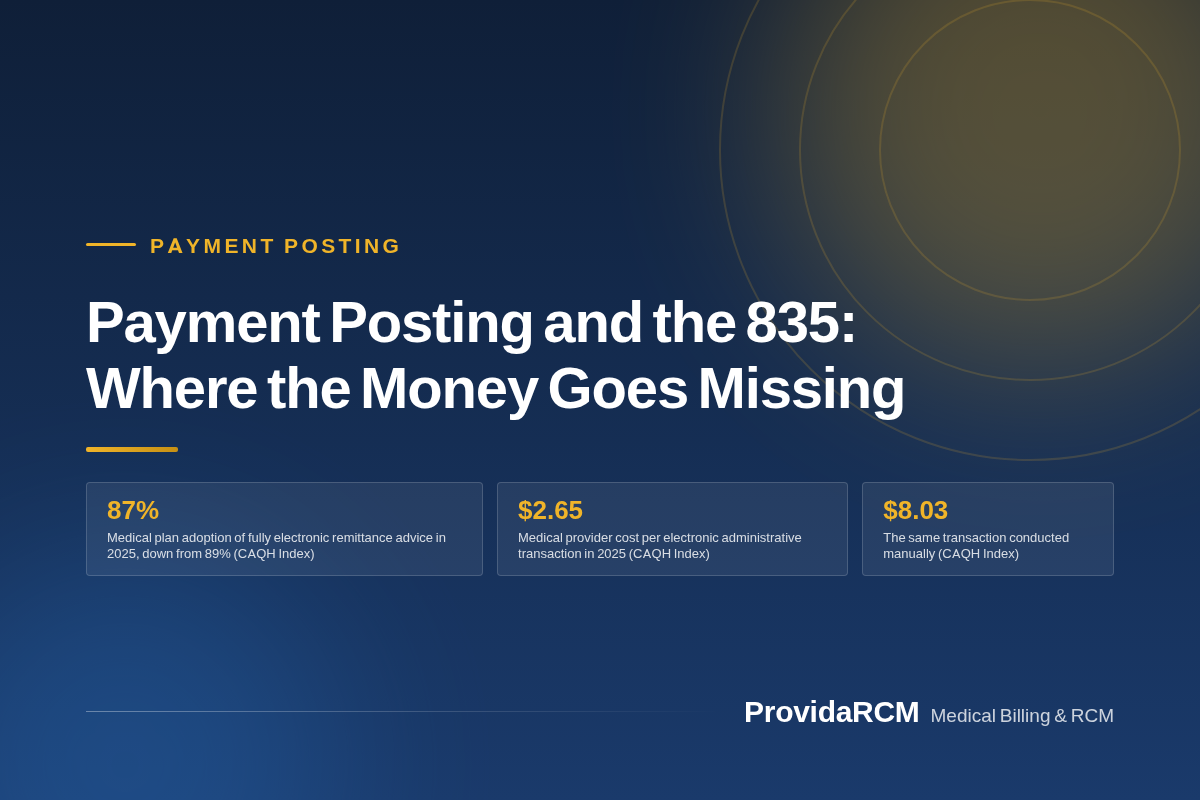
You cannot post an 835 that was never sent. The 2025 CAQH Index put medical plan adoption of fully electronic remittance advice at 88% in 2023, 89% in 2024 and 87% in 2025. Remittance advice and attachments were the two transactions that slipped that year, and CAQH attributes the pause to organizations prioritizing system stability over new automation while they recovered from the Change Healthcare cyberattack.
Fully electronic remittance advice, medical plans
Source: 2025 CAQH Index, medical plan adoption of fully electronic administrative transactions.
The remaining share is not a rounding error in a practice’s week. Those remittances arrive as paper, as a portal PDF, or as nothing until someone calls the payer. Posting then happens in a batch, weeks after the money landed, and the cash that never gets matched is the problem described under unapplied payments.
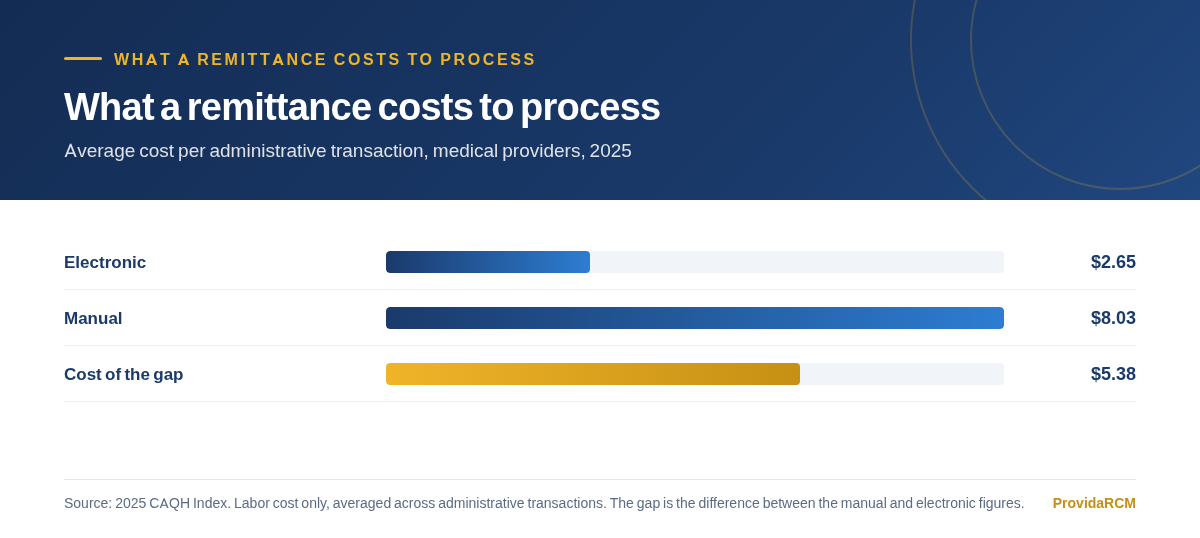
The cost difference explains why the gap persists at the margins. CAQH puts a medical provider’s average cost per administrative transaction at $3.45 electronic against $7.19 manual in 2023, and $2.65 against $8.03 in 2025. Electronic cost fell by close to a quarter in two years while manual cost rose 12%.
Average cost per administrative transaction, medical providers
Source: 2025 CAQH Index. Labor cost per transaction, averaged across administrative transactions. System costs are excluded.
- Confirm the 835 enrollment is on file with each payer, separately from EFT enrollment
- Send a test remittance after any clearinghouse or practice management system change
- Count remittances against deposits every business day, not every month
- Chase a missing remittance within 72 hours instead of at month end
A posting routine that closes the gap by Friday
- 01
Morning: count, then download
Pull every 835 available and count them against yesterday’s deposits. A payer that owes a remittance and sent none goes on today’s list, not next week’s.
- 02
Reconcile the header to the bank
Match the 835 total to the EFT amount for each payment. A difference of more than a penny means a PLB line or a missing remittance, and both need a name before posting starts.
- 03
Post at the line, not the claim
CO to the write-off, PR to the patient balance, OA held for review. A claim-level summary hides the split that decides who owes the money.
- 04
Clear the PLB before the claims
Recoupments and interest go to provider-level accounts with the supporting letter attached. This one habit removes most of the unexplainable credits from a ledger.
- 05
Work the exception queue by age
Anything unapplied over $50 or older than five days gets worked daily. Age is the only reliable signal that a payment will not resolve itself.
- 06
Sample twenty-five lines a week
Compare paid amounts to the fee schedule on a random sample. Underpayments are found by sampling, because no report flags a line that paid.
None of that requires new software. It requires the remittance to be treated as the source document rather than the receipt, and the reconciliation to happen before posting instead of after the month closes. Practices that run it stop discovering lost money at year end, when the write-offs are already booked and the appeal windows have closed.
We post payments, reconcile remittances and work the underpayment log inside full-cycle medical billing, alongside A/R management and denial management. If payments land but the ledger never quite agrees with the bank, a revenue cycle health check will show where the split breaks.
Questions practices ask us about this
What is an 835 remittance advice?
The 835 is the electronic remittance advice a health plan sends to explain a payment. It carries the total payment, then for each claim the submitted charge, the amount paid, the patient responsibility and every adjustment with a group code, reason code and amount. Medicare and commercial payers both use it, and CMS requires each 835 to balance at the line, claim and provider level.
Why does my payment posting not match the bank deposit?
Usually because of provider-level adjustments. The 835 total is the sum of claim payments less any recoupments, interest or penalties recorded in the PLB segment. If staff post only the claim lines, the ledger runs higher than the deposit by exactly the PLB amount. Reconcile the 835 header to the EFT before posting and the difference appears immediately.
Can a CO adjustment be billed to the patient?
No. CMS describes CO as a contractual or regulatory adjustment that is generally a write-off for the provider and is not billed to the patient. Billing it turns a known contract term into a patient complaint, and on an assigned Medicare claim it raises a compliance issue. Only amounts coded PR, typically deductible and coinsurance, belong on a patient statement.
What is a PLB adjustment on an 835?
A provider-level adjustment, reported below the claims rather than inside them. X12 reason codes describe each one, including overpayment recovery and interest. Positive amounts reduce the payment and negative amounts increase it. Because a PLB belongs to no single claim, it has to be posted to a provider-level account, or the money ends up smeared across claims that were paid correctly.
How do I know whether a payer underpaid a claim?
Compute the allowed amount as the billed charge minus the contractual adjustments on the line, then compare it with the contracted rate for that code in the payer’s fee schedule exhibit. The 835 never states the rate it applied, so the comparison is the only control. Sample paid lines weekly, because an underpaid claim has no denial code on it.
How quickly should payments be posted?
Within 24 to 48 hours of the remittance arriving, which is also fast enough to catch a payer that stopped sending 835s before the month closes. The stronger control is the daily count of remittances against deposits. A payment posted in week three has usually lost most of the time available to work any denied line inside it.
Want to know where your posting loses money?
We reconcile 835s to deposits, post at the line, and work the underpayment log for practices across the country. A short review of ninety days of remittances usually names the leak.
Book a free billing review- CMS, Medicare Claims Processing Manual, Chapter 22, Remittance Advice. cms.gov/regulations-and-guidance/guidance/manuals/downloads/clm104c22pdf.pdf
- X12, Claim Adjustment Reason Codes (current list, reviewed November 2026). x12.org/codes/claim-adjustment-reason-codes
- X12, Provider Adjustment Reason Codes used in the 835 PLB segment. x12.org/codes/provider-adjustment-reason-codes
- 2025 CAQH Index Report, executive report (remittance advice adoption and cost per transaction). index.caqh.org/hubfs/Index/CAQH_IndexReport_2025_Executive%20Report_v6.pdf
- 42 CFR 405.922, time frame for processing initial determinations and interest on late claims. ecfr.gov/current/title-42/chapter-IV/subchapter-B/part-405/subpart-I/section-405.922