Medicare Advantage denials do not behave like fee-for-service denials. The plan makes its own coverage determination, applies its own criteria where Medicare criteria are not fully established, and runs a separate appeal ladder with its own clocks. Level one is the plan, not a Medicare contractor. The filing window, the reviewer and the remedy are all different.
Why Medicare Advantage denials start with a different decision
In traditional Medicare the first coverage decision is made by a Medicare contractor working from national and local coverage determinations and the fee schedule. A Medicare Advantage plan is the first decision-maker instead. The plan issues an organization determination on whether a service is covered, how much of it is covered, and what the enrollee owes (42 CFR 422.566). That is why the same service can be paid in original Medicare and denied by the plan.
The plan does not get to invent coverage. It must apply national coverage determinations, local coverage determinations, and the general coverage and benefit conditions in traditional Medicare law. Where Medicare coverage criteria are not fully established, the plan may create its own internal coverage criteria, based on widely used treatment guidelines or clinical literature, and publish them. CMS made that allowance explicit in the contract year 2024 final rule and required every plan to review its utilization management policies each year.
That allowance is where most Medicare Advantage medical necessity denials come from. The plan or its review vendor decides a service fails a criterion that appears in no Medicare coverage determination. The criterion belongs to the plan. An appeal that argues from the Medicare rule and never answers the criterion the plan cited is answering a different question.
| Question | Traditional Medicare | Medicare Advantage | Where it comes from |
|---|---|---|---|
| Who decides first | A Medicare contractor applies the fee schedule and Medicare coverage rules | The plan makes its own organization determination on coverage, payment and the amount owed | 42 CFR 422.566(b) |
| What criteria apply | National and local coverage determinations and Medicare benefit conditions | The same Medicare criteria, plus the plan’s internal coverage criteria where Medicare criteria are not fully established | 42 CFR 422.101(b) |
| Whether the plan’s criteria are public | Not applicable | The internal criteria must be publicly accessible, with the evidence and the rationale behind them | 42 CFR 422.101(b)(6)(ii) |
| Prior authorization | Not used the same way for most Part B services | A coordinated care plan may require it, to confirm criteria or establish necessity | 42 CFR 422.138(b) |
| Who reviews an adverse necessity decision | A Medicare contractor reviewer | A physician or health care professional with expertise in the field and knowledge of Medicare coverage criteria | 42 CFR 422.566(d) |
Do not present the plan’s criterion as a Medicare coverage rule. It is the plan’s policy, and a plan may not deny a basic benefit on criteria outside the regulation. Do not paste licensed criteria text into the appeal either. Quote the criterion the plan cited in its own notice and show how the record meets it.
Prior authorization has no fee-for-service twin
Traditional Medicare does not route most Part B services through a plan authorization. A Medicare Advantage coordinated care plan may require prior authorization, and when it does, the regulation limits what it can do. It may only be used to confirm the presence of diagnoses or other medical criteria, or to establish that the item or service is medically necessary. An approval has to stay valid for the course of treatment, and a new enrollee gets a 90-day transition period for an active course of treatment.
The response clocks are tighter than fee-for-service and they start when the request arrives. A standard organization determination is due in 14 calendar days, or 7 calendar days beginning January 1, 2026 for a service subject to the prior authorization rules at 42 CFR 422.122. An expedited determination is due in 72 hours. Missing the window is not a delay the practice has to wait out: the failure is itself an adverse organization determination and can be appealed.
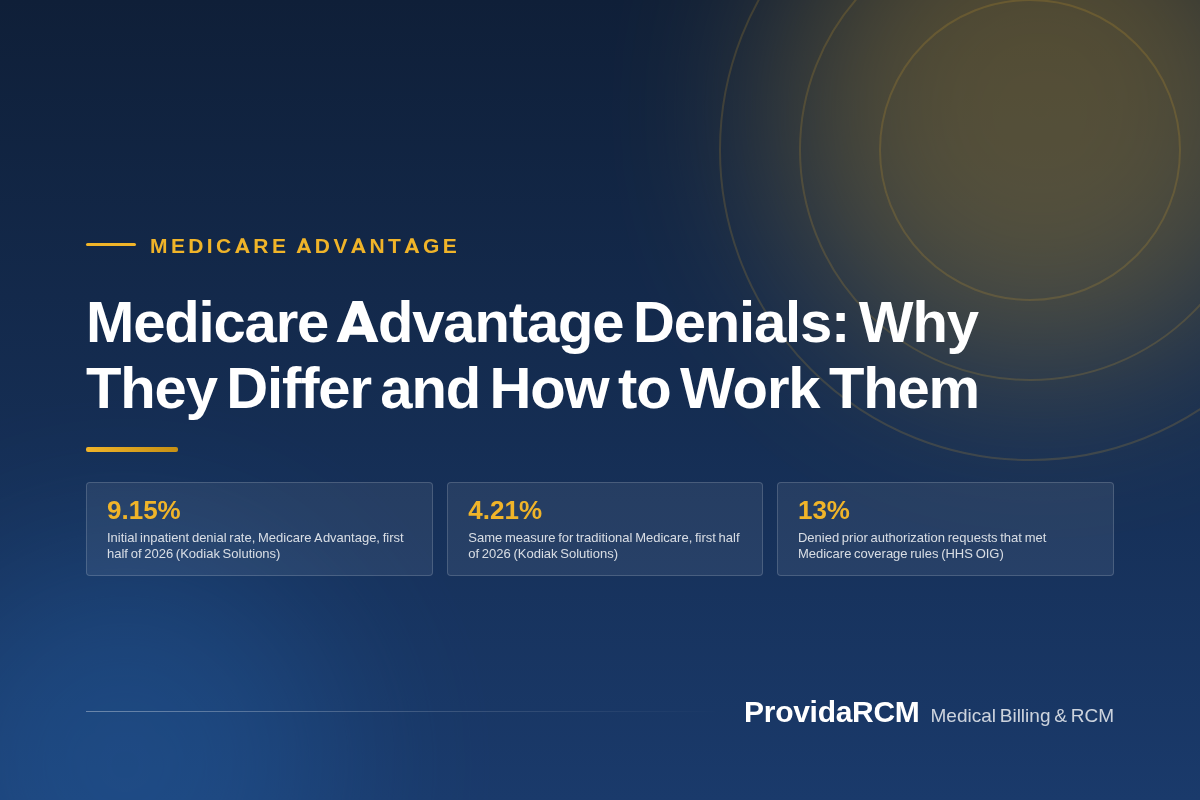
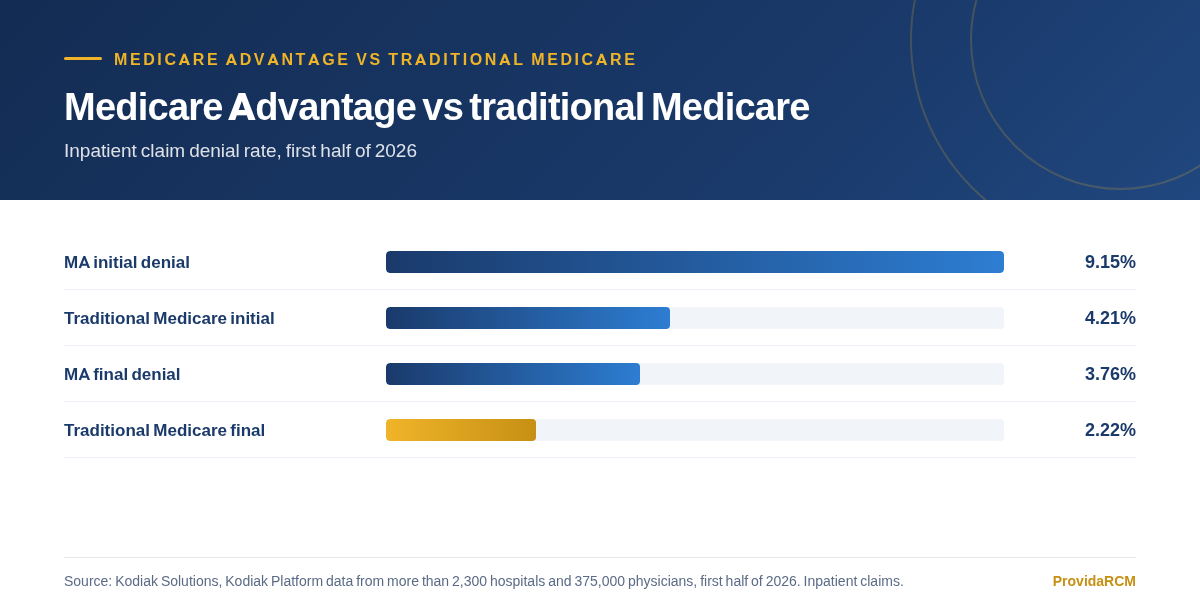
Initial inpatient denial rate, first half of 2026
Source: Kodiak Solutions, Kodiak Platform data from more than 2,300 hospitals and 375,000 physicians, first half of 2026. Initial denial rate on inpatient claims.
Denials happen anyway, and a share of them should not. HHS OIG reviewed 12,273 prior authorization denials issued by 15 plans during the first week of June 2019 and found that 13% met Medicare coverage rules, meaning those services likely would have been approved in original Medicare. OIG traced many of them to plans applying clinical criteria that sit outside the Medicare coverage rules (HHS OIG, OEI-09-18-00260).
When a denial is an organization determination
A denial is appealable when it is an organization determination. The regulation lists the actions that count, and the list is wider than most practices assume: pre-service and post-service decisions, the reduction or early end of a treatment the plan already authorized, and the plan’s own failure to decide on time.
- A refusal to cover or pay for a service, in whole or in part, before or after it is furnished
- A reduction or premature discontinuation of a course of treatment the plan already authorized
- A payment decision on emergency, urgently needed or out-of-area renal dialysis services
- A limit the plan sets on the quantity of an item or service
- A failure to decide, or to send notice of an adverse decision, within the required window
There is one limit worth knowing before an appeal gets worked. If a contract provider’s request for payment has been adjudicated and the enrollee has no remaining liability for the service, that payment determination is not subject to the subpart M appeal process under 42 CFR 422.562(c)(2). The remedy there is the plan’s payment review and the contract terms, not the enrollee appeal ladder.
The denial notice has to state the specific reasons for the decision and describe the appeal rights and timeframes under 42 CFR 422.568(e). Treat that paragraph as the appeal outline. Every stated reason left unanswered is a reason the plan keeps.
The Medicare Advantage appeal ladder and its clocks
Level one is the plan’s own reconsideration, and this is the step people get wrong. In fee-for-service the first appeal goes to a Medicare contractor. In Medicare Advantage it goes back to the plan. A party files within 60 calendar days after receipt of the denial notice, and receipt is presumed 5 calendar days after the date on the notice unless there is evidence to the contrary under 42 CFR 422.582.
| Level | Who decides | Clock to file | Clock to decide | Authority |
|---|---|---|---|---|
| Reconsideration by the plan | Plan staff, plus a physician for a medical necessity decision | 60 calendar days from receipt of the denial notice | 30 days for a service, 60 days for a payment, 7 days for a Part B drug | 42 CFR 422.582, 422.590 |
| Expedited plan reconsideration | The same reviewers on a shortened clock | 60 calendar days from receipt of the denial notice | 72 hours | 42 CFR 422.584, 422.590(e) |
| Independent review entity | The CMS-contracted reviewer, C2C Innovative Solutions from May 1, 2026 | Automatic. The plan forwards the file when it affirms | 30 calendar days standard pre-service, 72 hours expedited, 60 days payment, 7 days for a Part B drug | 42 CFR 422.592; CMS managed care appeals |
| Administrative law judge | The Office of Medicare Hearings and Appeals | 60 calendar days from receipt of the reconsidered determination | Set on the hearing schedule | 42 CFR 422.600, 422.602 |
| Medicare Appeals Council | The Departmental Appeals Board | Part 405 Council rules apply | Part 405 Council rules apply | 42 CFR 422.608 |
| Federal district court | A United States district court | After the Council, when the amount in controversy is met | Court schedule | 42 CFR 422.612 |
The second level is automatic, which surprises practices used to filing it. When the plan affirms its denial in whole or in part, it must send a written explanation and the case file to the CMS-contracted independent review entity within 30 calendar days for a service reconsideration, or 60 for a payment. The practice does not request that review. It is already in motion.
From May 1, 2026 the entity is C2C Innovative Solutions, and MAXIMUS handled cases received through April 30, 2026. The decision clocks come from the CMS contract rather than the regulation text: 72 hours expedited, 30 calendar days standard pre-service, 60 calendar days for payment and 7 calendar days for a Part B drug (CMS managed care appeals). The practice can still add evidence while the case is open.
Initial inpatient denial rate, first half of 2026 vs 2025
Source: Kodiak Solutions, Kodiak Platform data, first half of 2026 compared with the first half of 2025. Initial denial rate on inpatient claims.
Above the independent entity the ladder looks more like fee-for-service, with one gate in front of it. An administrative law judge hears the case only if the amount in controversy meets the threshold the Secretary sets each year, and the request is filed within 60 calendar days of receipt of the reconsidered determination. The Medicare Appeals Council reviews that decision under the part 405 rules, and judicial review sits in a federal district court once the amount in controversy is met (42 CFR 422.600, 422.602, 422.608 and 422.612).
What wins a Medicare Advantage medical necessity appeal
The appeal that works answers the criterion the plan cited, not the Medicare coverage rule the practice wishes the plan had applied. If the stated reason is that the record does not show a failed conservative treatment or a required prior study, the appeal has to put that evidence in front of the reviewer and quote the line of the note that establishes it.
- 01
Pull the reason and the criterion
Read the denial notice for the stated reason, then ask the plan for the internal coverage criterion it applied. The plan publishes its internal criteria, with the evidence behind them, under 42 CFR 422.101(b)(6).
- 02
Map the record to each element
The criterion has elements. Give the reviewer the note, the prior studies and the failed treatments that satisfy each one, and quote the line rather than summarizing.
- 03
Run the peer-to-peer in parallel
A physician can support an expedited request, and the plan may not take punitive action against a physician for helping an enrollee ask. The conversation is clinical and is not itself a level of appeal.
- 04
File the right track, on time
A service denial runs on the plan’s 30-day track, a payment denial on the 60-day track. Both filing windows are 60 calendar days from receipt of the notice.
Peer-to-peer review is the most underused step on the list. It is not a formal level of appeal and it does not pause the filing clock. A plan medical director who has the note and the criterion can reverse a denial before the paperwork starts. Run it beside the reconsideration, never instead of it.
| The mistake | What it looks like | The fix |
|---|---|---|
| Arguing Medicare rules at a plan criterion | The letter cites a national coverage determination while the denial cited the plan’s own criterion | Quote the criterion in the denial notice and answer it element by element |
| Missing the plan-level window | The reconsideration lands after the 60 calendar days from receipt of the notice | Calendar the filing date the day the denial posts, with a 14-day internal buffer |
| Running a payment denial on the service track | A payment reconsideration is worked to the 30-day service clock | Payment requests run on the plan’s 60-day track and must be in writing unless the plan accepts verbal requests |
| Pasting licensed criteria text | The letter copies pages from a vendor guideline the plan licenses | Describe how the record meets the criterion the plan cited, in your own words |
Run Medicare Advantage denials as a separate queue
Medicare Advantage denials do not belong in the same pile as commercial and Medicare fee-for-service denials. The filing window, the reviewer and the level structure are all different, and a team working one calendar for all three will lose cases it could have won. Splitting the queue takes an afternoon.
- Separate Medicare Advantage denials from fee-for-service and commercial denials the day the remittance posts
- Calendar the 60-calendar-day reconsideration date with a 14-day internal buffer
- Mark each case as a service denial or a payment denial, because the plan-level track differs
- Flag whether the plan affirmed, so the automatic independent review step is never assumed to be your filing
- Track the overturn rate by plan, not as one blended number across every payer
The work connects back to the front end. Authorization gaps that turn into denials are caught by a real authorization tracker, and a medical necessity denial is answered with the same criteria-first method on any payer (prior authorization tracking, medical necessity denial appeals). The code on the remittance still tells you which pile a claim belongs in (claim denial codes explained). We run this as denial management with prior authorization services behind it.
Track the time from denial notice to reconsideration filed, by plan. A Medicare Advantage denial touched inside two weeks is still recoverable. The same denial found in week six is usually a write-off.
Questions practices ask us about this
Why does Medicare Advantage deny a service that traditional Medicare pays?
The plan, not a Medicare contractor, makes the first coverage determination, and where Medicare coverage criteria are not fully established it may apply and publish its own internal coverage criteria. A service that meets a national or local coverage determination can still fail the plan’s criterion. HHS OIG found that 13% of the prior authorization denials it reviewed met Medicare coverage rules.
How long do we have to appeal a Medicare Advantage denial?
A reconsideration request must be filed with the plan within 60 calendar days after receipt of the written organization determination notice, and receipt is presumed 5 calendar days after the date on the notice unless there is evidence to the contrary. That window covers service and payment requests. A request for an administrative law judge hearing runs 60 calendar days from receipt of the reconsidered determination.
Is level one of the Medicare Advantage appeal the plan or a contractor?
It is the plan. The first level is a reconsideration the plan performs itself, and the people who decide it cannot be the people who made the original determination. A medical necessity reconsideration must be made by a physician with expertise in the field. The independent review entity, not the plan, is the second level of appeal.
Do we have to request the independent review entity review ourselves?
No. When the plan affirms its denial in whole or in part, it must send a written explanation and the case file to the CMS-contracted independent review entity on its own, within 30 calendar days for a service reconsideration or 60 for a payment. The practice does not file that request, but it can still submit evidence while the case is open.
What counts as an organization determination?
Any decision the plan makes about whether a service is covered, how much of it is covered, and what the enrollee owes. The regulation lists the actions that count, including a refusal to provide or pay for a service, a reduction or early end of an authorized course of treatment, a quantity limit, and a failure to decide on time.
Can we appeal a Medicare Advantage payment denial?
Sometimes. If a contract provider’s request for payment has been adjudicated and the enrollee has no remaining liability for the service, that payment determination is not subject to the subpart M appeal process. Where the enrollee does carry liability, the payment reconsideration runs on the plan’s 60-calendar-day track, and the request must be in writing unless the plan accepts verbal requests.
Want this fixed in your practice?
We run full-cycle billing, coding, credentialing and denial work for practices across the country. Send us a few months of claims and we will show you where the money is going.
Book a free billing review- eCFR, 42 CFR part 422 subpart M, Grievances, Organization Determinations and Appeals. ecfr.gov/current/title-42/chapter-IV/subchapter-B/part-422/subpart-M
- eCFR, 42 CFR 422.101, Requirements relating to basic benefits. ecfr.gov/current/title-42/chapter-IV/subchapter-B/part-422/subpart-C/section-422.101
- CMS, Medicare Managed Care Appeals and Grievances. cms.gov/medicare/appeals-grievances/managed-care
- CMS, Organization Determinations. cms.gov/medicare/appeals-grievances/managed-care/organization-determinations
- CMS, 2024 Medicare Advantage and Part D Final Rule (CMS-4201-F) fact sheet. cms.gov/newsroom/fact-sheets/2024-medicare-advantage-and-part-d-final-rule-cms-4201-f
- HHS Office of Inspector General, OEI-09-18-00260, Medicare Advantage prior authorization denials, April 2022. oig.hhs.gov/oei/reports/OEI-09-18-00260.asp
- Kodiak Solutions, healthcare revenue cycle benchmarking reports. kodiaksolutions.io/internal/benchmarking_reports