A denial management workflow that survives volume needs one thing above all: a named owner for every denial and a first action within two business days. Denials sorted by code and left in a spreadsheet pile up. Denials sorted by the team that owns the fix move. Volume does not break a workflow. Ambiguity about who owns the next step does.
What a denial management workflow has to do
A denial is not a rejection. A rejection means the claim never reached adjudication, because a clearinghouse or payer front-end edit stopped it. A denial means the payer processed the claim and paid less than the billed amount, which is what puts a claim adjustment reason code on the 835 remittance. Mixing the two sends work to the wrong desk on day one.
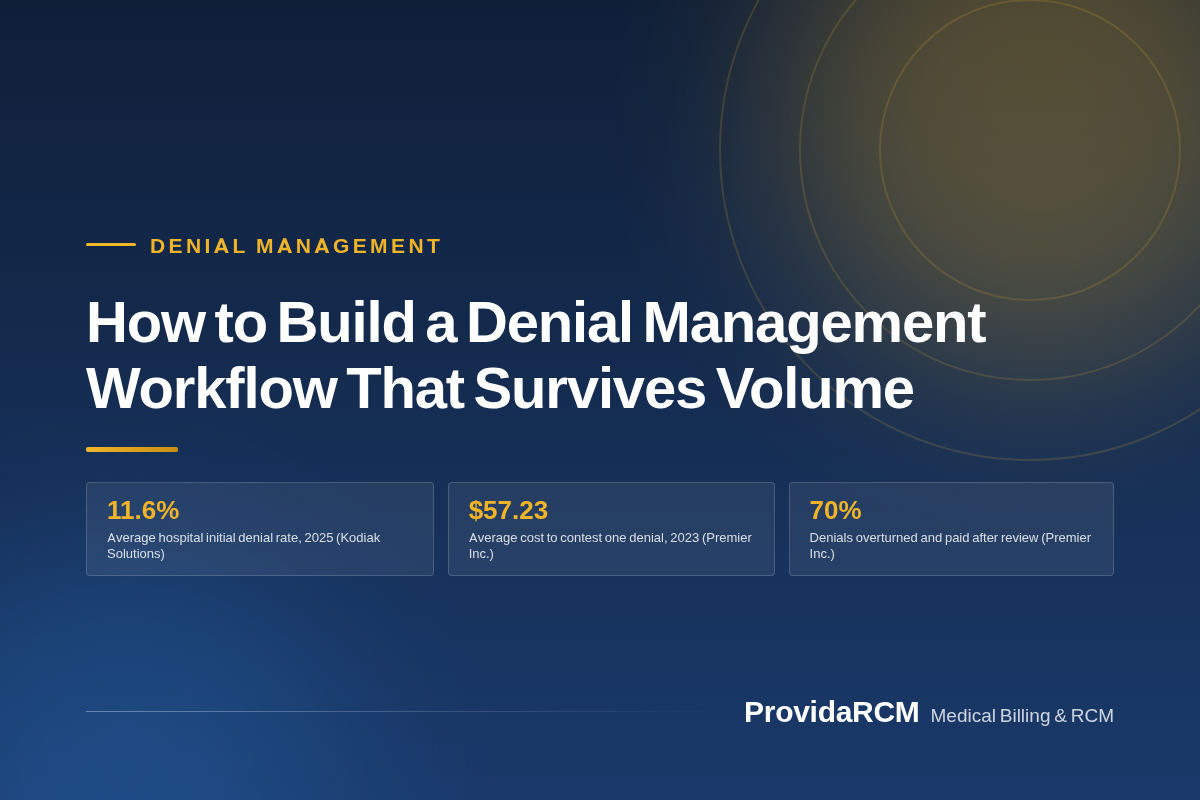
Volume is the part practices underestimate. Kodiak Solutions, which tracks revenue cycle data from more than 2,300 hospitals, reported that final denials and uncollected patient balances cost its sample more than $48 billion in 2025, up from $38.6 billion in 2024 (Healthcare Finance News reported the increase). The median final denial rate moved from 2.5% to 2.7%.
A workflow that survives that volume does one thing differently from one that drowns. It assigns every denial to the team that can fix it before anyone argues about whether it is worth fighting. Sorting by code alone is not enough, because the same code can mean two different owners on two different payers.
| Denial group | Typical CARC codes | Who owns the fix | First action |
|---|---|---|---|
| Front end | 16, 22, 27, 109 | Registration and eligibility staff | Correct the data and resubmit the same week |
| Coding | 11, 97, 151 | Certified coders | Review the code and modifier against the note |
| Clinical documentation | 50, 167, 252 | Provider and the CDI team | Pull the payer policy and match the record to it |
| Operations | 29, 285, 286 | Billing operations manager | Log the miss and fix the deadline process |
That table is the whole design. The code tells you which column a denial belongs in, not how much money it is worth. Value sets the order inside the column. The owner is who is accountable when nothing moves.
Denial volume is climbing on the payer side too
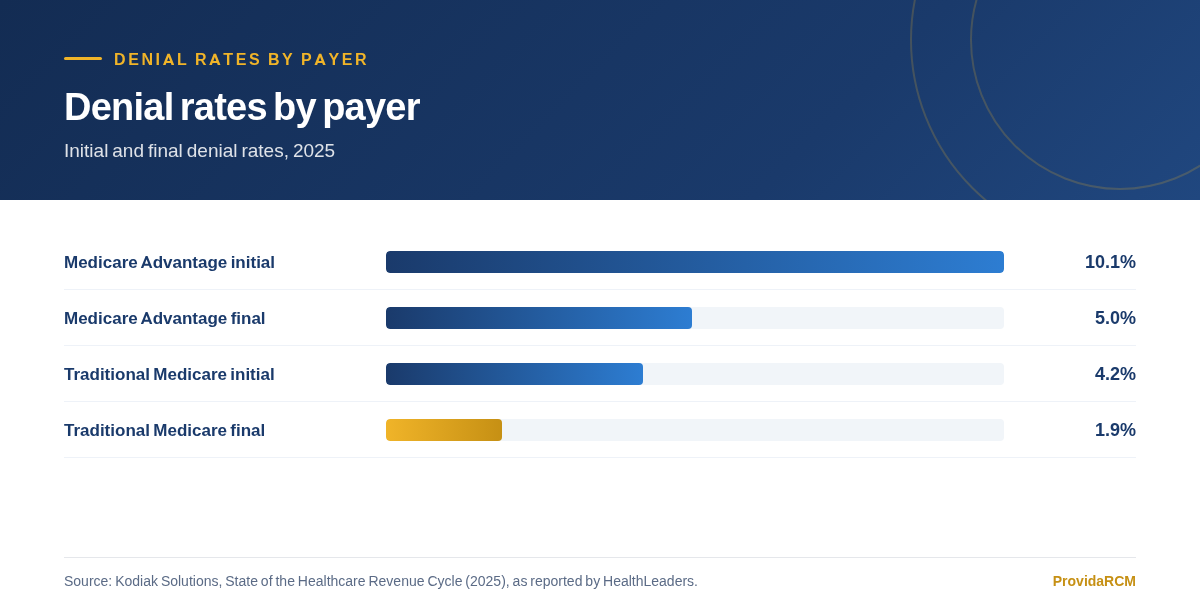
Payer behavior is the bigger driver now. Kodiak’s 2025 analysis found Medicare Advantage plans denied initial claims at more than double the rate of traditional Medicare, and the gap held on final denials. That matters to a practice because Medicare Advantage enrollment keeps growing and those claims carry the highest denial exposure in the book.
The national denial rate did not spike in one year. It ground upward for most of a decade. The Change Healthcare (now Optum) Revenue Cycle Denials Index put the hospital rate near 9% in 2016 and 12% by 2023, and the 2023 index found that nearly half of all denials trace to front-end revenue cycle issues rather than clinical review.
National hospital claim denial rate
Source: Optum (Change Healthcare) 2024 Revenue Cycle Denials Index, 2016 to 2023.
Sort denial work by owner, then by value
The work queue is where a denial report becomes a task list. Sort the report three times: by owner first, by dollar value second, by payer third. The first sort decides who works it today. The second decides what gets touched first. The third shows which payer relationship is costing the most.
A queue that lives in a spreadsheet and gets reviewed once a month is not a queue. It is a report. The difference shows up in the age of the work, which is the number a billing manager should see every morning before anything else.
- Post every 835 within 24 hours of receipt, so the appeal clock starts on the real date
- Sort denials into the four owner buckets before sorting by anything else
- Flag any denial older than two business days with no action recorded
- Give each denial over $1,000 a named person, not a team
Turnaround is the target most practices never set. A denial that gets a first touch within two business days is recoverable. The same denial touched in week three has usually lost both the filing window and part of the appeal window, and it becomes a write-off that nobody reports as a decision.
Set turnaround targets you can actually hit
Targets only work if they are tied to the calendar the payer runs on. Medicare gives a provider 120 days from receipt of the remittance to file a first-level redetermination, and presumes the remittance arrived five days after its notice date. Commercial windows run longer and vary by contract, so each payer needs its own deadline on the board.
| Denial type | First touch, from remit | Resolution target | Escalates to |
|---|---|---|---|
| Registration and eligibility | Within 2 business days | 7 days | Front-desk lead |
| Coding and bundling | Within 3 business days | 10 days | Coding manager |
| Medical necessity | Within 3 business days | Appeal filed within 30 days | Provider for a peer-to-peer |
| Prior authorization | Within 2 business days | Retro request within 10 days | Prior-auth team |
| Timely filing | Same day | Written off or escalated | Billing operations |
The internal target should always sit inside the payer deadline, not on it. A buffer of 14 days absorbs a note that has not been signed, a provider who is out of the office, and a records request that takes two weeks to answer.
Once the timely filing window closes, no appeal reopens it. CO-29 is the one denial in the set with no corrective action on the claim itself. Everything you can fix about it sits upstream, in how the claim was filed the first time.
Who appeals what, and by when
Not every denial earns an appeal, and the Medicare levels are the cleanest example of a process with a fixed calendar. The CMS redetermination page sets the first-level window and the form. The same structure scales down to a five-person practice: one owner, one deadline, one document per level.
| Appeal level | You must file within | Reviewed by | Form |
|---|---|---|---|
| Level 1, redetermination | 120 days of the remittance | The MAC | CMS-20027 |
| Level 2, reconsideration | 180 days of the redetermination notice | A QIC | CMS-20033 |
| Level 3, OMHA | 60 days of the reconsideration decision | An ALJ or attorney adjudicator | OMHA-100 |
| Level 4, Appeals Council | 60 days of the OMHA decision | The Medicare Appeals Council | DAB-101 |
Two rules keep appeals honest. The deadline gets pulled the day the denial posts, not the day someone decides to appeal. And an appeal answers the payer’s stated reason, not the practice’s frustration.
- 01
Open the file the day the denial posts
Pull the filing and appeal deadlines and put both on a calendar with a 14-day internal buffer. The date belongs on the ticket, not buried in an email thread.
- 02
Match the appeal to the denial reason
A medical necessity denial quotes the payer’s own criteria. An authorization denial carries the retro request and the note. A bundling denial states the modifier rationale and the edit it clears.
- 03
Log the outcome against the code
Record what you sent and what the payer did. After a quarter, the overturn rate by code shows which appeals are worth building and which are ceremony.
Telling a fixable denial from a write-off
Premier Inc.’s national survey of 280 hospitals found that about 70% of denials were overturned and paid, but only after multiple rounds of review. The same survey put the average cost to contest one denial at $57.23 in 2023, up from $43.84 in 2022. When most appeals win and each one costs more than many small claims pay, triage is the whole job.
| On the remittance | Recoverable? | Why | What to do |
|---|---|---|---|
| CO-16 with a remark code | Yes | A required field or data element is missing | Correct and resubmit |
| CO-45 contractual adjustment | No | The write-off is required by the contract | Post it and move on |
| CO-97 bundling | Sometimes | A modifier can unbundle a distinct service | Check the edit, then decide |
| CO-50 medical necessity | Sometimes | Needs documentation that meets the payer policy | Appeal with the policy criteria |
| CO-29 timely filing | Rarely | The filing window has already closed | Write off and fix the process |
CARC 15, the old code for a missing or invalid authorization number, stopped on 1 May 2018. The X12 code list still shows the row with both a start and a stop date. A denial dashboard that reports CO-15 volume today is mapping to a code that has not existed for eight years. The live codes for that problem are CO-197 and CO-284.
One denial class is growing faster than the rest. Premier found that 10.4% of the denials it studied in 2023 had already been pre-approved through prior authorization, up from 3.2% in 2022. A denial on a pre-authorized claim is rarely about medical necessity. It is usually a data or documentation mismatch, which makes it fixable.
Denied claims that had been pre-approved
Source: Premier Inc., national survey of 280 hospitals, claims from 2023.
The practices that hold up under volume do this work through a denial management service that sits on top of full-cycle medical billing and AR management. The team that works the denials is the same team that scrubs the claims, so a fix lands in the front end instead of a folder. When prior authorization is the leak, a prior authorization review of the last 90 days usually shows the pattern inside a week.
Questions practices ask us about this
What is a denial management workflow?
It is the set of steps a practice follows from the moment a denial posts to the moment the claim is paid, resubmitted, or written off. A working one assigns each denial to a named owner, sets a first-action deadline inside two business days, tracks the payer filing and appeal windows, and reports outcomes by code and payer. HFMA’s Claim Integrity Task Force defines the standard metrics for it, including denial write-offs as a share of net patient service revenue.
How quickly should a denied claim get its first action?
Within two business days of the remittance posting. Denials touched in that window are still inside every filing and appeal deadline, so the work is a correction or an appeal rather than a loss. Denials that sit for three weeks usually have a closed filing window, which turns a recoverable claim into a write-off. First-action speed matters more than the appeal win rate.
Which denied claims should not be appealed?
Contractual adjustments and closed filing windows. A CO-45 line is the difference between the charge and the contracted rate, so it is a required write-off, not a denial to fight. A CO-29 timely filing denial has no appeal remedy on the claim itself. Premier’s data puts the average cost to contest one denial at $57.23 in 2023, so a small claim with a weak position can cost more to appeal than it pays.
How long does a practice have to appeal a Medicare denial?
For Original Medicare, a first-level redetermination must be filed within 120 days of receiving the initial determination, and CMS presumes the remittance was received five days after its notice date. If the redetermination is upheld, a reconsideration by a Qualified Independent Contractor must be requested within 180 days of the redetermination notice. Commercial windows differ by contract, so each payer’s deadline belongs on the board.
What is the difference between a CARC and a RARC?
A claim adjustment reason code explains why the payer adjusted or denied the line, and a remittance advice remark code adds the detail the CARC leaves out. CARC 16 says the claim lacks information; the RARC that accompanies it names the missing field or record. The pair is the actionable unit, because the CARC alone rarely tells a biller what to fix. X12 maintains both and publishes them in one list.
How do you tell a fixable denial from a write-off?
Read the code against the stated reason. CO-16 and CO-22 are data problems that correct and resubmit. CO-11 and CO-97 are coding reviews that sometimes clear with the right modifier. CO-50 and CO-197 need documentation or a retro-authorization, so they are fixable with effort. CO-45 and CO-29 are not fixable on the claim. Sort by that split before deciding how much money to spend.
Want this fixed in your practice?
We run full-cycle billing, coding, credentialing and denial work for practices across the country. Send us a few months of claims and we will show you where the money is going.
Book a free billing review- X12, Claim Adjustment Reason Codes (current list). x12.org/codes/claim-adjustment-reason-codes
- CMS, First Level of Appeal: Redetermination by a Medicare Contractor. cms.gov/medicare/appeals-grievances/fee-for-service/first-level-appeal-redetermination-medicare-contractor
- CMS, Medicare Claims Processing Manual, Chapter 1, section 70 (time limits for filing). cms.gov/regulations-and-guidance/guidance/manuals/downloads/clm104c01.pdf
- Premier Inc., Claims Adjudication Costs Providers $25.7 Billion (2023 survey data). premierinc.com/newsroom/policy/claims-adjudication-costs-providers-257-billion-18-billion-is-potentially-unnecessary-expense
- HFMA Claim Integrity Task Force, Standardizing denial metrics for the revenue cycle. hfma.org/guidance/standardizing-denial-metrics-revenue-cycle-benchmarking-process-improvement
- Kodiak Solutions, State of the Healthcare Revenue Cycle, reported by Healthcare Finance News (April 2026). healthcarefinancenews.com/news/hospitals-net-revenue-leakage-increases-25-due-denied-claims
- Kodiak Solutions 2025 denial rates by payer, reported by HealthLeaders. healthleadersmedia.com/revenue-cycle/cash-flow-improves-despite-484-billion-revenue-leakage-2025
- MGMA Stat, Days in A/R holds steady but payer pressure persists in 2026 (July 2026). mgma.com/mgma-stat/days-in-a/r-holds-steady-for-most-practices-but-payer-pressure-persists-in-2026
- Optum (Change Healthcare), 2024 Revenue Cycle Denials Index. marketplace.optum.com/content/dam/change-healthcare/marketplace-assets/outcomes-and-insights/2024-denials-index.pdf