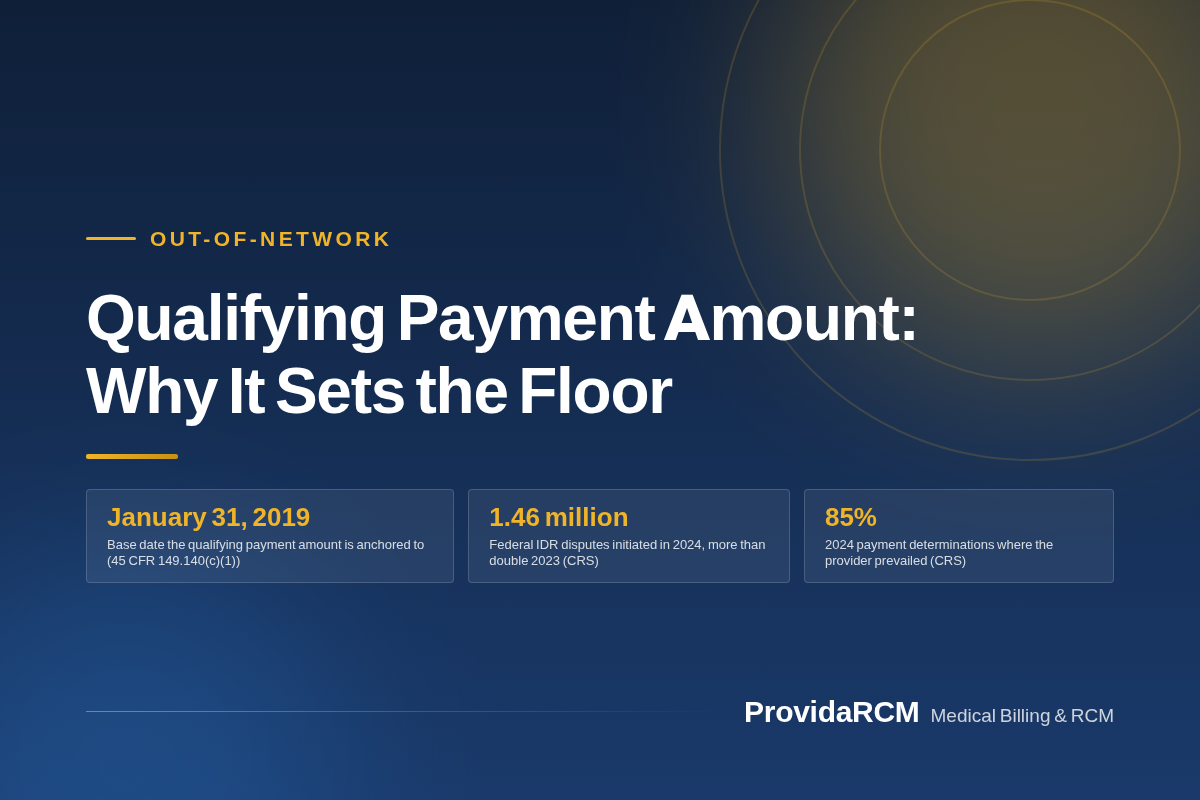
The qualifying payment amount is the median rate a plan had contracted with in-network providers on January 31, 2019, indexed forward for inflation. It caps what the patient owes, it anchors what an arbitrator weighs, and it is not the amount the plan is obligated to pay you. Three different jobs attached to one number.
The qualifying payment amount is a 2019 rate, indexed forward
The qualifying payment amount is the median of the rates a plan or issuer had already contracted with in-network providers for the same or a similar item or service, from a provider in the same or a similar specialty, in the geographic region where the service was furnished, measured on January 31, 2019. The base date is fixed in 45 CFR 149.140(c)(1)(i).
Everything above that base is an index. For an item or service furnished in 2023 or any later year, the regulation does not recompute the median from current contracts. It takes the prior year’s figure and raises it by a percentage the Treasury Department and the IRS publish using the Consumer Price Index for All Urban Consumers. The number compounds off itself, once a year, at consumer inflation.
That design choice explains most of the friction on out-of-network claims. If the median in-network rate for a level 4 emergency department visit in your market climbed far faster than consumer prices after 2019, the QPA did not climb with it. The plan is not improvising. It is running a formula whose base year is permanently 2019. Dispute the inputs and you have an argument. Dispute the concept and you are arguing with the statute.
| Component | What the rule requires | Citation |
|---|---|---|
| Base date | Contracted rates in effect on January 31, 2019 | 45 CFR 149.140(c)(1)(i) |
| Comparison group | The same or a similar item or service from the same or a similar specialty | 45 CFR 149.140(b)(1), (b)(3)(i) |
| Geography | A metropolitan statistical area, or the rest of the state | 45 CFR 149.140(a)(7)(i) |
| Market | All plans of the sponsor, or all coverage the issuer offers in that market | 45 CFR 149.140(b)(2)(i) |
| Annual escalator | For 2023 and later, the prior year amount plus the published CPI-U change | 45 CFR 149.140(c)(1)(ii) |
| Excluded | Risk sharing, bonus, penalty and other incentive or retrospective payments | 45 CFR 149.140(b)(2)(iv) |
How the regulation builds the median contracted rate
The median is built mechanically. Arrange the contracted rates from least to greatest and select the middle number. If the count is even, average the two middle numbers. Each negotiated amount is its own data point. A rate negotiated with a provider group counts once when the same amount applies to every provider in that group, while separate contracts with individual providers stay separate even when the dollars match.
The regulation then forces separations that plans and their vendors sometimes blur. Professional and technical components of a code get separate medians. Anesthesia runs off the anesthesia conversion factor rather than the procedure code. Air ambulance mileage runs off A0435 and A0436. Where contracted rates vary by specialty, the median is calculated separately for each specialty. Risk sharing, bonus and penalty payments come out first.
A sufficiency test sits underneath all of it. A plan may treat its 2019 information as sufficient only if it has at least three contracted rates, and for a year after 2022 those rates must also account for at least 25 percent of the claims paid for that item or service. When the test fails, the plan goes to an eligible database, and it must stay with that database through the last day of the calendar year.
Which rates may be counted, and what the 2023 changes did
The current wording of 45 CFR 149.140 is not the 2021 wording, and the difference matters when you argue a specific claim. The base formula came from the October 2021 interim final rules. The August 2022 final rules finalized the information a plan must share about how the number was produced. The June 2026 final rules added the plan’s legal business name and registration number to the disclosure that rides with the initial payment or denial.
What narrowed the qualifying payment amount in 2023 was litigation rather than rulemaking. On August 24, 2023, the federal district court in the Eastern District of Texas vacated parts of 45 CFR 149.140 and related IDR rules, including the requirement that a same or similar item or service be billed under the same service code or a comparable code. The December 2023 final rule moved the IDR fees into notice-and-comment rulemaking.
The 2023 fee rule did not rewrite the median formula in 149.140(b) or the indexing chain in 149.140(c). Those came from the 2021 and 2022 rules and were carried forward until the June 2026 final rules amended the section. Naming the year of the methodology you dispute is the difference between a letter the plan must answer and one it can file unread.
| Instrument | What it did | Dates |
|---|---|---|
| Requirements Related to Surprise Billing; Part II | Created the QPA methodology: median contracted rate on January 31, 2019, indexed by the CPI-U | Published October 7, 2021 (86 FR 55980) |
| Requirements Related to Surprise Billing | Finalized the QPA information plans must give providers | Issued August 19, 2022; published August 26, 2022 (87 FR 52618) |
| Eastern District of Texas order | Vacated parts of 45 CFR 149.140, including the same-service-code requirement for a same or similar item or service | Order issued August 24, 2023 |
| IDR fee ranges final rule | Moved the IDR fees into notice-and-comment rulemaking and set the amounts | Published December 21, 2023 (88 FR 88494) |
| Federal IDR Operations final rules | Added the plan’s legal business name and registration number to the disclosure, and required CARCs and RARCs on remittances | Published June 4, 2026 (91 FR 33900); effective August 3, 2026 |
Federal IDR disputes initiated
Source: CRS Report R48738, No Surprises Act Independent Dispute Resolution Process Data Analysis for 2024.
The QPA is a payment floor and an IDR benchmark. Those are different jobs.
As a payment floor, the qualifying payment amount does one specific thing. For out-of-network emergency services, for non-emergency services from a nonparticipating provider at a participating facility, and for air ambulance services, the patient’s cost sharing is based on the lesser of the billed charges or the QPA. That keeps the patient out of the middle. It sets the recognized amount. It does not set what the plan owes the practice.
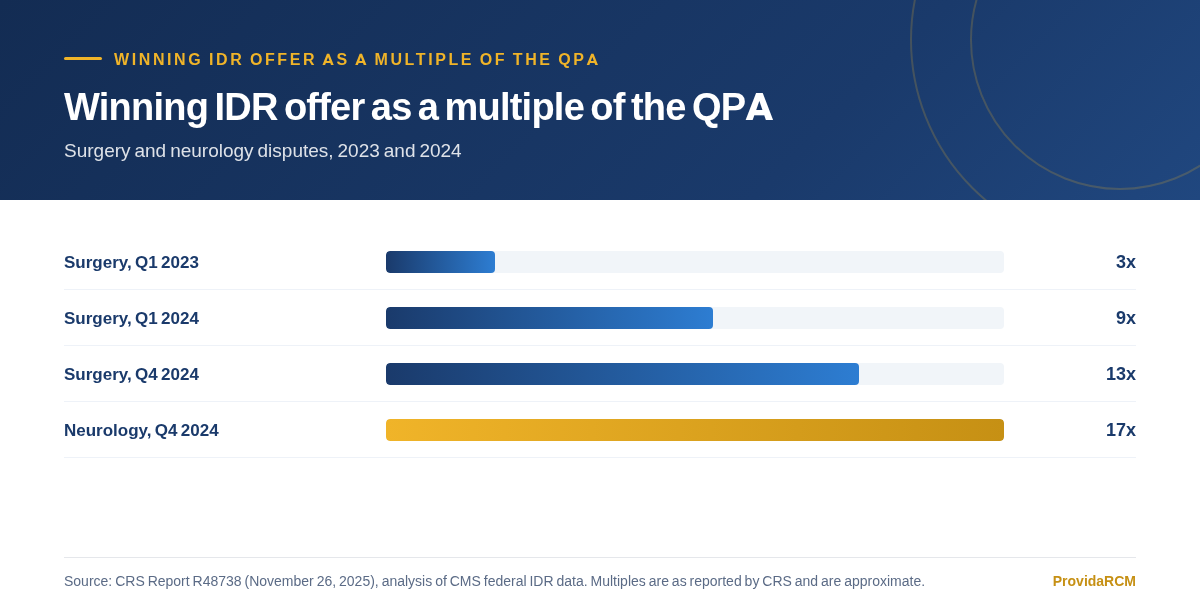
As an IDR benchmark the same figure does something else. If open negotiation fails, each side submits a payment offer and a certified IDR entity selects one. The QPA is one of the factors the entity weighs, alongside the provider’s training and experience, the acuity of the case, and good-faith efforts to join the network. The Congressional Research Service found that insurers’ offers were at or below the QPA in roughly 47 percent of 2024 disputes, which makes the QPA the plan’s opening position rather than the outcome.
| Question | As a payment floor | As an IDR benchmark |
|---|---|---|
| Who does it bind? | What the plan may charge the patient in cost sharing | What the arbitrator weighs when picking an offer |
| Ceiling or floor? | A ceiling on the patient’s recognized amount | One data point, not a cap on the award |
| Can it be substituted? | No, unless a specified state law or an All-Payer Model Agreement applies | Yes. The entity selects one party’s offer in full |
| What evidence moves it? | Almost none. It is a calculation, not a negotiation | The statutory factors, including your own market data |
| What should you argue? | That the patient was billed correctly against the recognized amount | That your offer is better supported than the plan’s offer |
Providers prevailed in most IDR payment determinations
Source: CRS Report R48738, analysis of CMS federal IDR data for 2023 and 2024.
Conflating the two costs money in both directions. A practice that reads the QPA as the plan’s payment obligation demands that number and settles for it, when the record would support more. A practice that treats it as a starting bid under-documents cost sharing. Keep the two arguments separate in the same file.
What the plan must give you on request, and on what clock
Two disclosure duties run on different schedules, and practices routinely assume the slower one applies to both. The first rides with the money. With each initial payment or notice of denial of payment, the plan must give the QPA for the item or service and contact details for the person who can open negotiations. For air ambulance claims the initial payment or notice of denial is due within 30 calendar days of the bill under 45 CFR 149.130.
The second duty answers questions, and the regulation attaches no day count to it. On request, a plan must provide, in a timely manner, whether the QPA included contracted rates that were not fee-for-service, whether it used underlying fee schedule rates or a derived amount, which eligible database was used, which related service code stood in for a new code, and whether risk sharing, bonus, penalty or other incentive payments were excluded. For disclosures on or after August 3, 2026, the initial disclosure also carries the plan’s legal business name and registration number.
| Item | Trigger | Window in the regulation |
|---|---|---|
| The qualifying payment amount for the item or service | Initial payment or notice of denial | With the payment or denial |
| Contact information for open negotiation | Initial payment or notice of denial | With the payment or denial |
| Legal business name and registration number | Initial payment or notice of denial | For disclosures on or after August 3, 2026 |
| Non-fee-for-service rates or a derived amount | Provider request | Timely, no fixed day count |
| Which database was used, and the related service code | Provider request | Timely, no fixed day count |
Practices often expect a 30-day turnaround on a QPA information request, because 30 days appears elsewhere in the Act, including the air ambulance payment clock. The request provision at 149.140(d)(2) says timely. Date the request either way.
Because the standard is timely rather than a fixed number, the request itself is the evidence. Ask per claim, and the answers tell you whether the number came from the plan’s own 2019 contracts, a database, or a derived amount.
When the QPA you receive does not match the market you can demonstrate
Most bad qualifying payment amounts are not fraud. They are a sufficiency failure, a wrong specialty, a wrong region, or a median taken across a book of business the plan bought at a discount. Each is checkable and each leads to a different argument. Before you write about the market, check the arithmetic.
The service-specific rules give you a free audit. For anesthesia, confirm the conversion factor and that the unit sum matches the base, time and physical status units on the claim. For air mileage, confirm loaded miles and the use of A0435 or A0436. For a service billed with a 26 or TC modifier, confirm the plan split the professional and technical components into separate medians.
- 01
Request the inputs on the claim
Ask whether the QPA used a database, a fee schedule rate or a derived amount, and which related code applied. Date the request and file the reply with the claim.
- 02
Rebuild the market from your own data
Pull billed charges and allowed amounts for that code in that region for the same period. Your own contract sample beats any published average.
- 03
Make the offer in writing
Open negotiation runs 30 business days from the initial payment or denial. If it fails, the dispute is generally initiated within 4 business days after it closes.
- 04
Submit an offer you can defend
Attach the documentation behind the number. Our evidence standard is set out in the guide to out-of-network claim documentation.
No federal per-specialty qualifying payment amount benchmark exists that a practice can cite as authoritative. The public IDR data file reports QPA amounts captured from the portal in closed disputes, and those amounts are not verified by the plan. Treat that file as a directional sample, not the standard you quote in an offer.
The practices that do well here are consistent rather than clever. They request the QPA inputs on every out-of-network claim and keep the documentation file current instead of building it mid-dispute. They read the 2026 changes in the IDR process before a batch goes out, and they check remark codes against the live list rather than a saved cheat sheet, using the CMS remark code guidance.
We handle this end to end through our out-of-network billing work, which sits alongside denial management and A/R follow-up for claims that do not resolve. The CARC and RARC reference explains how the remittance advice tells you whether a claim is even eligible for the federal process.
Questions practices ask us about this
What is the qualifying payment amount under the No Surprises Act?
It is the median of the rates a plan or issuer had contracted with in-network providers for the same or a similar item or service, from a provider in the same or a similar specialty, in the region where the service was furnished, as of January 31, 2019. For 2023 and later, the prior year amount is increased by the published CPI-U change.
Is the qualifying payment amount the same as Medicare or usual and customary rates?
No. The median must be built from commercial in-network rates. A plan may not use amounts paid by public payers, including Medicare and Medicaid, or amounts billed by nonparticipating providers. That exclusion sits in the eligible database definition at 45 CFR 149.140(a)(3)(ii)(C), which is why a QPA that lands close to Medicare deserves a written question.
Does the qualifying payment amount change every year?
It increases but is not recalculated. For an item or service furnished in 2023 or later, the rule starts from the prior year figure and raises it by the percentage increase the IRS publishes using the Consumer Price Index for All Urban Consumers. Because the chain starts at a fixed January 31, 2019 median, a market whose commercial rates grew faster than consumer prices outruns its own QPA.
Can a practice challenge the qualifying payment amount itself?
Not directly. Federal IDR resolves the out-of-network rate, it does not audit the plan’s arithmetic. What you can challenge is the inputs, in writing, because the plan owes you information about whether a database, a fee schedule rate or a derived amount produced the number. Then make an offer that does not depend on the QPA being right.
What information can we demand from the plan about the QPA?
On request, 45 CFR 149.140(d)(2) requires the plan to say whether the QPA included non-fee-for-service contracted rates, whether underlying fee schedule rates or a derived amount were used, which eligible database was used, which related service code applied to a new code, and whether risk sharing, bonus, penalty or other incentive payments were excluded. No fixed day count is set, so date the request.
If the patient is protected from balance billing, why does the QPA still matter to us?
Because the QPA is only the floor. It sets the patient’s cost sharing at the lesser of billed charges or the QPA, but it does not set what the plan owes the practice. That amount is agreed in open negotiation or selected by a certified IDR entity. In 2024 providers prevailed in about 85 percent of determinations and about 47 percent of insurer offers were at or below the QPA.
Want the QPA checked claim by claim?
We request the QPA inputs, rebuild the market position, and run open negotiation and IDR for out-of-network claims. Send us a sample and we will show you where the floor is set too low.
Book a free billing review- 45 CFR 149.140, Methodology for calculating qualifying payment amount (eCFR, current text). ecfr.gov/current/title-45/subtitle-A/subchapter-B/part-149/subpart-B/section-149.140
- CMS, Qualifying Payment Amount Calculation Methodology, 45 CFR 149.140. cms.gov/cciio/programs-and-initiatives/other-insurance-protections/caaqualifying-payment-amount-calculation-methodology.pdf
- Congressional Research Service, No Surprises Act Independent Dispute Resolution Process Data Analysis for 2024, R48738, November 26, 2025. congress.gov/crs-product/R48738
- CMS, Federal Independent Dispute Resolution Operations final rules fact sheet. cms.gov/newsroom/fact-sheets/federal-independent-dispute-resolution-operations-final-rule
- Federal Register, Federal Independent Dispute Resolution Operations, 91 FR 33900, June 4, 2026. govinfo.gov/content/pkg/FR-2026-06-04/pdf/2026-11140.pdf
- CMS, Guidance on Required Remittance Advice Remark Codes Related to the No Surprises Act, July 17, 2026. cms.gov/cciio/programs-and-initiatives/other-insurance-protections/caa-nsa-rarc-codes.pdf
- Federal Register, Federal Independent Dispute Resolution (IDR) Process Administrative Fee and Certified IDR Entity Fee Ranges, 88 FR 88494, December 21, 2023. federalregister.gov/d/2023-27931