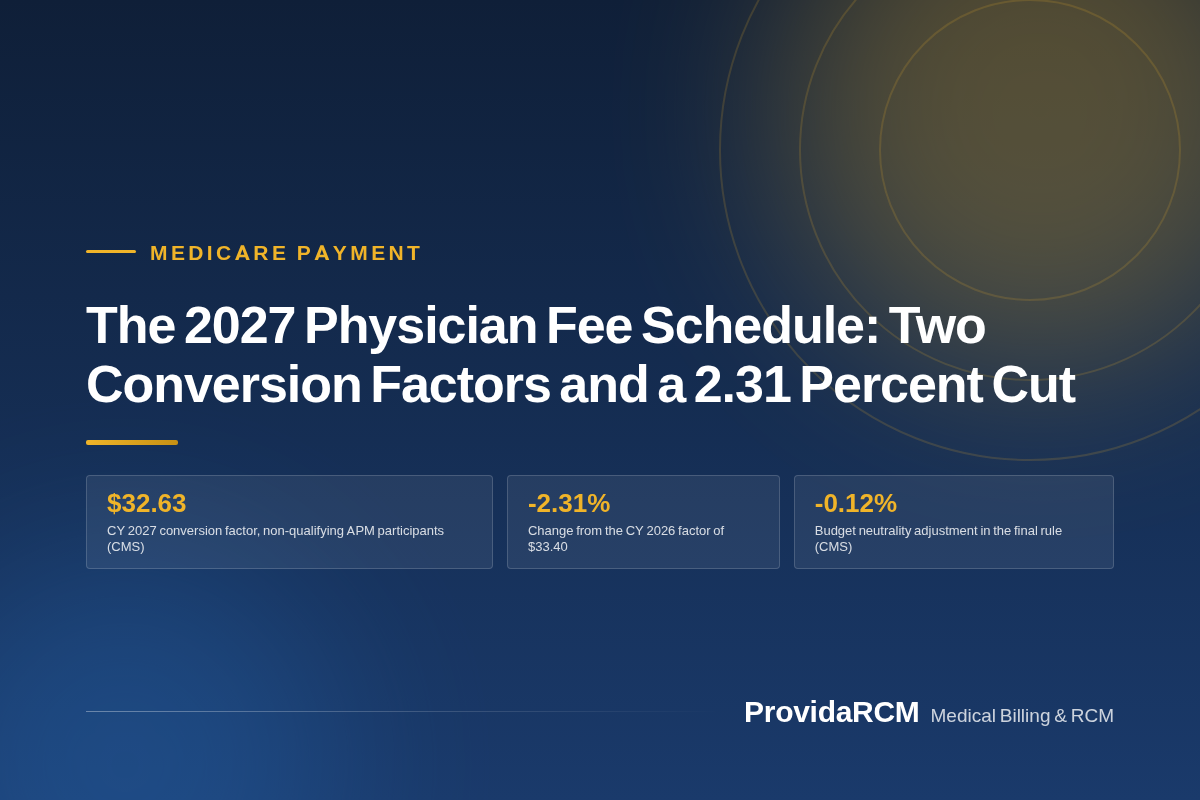
The 2027 Medicare physician fee schedule sets the conversion factor at $32.63 for clinicians who are not qualifying APM participants, down 2.31 percent from $33.40, and at $32.95 for qualifying participants, down 1.83 percent. It applies to services on or after January 1, 2027. Most of the drop is the one-year 2.5 percent increase Congress passed for 2026, now expired.
The 2027 physician fee schedule pays 2.31 percent less for most clinicians
Every Medicare payment under the fee schedule is total RVUs multiplied by a conversion factor, after geographic indices adjust for the locality. The rule changes the multiplier that prices every code on the schedule. Two factors exist because qualifying APM participants get a higher statutory update. Both fall in 2027, by different amounts: $33.5675 to $32.9548 for qualifying participants, and $33.4009 to $32.6286 for everyone else.
| Clinician group | CY 2026 | CY 2027 | Dollar change | Percent change |
|---|---|---|---|---|
| Qualifying APM participants | $33.5675 | $32.9548 | -$0.62 | -1.83% |
| All other clinicians | $33.4009 | $32.6286 | -$0.77 | -2.31% |
The gap between the two columns is the permanent APM differential, not a new policy. Since 2026 the statute pays qualifying participants a 0.75 percent update and everyone else 0.25 percent, and the CY 2027 rule applies both. What changed is the third piece: the one-year 2.5 percent increase that Public Law 119-21 added to the CY 2026 factor, which expires on December 31, 2026.
The conversion factor cuts every payment by the same percentage before locality adjustment. The rule also reprices individual codes, so the change a practice actually feels is the conversion factor plus the RVU movement on the codes it bills most. The two effects are separate, and only one of them is uniform.
Three adjustments turn the 2026 factor into the 2027 factor
CMS builds the new factor from the old one with three multipliers. The statutory update adds 0.25 percent for most clinicians and 0.75 percent for qualifying APM participants. A budget neutrality adjustment takes 0.12 percent away to pay for work RVU increases elsewhere in the schedule. The expired 2.5 percent increase is then stripped out, which is where the net reduction comes from.
| Piece | Applies to | Multiplier | Direction |
|---|---|---|---|
| Statutory update | Non-qualifying APM factor | 1.0025 | Adds 0.25% |
| Statutory update | Qualifying APM factor | 1.0075 | Adds 0.75% |
| RVU budget neutrality | Both factors | 0.9988 | Removes 0.12% |
| Expiration of the CY 2026 increase | Both factors | divide by 1.025 | Removes 2.50% |
| Net effect, non-qualifying factor | All other clinicians | 0.9769 | -2.31% |
| Net effect, qualifying factor | Qualifying APM participants | 0.9817 | -1.83% |
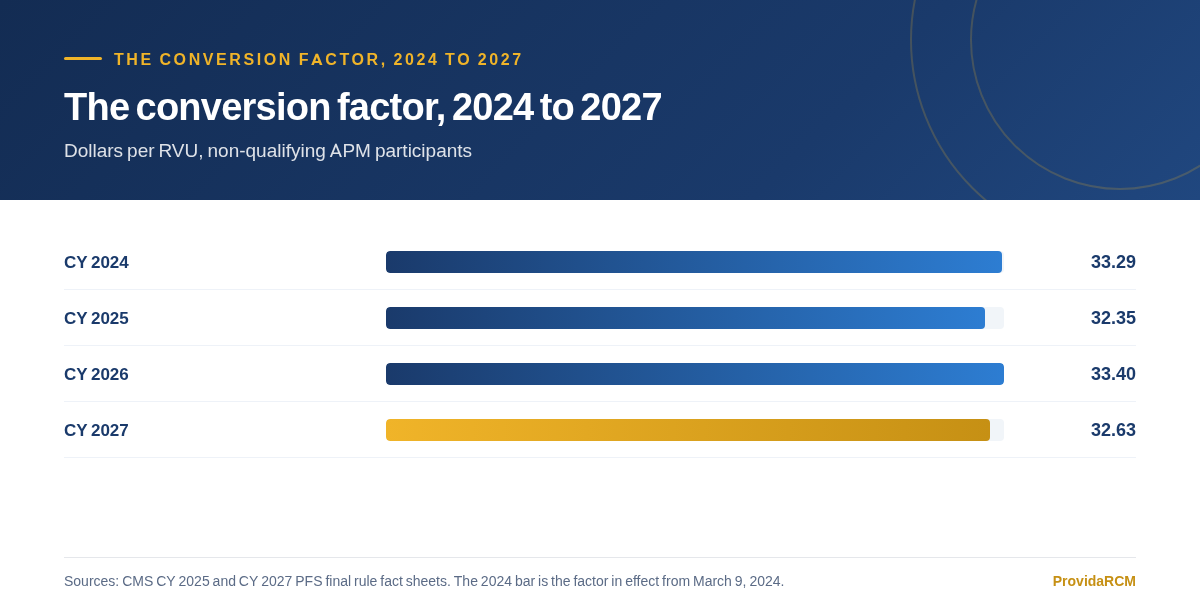
The conversion factor, 2024 to 2027
Sources: CMS CY 2025 and CY 2027 PFS final rule fact sheets. The 2024 bar is the factor in effect from March 9, 2024, after the Consolidated Appropriations Act, 2024 replaced the earlier update.
The chain is worth running by hand once, because it explains why a positive update still produces a cut. Take $33.4009, the 2026 factor with the temporary increase still inside it. Multiply by 1.0025 for the update and 0.9988 for budget neutrality, then divide by 1.025 to remove the expired increase. The answer lands within a tenth of a cent of the published $32.6286.
Congress has changed this number after publication before. The CY 2024 rule set $32.7442, then the Consolidated Appropriations Act, 2024 raised the factor to $33.2875 for dates of service from March 9, so one code paid two amounts inside a year. A fee schedule built in November is a planning document. The 2026 fee schedule post walks through the same mechanics for the prior year.
What the cut looks like on the codes you bill every day
CMS publishes an impact table for selected procedures alongside the rule, and it prices each service at the 2026 and the 2027 non-qualifying conversion factor with geographic indices held at 1.000. It is the fastest way to see the rule on real codes without rebuilding a fee schedule. Office visits fall about 3 percent, procedures fall 4 to 6 percent, and two orthopedic codes fall far more.
| Code | Service | Setting | CY 2026 | CY 2027 | Change |
|---|---|---|---|---|---|
| 99203 | New patient office visit, low | Non-facility | $117.57 | $113.55 | -3% |
| 99213 | Established office visit, low | Non-facility | $95.19 | $92.01 | -3% |
| 99214 | Established office visit, moderate | Non-facility | $135.61 | $131.17 | -3% |
| 99291 | Critical care, first hour | Non-facility | $308.96 | $300.84 | -3% |
| 43239 | Upper GI endoscopy with biopsy | Non-facility | $418.85 | $393.50 | -6% |
| 66984 | Cataract removal with lens implant | Facility | $462.60 | $442.12 | -4% |
| 27447 | Total knee arthroplasty | Facility | $1,159.35 | $953.08 | -18% |
| 90471 | Immunization administration | Non-facility | $22.04 | $22.19 | +1% |
The office visit numbers show why the headline percentage is a poor forecast. 99213 moves from $95.19 to $92.01, a drop of 3.34 percent, more than the 2.31 percent conversion factor because the RVUs behind the code changed too. Immunization administration moves the other way, up 0.68 percent, because its RVUs rose enough to beat the factor. Apply the factor to each code, not to a revenue total.
The two arthroplasty codes are the outlier worth understanding. Total knee and total hip both drop 17.8 percent, and the conversion factor explains 2.31 points of that. The rest is a revaluation of the code itself. CMS states in the rule that post-operative visits inside the global period are paid for but often not furnished, which is the case for revaluing them. A practice that bills joints should read the code-level RVUs in Addendum B before setting 2027 fees.
A practice that earns 40 percent of its Medicare dollars from E/M visits and 60 percent from procedures does not lose 2.31 percent. It loses the weighted average of the code-level changes in its own mix. Model that from your own claims.
Same-day E/M with a 0-day global procedure pays 80 percent
CMS finalized a payment reduction that most practices have not priced yet. When a separately identifiable office or outpatient E/M visit is furnished the same day as a procedure with a 0-day global period, the higher-valued service pays at 100 percent and the other service pays at 80 percent. The rule narrowed the proposal twice: 10-day and 90-day global procedures are out, and the reduction is 20 percent rather than the 50 percent CMS first proposed.
| Same-day combination | Final rule | Proposed rule |
|---|---|---|
| E/M plus a 0-day global procedure | Higher service at 100%, the other at 80% | Other service at 50% |
| E/M plus a 10-day global procedure | No reduction | Other service at 50% |
| E/M plus a 90-day global procedure | No reduction | Other service at 50% |
Modifier 25 still does the work it did before. It tells the payer the E/M was significant and separately identifiable from the procedure, and the documentation has to support that. What changes is the price of the second service when the modifier is accepted on a same-day 0-day global claim. A 99213 at the 2027 non-facility rate pays $92.01. At 80 percent it pays $73.61, an $18.40 difference on one encounter.
Two operational consequences follow. A same-day procedure that used to justify a full E/M payment now has to justify 80 percent of one, so the scheduling and coding judgment behind the visit matters more. It applies by code pair, so a practice that cannot tell a 0-day global from a 10-day global in its own charge master will get this wrong in both directions.
G2211 becomes modifier B1, and ACO practices get B2
The office visit complexity add-on changes form. Since 2025, HCPCS code G2211 has been billed on its own line for a flat amount when the practitioner is the continuing source of care for a serious or complex condition. In CY 2027 CMS converts it to modifier B1, appended to the base E/M code, and the payment becomes 16 percent of the associated E/M payment instead of a flat rate.
| Element | CY 2026 | CY 2027 |
|---|---|---|
| How it is reported | HCPCS code G2211 on its own line | Modifier B1 on the E/M line |
| Payment | Flat add-on amount | 16 percent of the associated E/M payment |
| ACO route | No separate route | Modifier B2, 32 percent, for Shared Savings and LEAD ACO participants |
| Effect on claim volume | One extra line per qualifying visit | No extra line, one modifier |
Modifier B2 is available to practitioners in a Shared Savings Program ACO or a Participant Provider in the Long-term Enhanced ACO Design model, adds 32 percent to the associated E/M visit, and is voluntary. CMS states it can be billed for every beneficiary the practitioner sees, including those not assigned to the ACO. Claims carrying B2 count toward assignment, benchmark and performance year spending calculations, so the compliance question runs past whether the visit qualifies.
For a billing team the practical work is configuration, not judgment. The edit that blocks G2211 has to be replaced with one that validates a modifier on the E/M line, the fee schedule needs a percentage rule rather than a dollar amount, and the E/M coding levels that B1 attaches to stay exactly as they are. Medicare Advantage plans set their own add-on policy and often lag a year, so expect a split book for a while.
RVU changes split the specialties, and the split is not small
The rule reprices work and practice expense RVUs, and CMS publishes the estimated effect by specialty. The table below is CMS’s own, built on CY 2025 utilization priced at CY 2026 rates, covering $95.0 billion of allowed charges. Its columns measure the RVU changes only, which is why the all-specialty total comes to 0 percent: budget neutrality holds the schedule’s overall spending roughly constant while moving money between specialties and codes.
| Specialty | Allowed charges ($ mil) | Work RVU | PE RVU | Combined |
|---|---|---|---|---|
| Clinical social worker | $979 | +3% | +8% | +11% |
| Clinical psychologist | $784 | +2% | +7% | +9% |
| Physical and occupational therapy | $5,874 | 0% | +3% | +3% |
| Interventional radiology | $553 | 0% | +3% | +3% |
| Family practice | $6,065 | 0% | 0% | +1% |
| Dermatology | $4,090 | 0% | -3% | -4% |
| Hand surgery | $282 | -1% | -3% | -4% |
| Otolaryngology | $1,235 | -1% | -4% | -5% |
| Orthopedic surgery | $3,348 | -2% | -4% | -6% |
Specialties CMS estimates gain from RVU changes
Source: CMS, CY 2027 PFS final rule estimated impact on total allowed charges by specialty. Values are the combined RVU impact, rounded.
Read the table as a first pass, not an answer. Adding minus 2.31 percent to each row gives the direction of the specialty result, and the losers get worse. Behavioral health comes out ahead because CMS raised work and practice expense RVUs for timed therapy and collaborative care.
Orthopedic surgery averages minus 6 percent, yet total knee arthroplasty falls 18 percent. A specialty average is a weighted sum of its codes, so a practice heavy in one code can sit far from its own specialty’s number.
What to do before the January 1 effective date
The 2027 factors apply to services furnished on or after January 1, 2027, which leaves six weeks between the Federal Register publication and the first claim. That is enough time to rebuild a fee schedule if the work starts early, and not enough if it starts in late December.
- 01
Rebuild the schedule from Addendum B
Load the CY 2027 RVUs and the $32.6286 factor, then reprice every code in your top 50 by allowed charges. Do not scale last year’s fees by 1.0231.
- 02
Reconcile against CMS’s selected procedure table
The published table gives 2026 and 2027 payment for a sample of codes. Any code where your number differs by more than rounding is a place to look for a wrong RVU, a wrong place of service, or a stale file.
- 03
Model cash flow on your own mix
Apply the new rates to twelve months of paid claims by code. A 2.31 percent cut on a $900,000 Medicare book is $20,790 a year, and the same book can lose twice that if its procedure mix leans toward the codes CMS repriced down.
- 04
Read the Medicare clauses in every payer contract
Contracts written as a percentage of Medicare inherit the reduction automatically, and the notice period may already be running. Contracts with a fixed fee schedule do not move at all, which is the exposure the next negotiation has to price.
The commercial side is where the number gets interesting. A plan paying 130 percent of Medicare pays 130 percent of $32.63, so the practice absorbs a 2.31 percent cut on its largest book without any negotiation, any notice, or any signature. Most contracts carry no floor. The payer contract negotiation work is the same arithmetic, and underpayment recovery catches what a stale mapping leaves behind.
- 2027 RVU file loaded and the conversion factor checked against $32.6286
- Top 50 codes repriced and compared to CMS’s selected procedure table
- Same-day E/M and 0-day global procedure edits rebuilt at the 80 percent rate
- G2211 edit replaced with a B1 modifier rule, and B2 evaluated for ACO participation
- Every percentage-of-Medicare contract flagged with its exposure in dollars
- Revenue cycle reports reset to a post-January baseline before the first 2027 claim posts
Questions practices ask us about this
What is the 2027 Medicare conversion factor?
The 2027 final rule sets two conversion factors: $32.9548 for qualifying APM participants and $32.6286 for all other clinicians, effective for services on or after January 1, 2027. CMS rounds these to $32.95 and $32.63 in its fact sheet. Both are lower than the 2026 factors of $33.5675 and $33.4009, which included a one-year 2.5 percent statutory increase that expires at the end of 2026.
Why did the conversion factor fall when the statutory update is positive?
Because the 2026 factor carried a temporary 2.5 percent increase that was never permanent. Congress added it for CY 2026 only. In 2027 the statutory updates of 0.25 percent and 0.75 percent still apply, along with a minus 0.12 percent budget neutrality adjustment, but they are smaller than the 2.5 percent being removed. Take the 2.5 percent out and put 0.13 percent back in, and the compounding lands at minus 2.31 percent.
Will Congress stop the 2027 cut before January?
Nobody can say, and CMS cannot plan for it. The CY 2024 rule is the precedent to watch: CMS finalized one factor, then legislation replaced it weeks before the effective date and set a second factor for dates of service from March 9. Build the 2027 schedule from the published rule, and keep a version that can absorb a mid-year change without rebuilding every contract.
Does the 2.31 percent cut apply to every code?
The conversion factor applies to every code priced under the fee schedule, but it is only one of two inputs. A code whose RVUs rose can pay more in 2027 than in 2026, and immunization administration does exactly that in CMS’s selected procedure table. A code whose RVUs fell can lose far more than 2.31 percent, as total knee arthroplasty does at 18 percent.
How does the 80 percent same-day rule interact with modifier 25?
Modifier 25 is still required to show the E/M was separately identifiable from the procedure. What changes on January 1 is the payment for the lesser service when the procedure has a 0-day global period: it pays 80 percent instead of the full allowed amount. Procedures with 10-day and 90-day global periods were removed from the final policy and pay as they did before.
Do commercial contracts indexed to Medicare change automatically?
Usually yes, and that is the reason to check them. A contract that pays 120 or 130 percent of the Medicare fee schedule recalculates from the new factor without an amendment, and the reduction arrives on the first claim after January 1. A contract with a fixed fee schedule does not move. Knowing which of the two you signed, and what notice it requires, is a bigger number than the Medicare cut itself.
Want this fixed in your practice?
We run full-cycle billing, coding, credentialing and denial work for practices across the country. Send us a few months of claims and we will show you where the money is going.
Book a free billing review- CMS, Calendar Year (CY) 2027 Medicare Physician Fee Schedule Final Rule fact sheet, November 4, 2026. cms.gov/newsroom/fact-sheets/calendar-year-cy-2027-medicare-physician-fee-schedule-final-rule
- Federal Register, CY 2027 Payment Policies Under the Physician Fee Schedule, 91 FR 70992, November 9, 2026. federalregister.gov/documents/2026/11/09/2026-22743/medicare-and-medicaid-programs-cy-2027-payment-policies-under-the-physician-fee-schedule-and-other
- CMS, CMS-1848-F rule page with addenda, RVU files and impact tables. cms.gov/medicare/payment/fee-schedules/physician/federal-regulation-notices/cms-1848-f
- CMS, CY 2027 PFS final rule estimated impact on total allowed charges by specialty. cms.gov/files/zip/cy-2027-pfs-final-rule-estimated-impact-total-allowed-charges-specialty-updated-11-05-2026.zip
- CMS, CY 2027 PFS final rule impact on payment for selected procedures. cms.gov/files/zip/cy-2027-pfs-final-rule-impact-payment-selected-procedures.zip
- CMS, Calendar Year (CY) 2025 Medicare Physician Fee Schedule Final Rule fact sheet. cms.gov/newsroom/fact-sheets/calendar-year-cy-2025-medicare-physician-fee-schedule-final-rule
- CMS, Physician Fee Schedule program page, conversion factor history and payment files. cms.gov/medicare/payment/fee-schedules/physician