In-house vs outsourced billing usually fails as a comparison before it starts, because one side is priced per hour of staff and the other as a percentage of collections. Put both on the same denominator and the decision narrows to one break-even volume, a written scope list, and the risk you are choosing to carry.
In-house vs outsourced billing fails on the denominator
An in-house team appears on the profit and loss statement as wages, payroll taxes, software and a manager’s attention spread across a dozen lines. A billing company appears as one line, a percentage of collections, invoiced monthly. The single line looks tidy beside the mess, which is how the decision gets made on how the two options look rather than what they cost.
Fix the denominator and most of the argument goes away. The vendor’s fee is a claim on net collections. Convert the in-house seat into dollars per dollar collected on the same base and the two numbers finally describe the same thing. Whatever will not convert is either a service difference or a risk difference, and both belong in the decision, just not in the cost column.
| Cost line | In-house | Outsourced | Where it hides |
|---|---|---|---|
| Wages and benefits | Your payroll, every month | Inside the vendor fee | Never a visible line in a percentage contract |
| Practice management system | Your license and your data | Usually yours, sometimes theirs | Ask whose license, and what you keep at termination |
| Statements and postage | Your print vendor | Commonly excluded from the fee | A per-statement charge is the usual add-on |
| Denials and appeals | Your team’s hours | Often first level only, or capped | Read the scope clause, not the fee table |
| Supervision and coverage | A manager’s hours, plus turnover | The vendor’s problem, in theory | Ask who covers an absent biller on a Friday |
| Audits and overpayments | Your staff time | Assistance, not liability | No fee transfers the obligation |
MGMA’s benchmarking keeps the two apart. Its DataDive glossary puts billing and collections purchased services in an expense category of its own, defined separately from the cost of employed staff, which means a practice that changes models lands in a different comparison without necessarily changing what it spends. Both lines have to be read together before a benchmark tells you anything.
Who pays for the work the fee does not cover, and what happens to that work when the person doing it leaves. Answer those in writing and the rest of the comparison is arithmetic.
What one billing seat actually costs in payroll
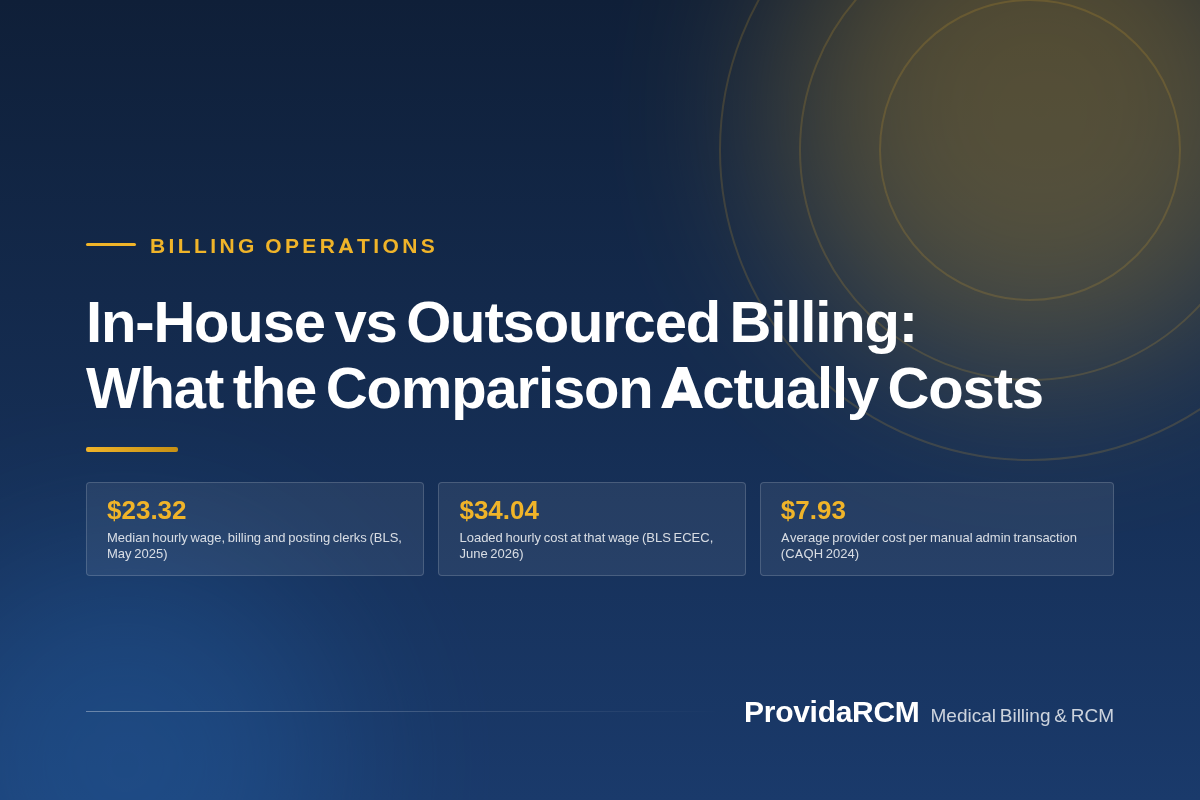
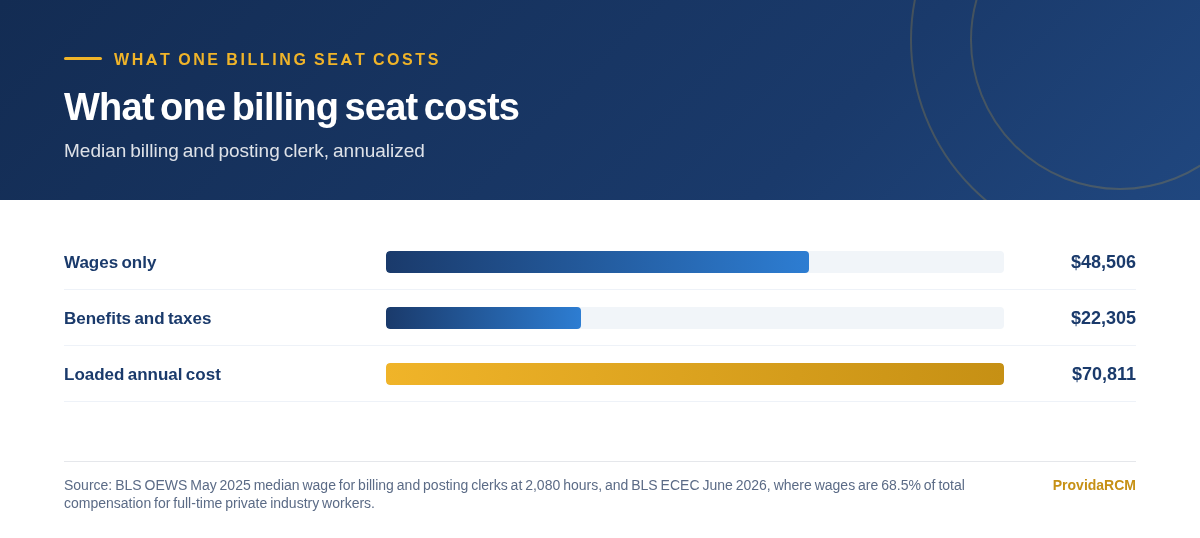
The Bureau of Labor Statistics puts the median wage for billing and posting clerks at $23.32 an hour in May 2025, which is $48,500 a year across 404,060 jobs, with a mean of $24.55 (BLS OEWS). Those are wages. A practice pays more than wages for the same hour of work, and the gap is not small.
BLS publishes the split in its Employer Costs for Employee Compensation. In June 2026, wages and salaries were 68.5% of total compensation for full-time private industry workers, leaving 31.5% for benefits, paid leave and legally required costs (BLS ECEC). At the median wage that is $34.04 an hour, or $70,811 a year for one full-time seat. The $22,305 difference never appears in a salary comparison, and it is close to a third of the real number.
The loaded cost of one billing hour
Sources: BLS OEWS May 2025 for the median and mean wage of billing and posting clerks; BLS ECEC June 2026 for the benefit share of total compensation.
Software and services sit on top of that. A billing module in the practice management system, clearinghouse fees per claim, statement printing and postage, an eligibility tool, and a share of a supervisor’s time all belong to the seat whether or not anyone counts them. None of these disappear under a percentage contract, because the vendor prices its own version of each one into the fee.
Coverage is the last cost and the easiest to ignore. The quits rate in health care and social assistance was 2.0% in September 2026, per BLS JOLTS, and a billing desk of one or two people has no slack in it. A resignation mid-month means a week of unposted cash, a stack of untouched denials, recruiting, onboarding, and a productivity dip that runs past the notice period.
What the outsourced fee actually buys
Three pricing structures cover most of what practices are offered. A percentage of collections ties vendor income to what it collects. A per-claim fee pays for volume, which is why denial work tends to appear as a separate line. A dedicated full-time equivalent prices a named person at a monthly rate, which is closer to hiring than to outsourcing and carries the same supervision question.
Then work out what a transaction costs either way. The 2024 CAQH Index puts the average medical provider cost at $7.93 for a fully manual administrative transaction and $3.39 for a fully electronic one, a gap of $4.54 (CAQH 2024 Index). Changing the employer of the person doing the work does not change that arithmetic. A billing company running the same manual process carries the same cost base and adds a margin, which it recovers in the fee.
| Transaction | Generalist, manual | Behavioral health, manual | Behavioral health, electronic |
|---|---|---|---|
| Eligibility and benefit verification | $4.05 | $14.32 | $2.37 |
| Prior authorization | $7.60 | $14.92 | $6.83 |
| Claim submission | $5.72 | $6.35 | $2.59 |
| Claim status inquiry | $11.00 | $18.35 | $3.31 |
| Remittance advice | $5.14 | $5.16 | $2.38 |
Behavioral health: cost per transaction by mode
Source: CAQH Index 2023, Administrative Transaction Costs by Provider Specialty, provider-reported labor cost per transaction.
Ask what the fee excludes before comparing it to anything. Statements and postage, appeals past the first level, credentialing and revalidation, patient phone calls, coding, EDI fees and the practice management license routinely sit outside a base percentage. A rate quoted without a written scope list is not a price, it is an opening position.
A per-statement charge, a platform fee and a denial rework charge can carry a 6% contract past 7% of collections before a single denial is worked. Ask for the all-in rate at your own volume, in writing, with the exclusions named.
The break-even point where the two models meet
Set the two sides equal and the comparison becomes one number. One loaded seat at $70,811 equals a 6% fee on $1,180,185 of annual net collections. Divide the loaded annual cost by the fee percentage and you have the volume at which your own team stops being the cheaper option. The same seat is worth $1,416,222 at a 5% fee and $1,011,587 at 7%.
Collections one seat must carry to match a fee
Calculated from BLS OEWS May 2025 median wage, BLS ECEC June 2026 benefit share, and 2,080 hours per full-time equivalent.
Read it as a threshold, not a verdict. If your billing team handles $2 million of net collections per full-time equivalent, in-house is cheaper on labor than a 6% contract, and the margin is wide enough to absorb software and supervision. If the same team handles $700,000 per equivalent, the fee is cheaper, and the gap is too wide for a lower quote to close.
The shape of the two costs differs in a way the arithmetic hides. A vendor fee moves with collections, so a bad quarter costs less in fees, and the vendor has no contractual reason to chase small balances unless the agreement says it does. An in-house seat costs the same in a bad quarter as a good one. That is a fixed cost and a fixed capacity at the same time, and whether it helps depends on how predictable your volume is.
The number worth computing before any of this is collections per billing full-time equivalent. It sits on no standard report, it takes an afternoon to assemble from payroll and the practice management system, and it decides the comparison more than the fee quote does. The revenue cycle KPI definitions walk through how the surrounding measures fit together.
What does not move when you outsource billing
Outsourcing moves the work. It does not move the accountability, and the regulation is plain about it. Medicare may pay an agent who furnishes billing and collection services to a supplier, and 42 CFR 424.80(b)(5) adds that payment to an agent is always made in the name of the supplier (eCFR 424.80). The remittance is yours, the appeal rights are yours, and the audit letter arrives at your address.
| What does not move | The rule | What it means in practice |
|---|---|---|
| Payment | 42 CFR 424.80(b)(5): payment to an agent is made in the name of the supplier | The check is yours, so the audit is yours |
| Privacy | 45 CFR 164.502(e) and 164.504(e): a written business associate contract is required | No signed agreement, no disclosure of records |
| Vendor conduct | 45 CFR 164.504(e)(1)(ii): knowing of a pattern of violations and not acting is non-compliance | Monitoring the vendor is an obligation, not a courtesy |
| Records | The claim history is the practice’s medical and financial record | Get export rights and the format named in the contract |
HIPAA adds a contract requirement rather than a transfer of duty. A covered entity needs a written business associate agreement before a billing company touches protected health information. The same section is explicit that a practice is out of compliance when it knew of a pattern of activity by the business associate that breached the agreement and did not cure it or end the relationship (eCFR 164.504).
Two clauses carry most of the practical risk, and neither belongs in an appendix. Data ownership and export decide whether you can leave at all. Breach notification timing decides how long you are exposed before you can act. A vendor that will not put both in the main agreement is telling you something about the exit.
Which model fits your practice
The answer usually follows from four facts: collections per billing full-time equivalent, how many payers carry most of the revenue, whether anyone on staff can supervise the work, and how stable the billing team has been for two years. None of them is about the fee percentage.
- Outsourcing tends to fit a practice with one or two providers, no billing manager, and a specialty whose rules change faster than the team can track.
- In-house tends to fit a practice with enough volume per full-time equivalent to beat the break-even, an existing manager, and revenue concentrated in a few payers.
- A hybrid is often the honest answer: keep charge entry and patient calls inside, move denials, appeals and old receivables to a vendor with a defined scope and end date.
- Provider count decides less than payer mix. A small behavioral health group with nine payers can carry more billing cost per dollar than a larger primary care group with two.
The mistake to avoid is changing models to fix a revenue cycle problem that neither model causes. A net collection rate that has slipped, or days in A/R that keep climbing, usually points at front-end data or unworked denials, and a new vendor inherits both on day one. Measure those two before you renegotiate anything, because moving work to a cheaper fee on top of a broken front end buys a smaller loss.
How to run the comparison in 30 days
The comparison takes about a month if you do it properly, and most of that is assembling numbers you already own. Do it before you request quotes, so the quotes are answering a question you have already framed.
- 01
Week 1: assemble 24 months of actuals
Net collections, billing payroll with benefits, software and clearinghouse costs, statement and postage spend. Use net collections, not gross charges, or nothing will match a vendor quote.
- 02
Week 2: compute collections per seat
Divide annual net collections by billing full-time equivalents. Write the number down. It is the input the entire decision turns on and it is rarely on a report.
- 03
Week 3: price the seat fully and write the scope
Add benefits, supervision and coverage to the wage. Then list every task you want covered, and mark the ones you are willing to keep. That list becomes the request.
- 04
Week 4: compare on outcomes, not fees
Ask each vendor for the all-in rate at your volume, the exclusions in writing, and their net collection rate and denial overturn history. Then compare those against your own.
Collections per billing full-time equivalent, placed next to the all-in vendor rate. Everything else in this decision is a preference dressed up as analysis.
We run this comparison on both sides of the question. Our medical billing service reports the measures above monthly, and a revenue cycle health check will tell you within a week whether the cost sits in the billing model or in the front end. When the answer is that denials and old receivables are the problem, denial management and A/R management are where the work lands.
Questions practices ask us about this
Is it cheaper to bill in-house or to outsource?
It depends on collections per billing full-time equivalent. A loaded in-house seat at the national median wage costs about $70,811 a year, which equals a 6% fee on roughly $1.18 million of net collections. Below that volume per seat the fee is usually cheaper. Above it, in-house labor costs less, and the remaining questions are supervision, coverage and software.
What percentage of collections should a billing company charge?
There is no single correct rate, and a figure quoted without a scope is meaningless. What matters is the all-in rate at your volume after statements, denial rework, platform fees and coding are priced. Ask for that number in writing on net collections, then compare it with your own loaded cost per dollar collected.
What does an outsourced billing fee usually exclude?
Common exclusions are patient statements and postage, appeals beyond the first level, credentialing and revalidation, coding, patient phone calls, EDI and clearinghouse fees, and the practice management license. Each exclusion is work that stays with your staff. The base percentage typically covers claim submission and payment posting, and little beyond them.
Who is responsible if an outsourced biller submits a bad claim?
The practice is. Medicare makes payment to a billing agent in the name of the supplier under 42 CFR 424.80(b)(5), so the claim, the remittance and any overpayment stay with the practice. A vendor contract can allocate cost between the two parties. It cannot move an obligation that the program places on the supplier of the service.
How many billing staff does a practice need per provider?
There is no defensible universal ratio, because payer mix and specialty change the work more than provider count does. Compute it from your own data instead. Divide annual net collections by billing full-time equivalents, then compare that figure with the break-even point for the fee you have been quoted.
Can a practice move billing back in-house after outsourcing?
Yes, and the contract decides how painful the move is. Check data ownership, export format and notice periods before signing, not after. A clean exit needs the full claim history, payer portals in the practice’s name, and enough lead time to hire and train before the vendor stops working the receivables.
What should be measured before changing billing models?
Four numbers: net collection rate, days in A/R, initial denial rate, and collections per billing full-time equivalent. Add the denial overturn rate if appeals are in scope. A model change is justified when those numbers point at the model. More often they point at front-end data or unworked denials.
Want this fixed in your practice?
We run full-cycle billing, coding, credentialing and denial work for practices across the country. Send us a few months of claims and we will show you where the money is going.
Book a free billing review- BLS Occupational Employment and Wage Statistics, Billing and Posting Clerks (43-3021), May 2025. bls.gov/oes/current/oes433021.htm
- BLS Employer Costs for Employee Compensation, June 2026. bls.gov/news.release/ecec.nr0.htm
- BLS Job Openings and Labor Turnover Survey, health care and social assistance quits rate. bls.gov/news.release/jolts.nr0.htm
- CAQH Index 2024, cost per transaction for electronic and manual administrative work. caqh.org/hubfs/Index/2024%20Index%20Report/CAQH_IndexReport_2024_FINAL.pdf
- CAQH Index 2023, Administrative Transaction Costs by Provider Specialty. caqh.org/hubfs/CAQH%20Insights_2023%20Index%20Report_Provider%20Specialty%20Issue%20Brief_Final.pdf
- 42 CFR 424.80, Prohibition of reassignment of claims by suppliers. ecfr.gov/current/title-42/chapter-IV/subchapter-B/part-424/subpart-F/section-424.80
- 45 CFR 164.504, uses and disclosures, business associate contracts. ecfr.gov/current/title-45/subtitle-A/subchapter-C/part-164/subpart-E/section-164.504
- MGMA 2025 DataDive glossary, billing and collections purchased services definition. mgma.com/getkaiasset/a6a7489d-986d-4635-96e1-a00996e13661/2025%20DataDive%20Glossary%20Definitions.pdf