The advance beneficiary notice is one form with one job: it asks the patient to decide, before the service is furnished, whether to accept financial responsibility for care Medicare may not pay for. Issued at the right moment and coded with the right modifier, it moves the bill from your practice to the patient. Missed, it does the opposite.
What an advance beneficiary notice is, and the decision it forces
The advance beneficiary notice, Form CMS-R-131, is a one-page standardized notice you give a Medicare fee-for-service patient before a service you expect Medicare to deny. It puts one question to them: accept financial responsibility for this care, or decline it. The option boxes on the form record the answer, and that answer decides who pays.
Medicare files it under financial liability notices, not consent forms. CMS describes the ABN as the notice that transfers potential financial liability when Medicare is not likely to cover an item or service in a specific case. That is a narrow job, done at a specific moment.
The instrument applies to Original Medicare only. The May 2025 MLN booklet states you do not use an advance written notice of non-coverage for items and services under Medicare Advantage (Part C) or the drug benefit (Part D). Medicare Advantage plans and commercial payers run their own waiver forms.
Three blanks decide whether the notice does anything. The service must be named in terms the patient understands, the reason you expect a denial has to be stated, and an estimated cost has to be given. The manual requires the correct OMB-approved notice with all required blanks completed.
When an advance beneficiary notice is required
The trigger is a prediction, not a policy. You issue the notice because you expect Medicare to deny payment for an item or service Medicare usually covers, and you expect the denial because the care is not reasonable and necessary for this patient in this particular case. The MLN booklet sets out what that covers.
- Care not indicated for the diagnosis or treatment of an illness or injury, or to improve the functioning of a malformed body member
- Care Medicare treats as experimental, investigational, or research only
- More services than Medicare allows in a specific period for that diagnosis
- Custodial care
- Outpatient therapy that runs past the therapy threshold amounts
- A preventive service you cover but will not cover because the frequency limit was exceeded
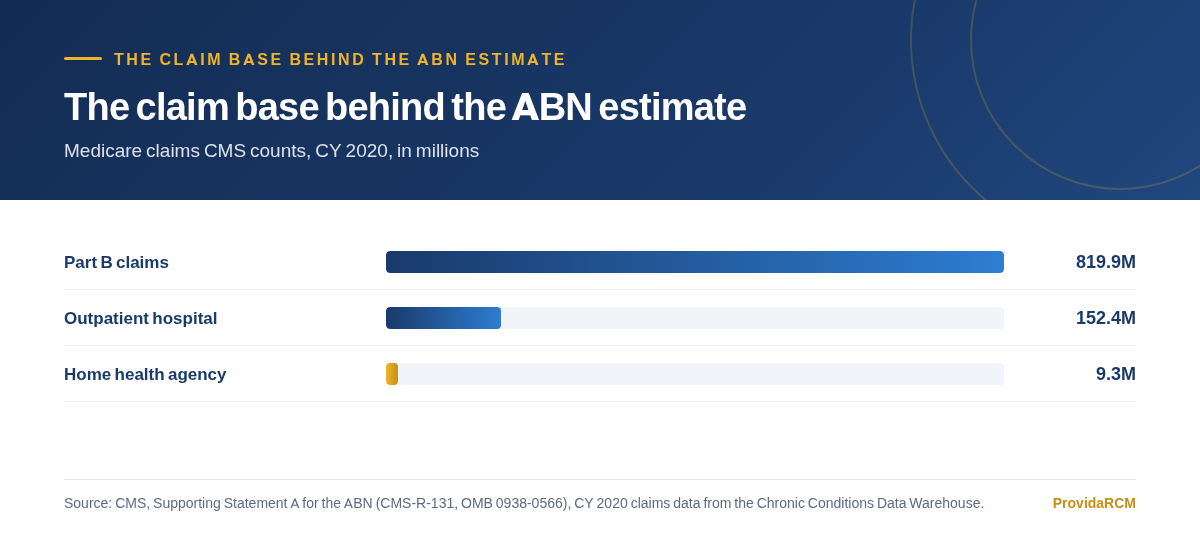
What CMS counts when it sizes the ABN burden
Source: CMS, Supporting Statement A for the ABN (CMS-R-131, OMB 0938-0566), CY 2020 claims data.
Frequency and setting limits run on the same logic. A service can be a covered benefit and still fail because it was furnished more often than Medicare allows in a defined period, or in a setting Medicare does not pay for. Issue the notice before the service when you expect that limit to be exceeded.
Notices attach to moments, and CMS names three. An initiation is the start of a new encounter, a plan of care, or a course of treatment. A reduction is a decrease in a component of care such as frequency. A termination stops the item or service. In each case the notice goes out before the non-covered care.
You cannot issue ABNs on a routine or blanket basis where no reasonable basis exists for expecting non-coverage. CMS carves out the systemic cases: experimental and investigational items, services with frequency limits set by statute, regulation, an NCD or an LCD, and services always denied as medically unnecessary.
A service Medicare never covers is not a service that may be denied
Some services sit outside the Medicare benefit altogether. They are statutorily excluded, Medicare never pays for them, and no coverage decision is involved. Others are covered benefits Medicare may decline in this instance as not reasonable and necessary. The two look alike on a remittance advice and are different problems.
An ABN is not required for care that is statutorily excluded or that does not meet the definition of a Medicare benefit. CMS treats notice there as a courtesy: you may issue one voluntarily, the patient does not choose an option or sign, and the notice does not change who is financially responsible.
| Question | Statutorily excluded service | Covered service that may be denied |
|---|---|---|
| Is there a Medicare benefit category? | No | Yes |
| Does Medicare ever pay? | No | Yes, when it is reasonable and necessary |
| Is an ABN required? | No, but you may issue one as a courtesy | Yes, before the service |
| What the patient does | Does not choose an option or sign | Chooses an option and signs and dates it |
| Modifier | GY, with GX if a voluntary notice was given | GA |
| Who can be billed | The patient, since there is no benefit | The patient only with a valid signed notice |
The modifier follows the situation, and the situation decides who can be billed. A statutorily excluded service is never a benefit, so there is nothing for Medicare to deny and the patient is not shielded by a coverage determination. A covered service denied as not reasonable and necessary is the opposite case, and a missing or invalid notice there puts the charge on the practice.
It cannot be used to move part of a service to the patient when Medicare pays the claim in full through a bundled payment. It cannot shift liability for a line denied by a medically unlikely edit. And it cannot be used to collect when Medicare would otherwise pay.
The modifiers that record what happened, and who pays
The modifier is how Medicare learns what the notice produced. Each answers a different question, and reporting the wrong one is the error this article exists to prevent. The May 2025 MLN booklet publishes the wording and the situation for each of the six.
| Modifier | CMS wording | When you report it | Who can be billed if Medicare denies |
|---|---|---|---|
| GA | Waiver of Liability Statement Issued, as Required by Payer Policy | You issued a mandatory ABN and it is on file. Use it when covered and non-covered services sit on the same claim. | The patient, for the non-covered amount |
| GX | Notice of Liability Issued, Voluntary Under Payer Policy | You issued a voluntary ABN for a service Medicare never covers. File it with GY or separately. | The patient, for a service Medicare never covered |
| GY | Item or Service Statutorily Excluded or Does Not Meet the Definition of Any Medicare Benefit | Medicare statutorily excludes the service, or it is not a Medicare benefit. File it with GX or separately. | The patient, because there is no benefit to deny |
| GZ | Item or Service Expected to Be Denied as Not Reasonable and Necessary | You expect a denial for lack of medical necessity and did not issue an ABN. | Nobody. The line is denied automatically and the practice carries it |
| GK | Reasonable and Necessary Item/Service Associated with a GA or GZ Modifier | An equipment upgrade, billed with GA if a notice is on file or GZ if not. | Follows the GA or GZ line |
| GL | Medically Unnecessary Upgrade Provided Instead of Non-Upgraded Item, No Charge, No ABN | An upgrade supplied with no charge for the non-upgraded item, and no notice. | Nobody. No charge was made |
Read the table by consequence, not by letter. GA means the patient was told before the service that Medicare might not pay, and agreed to be responsible. A mandatory notice on file is what lets the practice bill for a denied non-covered amount. GX and GY tell Medicare that no benefit exists to deny, and the modifier cheat sheet lists the rest of the family. GZ is the record of a missed notice, not a repair for one.
GZ has a hard edge. CMS directed its contractors to deny claim lines billed with GZ automatically, effective for dates of service on and after July 1, 2011, without complex medical review. The beneficiary is not liable for that amount. The practice is.
When an ABN line is denied, the 835 carries a claim adjustment reason code. X12 words CARC 50 as non-covered services because they are not deemed a medical necessity by the payer, and CARC 96 as a non-covered charge. Neither is CARC 15, the old authorization-number code X12 deactivated on May 1, 2018.
Who signs the notice, and when the clock starts
Identifying the service is the practice’s job, and CMS places the obligation on the entity that bills. When separate entities deliver the care, CMS does not require separate notices: any notifier can issue one, and the billing notifier is held responsible for it. The ordering provider knows which line is likely to be denied.
- 01
Name one owner for the service
Give the expected non-covered service to a named person, with the applicable coverage policy attached, before the patient arrives.
- 02
Complete every blank before you print it
Service, reason for the expected denial, and a good faith estimate of the cost. An incomplete form fails the standard the manual sets.
- 03
Sign before the service, not after
Delivery has to come far enough ahead for the patient to weigh the options, and the patient signs and dates the notice before you furnish the care.
- 04
Record a refusal on the original
Annotate that the patient refused to choose an option or sign. CMS says to consider not furnishing the item unless health, safety or civil liability rule that out.
- 05
Keep the original for five years
The signed notice goes in the patient record, not a front-desk folder, and stays five years from completion of care even when the patient refused to sign.
- 06
Watch the form version
The revised ABN took effect March 13, 2026 and expires March 31, 2029. The previous version could be used only until May 12, 2026.
The one-year line governs duration. A single notice can cover an extended or repetitive course of non-covered treatment when it lists every item and service and states the duration, and it stays effective for up to one year. If the care, the patient’s health status, or the coverage guidelines change inside that year, issue a new notice. A notice issued after repetitive treatment begins cannot be dated backward.
How long each ABN rule lasts
Source: CMS Medicare Claims Processing Manual, Chapter 30, sections 50.6.4 and 50.7.1.
Retention is the last discipline. The signed original stays in the patient’s record for five years from completion of care when state law sets no longer period, and retention is required in every case, including when the patient declined the care or refused to sign. Electronic retention of the signed paper is acceptable.
What a missed notice costs, and what a reviewer checks
The cost of a missed notice is the whole charge. If you do not issue the required notice, or your MAC finds it invalid, you cannot bill the patient for the service and you may be held financially liable when Medicare denies payment. The MLN booklet states that in one line.
The regulation decides liability on knowledge. 42 CFR 411.404 treats a beneficiary as having known the services were not covered when written notice was given. 42 CFR 411.408 requires a physician who does not accept assignment to refund what was collected when Medicare denies a service as not reasonable and necessary, unless the physician could not reasonably have been expected to know Medicare would not pay.
A signed notice is not a guarantee. The manual notes that being in receipt of a valid ABN does not always establish that the beneficiary had knowledge: where a claim the notice covered was paid as covered, the original notice cannot be used as evidence of knowledge for a later similar service. Reviewers read the file, and the payment history behind it.
| What the reviewer opens | What fails it | Where it should be documented |
|---|---|---|
| The notice itself | A blank reason for the expected denial, a missing cost estimate, or an altered form | Scanned copy in the patient record |
| The option chosen | An option the staff preselected | Option box plus the patient’s signature and date |
| Timing | A signature dated on or after the date of service | Delivery note dated before the service |
| The claim modifier | GZ where a valid notice exists, or GY on a covered service | The claim line and the notice on file |
| The record | No copy retained, or kept less than five years | Patient record, five years from completion of care |
Two things follow. The first is a control: one owner per expected non-covered service, one completed form, one signature before the visit, and one modifier that matches what happened. The second is a habit: when a denial lands, read the modifier and the reason code together before anyone touches the account. That pair separates a documentation problem from a notice problem.
Our denial management services work backwards from the remittance, and patient balance collection handles the accounts a valid notice should have moved.
Questions practices ask us about this
What is the difference between a service Medicare never covers and one it may deny?
A statutorily excluded service sits outside the Medicare benefit altogether, so Medicare never pays for it and no ABN is required. A covered service that Medicare may deny as not reasonable and necessary in a patient’s case is what the ABN was built for: you issue it before the service, the patient decides, and the modifier records the outcome.
Which modifier do I report after issuing an ABN?
GA, the waiver of liability statement issued as required by payer policy, when you issued a mandatory ABN and it is on file. You do not submit the notice with the claim, but you must produce it on request. GX reports a voluntary notice, GY reports a statutorily excluded service, and GZ reports that you expected a denial and issued no notice.
What happens if the patient refuses to sign the ABN?
Annotate the original notice that the patient refused to choose an option or sign. CMS says to consider not furnishing the item unless health, safety or civil liability rule that out. Retention is required either way. A refusal is not an agreement to pay, so an annotated form is not a signed notice that moves the bill to the patient.
How long is an ABN good for?
A single notice can cover an extended or repetitive course of non-covered treatment when it lists every item and service and the duration, and it stays effective for up to one year. If the care, the patient’s health status, or the coverage guidelines change inside that year, issue a new notice. A notice delivered more than a year before the service is not acceptable evidence.
What denial code comes back on a service that had an ABN?
A service denied as not medically necessary returns CARC 50, which X12 words as non-covered services because they are not deemed a medical necessity by the payer. A service that is not a Medicare benefit returns CARC 96, a non-covered charge. Do not expect CARC 15: that authorization code was deactivated on May 1, 2018.
Do I need an ABN for a Medicare Advantage patient?
No. Form CMS-R-131 applies to Original Medicare, also called fee-for-service, for Part B items and services and for a narrow set of Part A services from hospices, home health agencies and religious nonmedical health care institutions. You do not use an advance written notice of non-coverage for services under Medicare Advantage (Part C) or the drug benefit (Part D).
Want this fixed in your practice?
We run full-cycle billing, coding, credentialing and denial work for practices across the country. Send us a few months of claims and we will show you where the money is going.
Book a free billing review- CMS, Medicare Advance Written Notices of Non-coverage (MLN006266, May 2025). cms.gov/files/document/mln006266-medicare-advance-written-notices-non-coverage.pdf
- CMS, Beneficiary Notices Initiative: FFS ABN, Form CMS-R-131 (expires March 31, 2029). cms.gov/medicare/forms-notices/beneficiary-notices-initiative/ffs-abn
- CMS, How to Complete the ABN (ABN form instructions). cms.gov/medicare/medicare-general-information/bni/downloads/abn-form-instructions.pdf
- CMS, Medicare Claims Processing Manual, Chapter 30, section 50 (ABN). cms.gov/regulations-and-guidance/guidance/manuals/downloads/clm104c30.pdf
- eCFR, 42 CFR 411.404, criteria for determining that a beneficiary knew services were not covered. ecfr.gov/current/title-42/section-411.404
- eCFR, 42 CFR 411.408, refunds of amounts collected for services not reasonable and necessary. ecfr.gov/current/title-42/section-411.408
- X12, Claim Adjustment Reason Codes (current external code list). x12.org/codes/claim-adjustment-reason-codes
- CMS, Federal Register notice on the ABN information collection (CMS-R-131, OMB 0938-0566), November 21, 2025. federalregister.gov/documents/2025/11/21/2025-20486/agency-information-collection-activities-submission-for-omb-review-comment-request