Downcoding claims and unbundling both shrink a payment, and billing teams file them under one label. They are two different failures. A downcoded claim comes back paid at a lower level than the one billed. An unbundled claim gets paid once for two services. Each has a different cause, a different remittance trail, and a different fix.
Downcoding claims and unbundling are two different failures
Both end with a payment smaller than the charge, which is why they get reported together and worked together. The mechanics are not alike. Downcoding is about the level or the code the payer paid. Unbundling is about how many services the payer recognised. One is a coding or pricing question, the other is a packaging question, and the evidence that answers them does not come from the same place.
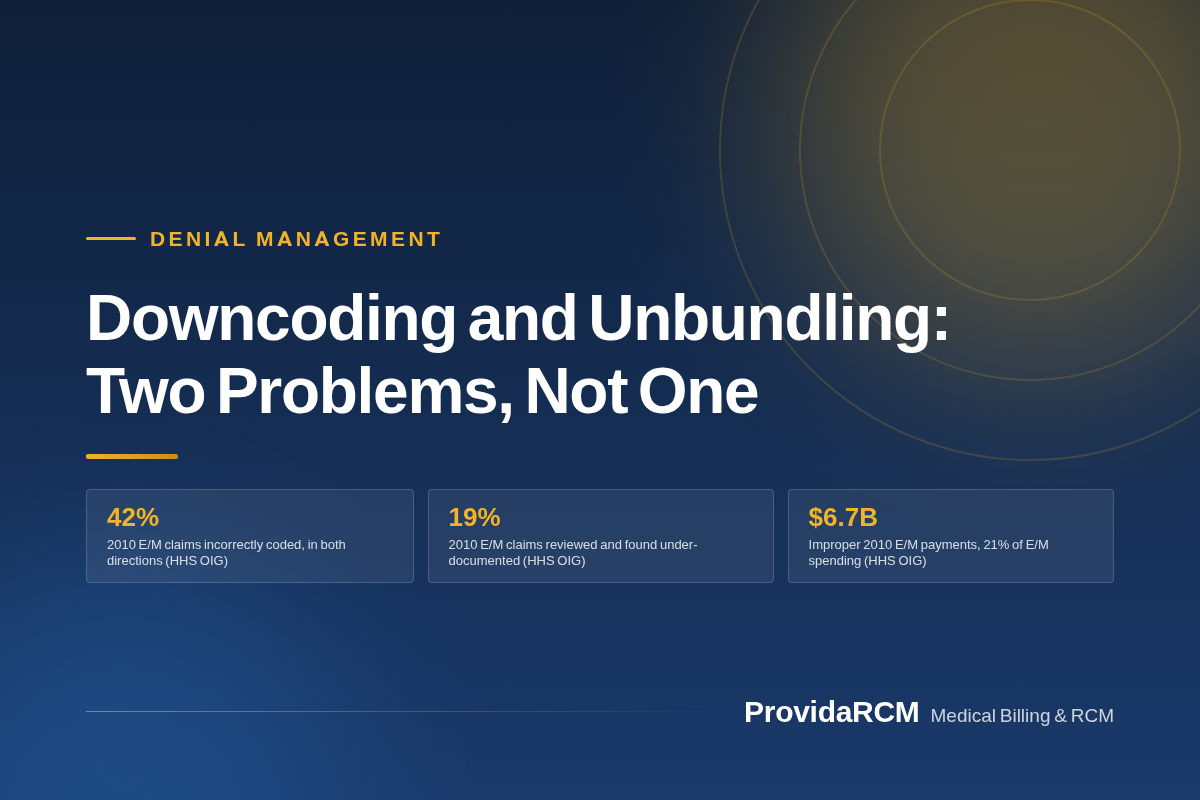
The cost of confusing them is measurable. The HHS Office of Inspector General reviewed a sample of 2010 Medicare claims for evaluation and management services and found that 42 percent were incorrectly coded, counting both claims billed above the documented level and claims billed below it, and 19 percent lacked documentation. Medicare paid $6.7 billion that year for E/M services coded or documented in error, about 21 percent of what it spent on those visits.
What the 2010 E/M record review found
Source: HHS Office of Inspector General, Improper Payments for Evaluation and Management Services Cost Medicare Billions in 2010, OEI-04-10-00181, 2014.
| What happened | Who caused it | What you see on the remittance | What fixes it |
|---|---|---|---|
| Payer paid a lower level than billed | The payer’s own edit, or a gap in the record | The allowed amount drops, and the paid code may differ from the code submitted | The record, when it supports the level that was billed |
| Payer paid once for two services | The payer’s bundling policy | The second service is zeroed with a bundling reason code | A modifier the edit permits, plus a note that shows the services were separate |
| Practice reported components of one code | The practice | An edit fires before payment is made | Correct the coding; an edit that allows no modifier cannot be rescued |
Downcoding claims: reading the lower payment on the 835
A downcode is a payer paying less because it decided the service was worth a lower code or a lower level, not because your charge exceeded an allowed amount. The tell sits on the 835. When the payer pays a different code than the one submitted, or pays a lower level of the same family, the payment reflects the payer’s version of the service rather than the provider’s.
This is the line between a downcode and a fee schedule change, and practices cross it constantly. A contractual reduction keeps your code and trims the allowance to the contracted or fee schedule amount, which X12 reports with CARC 45, the code for a charge that exceeds the fee schedule, maximum allowable, or contracted rate. CARC 45 is pricing, not a downcode. There is nothing to appeal, because the plan is applying the number the contract already set.
| What the remittance shows | The code on the line | What it means | Can the record overturn it? |
|---|---|---|---|
| Paid code differs from the billed code | A payer-specific adjustment | The payer recoded the service to the level it would allow | Yes, when the note supports the level billed |
| Charge exceeds fee schedule or contracted rate | 45 | A contractual write-off, not a denial | No. The contract set the price |
| Benefit is included in another service already adjudicated | 97 | The payer bundled one service into another allowance | Sometimes, with a modifier the edit permits |
| Procedure code is inconsistent with the modifier used | 4 | The modifier and the code do not fit, per the current X12 wording | Yes, by correcting the modifier or the code |
| Claim lacks information or has a submission error | 16 | A required element is missing or inconsistent | Yes, by supplying what the payer says is missing |
Three reasons a payer downcodes a claim
The first cause belongs to the practice. A reviewer opens the note, cannot find the elements that justify the level billed, and pays the level the note does support. This is the downcode you can win, because the answer is a better note rather than a different argument. The encounter was often the same; the documentation did not carry the level.
The second cause is an edit the payer owns. Payers run their own code pairs and level rules on top of the national ones, and those edits are not published the way the NCCI edits are. A claim can clear every national rule and still come back at a lower level because of a rule only that payer applies to its own membership.
The third is an automatic downgrade, where a system reduces the level or the units without a reviewer reading the note. These show up as a pattern: the same code reduced the same way on every claim from a provider, a place of service, or a plan. Volume without variation is the signature of a system rule rather than a judgement about your documentation, and it is the cheapest kind to identify.
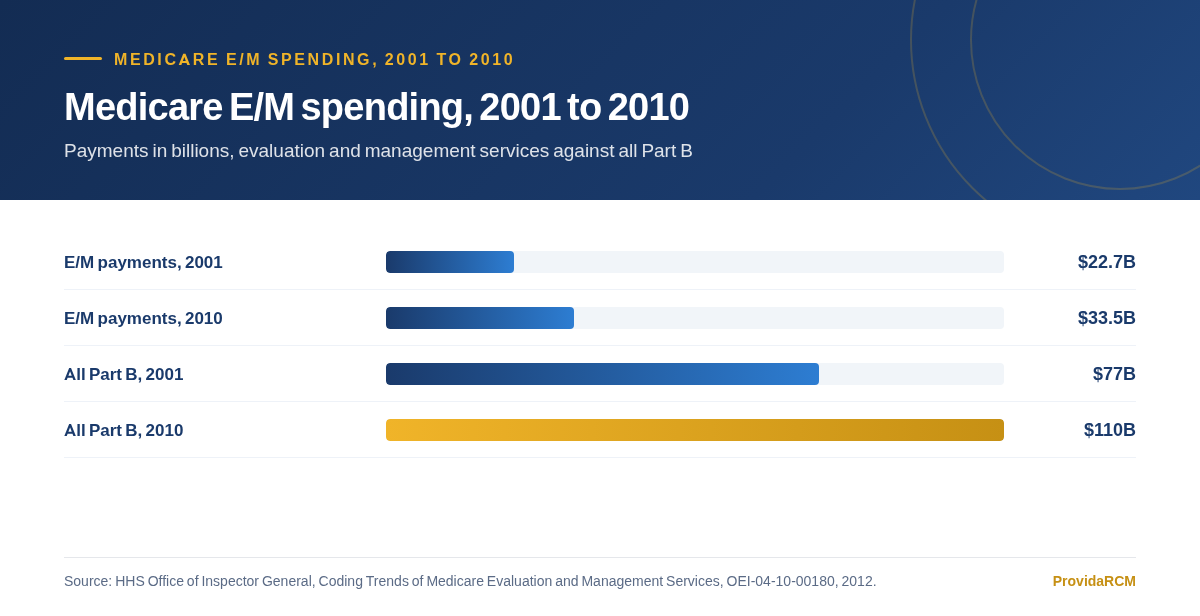
E/M payments grew faster than all Part B, 2001 to 2010
Source: HHS Office of Inspector General, Coding Trends of Medicare Evaluation and Management Services, OEI-04-10-00180, 2012.
If the payer paid your code at the contracted rate, CARC 45 is doing its job and there is nothing to reopen. If the payer paid a different or lower code, you have a coding and documentation question, and the record is the evidence. Filing an appeal against a contractual reduction spends staff time for no return, and it trains the team to treat every adjustment as a denial.
- Check whether the paid code matches the billed code before anything else
- Read the adjustment reason on the line: 45 is pricing, not a denial
- Look for volume without variation, which points to an automatic downgrade
- Pull the note and see whether it supports the level that was billed
- Compare the plan’s payment policy to the paid amount before you appeal
Unbundling runs in both directions
The first direction is the practice’s. Two codes are submitted when one would have covered both, and the payer treats the smaller one as part of the larger. Medicare controls this with the NCCI procedure-to-procedure edits, pairs of HCPCS or CPT codes that CMS says may not be reported together except under special circumstances.
Each edit carries a modifier indicator, and the indicator decides the fight. CMS sets out three values in Chapter I of the NCCI Policy Manual: a modifier indicator of 0 means no NCCI-associated modifier can bypass the edit, a modifier indicator of 1 means the edit may be bypassed with an appropriate modifier under the right circumstances, and a modifier indicator of 9 means the edit has been deleted and the indicator no longer applies.
| Modifier indicator | What CMS says it means | What it means for the claim |
|---|---|---|
| 0 | No NCCI-associated modifier can be used to bypass the edit | The pair is not separately payable, and a modifier will not change that |
| 1 | An NCCI-associated modifier may bypass the edit under appropriate circumstances | The services can be paid separately when the record shows they were distinct |
| 9 | The edit has been deleted and the modifier indicator is not relevant | There is no edit on this pair to bypass |
The second direction is the payer’s. When a practice reports a genuinely separate service and the payer folds it into another, the line comes back with a bundling reason. CARC 97 says the benefit for the service is included in the payment or allowance for another service that has already been adjudicated. It is the payer saying one allowance covers both services, and it is the code that turns a legitimate separate service into a written-off line.
The same claim can be either, and the record decides
Here is the part no code list settles. Two services on a claim look identical on the 835 whatever the truth is. The same pair that is an improper unbundle in one chart is a legitimate separate service in another, and the difference is never the code. It is whether the record shows the work that made the two services distinct.
Distinctness has a small number of shapes in NCCI policy: services at separate patient encounters, at separate anatomic sites, or as separate procedures. A modifier asserts one of those relationships, and the note has to establish it in the provider’s own words. The manual is direct that documentation must satisfy the criteria of any modifier that is used, which is the standard an appeal will be judged against.
- 01
Find the edit first
Look the pair up in the NCCI procedure-to-procedure file before deciding anything. If there is no edit, a bundling denial is the payer’s policy rather than the national rule.
- 02
Read the modifier indicator
Indicator 0 ends the conversation. Indicator 1 means a modifier can be supported. Indicator 9 means there is no edit left to argue about.
- 03
Test the record against distinctness
Can the note show a separate encounter, a separate site, or a separate procedure? If it cannot, no modifier will hold under review.
- 04
Match the modifier to the fact
Use the modifier that describes what the record shows. A general modifier where a specific one fits is the claim a payer reverses.
- A separate encounter, site, or procedure, stated plainly in the note
- The reason each service was medically necessary on its own
- The anatomic site or session, when the modifier depends on it
- The specific modifier, chosen for the fact the note establishes
- The same facts the claim reports, with nothing added after the fact
If the record carries those five things, the claim is a separate service and is worth appealing. When it carries two of them, the claim is an unbundle, and resubmitting it with a stronger modifier spends a filing window on a line that will come back the same way. The record decides, and the decision is usually visible before the appeal is written.
Turning the distinction into a workflow
The distinction only helps if the team works it. Sort every reduced line into three piles on the day the remittance posts: pricing reductions that need no action, downcodes that need the record, and bundling reductions that need the edit checked. The first pile is closed, the second goes to coding with a documentation request, and the third goes to whoever owns modifiers.
Two numbers tell you whether the sorting is working. The first is the share of reduced lines paid at a lower code than billed, split by payer; a spike on one payer is a policy or edit change, not a sudden drop in your documentation. The second is the share of bundling lines overturned on appeal. A rate that stays near zero means modifiers are being appended to claims the record never supported.
The detail behind each pile is already written up on this site. The NCCI edits and modifiers guide walks the indicator values through worked examples, and the clean claim rate post shows how to measure whether the front end is doing its part. When the sorting keeps landing on the same providers, the fix is a coding review rather than more appeals, which is what our medical coding team and denial management service run together.
Ask whether the payer changed the code or changed the price. A changed price is the contract, and it is finished. A changed code is a claim about your documentation, and it is answerable with the note.
Questions practices ask us about this
What does it mean when a payer downcodes a claim?
It means the payer paid a lower level or a lower-valued code than the one billed, rather than paying your code at a reduced allowance. The signal is on the 835: the paid code differs from the submitted code, or a lower level of the same family is allowed. This is different from a contractual reduction under CARC 45, which keeps your code and applies the fee schedule or contracted rate.
Is a downcode the same as a fee schedule reduction?
No, and treating them the same wastes appeal time. A fee schedule or contractual reduction keeps the code you billed and pays the allowed amount for that code, which X12 reports with CARC 45. There is nothing to appeal because the plan is applying the number the contract set. A downcode changes the code or the level the payer paid, which is a coding and documentation question the record can answer.
What is CARC 97 telling me?
CARC 97 means the benefit for the service is included in the payment or allowance for another service that has already been adjudicated. The payer is saying one allowance covers both services, so the second line is bundled into the first. It is the reason code behind a legitimate separate service being written off, and it is answered with a modifier the edit permits plus documentation of distinctness.
Can a modifier always unbundle an NCCI edit?
No. Whether a modifier can bypass a procedure-to-procedure edit depends on the edit’s modifier indicator. An indicator of 0 means no NCCI-associated modifier can bypass it, and no modifier will change the payment. An indicator of 1 means a modifier may bypass the edit when the circumstances are appropriate and the record supports them. An indicator of 9 means the edit has been deleted.
What does a modifier indicator of 0 mean?
CMS defines it as an edit that no NCCI-associated modifier can be used to bypass. The two codes in that pair are not separately payable as submitted, so adding a modifier does not unlock payment and can invite review. The correct move is to bill the pair the way the policy expects, usually as the single comprehensive code, rather than to append a modifier and hope.
Is CARC 15 still a valid denial code?
No. X12 deactivated CARC 15 on 1 May 2018, so a remittance dated after that cannot legitimately carry it, though old crosswalks still list it. The live code for the same situation is CARC 197, which reports that precertification, authorization, notification, or pre-treatment is absent. If a current denial report shows CARC 15 volume, the code mapping is running years behind the remittance.
What documentation proves two services were separate?
A note that establishes one of the relationships the policy recognises: a separate patient encounter, a separate anatomic site, or a separate procedure. State it plainly, explain why each service was necessary on its own, and record the site or session when the modifier depends on it. The claim should report the same facts the note contains, with nothing added after the service.
Want this fixed in your practice?
We run full-cycle billing, coding, credentialing and denial work for practices across the country. Send us a few months of claims and we will show you where the money is going.
Book a free billing review- X12, Claim Adjustment Reason Codes (current list). x12.org/codes/claim-adjustment-reason-codes
- CMS, NCCI Policy Manual for Medicare Services, Chapter I, Modifiers and Modifier Indicators. cms.gov/files/document/medicare-ncci-2019-coding-policy-manual-chapter-1-pdf.pdf
- CMS, National Correct Coding Initiative (NCCI) Policy Manual for Medicare Services. cms.gov/medicare/coding-billing/national-correct-coding-initiative-ncci-edits/medicare-ncci-policy-manual
- HHS Office of Inspector General, Improper Payments for Evaluation and Management Services Cost Medicare Billions in 2010 (OEI-04-10-00181). oig.hhs.gov/reports/all/2014/improper-payments-for-evaluation-and-management-services-cost-medicare-billions-in-2010
- HHS Office of Inspector General, Coding Trends of Medicare Evaluation and Management Services (OEI-04-10-00180). oig.hhs.gov/reports/all/2012/coding-trends-of-medicare-evaluation-and-management-services
- CMS MLN Matters, MM10082, Quarterly Update to the NCCI Procedure to Procedure Edits. cms.gov/Outreach-and-Education/Medicare-Learning-Network-MLN/MLNMattersArticles/downloads/MM10082.pdf