Whether to appeal denied claims is a cost question with four possible answers: appeal, correct and resubmit, move the balance to the patient, or write it off. The deciding numbers are what the denial is worth, what it costs to work, and whether the cause will repeat next month.
What one denial costs to work, and what it is worth
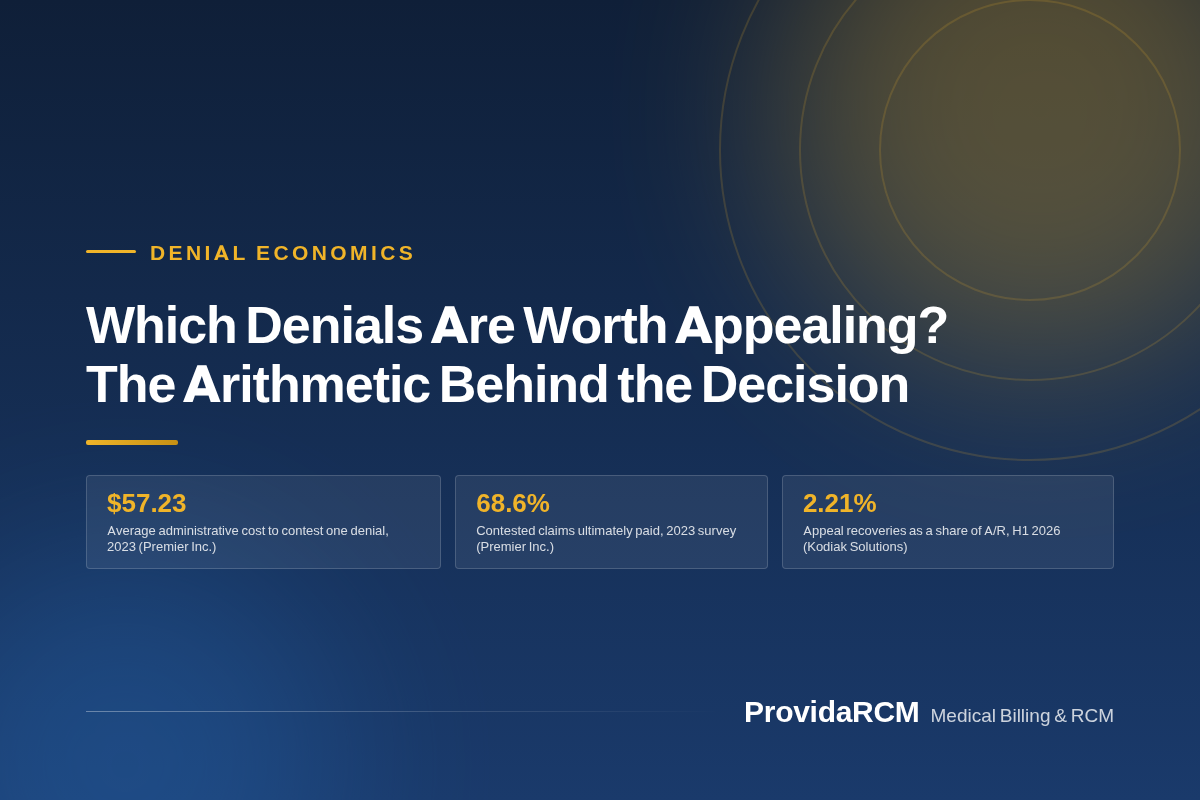
Premier Inc. surveyed 280 hospitals across 23 states and asked them to account for every claim from January 1 to December 31, 2023. The average administrative cost of contesting one denied claim came to $57.23, up from $43.84 for 2022 (Premier published the survey). Labor was the main driver of the increase.
Set that against what the claim pays. A practice collecting an average allowed amount of $140 on an office visit spends $57.23 of staff time to chase $140, and the appeal can still lose. At that ratio the decision is not obvious, which is how a lot of recoverable money gets written off by default.
Average administrative cost to contest one denied claim
Source: Premier Inc., national survey of 280 hospitals across 23 states, claims from January 1 to December 31, 2023.
The default is wrong in one specific case. A denial caused by a configuration error is not a single claim. It is a rate. If a clearinghouse field defaults to the wrong place of service, or an authorization flag is keyed to the wrong payer ID, every claim the practice submits carries the same defect.
Work one denial of that type and you recover one claim. Find the configuration behind it and you recover every claim it touched, including the ones the payer already denied and the ones not yet submitted. A $45 denial is worth appealing when it is the visible edge of a repeatable error.
Ask one question before deciding: is this denial a one-off, or the first of a series? A one-off is worth the claim value. A configuration error is worth the run rate, which is why a low-dollar denial sometimes justifies more work than a high-dollar one.
Four categories that should not be appealed
An appeal asks a reviewer to change a determination. When there is no determination to change, or the determination is factually correct, no amount of drafting fixes the claim. These four categories fail on the facts, not on the paperwork.
| Denial | Why an appeal cannot win | What to do instead | Signal on the remittance |
|---|---|---|---|
| Contractual adjustment | The gap between charge and contracted rate is a required write-off, not a disputed amount | Post the adjustment and reconcile the payment | CARC 45 on the line |
| Valid patient responsibility | The deductible, coinsurance or copay is the member’s obligation under the plan | Bill the patient and manage the balance | Group code PR on CARC 1, 2 or 3 |
| No initial determination | A claim the payer never adjudicated carries no appeal right | Correct the claim and submit it, or file a new claim | A rejection or return-to-provider notice |
| Deadline already run | The filing or appeal window closed, and no appeal reopens it | Write it off, then fix the process that let it age | CARC 29 or 286 |
The third row is the one practices misread. A claim that never reached adjudication is a rejection, not a denial. CMS states the point plainly: a return-to-provider claim is not subject to a reopening because no initial determination was made, and an item never billed on the original claim has no determination to reopen (CMS MLN Matters MM4147). Correct the claim or submit it as new.
The fourth row is arithmetic rather than administration. Once the timely filing window has closed, the money is gone and the only recoverable thing is the cause. Medicare allows a first-level redetermination to be filed within 120 days of receiving the initial determination, and CMS presumes the remittance arrived five calendar days after its notice date.
CARC 15, the old authorization-number error, stopped on 1 May 2018. The live X12 list still shows that row with its stop date attached. A dashboard reporting CARC 15 volume today is mapping to a code that has not existed for years. The current code for an absent authorization is CARC 197, which X12 last modified on the same date.
Five categories that usually should be appealed
The other side of the list is where the money sits. Each of these denials turns on a factual question, and the record can answer that question in the practice’s favor. That is what separates a winnable appeal from a written complaint.
| Denial type | What has to be true to win | Where the proof lives | Typical CARC |
|---|---|---|---|
| Authorization absent, retro path open | The payer allows a retroactive request and the service met its criteria | The clinical note plus the payer’s retro policy | 197 |
| Medical necessity | The record establishes the specific criterion the payer cited | Quoted chart lines matched to the payer’s own policy | 50 |
| Coding or modifier dispute | The documentation supports the code originally billed | The visit or operative note and the code definition | 5, 11 or 97 |
| Coordination of benefits order | The wrong payer was billed first, or the order was never updated | Eligibility history and the other plan’s determination | 22 |
| Duplicate or bundling | The services were distinct, or the duplicate flag is wrong | Modifier rationale and the edit in question | 18, 97 or 234 |
Authorization is the clearest case. CARC 197 says the precertification, authorization, notification or pre-treatment requirement was absent. Some plans accept a retroactive request, some refuse it, and some have removed retro review entirely. The provider manual decides, so the first step is confirming that a retro path exists for that plan and that service.
Medical necessity appeals are won on quotation. A denial under CARC 50 was a coverage opinion, and the reviewer will apply the payer’s policy to the record. The appeal that wins cites the exact criterion and the exact line in the note that satisfies it.
Share of contested claims ultimately paid
Source: Premier Inc., national survey of 280 hospitals; the 2023 figure as Premier reported it, the 2022 figure from Premier’s prior-year analysis as reported by Fierce Healthcare.
Premier reported that 68.6% of the claims contested in 2023 were ultimately paid, against a 54% ultimate payout rate in its 2022 analysis (Fierce Healthcare reported the comparison). Two thirds is the honest headline. Appeals win often enough that a threshold drawn only on dollar value gives away recoverable revenue, which is why the routing questions matter more than the amount.
When to appeal denied claims instead of correcting the claim
Four routes absorb every denial. An appeal is one of them and it is the most expensive, so the cheaper routes should be ruled out first. The routing runs on a short set of questions, asked in order, and the first answer that fits decides the route.
- Was there an initial determination? If the claim was rejected or returned before adjudication, there is nothing to appeal. Correct the claim and resubmit it.
- Is the payer’s stated reason factually wrong? If the code, the modifier or the payer order was right, the route is an appeal, because the record contradicts the determination.
- Is the stated reason factually right? If the documentation does not support the code billed, or the authorization was genuinely never obtained, the route is a correction or a retro request.
- Is the amount patient responsibility under the plan? Deductible, coinsurance and copay belong on the patient’s statement, not in an appeal queue.
| Route | Test that lands here | What it recovers | Where it ends |
|---|---|---|---|
| Appeal | A determination exists and the facts contradict it | The allowed amount on that claim | The payer’s final appeal level |
| Correct and resubmit | The claim or the data on it was wrong | The claim, once it adjudicates cleanly | A paid remittance or a new denial |
| Patient responsibility | The balance is the member’s obligation under the plan | The patient balance, not the payer’s share | Statement, then collections |
| Write-off | No determination, no remedy, or a closed window | Nothing on this claim | A root-cause fix upstream |
The common error is sending a factually correct denial up the appeal chain. A bundling denial that the documentation does not actually support is a correction, not an appeal, and filing it as an appeal consumes a window on a claim that will lose at every level. Route on the facts first, then on the money.
Do the appeals earn their cost, per payer
An appeal that wins is still a cost, and the return on that cost is moving the wrong way. Kodiak Solutions analyzed claims and financial data from more than 2,300 hospitals and 375,000 physicians. Recoveries after appeal fell to 2.21% of accounts receivable in the first half of 2026 from 2.48% a year earlier, while takebacks rose to 1.57% from 1.38% (Healthcare Finance News reported the analysis).
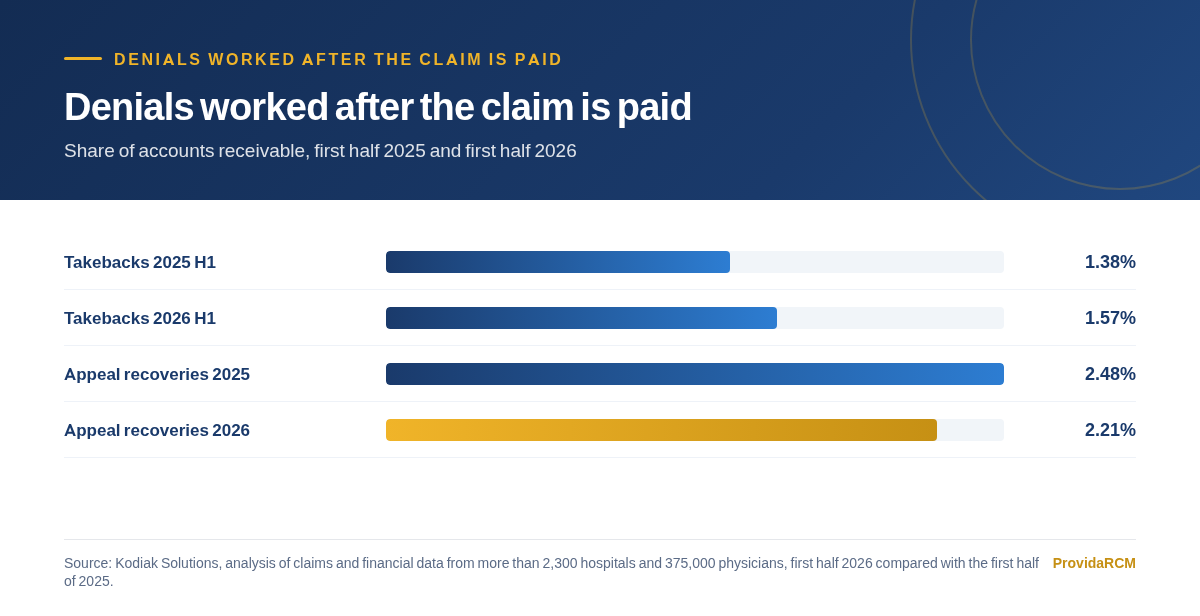
The two figures tell you appeals are getting harder and takebacks are getting more common. Neither is a verdict on your team’s work. Both are reasons to measure the return on appeal per payer instead of as one house number that hides which contracts are worth the effort.
| Metric | The base it must be measured against | What a bad reading looks like | Who defines it |
|---|---|---|---|
| Initial denial rate | Claims submitted in the period, by count and by dollars | Rising for two straight months | HFMA Claim Integrity Task Force |
| Percentage of initial denials overturned | Denials appealed in the same period, numerator and denominator matched | Below that payer’s own pattern | HFMA Claim Integrity Task Force |
| Denial write-offs | Net patient service revenue for the month, net of recoveries | Creeping up while the denial rate falls | HFMA MAP Key AR-6 |
| Appeal recovery with one payer | Accounts receivable held with that payer | Falling while that payer’s takebacks rise | Kodiak Solutions, as reported |
HFMA’s Claim Integrity Task Force published standard definitions for this reason. A denial rate without a stated base cannot be compared across payers or across quarters, and two practices can report the same number while measuring different things. Its write-off metric is net dollars written off as a denial in the month, net of recoveries, against net patient service revenue.
The Medicare levels add a floor to the arithmetic. A first-level redetermination has no minimum monetary threshold, but a hearing before an administrative law judge requires the amount remaining in controversy to clear a threshold that CMS adjusts each year. For calendar year 2026 that figure is $200. Small claims can be appealed, but only the early levels are free of a dollar bar.
Turning the decision into fewer denials next quarter
Every denial that reaches an appeal is a claim that failed once already. The return on the appeal is the money on that claim. The return on the root cause is every claim after it. Practices that only count the first return keep paying the second one forward.
MGMA’s January 2026 poll found that 48% of medical group leaders named denials and appeals their largest source of revenue leakage, against 23% who named front-end issues. MGMA’s benchmarking puts first-submission denials at 7% to 8% across the past four years, and its 2025 Financials and Operations report suggests targeted process fixes can push below 5%.
- Log every denial by cause category rather than by code alone, so a repeat pattern stays visible
- Route each cause to the person who can change the upstream setting, not to the appeal desk
- Re-run the same report in 60 days and check the volume for that cause
- Compare appeal recovery per payer against the cost of working those appeals
The decision rule and the workflow are two halves of one job. The routing logic here decides what each denial is worth. The queue and the ownership behind it decide whether the work happens on time, which is the subject of our post on the denial management workflow. If a code on the remittance is what you need to identify first, claim denial codes explained sets out the families.
We work this as a service through denial management, sitting on top of full-cycle medical billing and AR management. The team that works the appeals is the team that scrubs the claims, so a configuration fix lands upstream instead of in a folder. When prior authorization is the cause behind the repeats, a prior authorization review of the last 90 days usually shows the pattern inside a week.
Questions practices ask us about this
How do I decide which denied claims are worth appealing?
Run the claim through four questions in order. Was there an initial determination? If not, correct and resubmit. Is the payer’s stated reason factually wrong? If so, that is a real appeal. Is the reason factually right and the money owed by the plan? Then it is a correction or a retro request. Is the balance the member’s obligation? It moves to the patient. Set the answer against what the denial is worth and what it costs to work it.
Should a practice ever appeal a small-dollar denial?
Yes, when the cause is a configuration error rather than a one-off. Premier Inc. puts the average administrative cost of contesting one denial at $57.23, which is more than many small claims pay. But a denial caused by a wrong field default or a mismatched payer ID is a rate, not a claim. Fixing the configuration recovers every claim it touched, so the value of the appeal is the run rate rather than the single claim.
What kind of denial cannot be appealed at all?
One where no initial determination exists, and one where the determination is correct. CMS states that a return-to-provider claim is not subject to a reopening because no initial determination was made, and an item never billed on the original claim has no determination to reopen. A contractual adjustment under CARC 45 and a valid patient-responsibility amount also cannot be appealed, because the payer applied the contract or the benefit correctly.
How long do we have to appeal a Medicare denial?
A first-level redetermination must be filed with the MAC within 120 days of receiving the initial determination, and CMS presumes the remittance arrived five calendar days after its notice date. There is no minimum monetary threshold at that level. A hearing before an administrative law judge requires the amount remaining in controversy to clear a threshold CMS adjusts annually, set at $200 for calendar year 2026.
What does CARC 197 mean and when does it support an appeal?
CARC 197 says the precertification, authorization, notification or pre-treatment requirement was absent. It replaced the retired CARC 15, which stopped on 1 May 2018. It supports an appeal when the payer allows a retroactive authorization request and the record shows the service met the plan’s criteria. Some plans refuse retro review, so confirm the payer’s policy before building the appeal around a retro path.
How do we tell whether our appeals are earning their cost?
Track appeal recovery per payer against the accounts receivable held with that payer, not as one blended number. Kodiak Solutions reported that recoveries after appeal fell to 2.21% of accounts receivable in the first half of 2026 from 2.48% a year earlier, while insurer takebacks rose. HFMA’s Claim Integrity Task Force defines the supporting metrics, including the percentage of initial denials overturned and denial write-offs against net patient service revenue.
Want this fixed in your practice?
We run full-cycle billing, coding, credentialing and denial work for practices across the country. Send us a few months of claims and we will show you where the money is going.
Book a free billing review- X12, Claim Adjustment Reason Codes (current list). x12.org/codes/claim-adjustment-reason-codes
- Premier Inc., Claims Adjudication Costs Providers $25.7 Billion (national survey of 280 hospitals, 2023 claims). premierinc.com/newsroom/policy/claims-adjudication-costs-providers-257-billion-18-billion-is-potentially-unnecessary-expense
- Kodiak Solutions analysis of denial and takeback trends, first half 2026, reported by Healthcare Finance News. healthcarefinancenews.com/news/lower-denials-do-not-lead-improved-cash-performance-hospitals
- HFMA Claim Integrity Task Force, Standardizing denial metrics for revenue cycle benchmarking and process improvement. hfma.org/guidance/standardizing-denial-metrics-revenue-cycle-benchmarking-process-improvement
- MGMA Stat, Days in A/R holds steady but payer pressure persists in 2026 (July 2026). mgma.com/mgma-stat/days-in-a/r-holds-steady-for-most-practices-but-payer-pressure-persists-in-2026
- CMS, First Level of Appeal: Redetermination by a Medicare Contractor. cms.gov/medicare/appeals-grievances/fee-for-service/first-level-appeal-redetermination-medicare-contractor
- CMS MLN Matters MM4147, claims with clerical errors processed as reopenings rather than appeals. cms.gov/outreach-and-education/medicare-learning-network-mln/mlnmattersarticles/downloads/mm4147.pdf
- CMS, Hearing by an Administrative Law Judge (amount in controversy thresholds). cms.gov/medicare/appeals-grievances/managed-care/hearing-administration-law-judge
- Fierce Healthcare, Premier’s 2023 claims adjudication analysis and the 2022 payout comparison. fiercehealthcare.com/providers/providers-potentially-wasted-almost-18b-2023-overturning-claims-denials-premier-estimates