A practice cannot bill for a new provider until four enrollment tracks finish, and they run in order: identifiers, an attested profile, Medicare and state Medicaid, then each commercial payer and the hospital. This is the checklist to credential new provider files, with the owner of every step and the money held up while an application is pending.
The four enrollment tracks a new provider runs at once
A new provider does not have one enrollment. There are four separate tracks, owned by four different parties, and each runs on its own clock. Medicare is run by CMS through a Medicare Administrative Contractor. State Medicaid is run by the state Medicaid agency. Commercial participation is run by each health plan. Hospital privileges are run by the hospital medical staff office.
The order matters because the tracks feed each other. A Type 1 NPI and an active state license exist before any of them start. The CAQH profile carries the data the commercial payers read. A hospital letter of good standing answers the affiliation question on several payer applications. Filing out of order leaves a file waiting on a document that has not been created yet.
| Track | Who owns it | What it gates | What must exist first |
|---|---|---|---|
| Medicare Part B | CMS, through the MAC | Medicare billing privileges and the effective date | Type 1 NPI, active license, CMS-855I or CMS-855B |
| State Medicaid | The state Medicaid agency | Medicaid billing for that state only | That state’s own application and screening |
| Commercial payers | Each health plan | In-network rates and the directory listing | An attested CAQH profile authorized to each plan |
| Hospital privileges | The hospital medical staff office | Admitting and procedure rights at that hospital | The medical staff application and peer references |
Nothing in the commercial track can advance until the identifiers and the CAQH profile exist, because the payer reads them first. Build the base data once, then file every application against it rather than rebuilding it per plan.
Identifiers first: how to credential new provider files in order
Before a single application goes out, the identifiers have to exist. CMS requires an enrollment application to carry documentation that uniquely identifies the provider: the legal business name, the practice location, the Social Security number, the tax identification number, the National Provider Identifier, and the owners of the business. 42 CFR 424.510 lists that set, and payer applications ask for the same items.
The Type 1 NPI identifies the individual clinician and is issued to the person. The Type 2 NPI identifies the organization that bills. A practice that files a payer application with only one of them hands the payer an incomplete record, and the file sits until the second number is supplied. Confirm both exist, and confirm the legal business name on the NPI record matches the name on the W-9.
| Item | What it is | Needed by | Owner |
|---|---|---|---|
| Type 1 NPI | The individual clinician’s identifier | Every track | The provider |
| Type 2 NPI | The billing organization’s identifier | Medicare, Medicaid, commercial | The practice |
| Active state license | The license for each state of practice | Every track | The provider |
| TIN and legal business name | The entity the claims are paid to | Medicare, Medicaid, commercial | The practice |
| Malpractice policy | Carrier, policy number, limits, expiry dates | Commercial credentialing, hospital | The practice |
| Attested CAQH profile | The shared credentialing record | Commercial payers, hospital | Credentialing coordinator |
The CAQH profile is the base data the commercial payers read. Every payer you authorize pulls from it, so the profile has to be complete and attested before the first application, not after. The attestation mechanics and the fields that block it are covered in the CAQH ProView guide. Keep that record current and the commercial track starts from a clean file.
- Confirm the Type 1 and Type 2 NPI are active and linked to the right legal name
- List every state of practice with a current, unrestricted license
- Enter the malpractice carrier, policy number, limits and expiry on the profile
- Authorize each target payer to pull the CAQH profile before filing
- Match the group name on the profile to the name that will appear on the claim
The Medicare path: CMS-855I, CMS-855B and PECOS
Medicare enrollment runs through CMS. A physician or non-physician practitioner files the CMS-855I, which enrolls physicians and non-physician practitioners who render Part B services. A clinic or group practice files the CMS-855B. Filing the wrong form sends the application back before anyone reviews it.
PECOS is CMS’s online enrollment system and the faster path. Enrollment Applications on the CMS site lets a provider review what is on file, upload documents, sign and submit without paper. The paper form still works, but it carries the same questions and a longer processing tail.
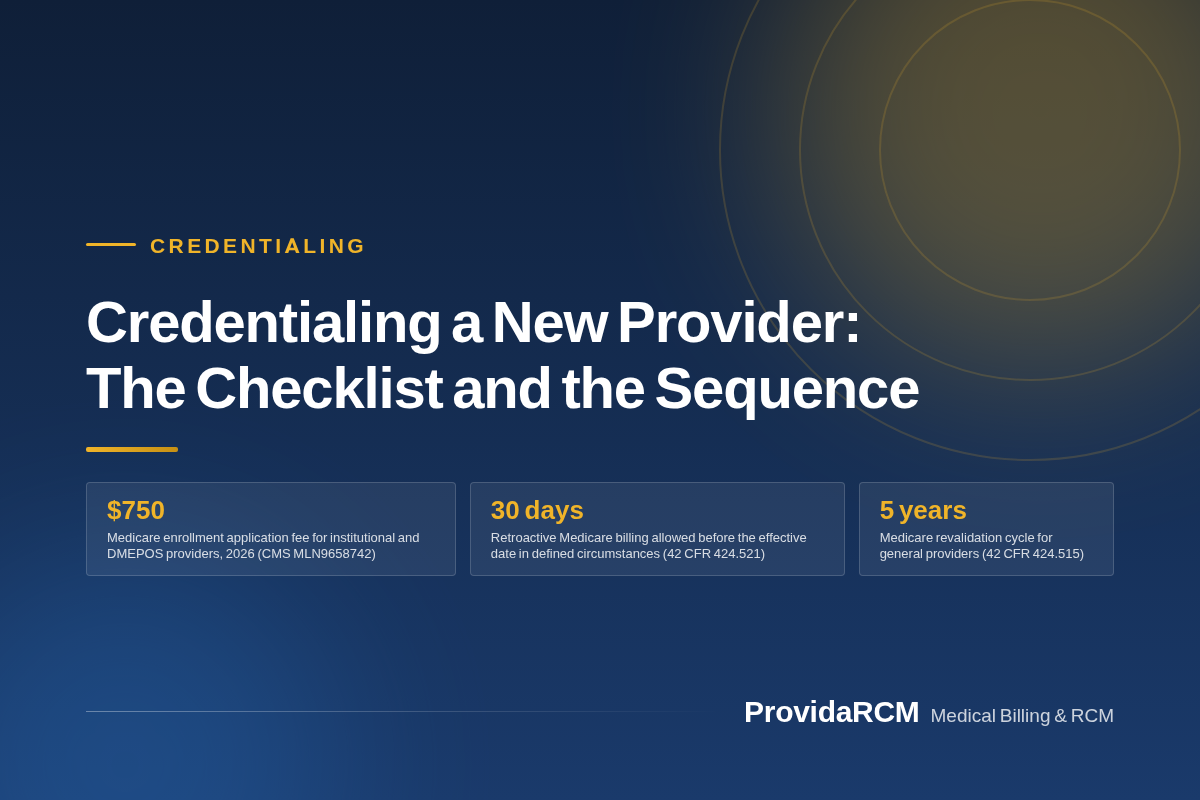
Physicians, non-physician practitioners and their organizations do not pay a Medicare enrollment application fee. Institutional providers and DMEPOS suppliers generally do, and the fee for 2026 is $750. A MAC processes an application only with the fee paid or a hardship exception on file. If the fee is missing, the MAC sends a letter and allows 30 days to pay before it may reject or deny the application.
Medicare enrollment application fee, 2026
Source: CMS, Medicare Provider Enrollment (MLN9658742).
The effective date, not the filing date, decides the money
For a physician or non-physician practitioner, Medicare’s effective date is the later of two dates: the date the enrollment application was filed and subsequently approved, or the date the provider first began furnishing services at the new practice location. 42 CFR 424.520 sets that rule. The later date wins, so filing early cannot buy an earlier effective date than the day services began.
That is the money point. A practice cannot bill Medicare for services furnished before the effective date, and the effective date cannot run ahead of the filing date. There is one carve-out. Under 42 CFR 424.521, a physician may retrospectively bill for services furnished up to 30 days before the effective date when circumstances precluded enrolling in advance, or up to 90 days when a Presidentially-declared disaster did.
How far back Medicare lets a new provider bill retroactively
Source: 42 CFR 424.521.
| Track | Blocked until | The owner who sets the date |
|---|---|---|
| Medicare Part B | The effective date under 42 CFR 424.520, subject to the 424.521 carve-out | CMS and the MAC |
| State Medicaid | That state’s own approval and effective date | The state Medicaid agency |
| Commercial payers | Each plan’s own effective date, which is not automatically retroactive | Each health plan |
| Hospital services | The date privileges take effect | The medical staff office |
The commercial rule is not the Medicare rule. Each plan sets its own effective date, and whether a plan backdates participation is that plan’s decision, not an industry standard. Do not assume a backdated start. Confirm the effective date in writing with each payer before the first patient is seen under that contract, and hold the start date until it is confirmed.
- Sequence the start date after the effective date, not after the application date
- File Medicare before the provider begins furnishing services at the new location
- Ask each payer to confirm the effective date in writing rather than approval alone
- Use the 30-day retrospective window only where circumstances precluded earlier filing
State Medicaid, commercial payers and hospital privileges
There is no national Medicaid application. 42 CFR 455.410 requires a state Medicaid agency to enroll and screen providers, and each state runs its own portal, its own forms and its own effective date. The Medicaid Provider Enrollment Compendium compiles how the states do it. A provider licensed in four states files four Medicaid enrollments, one per state.
Commercial payers each run their own application. UnitedHealthcare’s network join page lists what a provider must have ready: a One Healthcare ID, licensing and certification details, an NPI, a W-9, work and education histories, a liability face sheet, and a current DataSpring, powered by CAQH, registration the plan is authorized to see. Joining a practice that already holds a UnitedHealthcare agreement still requires completing onboarding before the provider can see patients in-network.
Hospital privileges are the hospital’s own track, run by its medical staff office and committee, not by any payer. Where a payer application asks about admitting privileges, or the practice bills for hospital services, that file gates the rest. NCQA’s credentialing standards require verification of a practitioner’s license, medical education, sanctions history and prior malpractice cases, and the medical staff office holds the same documents.
| Track | Who owns it | First document | What stalls the file |
|---|---|---|---|
| State Medicaid | The state Medicaid agency | That state’s enrollment application | Screening or a missing state-specific document |
| Commercial payers | Each health plan | The plan’s application plus CAQH authorization | An unattested profile or a plan not authorized |
| Hospital privileges | The medical staff office | The medical staff application | Peer references or a gap in work history |
The directory and fee schedule load last
A signed contract is not a working provider record. The payer still has to load the provider into its claims system and attach the contracted fee schedule. Until both are loaded, claims can pay at out-of-network rates or deny. The sequence of that step, and the payer figures behind it, sit in the credentialing timeline.
- Confirm the effective date in writing before the first patient is seen under the contract
- Ask the payer to confirm the provider record is loaded once the contract is signed
- Confirm the contracted fee schedule is attached to the provider record
- Check the payer directory listing for the correct address, phone and specialty
- Submit a test claim through the real payer path and read the remittance
The test claim is the proof that the whole chain worked. Send one real, low-value claim through the normal submission path and read the remittance advice. If it pays at the contracted rate, the identifiers, the enrollment, the contract and the fee schedule all line up. If it denies or pays at out-of-network rates, the failure is in a specific link and the tracker should show which one.
One tracker: owner, submitted, expected, actual, re-attestation
Every track above lands in one tracker with one line per payer. The tracker holds five fields on each line: the named owner, the submission date, the expected decision date, the actual decision date, and the re-attestation or revalidation due date. Without the expected date there is nothing to chase against, and without the actual date there is no record of how long the payer really took.
| Column | What it holds | Why it matters | Owner |
|---|---|---|---|
| Owner | The named person or vendor for that payer | A file with no owner is the one that goes stale | Credentialing coordinator |
| Submitted | The date the application was filed | It anchors the Medicare effective-date rule | Credentialing coordinator |
| Expected decision | The payer’s own published or stated timeline | Chasing needs a date to chase against | Credentialing coordinator |
| Actual decision | The date the payer decided | Shows the real turnaround, payer by payer | Credentialing coordinator |
| Re-attestation due | The next attestation or revalidation date | Prevents a lapse that deactivates or stalls billing | Credentialing coordinator |
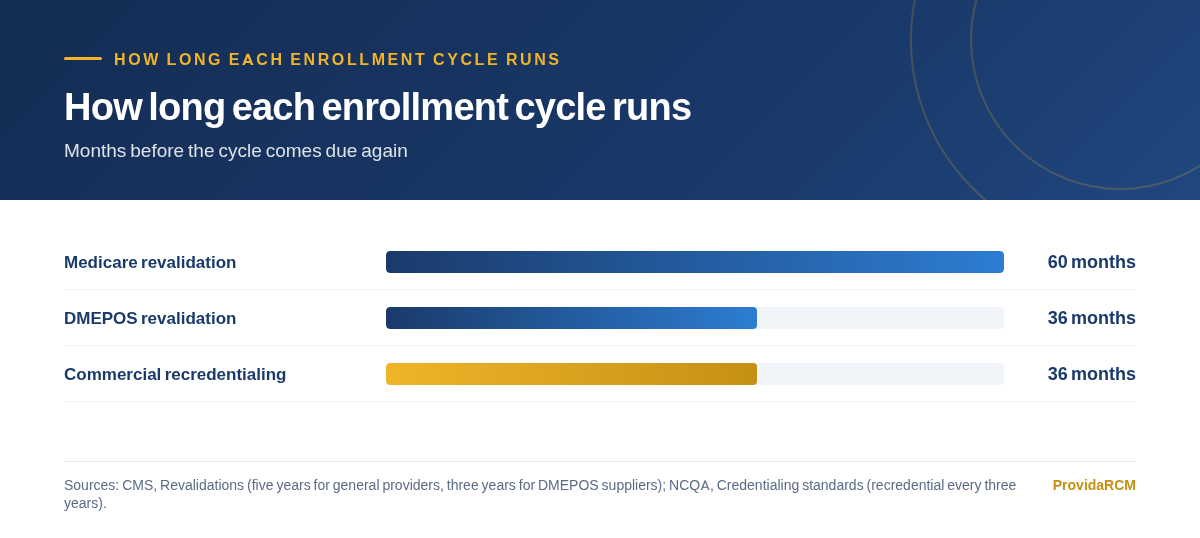
Medicare posts revalidation due dates seven months in advance and mails a notice three to four months before the date, as CMS states. A CAQH attestation runs on its own 120-day clock. Both belong on the same tracker as the payer lines, and both have their own posts: Medicare revalidation and CAQH ProView maintenance.
Questions practices ask us about this
What is the correct order to credential a new provider?
Identifiers and an attested CAQH profile come first, because every application reads them. Then Medicare and state Medicaid, because their effective dates gate billing. Then each commercial payer application, and hospital privileges where they apply. Load the directory and fee schedule after the contract, and send a test claim to prove the chain worked before the provider sees patients.
What has to exist before we can file any enrollment application?
A Type 1 NPI for the clinician, a Type 2 NPI for the billing entity, an active state license for each state of practice, the tax identification number and legal business name, a malpractice policy with current limits, and an attested CAQH profile authorized to the payers you are targeting. CMS lists the identifier set in 42 CFR 424.510.
Can we bill for a new provider while Medicare enrollment is pending?
Not on a normal basis. Medicare will not pay for services furnished before the enrollment effective date, and 42 CFR 424.520 makes the effective date the later of the filing date or the date services began. 42 CFR 424.521 allows a physician to bill retrospectively for up to 30 days before the effective date in defined circumstances, and 90 days after a Presidentially-declared disaster.
Does Medicare backdate billing privileges to the application date?
Only as far as the rule allows. The effective date is the later of the filing date and the date the provider first furnished services at the location, so filing early does not backdate payment. Medicare permits retrospective billing for up to 30 days before the effective date when circumstances precluded enrolling in advance, and up to 90 days after a Presidentially-declared disaster.
Do we have to file a separate Medicaid application in every state?
Yes. There is no national Medicaid application. Each state Medicaid agency runs its own enrollment and screening under 42 CFR 455.410, with its own forms and effective date. A provider who practices in four states needs four separate Medicaid enrollments, one from each state agency, and each one has to be tracked on its own line.
What should a credentialing tracker hold?
One line per payer, with five fields: the named owner, the submission date, the expected decision date, the actual decision date, and the re-attestation or revalidation due date. The expected date gives you something to chase, the actual date records the real turnaround, and the re-attestation date keeps a profile or enrollment from lapsing behind you.
Want this fixed in your practice?
We run full-cycle billing, coding, credentialing and denial work for practices across the country. Send us a few months of claims and we will show you where the money is going.
Book a free billing review- eCFR, 42 CFR 424.510, requirements for enrolling in the Medicare program. ecfr.gov/current/title-42/chapter-IV/subchapter-B/part-424/subpart-P/section-424.510
- eCFR, 42 CFR 424.520, effective date of Medicare billing privileges. ecfr.gov/current/title-42/chapter-IV/subchapter-B/part-424/subpart-P/section-424.520
- eCFR, 42 CFR 424.521, retrospective billing before the effective date. ecfr.gov/current/title-42/chapter-IV/subchapter-B/part-424/subpart-P/section-424.521
- eCFR, 42 CFR 455.410, state Medicaid enrollment and screening of providers. ecfr.gov/current/title-42/chapter-IV/subchapter-C/part-455/subpart-E/section-455.410
- CMS, Medicare Provider Enrollment (MLN9658742). cms.gov/Outreach-and-Education/Medicare-Learning-Network-MLN/MLNProducts/EnrollmentResources/provider-resources/provider-enrolment/Med-Prov-Enroll-MLN9658742.html
- CMS, Revalidations (Renewing Your Enrollment). cms.gov/medicare/enrollment-renewal/providers-suppliers/revalidations
- CMS, Enrollment Applications (Internet-based PECOS). cms.gov/medicare/enrollment-renewal/providers-suppliers/chain-ownership-system-pecos/enrollment-applications
- CMS, Medicare Enrollment Application: Physicians and Non-Physician Practitioners (CMS-855I). cms.gov/medicare/cms-forms/cms-forms/downloads/cms855i.pdf
- CMS, Medicare Enrollment Application: Clinics/Group Practices and Other Suppliers (CMS-855B). cms.gov/medicare/cms-forms/cms-forms/downloads/cms855b.pdf
- Medicaid.gov, Medicaid Provider Enrollment Compendium (MPEC). medicaid.gov/medicaid/program-integrity/downloads/mpec.pdf
- UnitedHealthcare, Join our network for medical providers (onboarding prerequisites). uhcprovider.com/en/resource-library/Join-Our-Network/Medical-Provider.html
- NCQA, Credentialing standards (verification scope and three-year recredentialing). ncqa.org/blog/ncqas-credentialing-standards-ensure-safety-and-integrity-of-practitioner-networks
- DataSpring (formerly CAQH), CAQH Provider Data Portal resources. dataspring.com/resources