ABA billing is built on 15-minute units, a payer authorization that names its own unit count, and a credential rule for whoever rendered the service. Get any of those three wrong and a claim that is clean on its face still denies. Here is how the code set, the units and the authorizations actually fit together.
ABA billing is a state Medicaid and commercial benefit, not a Medicare one
Most ABA billing guides start with the CPT codes and skip the part that decides whether the claim pays. Applied behavior analysis is a benefit inside state Medicaid programs and commercial plans, most often for children under EPSDT or a state autism mandate. Medicare works differently, and that difference is why no single national rule exists.
CMS has not mandated ABA for children with autism. The agency’s position is that state Medicaid agencies decide what is medically necessary, then must provide it to eligible people from birth to age 21 under EPSDT. Two neighboring states can therefore authorize ABA very differently, and they do. Read the CMS statement.
Medicare has no national coverage determination for ABA, and CMS has extended carrier pricing for the adaptive behavior codes rather than publish a national rate. BCBAs cannot enroll as independent Medicare providers. Medicare Advantage plans can cover ABA under their own internal criteria, so a Medicare Advantage patient may be covered when an Original Medicare patient is not.
A rule in a Texas Medicaid guide is not a rule in a commercial Aetna plan or a Nevada managed care contract. Every unit cap, authorization window and credential requirement here is owned by a named payer.
The ABA code set, and who may report each code
The adaptive behavior services codes took effect in 2019 and replaced the temporary codes most payers had used before. Ten are active: eight Category I codes, 97151 through 97158, and two Category III codes, 0362T and 0373T, for patients whose behavior requires additional staff. Every one is a timed code reported in 15-minute units.
| Code | What it covers | Who renders it | Unit |
|---|---|---|---|
| 97151 | Behavior identification assessment, face to face plus analysis and the written treatment plan | Physician or other qualified health care professional | 15 min |
| 97152 | Behavior identification supporting assessment | One technician, under QHP direction | 15 min |
| 97153 | Adaptive behavior treatment by protocol, one patient | Technician, under QHP direction | 15 min |
| 97154 | Group adaptive behavior treatment by protocol, two or more patients | Technician, under QHP direction | 15 min |
| 97155 | Adaptive behavior treatment with protocol modification, which may include directing a technician | Physician or other qualified health care professional | 15 min |
| 97156 | Family adaptive behavior treatment guidance, with or without the patient present | Physician or other qualified health care professional | 15 min |
| 97157 | Multiple-family group adaptive behavior treatment guidance, without the patient | Physician or other qualified health care professional | 15 min |
| 97158 | Group adaptive behavior treatment with protocol modification | Physician or other qualified health care professional | 15 min |
| 0362T | Supporting assessment for destructive behavior, professional on site with two or more technicians | Qualified professional on site, with two or more technicians | 15 min |
| 0373T | Treatment with protocol modification under the same intensive conditions | Qualified professional on site, with two or more technicians | 15 min |
One line splits the set. Codes 97152, 97153 and 97154 are technician work, delivered under a qualified professional’s direction. Codes 97151, 97155, 97156, 97157 and 97158 are the professional’s own time, reported under that professional’s NPI.
Credential is reported with a modifier as well as the provider’s name. The HCPCS set uses HM below bachelor’s level, HN at bachelor’s, HO at master’s and HP at doctoral. A claim that omits the modifier can pay at the wrong rate or deny.
How units work, and why eight units a day is not a rule
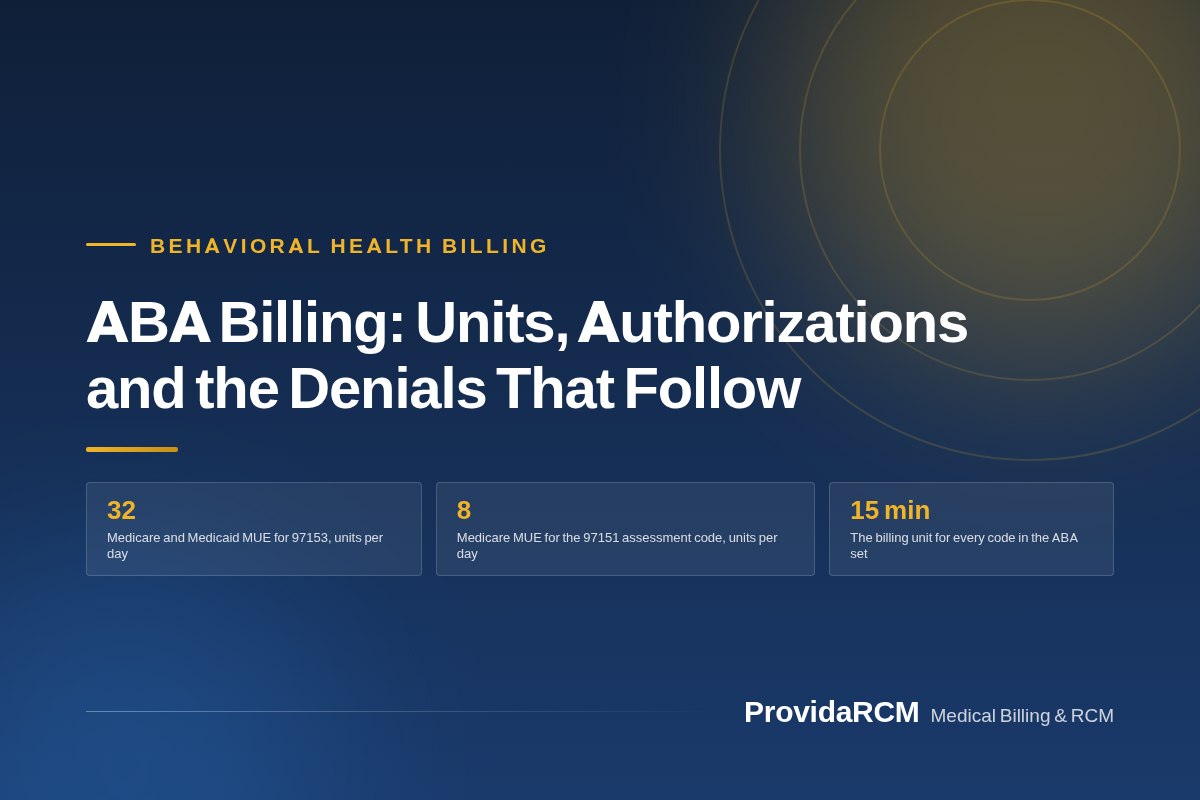
Every code in the set is a 15-minute unit. One hour is four units, a two-hour session is eight units, and a full day of direct treatment at eight hours is thirty-two. The arithmetic is the easy part. What trips practices up is the rounding rule and the daily ceiling, because the two are different things.
For a time-based code, a unit may be reported once the halfway point is passed. On a 15-minute code that is the eighth minute, so a 68-minute session rounds up to five units. The same rule decides line structure: two separate blocks of the same service on one day go on a single claim line, because splitting them reads as a duplicate.
The phrase eight units a day shows up in a lot of ABA billing advice, usually as a cap on direct treatment. The code set sets no daily unit limit. CMS does, through the NCCI medically unlikely edits, which cap the units a payer will accept for a patient on one date of service. Those caps run from 16 to 32 units for most codes.
In exactly one place the number is eight: the Medicare MUE for 97151, the assessment code, against a Medicaid MUE of 32. CMS publishes only the Medicare figures. A two-hour session is also eight units, which is a time conversion, not a limit.
CMS Medicare MUE: maximum units per patient per day
Source: ABA Coding Coalition, Medicare Practitioner Services MUE values, from the CMS NCCI medically unlikely edits.
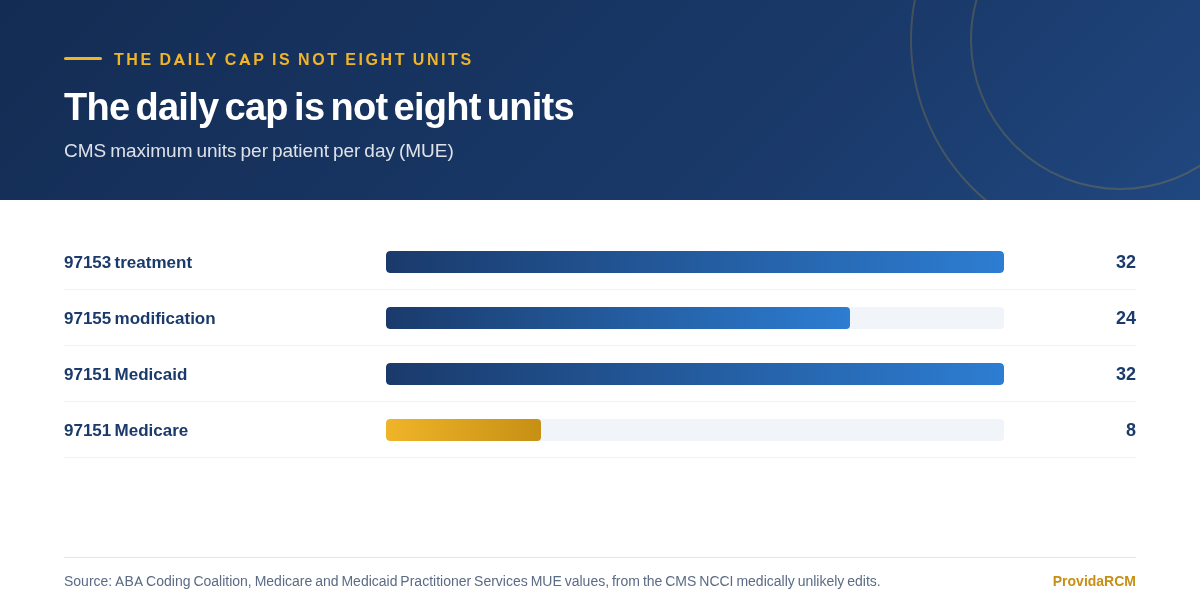
| Code | Medicare MUE | Medicaid MUE | Adjudication indicator |
|---|---|---|---|
| 97151 | 8 | 32 | 3 |
| 97152 | 16 | 16 | 3 |
| 97153 | 32 | 32 | 3 |
| 97154 | 18 | 18 | 3 |
| 97155 | 24 | 24 | 3 |
| 97156 | 16 | 16 | 3 |
| 97157 | 16 | 16 | 3 |
| 97158 | 16 | 16 | 3 |
| 0362T | 16 | 16 | 3 |
| 0373T | 24 | 32 | 3 |
An MUE is a claims-processing edit, not a benefit limit. Every adaptive behavior code carries adjudication indicator 3, which means a payer can pay past the edit when the units were delivered, coded correctly and documented as medically necessary. A denial that cites the edit alone is appealable with the session records.
What an authorization actually authorizes
An ABA authorization is a contract with five parts: the codes covered, the number of units for each code, the start and end dates, the rendering provider, and the place of service. A claim can match the codes and the dates and still deny because it fails one of the other three. An authorization number by itself proves nothing.
Units are authorized per code, not as one pool. A payer might approve 600 units of 97153 and 60 units of 97155 for six months. Spending the 97153 units faster does not free up supervision units, and running short on 97155 does not let you rebill that time as 97153. Virginia Medicaid now authorizes each treatment code with its own unit count.
The rendering provider is part of the authorization. Aetna Better Health of Virginia tells providers the authorization lives on the supervising clinician’s NPI and must match the claim’s rendering NPI, and that a change in rendering provider requires a new authorization. Bill a session under a different technician than the one named and the claim denies even though the service was authorized.
- The exact codes covered, including whether the group and caregiver codes were approved
- A unit count for each code, and whether it is per week or per authorization period
- The start and end dates, with no gap between consecutive authorizations
- The rendering provider’s NPI and credential level
- The place of service: home, clinic, community or school
Aetna sets its ABA authorization period at no more than six months and re-evaluates every six months. Evernorth, which runs Cigna’s behavioral benefit, no longer requires prior authorization for the assessment codes 97151, 97152 and 0362T when the provider is a licensed or certified behavior analyst, but still authorizes treatment.
Place of service is the part practices forget. A payer that authorizes a home program may not pay the same units delivered at a clinic address. Ask our prior authorization team to confirm which place of service an authorization covers before the first session.
Supervisor and technician credentialing, payer by payer
Two credentials are in play on every ABA claim: the qualified health care professional who designs and supervises the program, and the technician who delivers it. The Behavior Analyst Certification Board certifies technicians as Registered Behavior Technicians and professionals as BCaBAs and BCBAs. Certification is not the same as a state license, and neither equals payer enrollment.
Most payers require a supervisor to hold both a certification and a state license in states that license behavior analysts. Enrollment is a separate gate. California’s Medi-Cal enrolls BCBAs and educational psychologists as qualified autism service providers and does not enroll technicians as providers at all, so technician time is billed under the supervising professional.
| Requirement | What it means | Who owns the rule |
|---|---|---|
| Supervisor certification | BCBA or BCaBA certified by the Behavior Analyst Certification Board | Certifying body, plus every payer that requires it |
| State licensure | A separate license in states that license behavior analysts | State licensing board |
| Payer enrollment | Approval to bill a specific payer, separate from certification and licensure | Each payer or state Medicaid agency |
| Technician enrollment | Some payers credential each technician, others bill technician time under the supervisor | Each payer |
| Credential modifier | HM, HN, HO or HP flags the rendering provider’s level on the claim | Payer, with state U-modifiers as the alternative |
Supervision payers expect, as a share of direct treatment hours
Sources: Nevada Medicaid ABA billing guidelines (up to 20 percent); Aetna ABA medical necessity guide (one to two hours per ten hours of treatment); Washington HCA ABA program billing guide (at least 5 percent).
Supervision is authorized work, not overhead. If a payer expects one supervision hour per twenty treatment hours, that ratio has to appear in the units the payer approved and in each session’s documentation. A practice that delivers supervision it never authorized, or authorized and never documented, loses the units either way.
The denials that follow from each authorization mismatch
When an ABA claim denies, the reason is usually one specific mismatch between what the payer authorized and what the claim reported. The claim adjustment reason code on the remittance tells you which one.
| What went wrong | CARC | What the payer is saying | Owner of the fix |
|---|---|---|---|
| Service delivered before or after the authorization dates | CO-197 | Precertification, authorization, notification or pre-treatment absent | Authorization desk |
| Units billed past the authorized or MUE ceiling | CO-16 | Claim or service lacks information, or has a submission or billing error | Billing, after a unit reconciliation |
| Rendering provider or credential differs from the authorization | CO-197 | The authorization does not match the billed service | Authorization desk and scheduling |
| Service falls outside the payer’s coverage policy | CO-50 | Non-covered because it is not deemed a medical necessity | Clinical documentation |
| 97153 and 97155 billed as overlapping duplicates | CO-97 | Benefit is included in the payment for another service already adjudicated | Coding |
| Diagnosis or age does not support the code | CO-11 | Diagnosis is inconsistent with the procedure | Coding and intake |
| Claim filed after the payer’s window closed | CO-29 | The time limit for filing has expired | Billing operations |
CO-197 is the authorization denial, and it is worth reading carefully, because the code it replaced still causes confusion. CO-15, the old reason for a missing or invalid authorization number, was deactivated on 1 May 2018. X12 modified CO-197 on the same date. A denial report that still shows CO-15 volume is mapped to a code that has not existed on a remittance for years. Check the current list at X12.
Every field on an ABA claim can be correct and the claim can still deny, because the payer is comparing the claim to the authorization on file, not to the session note. If the authorization names 400 units and the claim reports 412, the extra 12 deny whether or not the time was delivered.
The fix for each denial sits with a different person. A date-range denial belongs to whoever renews authorizations, because a gap between two authorizations creates a denied window that is hard to recover. A unit-ceiling denial belongs to whoever reconciles authorized against billed units. A rendering-provider denial belongs to scheduling and enrollment.
Keeping a clean ABA claim from being denied
ABA denial work is mostly prevention, because the mismatches are knowable before the claim goes out. Three controls catch most of them: a live unit ledger tracking authorized against billed and scheduled units per code and client, an authorization calendar that starts renewal before the current period ends, and a credential check confirming every rendering provider is enrolled and named on the authorization.
- Track authorized units against billed units per code, per client, per authorization period
- Alert the clinical team before a code approaches its authorized ceiling
- Start reauthorization before the current period ends, with the updated treatment plan
- Confirm the rendering provider’s credential and enrollment before scheduling the first session
- Verify the authorization dates cover every date of service, with no gap
The claim follows from those controls. Bill the assessment under the qualified professional, bill technician time under the technician with the right credential modifier, keep concurrent 97153 and 97155 on matching timestamps only where the payer allows them, and reconcile units before submission rather than after the first denial.
We run this work through behavioral health and ABA billing, built on top of full-cycle medical billing, medical coding and prior authorization services. Credentialing and enrollment for supervisors and technicians sits under medical credentialing, and the denials that still land go to denial management. Our claim denial codes reference carries the full CARC and RARC wordings.
Questions practices ask us about this
How many ABA units can be billed in a day?
There is no daily unit limit in the code set. CMS sets a medically unlikely edit for each code, which caps the units a payer will accept for one patient on one date of service. For Medicare the caps run from 8 units for the 97151 assessment code to 32 units for 97153 treatment. Individual payers can set lower limits, and Texas Medicaid caps direct treatment at 32 units, or eight hours, per day.
Why is 97153 billed in units of 15 minutes and not per session?
97153 is a time-based code, so it is reported in 15-minute increments. One hour of direct treatment is four units, and a three-hour session is twelve. The unit is fixed by the code descriptor, not by the payer, though the payer decides how many units it will authorize and pay. Document the session start and stop times so the billed units can be reconciled against the note.
Can 97153 and 97155 be billed on the same day?
The CPT descriptor for 97155 allows it to include simultaneous direction of a technician, so the two codes can overlap in clock time when the professional is directing the technician and modifying the protocol. Payer policy decides whether that is payable. Vermont Medicaid prohibits billing 97153 and 97155 concurrently, on the same day at the same time, so verify the rule before billing both.
Who can bill ABA codes, a technician or a BCBA?
It depends on the code. Codes 97152, 97153 and 97154 are technician codes, delivered by a Registered Behavior Technician under a qualified professional’s direction. Codes 97151, 97155, 97156, 97157 and 97158 are the professional’s own time. Many payers require the supervising professional to hold both Behavior Analyst Certification Board certification and a state license where the state licenses behavior analysts.
What does CARC 197 mean on an ABA claim?
CARC 197 means the precertification, authorization, notification or pre-treatment requirement was absent. It is the code that replaced the retired CO-15, which X12 deactivated on 1 May 2018. On an ABA claim it usually means the service fell outside the authorized dates, the units exceeded the authorization, or the rendering provider did not match the authorization on file. Check which of those applies before you appeal.
Does Medicare cover ABA therapy?
There is no national coverage determination for ABA, and CMS has extended carrier pricing for the adaptive behavior codes rather than publish a national rate. BCBAs cannot enroll as independent Medicare providers. Medicare Advantage plans can cover ABA under their own internal criteria. The typical ABA patient is a child on Medicaid or a commercial plan, and those payers set their own rules.
Want this fixed in your practice?
We run full-cycle billing, coding, credentialing and denial work for practices across the country. Send us a few months of claims and we will show you where the money is going.
Book a free billing review- CMS, Medicare NCCI Medically Unlikely Edits (MUEs). cms.gov/medicare/coding-billing/national-correct-coding-initiative-ncci-edits/medicare-ncci-medically-unlikely-edits-mues
- Medicaid.gov, CMS FAQ on ABA and autism (FAQ 93211). medicaid.gov/faq/2020-04-14/93211
- X12, Claim Adjustment Reason Codes (current list). x12.org/codes/claim-adjustment-reason-codes
- ABA Coding Coalition, MUE values for the adaptive behavior codes. abacodes.org/advocacy
- Washington HCA, ABA Program Billing Guide, January 1, 2026. hca.wa.gov/assets/billers-and-providers/aba-services-bg-20260101.pdf
- Nevada Medicaid, ABA billing guidelines (PT 85), March 2025. medicaid.nv.gov/Downloads/provider/NV_BillingGuidelines_PT85_20250304.pdf
- Evernorth (Cigna), Intensive Behavioral Interventions policy EN0499. static.evernorth.com/assets/evernorth/provider/pdf/resourceLibrary/behavioral/mm_0499_coveragepositioncriteria_intensive_behavioral_interventions.pdf
- Aetna, ABA medical necessity guide. aetna.com/content/dam/aetna/pdfs/health-care-professionals/applied-behavioral-analysis-necessity-guide.pdf