Infusion billing is two claims built from one encounter. The first claims the time and the route of getting the drug into the patient, and it follows one set of coding rules. The second claims the drug itself, in whatever unit its own code states. Each one fails for its own reasons.
Infusion billing splits one visit into two claims
A patient sits in a chair for four hours and receives two drugs. That visit produces two billing events, edited against different files and paid from different limits. Administration is the work and time of getting the drug into the patient. The drug is a separate line reported in units. One of the two can be right while the other is wrong on the same encounter.
CMS keeps the two rule sets in different chapters of the Medicare Claims Processing Manual. Administration sits in Chapter 12, section 30.5. The drug sits in Chapter 17, which carries the payment limits and the rule that turns a dose into units. Neither chapter rescues the other at adjudication.
The administration side is also where visit codes collide. CMS does not allow 99211 to be paid with a nonchemotherapy drug infusion code or a chemotherapy administration code, with or without modifier 25, for dates of service on or after January 1, 2004. It extended that policy to diagnostic and therapeutic injection codes on or after January 1, 2005. A separately identifiable E/M service above 99211 is payable with modifier 25.
The fluid that carries the drug is not separately billable. CMS calls it incidental hydration and states that directly. The same section lists the IV start, access to an indwelling line or port, the flush at the end and the standard tubing and syringes as included in the administration payment.
One initial code a day, and everything after it is subsequent
CMS instructs physicians to report one initial service code when multiple infusions, injections or combinations are given. The initial code is the one that best describes the key or primary reason for the encounter, and it is reported whatever order the services happened in. A second initial code is allowed only when protocol requires two separate IV sites.
Anything subsequent or concurrent takes a subsequent or concurrent code, even when it is the first service in its own group. CMS gives the worked case of an IV push given after an initial one-hour infusion: that push is reported with a subsequent IV push code. The clock order does not change the family.
If a second initial code does go out, the MAC denies it unless the patient came back for a separately identifiable service the same day or had two IV lines per protocol. Those exceptions are reported with modifier 59. This is a pairing question first, which is why the NCCI edit tables and the modifier rules sit underneath it.
Concurrent is not sequential. CMS allows only one concurrent infusion per patient per encounter, and it does not pay a concurrent infusion billed with modifier 59 unless the patient had a second encounter the same day and the record documents it. Sequential means one infusion follows another. Concurrent means they run at the same time.
| Position in the day | What to report | CMS rule that applies |
|---|---|---|
| First service, primary reason | One initial code | Report one initial code unless protocol requires two separate IV sites |
| Given after the initial service | Subsequent code | Subsequent services take a subsequent code even if first in their group |
| Running at the same time | Concurrent code | Only one concurrent infusion per patient per encounter |
| Return visit, same day | Initial code with modifier 59 | Allowed for a separately identifiable service or two IV lines per protocol |
| Irrigation of an access device | That code alone | Payable only when it is the only service provided that day |
The additional-hour code needs more than 30 minutes
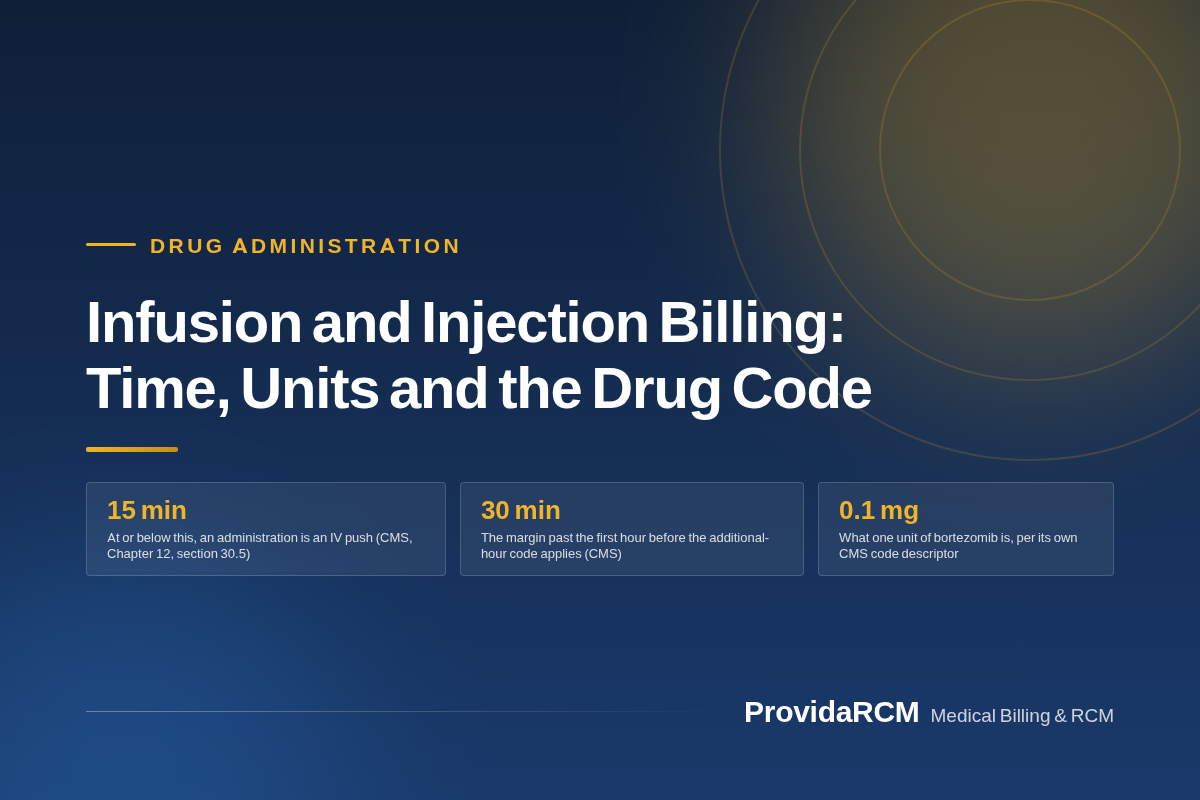
The each-additional-hour code is not proportional to time. CMS states that the physician may report it only when the infusion interval is greater than 30 minutes beyond the 1 hour increment. Its worked example is a single-drug infusion lasting 1 hour and 45 minutes: the initial code covers the first hour and the add-on covers the remaining 45 minutes.
Read against that wording, an interval that stops at or short of the 30 minute mark produces no add-on. A nurse who documents 1 hour and 25 minutes has recorded a service that bills as the initial code alone. Nothing is lost when that is understood before submission.
Minutes that decide the administration code
Source: CMS Medicare Claims Processing Manual, Chapter 12, section 30.5.
A push is defined by the same section, and the definition turns on presence as well as duration. An intravenous or intra-arterial push is an injection where the professional is continuously present to administer the drug and observe the patient, or an infusion of 15 minutes or less. Presence is a documentation requirement as well as a coding one.
Many administration codes carry the parenthetical note about being listed separately in addition to a primary procedure and a physician fee schedule indicator of ZZZ. CMS warns against reading that note too narrowly. The add-on is not tied to one specific primary code.
The drug line is billed in units, and the unit is in the code
Chapter 17 sets the mechanic, and it is a rounding rule first. Drugs are billed in multiples of the dosage stated in the HCPCS code long descriptor. When the dose given is not a multiple of that descriptor, the provider rounds to the next highest unit. When the whole dose is less than the minimum the descriptor states, the provider reports one unit.
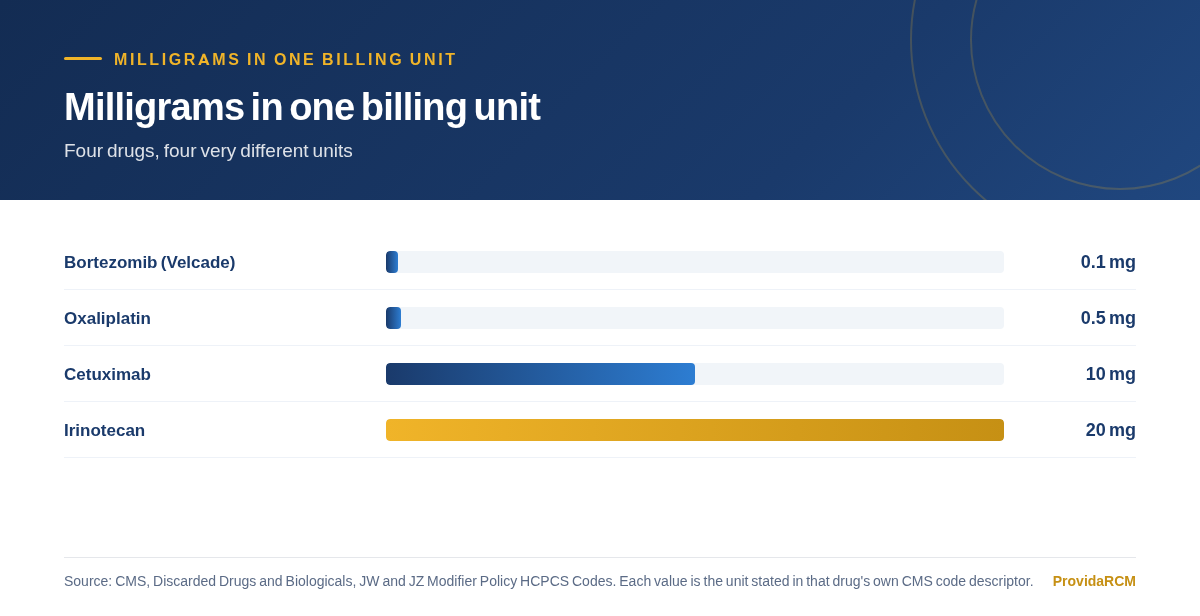
The descriptor is where the unit lives, and it is not always a milligram. In the CMS list of codes subject to the discarded drug policy, onabotulinumtoxinA is stated per 1 unit, darbepoetin alfa per 1 mcg, bortezomib per 0.1 mg, oxaliplatin per 0.5 mg, rho D immune globulin per 100 IU, and talimogene laherparepvec per 1 million plaque forming units.
A 20 mg dose in each drug’s own unit
Source: CMS, Discarded Drugs and Biologicals, JW and JZ Modifier Policy HCPCS Codes. Arithmetic applies the unit stated in each CMS descriptor.
Two drugs weighed in milligrams can still bill in units of very different size. One unit of oxaliplatin is half a milligram. One unit of irinotecan is twenty milligrams. Forty milligrams of each is 80 units of the oxaliplatin code and 2 units of the irinotecan code.
| HCPCS code | Drug | Unit in the code | What one unit covers |
|---|---|---|---|
| J0585 | OnabotulinumtoxinA | 1 unit | One biologic unit of the prepared product |
| J0881 | Darbepoetin alfa | 1 mcg | One microgram of the drug |
| J9041 | Bortezomib | 0.1 mg | A tenth of a milligram, so a 3.5 mg dose is 35 units |
| J2792 | Rho D immune globulin | 100 IU | One hundred international units of activity |
Why the unit basis causes most short payments on the drug line
CMS draws a line between two similar words in its ASP data collection FAQ. Unit means the lowest identifiable quantity dispensed. Billing unit means the identifiable quantity associated with the billing and payment code. They are different numbers for the same vial, and only the second one belongs on the claim.
The crosswalk files are how CMS maps a drug product to its billing and payment code, and they carry billable units per package. The CMS illustration divides a 100 mg package by a 10 mg billing unit to get 10 billing units per package.
Then the units meet an edit. A medically unlikely edit is the maximum units of service CMS expects for a code on the vast majority of claims for one patient on one date. An MAI of 1 is a claim line edit. An MAI of 2 is an absolute date of service limit that a modifier cannot override. An MAI of 3 is a clinical benchmark that can be paid above the value on appeal with documentation.
Waste is the last piece. CMS requires the JW modifier to report the amount of a single-dose container drug that is discarded and eligible for payment, and since July 1, 2023 it has required the JZ modifier where nothing is discarded. Claims editing for the two modifiers began October 2, 2023.
A short payment on this line is rarely a coverage decision. It is a quantity that disagrees with the code, or a quantity the edit caps. Both are checkable before submission, with the same crosswalk and edit tables the contractor uses to price and edit the claim.
The claim for the drug has to carry its national drug code
A national drug code identifies the manufacturer, the drug, the strength and the package. Medicare systems accept the NDC and its quantity on a claim so the data can cross over to Medicaid for drug rebate invoicing, the purpose the Deficit Reduction Act of 2005 set for collecting NDCs on physician-administered drugs.
On the CMS-1500 the NDC goes in the shaded portion of the detail line, preceded by the qualifier N4 and followed immediately by the 11 digit code in a 5-4-2 grouping, with the quantity next and a unit qualifier such as UN, ML, GR, F2 or ME. The electronic claim carries the same elements together in the drug identification segment of that line.
That precision makes it a system requirement before a billing one. The charge master has to hold, for each drug, both the NDC administered and the billing unit the code uses, because the quantity on the claim is units while the dose in the note is milligrams, micrograms or international units.
Leave the NDC off and the claim is incomplete rather than wrong. X12’s published list gives CARC 16 as the code for a claim or service that lacks information or has a submission or billing error, and that code requires at least one remark code to accompany it.
The record that has to support the time, the route and the dose
Every rule above is rebuilt from the medical record at review. The administration codes are built on an interval, so the note needs a start time and a stop time that produce it, plus the route, the drug, the dose given and who was in the room.
Supervision is not decorative. CMS states that if an RN, LPN or other auxiliary personnel furnishes an injection in the office and the physician is not present to meet the supervision requirement for an incident to service, the injection is not covered. The physician cannot bill 99211 for it either.
| Element the record must show | Where it comes from | The denial that follows |
|---|---|---|
| Start and stop times | The nursing note, clock times rather than intervals | The additional-hour service is dropped for want of a measurable interval |
| Route of administration | The order and the administration note | CARC 16, claim lacks information, with at least one remark code |
| Drug, dose and units | The order plus the charge master entry | CARC 16, or a quantity that survives at a fraction of what was given |
| NDC and unit of measure | The shaded area or drug identification segment | CARC 16, corrected claim required before it can adjudicate |
| Who was present | The supervision record for the incident to service | The service is not covered, and 99211 cannot be billed for it |
Two codes are worth recognising on sight. X12 lists CARC 16 for a claim or service that lacks information and CARC 50 for a service the payer does not consider medically necessary. Where a service requires prior approval, CARC 197 reports a precertification, authorization, notification or pre-treatment requirement that is absent. The CARC and RARC reference covers where each one lands.
The practical conclusion is that infusion revenue is a coding problem on one line and a charge master problem on the other. Practices that keep both clean treat infusion therapy billing as a specialised function, with the drug list, its billing units and its NDCs maintained together in medical coding rather than re-derived at claim time.
Questions practices ask us about this
How many initial infusion codes can be billed on one date of service?
One, in most cases. CMS instructs physicians to report only one initial service code unless protocol requires two separate IV sites. The initial code is the one that best describes the primary reason for the encounter and is reported regardless of the order the services occurred in. Everything given afterwards takes a subsequent or concurrent code.
When can the additional-hour infusion code be billed?
CMS allows the each-additional-hour code only when the infusion interval is greater than 30 minutes beyond the 1 hour increment. Its example is a single-drug infusion of 1 hour and 45 minutes: the initial code covers the first hour and the add-on covers the other 45 minutes. An interval of 1 hour and 25 minutes produces no add-on.
What is the difference between a sequential and a concurrent infusion?
Sequential means one infusion runs after another, and the later one takes a subsequent code. Concurrent means two run at the same time, and CMS allows only one concurrent infusion per patient per encounter. A concurrent infusion billed with modifier 59 is not payable unless the patient had a second encounter the same day and the record documents it.
Why is one drug billed in milligrams and another in units?
Because the unit basis is set in each drug’s own HCPCS code descriptor. In the CMS list of codes subject to the discarded drug policy, onabotulinumtoxinA is stated per 1 unit, darbepoetin alfa per 1 mcg, bortezomib per 0.1 mg, oxaliplatin per 0.5 mg, and rho D immune globulin per 100 IU. Each dose must be converted with its own descriptor.
What happens if a claim for a drug is missing the NDC?
The claim is incomplete rather than wrong, and it generally comes back as CARC 16, the code X12 publishes for a claim or service that lacks information or has a submission or billing error. That code requires at least one remark code alongside it. A corrected claim with the 11 digit NDC, the quantity and a unit qualifier such as UN, ML, GR or F2 is the usual fix.
What documentation supports infusion billing when a claim is reviewed?
The start and stop times that establish the infusion interval, the route, the drug and the dose given, and who was present. The presence detail is not optional. CMS states that an injection furnished by auxiliary personnel without the physician present to meet the supervision requirement is not covered, and 99211 cannot be billed in its place.
Two lines, two sets of rules, one claim
We run full cycle billing, coding and denial work for practices that carry drug revenue. Send us a few months of infusion claims and we will show you which line is losing money and why.
Book a free billing review- CMS, Medicare Claims Processing Manual, Chapter 12, section 30.5, payment for codes for chemotherapy administration and nonchemotherapy injections and infusions. cms.gov/regulations-and-guidance/guidance/manuals/downloads/clm104c12.pdf
- CMS, Medicare Claims Processing Manual, Chapter 17, drugs and biologicals. cms.gov/regulations-and-guidance/guidance/manuals/downloads/clm104c17.pdf
- CMS, Change Request 13904 and Transmittal 13012, update to Chapter 12, section 30.5, effective January 1, 2025. cms.gov/files/document/r13012cp.pdf
- CMS, Medicare Part B drug average sales price and quarterly payment limit files, including the ASP NDC-HCPCS crosswalk. cms.gov/medicare/payment/part-b-drugs/asp-pricing-files
- CMS, Average Sales Price quarterly publication process FAQ, definitions of unit and billing unit. cms.gov/files/document/frequently-asked-questions-faqs-asp-data-collection.pdf
- CMS, Discarded Drugs and Biologicals, JW modifier and JZ modifier policy HCPCS codes. cms.gov/files/document/jw-modifier-and-jz-modifier-policy-hcpcs-codes.pdf
- CMS, MLN Matters MM13056, new JZ claims modifier for certain Medicare Part B drugs. cms.gov/files/document/mm13056-new-jz-claims-modifier-certain-medicare-part-b-drugs.pdf
- CMS, Medicare NCCI medically unlikely edits, MUE tables and adjudication indicators. cms.gov/medicare/coding-billing/national-correct-coding-initiative-ncci-edits/medicare-ncci-medically-unlikely-edits
- CMS, MLN901346, how to use the Medicare National Correct Coding Initiative tools. cms.gov/outreach-and-education/medicare-learning-network-mln/mlnproducts/downloads/how-to-use-ncci-tools.pdf
- CMS, Change Request 5835 and Transmittal R1401CP, national drug codes on CMS-1500 crossover claims. cms.gov/regulations-and-guidance/guidance/transmittals/downloads/r1401cp.pdf
- CMS, MLN Matters MM5835, accepting national drug codes and quantities on paper claims. cms.gov/outreach-and-education/medicare-learning-network-mln/mlnmattersarticles/downloads/mm5835.pdf
- X12, claim adjustment reason codes, current published list. x12.org/codes/claim-adjustment-reason-codes