Annual wellness visit coding runs on three HCPCS codes and one health risk assessment, and the visit is a personalized prevention plan rather than a head to toe physical. Bill it as a physical and the claim comes back as a routine preventive exam the patient owes for personally.
The wellness visit is a prevention plan, and it is not a physical
CMS describes the annual wellness visit as a visit to develop or update a personalized prevention plan and perform a health risk assessment. What that produces is a documented plan: history, risk and function, a short list of measurements, and a written screening schedule. Nothing in the benefit requires a head to toe examination, and the elements that make it payable sit in the record rather than in the exam.
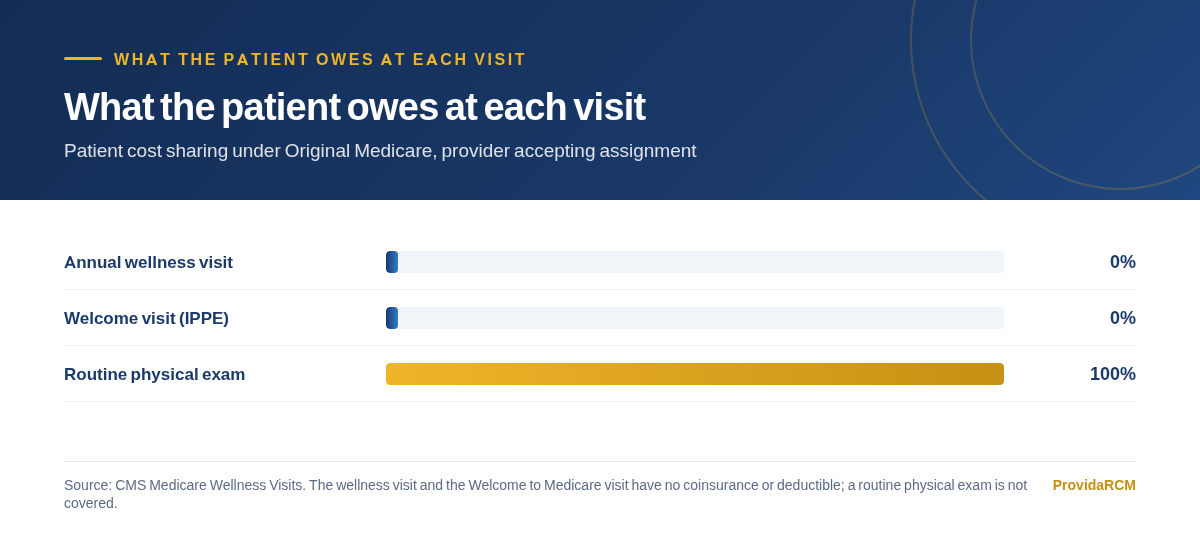
That distinction decides most coding arguments. Medicare covers the annual wellness visit and pays nothing toward a routine physical exam, which CMS calls an exam performed without relationship to treatment or diagnosis of a specific illness, symptom, complaint or injury. Providers are told not to report preventive medicine services in the CPT range 99381 to 99397 for a wellness visit (CMS MLN Matters MM13548).
The health risk assessment is the spine of the visit. CMS requires the visit to include, and take into account the results of, a self-reported health risk assessment. A questionnaire nobody read, or one that never reached the chart, is the most common reason an otherwise correct claim fails review. CMS also allows the elements to be furnished over more than one day, in which case the date of service is the day the visit is completed (CMS MLN Matters MM13486).
| Code | What it covers | How often it pays | Patient cost sharing |
|---|---|---|---|
| G0402 | Welcome to Medicare visit, the initial preventive physical exam | Once per lifetime, inside the first 12 months of Part B | Nothing with assignment |
| G0438 | First annual wellness visit, with a personalized prevention plan | Once per lifetime | Nothing with assignment |
| G0439 | Subsequent annual wellness visit | Once in a 12 month period | Nothing with assignment |
| G0136 | Optional add-on: standardized physical activity and nutrition assessment, 5 to 15 minutes | Not more often than every 6 months | Nothing when billed with the visit and modifier 33 |
Annual wellness visit coding: the clocks that decide the claim
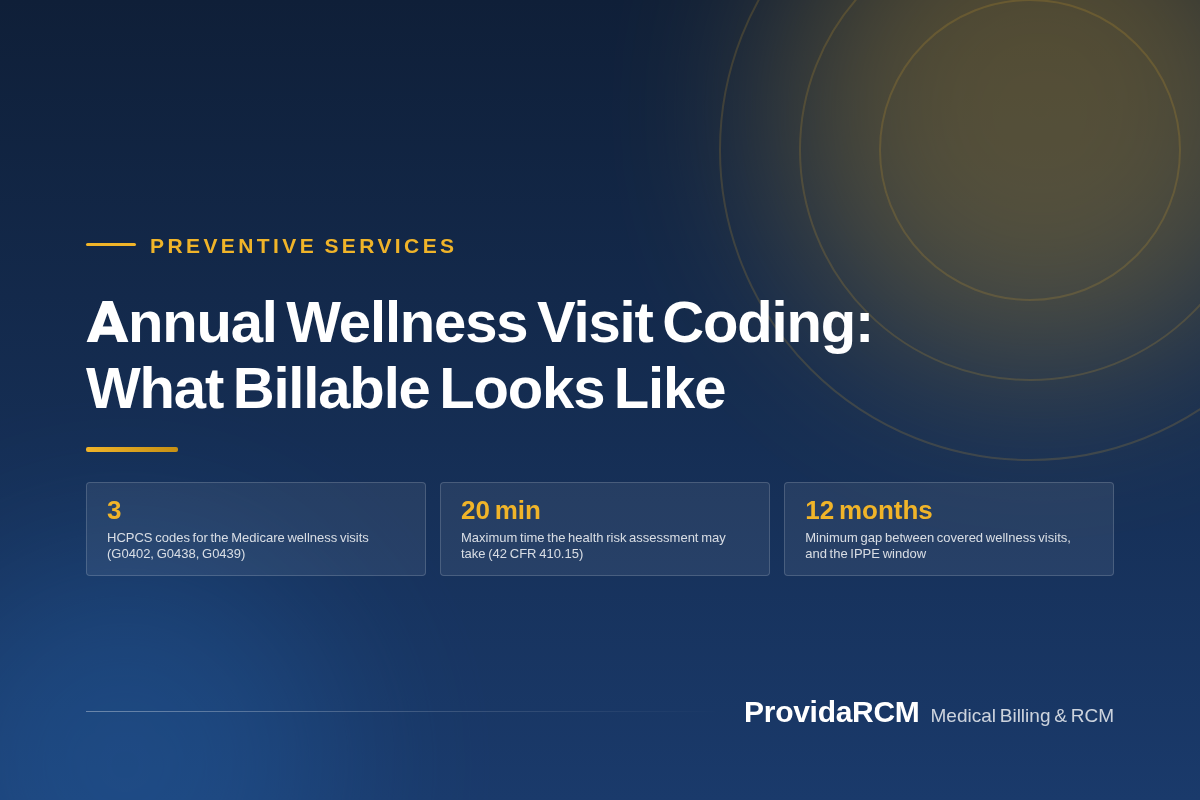
Frequency is where the front desk either gets paid or eats a denial. CMS states that you can bill G0438 or G0439 once in a 12 month period, that G0438 is the first annual wellness visit and G0439 every one after it, and that neither may be billed within 12 months of billing G0402, the Welcome to Medicare visit. Claims that break those rules come back as exceeding the benefit maximum for the period.
The clocks on the three Medicare wellness visits
Source: CMS Annual Wellness Visit (once in a 12 month period) and Initial Preventive Physical Exam (first 12 months of Part B); CMS MLN wellness visit materials.
The patient has to be past the 12 month window that follows the effective date of the first Medicare Part B coverage period before a first annual wellness visit will pay, and 12 months have to pass after a Welcome to Medicare visit. The sequence is G0402 in year one if it happened, then G0438 once, then G0439 every year after (CMS Annual Wellness Visit). The 12 months run from the date of the prior visit, not the calendar year, so a patient who moves each visit earlier eventually collides with the limit.
| Furnisher listed by CMS | May bill the visit | What the rule requires |
|---|---|---|
| Physician who is a doctor of medicine or osteopathy | Yes | Furnishes the visit personally |
| Physician assistant, nurse practitioner, clinical nurse specialist | Yes | Furnishes the visit personally, within state scope |
| Health educator, registered dietitian, nutrition professional, or other licensed practitioner | Yes, as part of a team | Works under the direct supervision of a physician, 42 CFR 410.32(b)(3)(ii) |
| Medical assistant or other staff outside those categories | No | Their time cannot be billed as the visit |
Every element has to be in the record before the claim goes out
The regulation at 42 CFR 410.15 lists what a first annual wellness visit contains: review of a health risk assessment, medical and family history, a list of current providers and suppliers, measurement of height, weight, body mass index or waist circumference and blood pressure, detection of cognitive impairment, review of depression risk, review of functional ability and safety, a written screening schedule, a list of risk factors with recommended interventions, and personalized advice with referrals.
The subsequent visit is an update of the same structure, not a fresh start. It swaps establishment for update, drops the height and body mass index measurements, and keeps the health risk assessment, history, provider list, cognitive detection, screening schedule, risk list and personalized advice.
| Element the regulation requires | First annual wellness visit | Subsequent annual wellness visit |
|---|---|---|
| Health risk assessment | Review, and administration if needed | Review of the updated assessment |
| Medical and family history | Establish | Update |
| Measurements | Height, weight, BMI or waist circumference, blood pressure | Weight or waist circumference, blood pressure |
| Detection of cognitive impairment | Required | Required |
| Written screening schedule for the next 5 to 10 years | Establish | Update |
| Personalized health advice and referrals | Furnish | Furnish and update as needed |
Two elements are the ones most often missing from a note that otherwise looks complete. Detection of cognitive impairment is assessment of cognitive function by direct observation, with due consideration of patient reports and concerns raised by family, friends, or caretakers. Review of functional ability and safety has to cover hearing impairment, activities of daily living, fall risk, and home safety.
A note that repeats last year’s wording, or a health risk assessment attached as a blank form, does not show that the visit happened for this patient on the date of service you bill. A reviewer reading the note should be able to point at each required element without hunting through the rest of the chart.
The health risk assessment is a defined instrument, not any questionnaire
The health risk assessment has its own definition, and it sets five conditions. It collects self-reported information about the patient. It can be completed by the patient alone or by a health professional before or during the visit. It is tailored to the communication needs of the population served, including people with limited English proficiency or health literacy needs. It takes no more than 20 minutes, and it addresses six topic areas at a minimum.
Minutes the rules put on the two time based elements
Source: 42 CFR 410.15 (health risk assessment definition, no more than 20 minutes) and CMS Annual Wellness Visit (HCPCS G0136 descriptor, 5 to 15 minutes).
| Condition in 42 CFR 410.15 | What it means in practice | How a reviewer tests it |
|---|---|---|
| Collects self-reported information | Patient’s own answers, not a clinician summary | A completed instrument in the chart |
| Administered independently or by a health professional | The patient may complete it before or during the visit | A dated entry showing who completed it |
| Tailored to communication needs | Readable and usable for the population served | A translated or plain language version where needed |
| Takes no more than 20 minutes | A short instrument, not a full history | The instrument itself |
| Addresses six minimum topic areas | Demographics, health status, psychosocial risks, behavioral risks, ADLs and IADLs | Every topic area answered, none left blank |
The six topic areas are where boilerplate gets caught. Demographic data covers age, sex, race and ethnicity. Health status covers self-assessment of health, frailty and physical functioning. Psychosocial risks include depression, life satisfaction, stress, anger, loneliness, pain and fatigue. Behavioral risks include tobacco use, physical activity, nutrition and oral health, alcohol consumption, sexual health, motor vehicle safety and home safety.
- Confirm the instrument collects self-reported answers across all six topic areas
- Give it to the patient before or during the visit, never after the claim goes out
- Date the completed assessment and record who administered it
- Keep the completed instrument in the chart, not a score in isolation
- Let the results change the prevention plan you document
A problem visit on the same day: the test, not a blanket answer
This question produces more denials than anything else on the topic, and the answer is a test rather than a yes or no. CMS states that when you provide an annual wellness visit and a significant, separately identifiable, medically necessary evaluation and management service, it may pay for the additional service, reported with modifier 25 on the E/M code. That portion must be reasonable and necessary to treat the patient’s illness or injury.
The Medicare Claims Processing Manual carries the same instruction for the Welcome to Medicare visit and the annual wellness visit, and adds the detail that decides most appeals: components of the medically necessary E/M service that were already part of the wellness visit, such as a portion of the history or the examination, must not be counted when the level of E/M service is determined (chapter 12, section 30.6.1.1).
- 01
Document the problem in its own section
Write the problem-oriented history, examination and assessment for each condition treated, and keep it physically separate from the wellness note.
- 02
Make the E/M stand alone
The level you report has to be supported by the problem work by itself. Components already counted toward the wellness visit cannot be counted again.
- 03
Append modifier 25 to the E/M code
Report the G code for the wellness visit and the office visit code with modifier 25, which asserts that the E/M was significant and separately identifiable.
Some commercial payers cover a preventive visit and a problem visit together, some bundle one into the other, and some want a different modifier or a different diagnosis order. Their habit is not Medicare’s rule. For Medicare the test is the one CMS publishes: was the problem significant, separately identifiable, medically necessary, and documented apart from the wellness elements?
When that test fails, the pattern is consistent. The note says a chronic condition was reviewed but records no assessment and no plan change beyond what the wellness visit already required. The problem was mentioned, not treated, so the E/M line looks unjustified next to the wellness note. Our modifier 25 documentation post walks through the same test for procedures, and a medical necessity denial appeal is the route when the payer disputes the problem work.
The four errors that turn a wellness visit into a takeback
Four errors account for most of the money lost on these visits, and each one leaves a different fingerprint on the claim. Two are coding choices, one is a documentation gap, and one is arithmetic the note cannot defend.
| Error | What lands on the claim | What the record has to show | What it costs |
|---|---|---|---|
| E/M billed with no separately documented problem | A wellness G code plus an office visit code with modifier 25 | A significant, separately identifiable problem assessed and planned apart from the wellness elements | The E/M payment is removed on review |
| Wellness visit reported as a physical | A preventive medicine code in the 99381 to 99397 range | Nothing; Medicare does not cover a routine physical exam | Non-covered, and the patient owes the full charge |
| Missing or boilerplate health risk assessment | A wellness code with a thin note, or a form that is not in the chart | A completed self-reported assessment across the six topic areas, taken into account in the plan | Element requirement unmet, so the visit is not billable |
| Time based E/M the note does not support | An office visit level selected on total time for the date of service | Total time documented apart from wellness time, which is excluded from the level | The level is reduced or the E/M is removed |
The time error arrives dressed as accuracy. Office visit levels can be selected on medical decision making or on total time on the date of the encounter, and a wellness visit can fill most of that date. The manual’s instruction that components already furnished as part of the wellness visit are not counted toward the level applies to the level, and time is one of the two routes to it. The same instruction rules out documenting an office visit level for the wellness visit itself, because the wellness code pays for its own elements.
We handle wellness visit coding inside full-cycle medical billing and medical coding, with the same team reading the note that submits the claim. Start with the denials rather than the visit count: a revenue cycle health check on the last 90 days shows whether these are exceptions or a pattern.
Questions practices ask us about this
Can you bill an office visit and an annual wellness visit on the same day?
Yes, when the problem work meets CMS’s test. CMS states that if you provide an annual wellness visit and a significant, separately identifiable, medically necessary E/M service, it may pay for the additional service reported with modifier 25. Components already counted toward the wellness visit cannot be counted again toward the E/M level.
Is the annual wellness visit the same thing as a physical exam?
No. The annual wellness visit is a personalized prevention plan built on a health risk assessment, with a short list of measurements and a written screening schedule. CMS states that a routine physical exam, meaning an exam performed without relationship to treatment or diagnosis of a specific illness, symptom, complaint or injury, is not covered and the patient pays in full.
What is the difference between G0438 and G0439?
G0438 is the first annual wellness visit and G0439 is every one after it. CMS limits both to once in a 12 month period, and G0438 pays once per lifetime. A patient who changes practices does not restart the sequence: the new practice bills the subsequent visit code for that patient’s next annual wellness visit.
How soon after the Welcome to Medicare visit can you bill an annual wellness visit?
Twelve months. CMS states that you must not bill G0438 or G0439 within 12 months of billing G0402, the Welcome to Medicare visit, for the same patient. The patient also has to be past the 12 months that follow the effective date of their first Medicare Part B coverage period. Claims that break either rule are denied as exceeding the benefit maximum.
What does a health risk assessment have to contain to satisfy CMS?
The regulation defines five conditions: it collects self-reported information, it can be completed by the patient alone or by a health professional before or during the visit, it is tailored to the communication needs of the population, it takes no more than 20 minutes, and it covers at least six topic areas. Those areas are demographics, health status and frailty, psychosocial risks, behavioral risks, activities of daily living, and instrumental activities of daily living.
Want this fixed in your practice?
We run full-cycle billing, coding, credentialing and denial work for practices across the country. Send us a few months of claims and we will show you where the money is going.
Book a free billing review- CMS, Medicare Wellness Visits (provider page, routine physical exam and cost sharing). cms.gov/medicare/coverage/preventive-services/medicare-wellness-visits
- CMS, Annual Wellness Visit (coding, diagnosis and billing rules). cms.gov/medicare/coverage/preventive-services/medicare-wellness-visits/annual-wellness-visit
- CMS, Initial Preventive Physical Exam (the Welcome to Medicare visit). cms.gov/medicare/coverage/preventive-services/medicare-wellness-visits/initial-preventive-physical-exam
- Medicare Benefit Policy Manual, Pub. 100-02, chapter 15, section 280.5, Annual Wellness Visit providing Personalized Prevention Plan Services. cms.gov/regulations-and-guidance/guidance/manuals/downloads/bp102c15.pdf
- Medicare Claims Processing Manual, Pub. 100-04, chapter 12, section 30.6.1.1 (IPPE and AWV billing, and a medically necessary E/M service at the same encounter). cms.gov/regulations-and-guidance/guidance/manuals/downloads/clm104c12.pdf
- 42 CFR 410.15, Annual wellness visits providing Personalized Prevention Plan Services, via eCFR. ecfr.gov/current/title-42/chapter-IV/subchapter-B/part-410/subpart-B/section-410.15
- CMS MLN Matters MM13548, HCPCS billing codes for IPPE and AWV services (May 2024). cms.gov/files/document/mm13548-medicare-claims-processing-manual-updates-hcpcs-billing-codes-advance-beneficiary-notice-non.pdf
- CMS MLN Matters MM13486, an optional wellness visit element billed with modifier 33. cms.gov/files/document/mm13486-annual-wellness-visit-social-determinants-health-risk-assessment.pdf