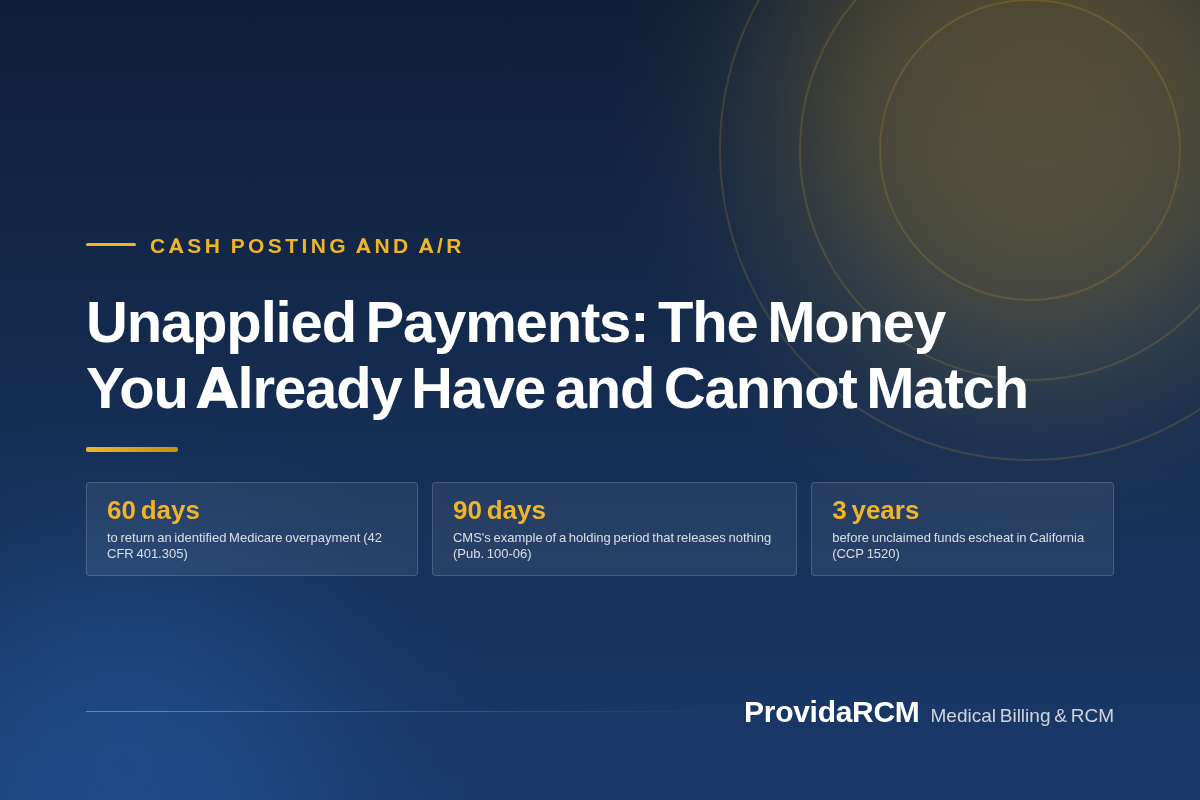
Unapplied payments are cash that arrived and never got matched to the claim it belongs to. The deposit clears the bank, the practice counts it as collected, and the claim stays open in A/R. One dollar, two wrong totals, and nobody assigned to find the claim.
What an unapplied payment is, and what it is not
An unapplied payment is money the practice received and did not attach to a claim. The deposit cleared. The amount sits in an unapplied or holding account. The claim it belongs to still shows as open in accounts receivable, and the payer believes that claim is settled. Until someone matches the two records, the same service is carried twice: once as cash, once as a receivable.
Three things are true at once. The bank balance is real. The money has not been earned into any account. Nothing in the system will fix that without a person. The software will not age it out on its own.
| Question | Unapplied cash | Credit balance |
|---|---|---|
| Is the money yours? | Not yet. It belongs to a claim you have not matched | No. It is a payment you were never owed |
| What the payer thinks | The claim is paid and closed | It may not know, or it has sent a demand |
| What you owe | Nothing, once the claim is matched | A refund, once the payer is told |
| What closes the item | Matching the payment to the claim | Reversing the posting and returning the money |
| Where the rules live | Your own posting and reconciliation controls | 42 CFR 401.305 and CMS Pub. 100-06 chapter 12, for Medicare |
If the money is real and the claim is also still open, you have unapplied cash. If the claim was never owed, you have a credit balance. The first is a matching problem. The second is a refund problem with its own rules and its own work.
Why unapplied payments happen in a working practice
The most common cause is an electronic remittance that did not post. A payer sends the 835 file and the deposit together. The file lands in a clearinghouse folder and the nightly job skips it because one claim number does not match your system. Cash is in the bank by morning and the claim is still open.
A claim adjustment reason code will not help you find it. Those codes appear when the payer adjudicated a claim, and the X12 code list holds the current wordings. An unapplied payment has no claim level adjustment to read, because there is no matched claim.
Payments land on the wrong account when two patients share a name, when a payer identifier changed, or when a front desk posts a copay to the first open charge on the screen rather than the charge the patient paid. The amount is real and the claim it was meant for is still sitting there.
Patient payments arrive with no claim on file more often than practices expect. A card payment at check-in, a portal payment, or a check mailed after the visit can land before the claim exists or after it was written off. The system has nowhere to put the money.
The last cause is timing. An EFT can arrive Tuesday and the remittance Thursday, or not at all. When nobody owns that gap, the cash sits for a week and then a month.
| Cause | What you see | Effect on the numbers | Owner |
|---|---|---|---|
| 835 did not auto-post | Deposit posted, claim open, remittance in a folder | Collections and A/R both overstated | Posting desk |
| Posted to wrong account | Payment on an account with no matching charge | The right claim stays open and ages | Posting desk |
| Patient payment, no claim | Credit on the patient, no service attached | Collections overstated if the cash is counted | Front desk |
| Deposit to posting lag | Cash in the bank for days with no posting | The reported month changes after it closed | Billing manager |
| Payer took money back | Negative provider level adjustment on the 835 | Deposit looks short, the offset stays invisible | Billing manager |
- Pull the era files for the last 30 days and look for any file that posted zero claims
- Reconcile the deposit total to the posted total for the same day, every day
- Search open claims for an allowed amount that matches an unapplied item
- Check patient accounts carrying a credit with no date of service
- Read the provider level adjustments on each 835 before calling the payer
The damage: two numbers that overstate at once
Unapplied cash does not sit quietly. It changes two numbers a practice owner reads every month, and it does so with a single dollar. That dollar is counted as collected when the deposit posts, and still counted as owed because the claim it belongs to was never closed.
Net collection rate in a worked example
Worked example built on the net collection rate definition at https://providarcm.com/net-collection-rate/. The figures are this article’s own arithmetic, not a published benchmark.
The net collection rate is payments received divided by the payments you expected on adjudicated claims. Here is the arithmetic. In one month a practice has $800,000 of allowed amounts on adjudicated claims, receives $780,000 in the bank, and posts $740,000 to claims. The other $40,000 is unapplied. Counting all the cash gives 97.5 percent. Counting only what was matched gives 92.5 percent.
Days in A/R in the same worked example
Worked example built on the days in A/R definition at https://providarcm.com/days-in-ar-benchmarks/. The figures are this article’s own arithmetic, not a published benchmark.
Days in A/R moves through the same door. The claim the payer already paid is still open, so it is still in the receivable. In the same example, $260,000 of A/R against $10,400 of average daily net revenue reads as 25.0 days. Remove the $40,000 already in the bank and it reads 21.2 days. The days in A/R benchmarks mean something only when the A/R underneath them is real.
The aging report is where the error hides longest. A paid but unmatched claim sits in the current bucket and looks recent. It never crosses into the ranges that trigger a worklist. The A/R aging buckets can look clean while the claim was paid twice over.
A claim that looks unpaid but was actually paid is the one claim you must not send again. A second submission invites a duplicate payment, and a duplicate payment becomes a credit balance you owe back. Read the remittance and the deposit before any claim goes out twice.
The reconciliation that finds it
One reconciliation surfaces every unapplied item: total bank deposits for a period against total posted payments for the same period, by date. Deposits come from the bank statement. Postings come from the practice management system. When the two disagree, the difference is the unapplied cash.
Run it daily while items are new and monthly as a control. Daily matters because an item found on day two is easy: the remittance is still in the folder and the operator remembers the account. The same item found on day 40 has lost its paper trail and needs a payer request.
The second report is the unapplied cash report, aged by how long an item has sat rather than by payer. Each row needs an amount, a date, the source, and a name. If a row has no name against it, the report is already failing.
- 01
Tie deposits to postings, by date
Compare the bank deposit total for the day to the total posted that day. A difference over your threshold opens an item.
- 02
List every open item with its age
Build one unapplied report. Age each item from the date the money landed, not the date someone noticed it.
- 03
Search for the claim by amount and date
Match the item to an open claim with the same allowed amount and a paid date close to the deposit date.
- 04
Assign a named owner and a due date
Every row gets one person and one date. A report with a team name on it is a report nobody works.
- 05
Close the loop in the ledger
Post the payment to the matched claim and clear the unapplied account the same day, so the two records agree.
| Report | Where it comes from | What it answers | How often |
|---|---|---|---|
| Deposit to posted tie-out | Bank statement and practice management system | How much cash is unmatched | Daily |
| Unapplied cash report, aged | The unapplied or holding account | Which items are old enough to escalate | Weekly |
| Open claim search by amount | The A/R system | Which claim the money belongs to | On each item |
| Provider level adjustments | The 835 remittance summary | Which offsets explain a short deposit | Every remittance |
Controls that stop the pile from rebuilding
The first control is auto-posting the remittance, and in most practices it is a configuration problem rather than a staff problem. An 835 set to post automatically still needs a reviewer for the exceptions: the file that posted nothing, the file whose claim numbers do not match, and the offsets that reduce the deposit.
Medicare reports payment adjustments at three levels, service, claim and provider, and the provider level is where money not tied to a claim shows up. Those adjustments ride in PLB segments, and a CMS instruction describes the PLB code list as an internal one that changes only with the transaction version (CMS transmittal 812). Codes such as FB and WO explain why a deposit can be smaller than the claims on the file suggest.
The second control is a daily deposit-to-posted reconciliation with a stated threshold. Choose a tolerance you are willing to ignore, five dollars or fifty, and make every difference above it an item that day.
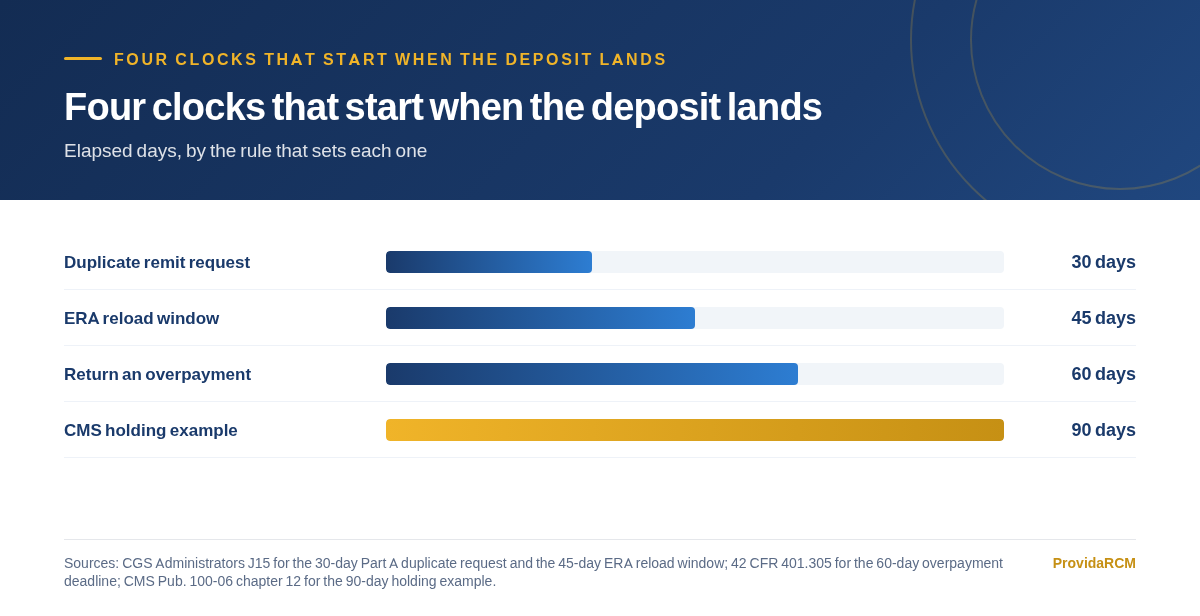
The third control is an escalation ladder. This is a recommendation rather than a rule; nothing in the Medicare manual requires a practice to call a payer at 30 days. It is the age at which a quiet item starts costing more than it returns.
| Age of the item | What it usually is | Action | Owner |
|---|---|---|---|
| 0 to 30 days | A remittance that did not post, or posted late | Search the era files and the payer portal, matching by amount and paid date | Posting desk |
| 31 to 60 days | A payment on the wrong account, or a missing remittance | Ask the payer for a duplicate remittance with the claim detail for that deposit | Billing manager |
| 61 to 90 days and older | Money with no recoverable record on your side | Escalate in writing and decide whether the amount stays a liability | Practice owner |
Asking for a duplicate remittance is the step practices skip, and it is the only step that resolves an item with no paper on your side. CGS Administrators publishes the process for its Medicare jurisdiction: a Part A duplicate request must be made within 30 days of the remittance date, and one ordered through the Part B voice response system is mailed in 7 to 10 business days (CGS payment information). Ask each payer for its own process.
If the payer has no remittance to send, the money still needs an answer. A payment you cannot attribute is a liability, not revenue. CMS makes the point about money moved to a holding account: transferring balances there and writing them off does not relieve the provider of the liability (Pub. 100-06, chapter 12). That rule governs credit balances, and the logic holds for any cash you hold with no claim behind it.
One more clock runs on money that is never matched. Every state has an unclaimed property law and the holding period differs by state. California, for example, sets a three year period for intangible property held in the ordinary course of business before it escheats to the state (Code of Civil Procedure 1520). Check your own state’s statute rather than borrowing another state’s number.
What to ask a billing partner about unapplied cash
A monthly report with a collection rate on it says nothing about matching. Five questions separate a partner that reconciles cash from one that posts it and moves on.
- Ask how deposits are tied to postings, and how often. A partner that reconciles daily can show you the last thirty days of tie-outs.
- Ask for the aged unapplied report and the name against each item. A row without a name is a row nobody is working.
- Ask what threshold opens an item. A tolerance stated in dollars is a control; a general commitment to review is not.
- Ask how the team handles an 835 that posted nothing. The exception file is where matching problems are cheapest to fix.
- Ask who clears an item at 90 days, and whether it goes to revenue or stays a liability. That answer shows whether the accounting is honest.
We run this inside full cycle medical billing and AR management, with the deposit tie-out built into daily work rather than saved for month end. A clean claim rate review of the last 90 days usually shows where cash and postings first drifted apart. To size the problem first, book a free billing review.
Questions practices ask us about this
What does unapplied payment mean in medical billing?
It is cash the practice received and did not match to a claim. The payer sent the money, the deposit cleared, and the payment has no claim attached in the practice management system. The claim it belongs to often still shows as open. Until the two records are matched, the amount sits in an unapplied account and appears as collected.
How is unapplied cash different from a credit balance?
Unapplied cash is money you were owed and have not attached to a claim. A credit balance is money you were not owed and have to give back. The first clears when you match the payment to the claim. The second clears with a refund or a posted reversal. Medicare’s credit balance instructions, at chapter 12 of Pub. 100-06, cover the second problem rather than the first.
Why did the payment post but the claim stay open?
Usually the remittance did not post even though the deposit did. An 835 file can fail to load because one claim number on it does not match your system, so the whole file is skipped while the cash arrives on schedule. Pull the era files for that deposit date and check by amount and paid date.
How do we find unapplied payments in our own numbers?
Tie total bank deposits for a period to total posted payments for the same period. The difference is the unapplied cash. Build one aged unapplied report and match each item to an open claim by amount and paid date. Give every row a named owner and a due date, so old items surface instead of sitting.
How long can an unapplied payment sit before it becomes a problem?
Age matters more than amount. An item found within a few days can be matched from the remittance still in the folder. After a month or two the paper trail is gone and the payer has to be asked for a duplicate. Every state also has an unclaimed property law, and unclaimed funds eventually escheat. California sets a three year period under Code of Civil Procedure 1520.
What if the payer will not send a duplicate remittance?
A duplicate remittance is the standard route, and Medicare contractors publish their own process. CGS Administrators requires a Part A duplicate request within 30 days of the remittance date and mails one ordered through the Part B voice response system in 7 to 10 business days. If no remittance exists at all, treat the money as a liability until it is attributed.
Want this fixed in your practice?
We run full-cycle billing, coding, credentialing and denial work for practices across the country. Send us a few months of claims and we will show you where the money is going.
Book a free billing review- CMS, Medicare Financial Management Manual, Pub. 100-06, chapter 12 (Medicare credit balance report activities). cms.gov/files/document/chapter-12-instructions-medicare-credit-balance-report-activities.pdf
- 42 CFR 401.305, Requirements for reporting and returning of overpayments (eCFR). ecfr.gov/current/title-42/section-401.305
- CMS transmittal 812, Instructions for PLB code reporting on remittance advice. cms.gov/regulations-and-guidance/guidance/transmittals/downloads/r812otn.pdf
- California Code of Civil Procedure section 1520, escheat of unclaimed property held in the ordinary course of business. leginfo.legislature.ca.gov/faces/codes_displaySection.xhtml?lawCode=CCP§ionNum=1520
- CGS Administrators J15, payment information and duplicate remittance requests. cgsmedicare.com/parta/cs/howdoi/hdi_payinfo.html
- X12, Claim Adjustment Reason Codes (current list). x12.org/codes/claim-adjustment-reason-codes